
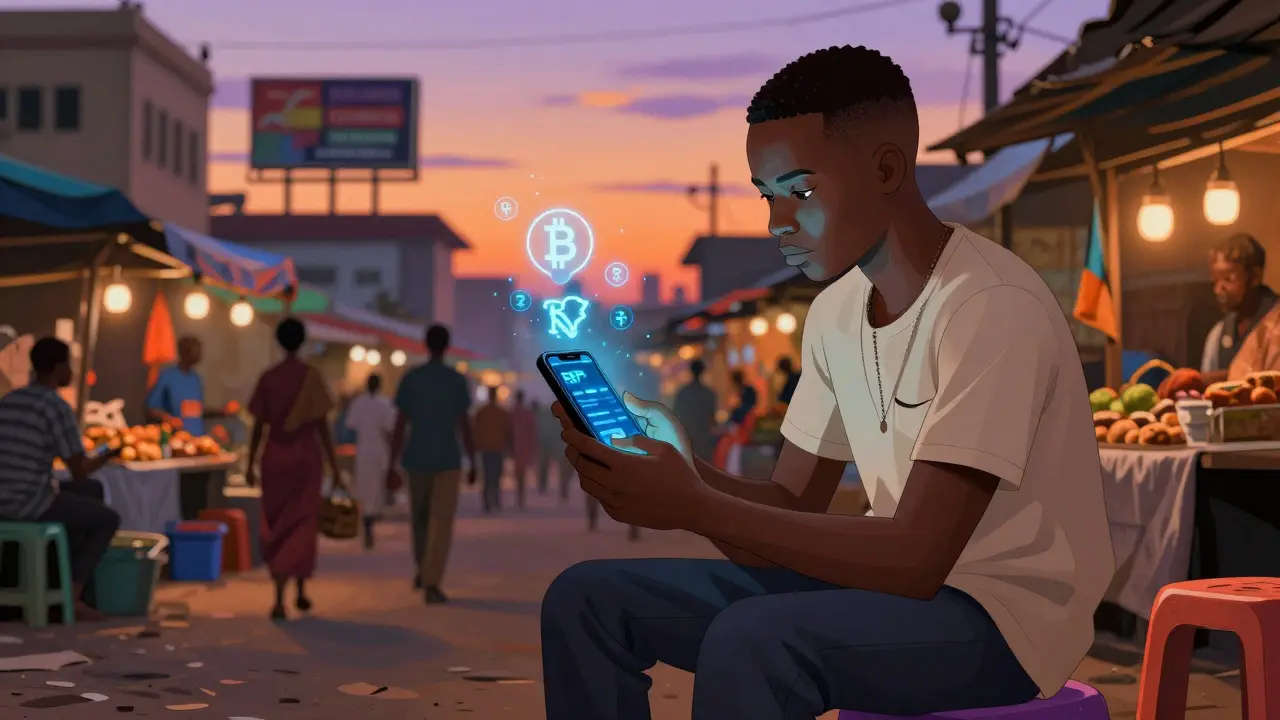
It sounds like a paradox. You have a country where the central bank once told commercial banks to stop processing cryptocurrency transactions entirely. Yet, that same country consistently ranks at the very top of global charts for peer-to-peer (P2P) crypto adoption. How does a nation with strict financial controls become the world’s leading hub for decentralized digital asset trading? The answer isn’t just about technology; it’s about survival, necessity, and an incredibly resilient population finding ways around systemic roadblocks.
The Birth of a Grassroots Movement
To understand why Nigeria dominates the P2P space, you have to look back at what happened in 2017. That was the year the Central Bank of Nigeria (CBN) issued a directive instructing all commercial banks to close accounts linked to cryptocurrency exchanges. On paper, this should have killed the market. In reality, it forced the ecosystem underground and accelerated innovation.
When traditional banking channels were blocked, Nigerians didn’t give up on crypto. They adapted. They turned to Peer-to-Peer (P2P) trading platforms. Instead of relying on banks to move money between fiat currency and digital assets, users started trading directly with each other. One person sends Naira via bank transfer or mobile money, and another releases Bitcoin from their escrow wallet. This bypassed the banks’ ability to flag and block crypto-related transactions because, to the bank, it looked like a standard personal transfer between two individuals.
This wasn’t a planned strategy by tech giants. It was a grassroots response to exclusion. By 2020, approximately 32% of participating Nigerians were using cryptocurrencies. The most traded pair? Bitcoin/Naira. But it wasn’t just Bitcoin. Users also embraced Dash and Ripple (XRP), showing a diversified understanding of which assets offered speed, low fees, or privacy features suitable for their needs.
Economic Pressure as a Catalyst
Technology alone doesn’t drive mass adoption. Economic pain does. Nigeria has faced severe macroeconomic instability in recent years. Inflation surged to over 24% in 2023. More critically, the Nigerian Naira lost more than three-quarters of its value against the US dollar since 2016. When your local currency is evaporating in real-time, holding cash feels like losing money every day.
Cryptocurrencies offered a hedge. For millions of Nigerians, converting Naira into stablecoins like Tether (USDT) or holding Bitcoin became a way to preserve wealth. It wasn’t necessarily about getting rich quick; it was about not getting poorer. This dynamic created a massive, sustained demand for P2P platforms where users could quickly swap volatile fiat for stable digital assets.
Consider the numbers. Between July 2023 and June 2024, Nigeria recorded over $59 billion in cryptocurrency transactions. That volume places it firmly among the top 10 countries globally. The Chainalysis 2025 Global Crypto Adoption Index placed Nigeria at 6th position globally as of September 2025, while Cornell Business analysis had previously ranked it second. Regardless of the exact ranking fluctuation, the consensus is clear: Nigeria is a heavyweight in the global crypto arena.

Bypassing the Unbanked Reality
Traditional banking infrastructure in Nigeria is uneven. Approximately 36% of Nigerian adults remain unbanked, while many others are underbanked-they have accounts but lack access to credit, foreign exchange, or reliable international transfer services. Sending money abroad through traditional channels like Western Union or bank wires can cost up to 8% in fees. That’s a huge chunk of remittance income disappearing before it reaches the recipient.
P2P crypto trading slashes these costs. Users report transaction cost savings of 60-80% compared to traditional banking and money transfer services. If you’re a freelancer earning in dollars or a family member sending support home, saving that much makes a tangible difference in daily life. This efficiency has driven an estimated 22 million Nigerians to use cryptocurrency by 2025, representing roughly 10% of the population. That penetration rate surpasses most developed economies.
| Feature | Traditional Banking | P2P Crypto Trading |
|---|---|---|
| International Transfer Fees | Up to 8% | Typically 0.5% - 1% |
| Access to Foreign Currency | Limited, requires approval | Direct, peer-based availability |
| Hedge Against Inflation | No (holds depreciating Naira) | Yes (USD stablecoins, Bitcoin) |
| Bank Account Requirement | Mandatory | Optional (mobile money/wallets work) |
| Regulatory Risk | Low (regulated by CBN) | Medium (evolving laws) |
From Underground to Institutional Acceptance
The narrative around Nigeria’s crypto journey is shifting from “rebellion” to “integration.” The regulatory ban that sparked the P2P boom was lifted in late 2023. The CBN reversed its stance, allowing licensed crypto exchanges to operate freely and integrate with traditional banking systems again. This was a pivotal moment. It boosted investor confidence and signaled that the government recognized the inevitability and potential benefits of the industry.
In 2025, this integration deepened significantly. The Nigeria Inter-Bank Settlement System (NIBSS) partnered with Zone’s blockchain network. This modernized the country’s financial infrastructure, enabling faster, more transparent interbank settlements while reducing fraud risks. This isn’t just about retail traders anymore; it’s about institutional-grade market infrastructure.
Legislation followed suit. The Investments and Securities Act (2025) was enacted, regulating cryptocurrency and recognizing digital assets as financial securities in Nigeria. This legal clarity helps protect consumers and attracts serious investment. Moniepoint, a major fintech player, achieved unicorn status with a $1 billion valuation after securing investments from Google, reflecting Nigeria’s leadership in financial innovation where crypto and blockchain play central roles.

Overcoming Skepticism and Security Challenges
Adoption hasn’t been without hurdles. Early on, Bitcoin was heavily associated with high-profile Ponzi schemes like Bitconnect, OneCoin, and MMM. This created deep-seated skepticism among the general public. Overcoming this stigma required extensive education. Communities formed on Telegram, WhatsApp, and local meetups to teach people how to distinguish between legitimate trading and scams.
Security remains a concern. P2P trading requires users to manage their own funds, often moving money out of platform escrow. The learning curve for basic proficiency is about 2-4 weeks, but mastering advanced security practices takes months. Common challenges include understanding wallet security, navigating price volatility, and staying compliant with evolving tax regulations.
However, the community support is robust. Major local exchanges like Quidax, Patricia, and Luno offer comprehensive guides in English and local languages. YouTube tutorials and peer mentorship networks help new users navigate the initial confusion. Users frequently praise these platforms for providing access to foreign currencies and enabling international commerce, despite the initial steep learning curve.
The Future of Nigerian Crypto
Where does this go from here? Industry analysts predict Nigeria could become Africa’s largest crypto economy by transaction volume within the next two years. The trajectory suggests a hybrid model: grassroots P2P trading continuing to serve the unbanked and those seeking inflation hedges, alongside regulated institutional infrastructure handling larger volumes and corporate finance.
There are risks, of course. Regulatory reversals are always possible. International pressure regarding financial compliance and anti-money laundering (AML) standards could tighten restrictions again. Competition from Central Bank Digital Currencies (CBDCs) might also reshape the landscape. However, the fundamental drivers-economic instability, young tech-savvy demographics, and the need for efficient cross-border payments-remain strong.
Nigeria’s story offers valuable lessons for other emerging markets grappling with similar financial shortcomings. It shows that when traditional systems fail to meet people’s needs, innovation will find a way. The P2P crypto ecosystem in Nigeria isn’t just a side hustle; it’s becoming an essential part of the national financial fabric.
Why did Nigeria ban cryptocurrency banks in 2017?
The Central Bank of Nigeria (CBN) banned banks from servicing crypto businesses in 2017 primarily due to concerns over financial stability, money laundering risks, and the potential loss of control over monetary policy. The regulator feared that unchecked crypto adoption could undermine the Nigerian Naira and expose citizens to volatile, unregulated assets.
Is P2P crypto trading legal in Nigeria now?
Yes. The CBN lifted its ban on banks servicing crypto businesses in late 2023. Furthermore, the Investments and Securities Act (2025) formally recognizes digital assets as financial securities, providing a clearer legal framework for trading and investment.
What is the most popular cryptocurrency in Nigeria?
Bitcoin (BTC) is the most widely adopted cryptocurrency, particularly for the Bitcoin/Naira trading pair. However, stablecoins like Tether (USDT) are extremely popular for hedging against inflation, and altcoins like Dash and Ripple (XRP) also see significant usage due to their speed and lower fees.
How do Nigerians avoid high international transfer fees?
By using P2P crypto platforms. Instead of paying up to 8% in fees via traditional wire transfers or services like Western Union, users convert Naira to crypto locally and send it internationally. The recipient then sells the crypto for their local currency. This process typically reduces fees to less than 1%.
Which exchanges are popular in Nigeria?
Local exchanges such as Quidax, Patricia, and Luno are highly popular. They offer user-friendly interfaces, support for local payment methods, and customer service tailored to Nigerian users. International platforms like Binance also maintain a strong presence through their P2P markets.



Comments
ravi mahla
June 13, 2026 AT 04:49 AMlol the irony is real. you ban it and they find a way to use it more. typical human nature when money is involved.
Kenneth Riley
June 14, 2026 AT 23:32 PMlet me get this straight you think this is just about tech innovation? no way. its pure desperation mixed with systemic failure. the article tries to sugarcoat it as 'resilience' but really its people losing their shirts because the government cant manage basic economics. i see through this narrative every time. they want you to believe crypto saves them but its just another layer of complexity for scams to hide in. dont fall for the hype machine.
Grace Newman
June 16, 2026 AT 04:18 AMOne must consider the deeper implications of such financial decentralization. The Central Bank’s initial prohibition was not merely bureaucratic inertia; it was a necessary defense against the erosion of sovereign monetary control. When citizens bypass state-sanctioned channels, they inadvertently participate in a globalist agenda that seeks to dismantle national borders and regulatory frameworks. The so-called 'P2P adoption' is actually a symptom of a population being herded into unregulated digital ledgers where surveillance capitalism can operate without oversight. We are witnessing the slow death of privacy under the guise of convenience. The data trails left by these transactions are far more comprehensive than any traditional bank record. It is a trap disguised as freedom.
Benjamin Eisen
June 17, 2026 AT 08:41 AMi totally get why people do this tho. if your currency is dropping like a stone you gotta do something right? seems like a smart move to protect savings even if the gov hates it. hope things stabilize soon though
Abby Sivertsen
June 18, 2026 AT 07:51 AMits wild how much pressure creates innovation. seeing people adapt like that is both inspiring and kinda sad at the same time. nobody should have to go underground just to keep their money safe from inflation. the system is clearly broken if this is the only option left for millions of people.
Mark Brunschwiler
June 18, 2026 AT 15:24 PMso what you are saying is that normal banking sucks and crypto is better? sounds simple to me. i dont understand all the fancy words but if it saves money on fees then sure why not. my uncle tried bitconnect and lost everything so i am still scared. but maybe this p2p stuff is different?
Filbert Reeves
June 18, 2026 AT 22:15 PMyou guys are missing the big picture here. this isn't about saving money or fighting inflation. it's about control. who owns the ledger? who controls the keys? when the central bank lifts the ban it's not because they changed their minds. it's because they realized they couldn't stop it so now they want to tax it and monitor it. the 'integration' mentioned in the article is just a euphemism for co-option. the grassroots movement has been absorbed by the very institutions it sought to escape. look at the NIBSS partnership. that's not freedom that's surveillance infrastructure built on blockchain. they are watching every transaction now. the early adopters thought they were rebels but they are just data points for the new financial industrial complex. wake up sheeple.
Nick Rice
June 19, 2026 AT 07:58 AMThe shift from underground trading to institutional acceptance is a fascinating case study in regulatory evolution. It demonstrates that technology often outpaces legislation forcing governments to adapt rather than suppress. This integration allows for greater transparency while maintaining the efficiency gains that users demand. We should encourage this hybrid model as it provides stability for investors while preserving access for the unbanked populations who benefit most from reduced transaction costs.
Amit Thakur
June 19, 2026 AT 14:17 PMthe macroeconomic drivers are undeniable here. hyperinflation coupled with currency devaluation creates a perfect storm for stablecoin adoption. it is not speculative mania but a rational economic response to fiat instability. the volume metrics cited confirm that this is a structural shift in payment rails not just a niche hobby for tech enthusiasts. the liquidity depth in naira pairs is becoming significant enough to impact local forex markets directly.
Eric Scheinberg
June 20, 2026 AT 11:11 AMIt is imperative to recognize the legal framework changes. The Investments and Securities Act of 2025 provides clarity that was previously absent. This reduces counterparty risk and encourages broader participation from institutional players. Regulatory certainty is the bedrock of sustainable market growth.
pankaj chawla
June 21, 2026 AT 02:36 AMagree with the point on fees. sending money home used to cost a fortune. now it is much cheaper and faster. good for families.
Jessica Lane
June 21, 2026 AT 13:47 PMI appreciate the detailed breakdown of the historical context. Understanding the 2017 ban helps explain the current resilience of the P2P ecosystem. It is remarkable how quickly communities can organize and educate themselves when traditional systems fail to provide adequate solutions for wealth preservation.
Charles Pawlikowski
June 21, 2026 AT 16:38 PMtypical third world problem :( our banks work fine here in america we dont need this shady crypto stuff. probably full of criminals anyway. stay away from it folks. :)
Andrea Burd
June 22, 2026 AT 11:13 AMboring read. nothing new here. everyone knows nigeria loves crypto. why write an essay about it?
Akeem Whittaker
June 22, 2026 AT 20:12 PMWe need to focus on education. The security challenges mentioned are real. Users must learn to verify escrow agents and secure their own wallets. Without proper knowledge the ease of access becomes a liability. Let us support initiatives that teach digital literacy alongside crypto usage.
Manish Prajapat
June 24, 2026 AT 01:30 AMThe philosophical implication here is interesting. Money is a social contract. When the state breaks that contract through inflation the people create a new one. Crypto is the embodiment of trustless cooperation. It reflects a desire for autonomy in an increasingly controlled world.
sreeja boora
June 24, 2026 AT 17:08 PMThis development strengthens India's position as well. If Nigeria can lead adoption despite restrictions it shows the potential for emerging markets to drive global fintech trends. We should observe closely and learn from their regulatory adaptations.
Annemarie Fitzgerald
June 26, 2026 AT 05:24 AMoh please. you think this is just economics? no. it is existential dread manifesting as digital tokens. the void stares back through the blockchain. we are all just nodes in a network of anxiety. the typo in my last comment mirrors the chaos of the market itself. beautiful really.
Sonya O'Brien
June 27, 2026 AT 10:42 AMWhile the technical aspects are compelling I cannot help but feel that the human element is often overlooked in these discussions. The stress of navigating a volatile market while trying to pay for groceries is immense. It is not just about hedging against inflation it is about the daily grind of survival. The community support networks mentioned are vital lifelines. We must remember that behind every transaction statistic there is a person trying to make ends meet in a difficult economic climate. The resilience shown by these individuals is commendable but it also highlights the urgent need for more stable and inclusive financial policies that do not force citizens to seek refuge in decentralized alternatives.