
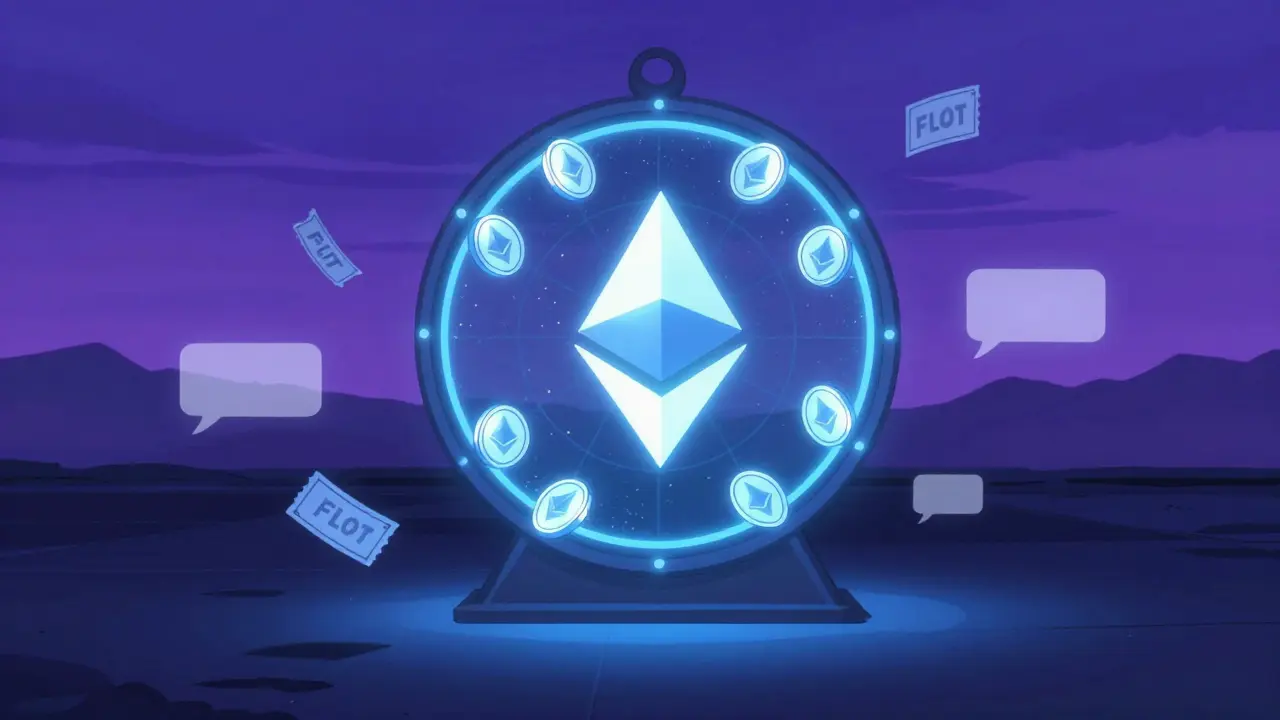
Fire Lotto (FLOT) isn’t just another crypto coin. It was built to change how lotteries work-by removing the middleman, making draws completely transparent, and letting anyone in the world play without needing a government license. Launched on January 1, 2018, it claimed to be the world’s first fully decentralized lottery powered by Ethereum smart contracts. No humans control the draws. No central server holds your money. Everything runs on code. That sounds revolutionary. But here’s the reality: as of late 2025, Fire Lotto is barely alive.
How Fire Lotto Was Supposed to Work
Fire Lotto’s idea was simple: buy a ticket with crypto (or even credit card), and let a smart contract pick the winner. The prize pool came from 70% of every ticket sold-way higher than traditional lotteries like Powerball, which usually give back only 50-60%. Winners got paid instantly in ETH or FLOT directly to their wallet. No delays. No bureaucracy. No corporate cut.
The platform didn’t rely on servers. Instead, every draw, every payout, every ticket purchase was handled by Ethereum smart contracts. That meant the system couldn’t be shut down by a government. No one could tamper with the results. The code was the law. And that was the big sell.
They even claimed to have solved Ethereum’s slow transaction problem by batching thousands of lottery entries into a single smart contract call. No mention of how, though. No whitepaper. No GitHub. No technical documentation. Just promises.
The FLOT Token: Supply, Price, and Where It Trades
FLOT is an ERC-20 token. That means it runs on Ethereum, like USDT or Chainlink. Total supply? Exactly 100 million FLOT tokens. That’s fixed. No more will ever be created.
As of November 2025, only about 27.5 million FLOT are in circulation. That’s 27.5% of the total. The rest? Locked up, unsold, or held by early investors. The token’s price? Around $0.01509. That might sound cheap-but it’s down 91% from its all-time high of $0.1739 in September 2018. In the same period, Bitcoin grew over 1,200%. FLOT didn’t just fall behind-it collapsed.
Market cap? Just $414,780. That’s less than the cost of a small apartment in some cities. For comparison, PoolTogether, another crypto lottery platform, has over $18 million locked in its smart contracts. FLOT’s 24-hour trading volume? Only $406.46. That means fewer than 30 people are trading it in a full day. Most exchanges don’t even list it anymore. It trades on only three platforms, according to CoinMarketCap.
Why Nobody Uses Fire Lotto Anymore
Let’s talk about the elephant in the room: no one’s playing.
When Fire Lotto launched, it had thousands of users. ChipIn.com reported heavy interest during its ICO in early 2018. Fast forward to 2025, and blockchain analytics show fewer than 500 active monthly users. The official website hasn’t had a meaningful update since March 2021-just a small addition for PayPal payments. No new games. No mobile app. No marketing. No team announcements. The Telegram group, once home to over 8,500 members, now has just 1,243. Most messages are from people asking if the site is still real.
And here’s the worst part: people are losing money trying to cash out.
On Reddit, users from 2021 and 2022 report winning ETH in instant games-but never getting paid. Trustpilot has 12 reviews with a 1.8/5 rating. Nine of them mention withdrawal failures. One user said they waited six months for a payout that never came. Another claimed their account got locked after asking for help. CoinMarketCap’s community section shows 6,310 token holders, but most haven’t touched their FLOT since 2019.
Even the website feels abandoned. The FAQ is empty. The support link goes nowhere. The blog hasn’t been updated in four years. It’s not broken-it’s ignored.
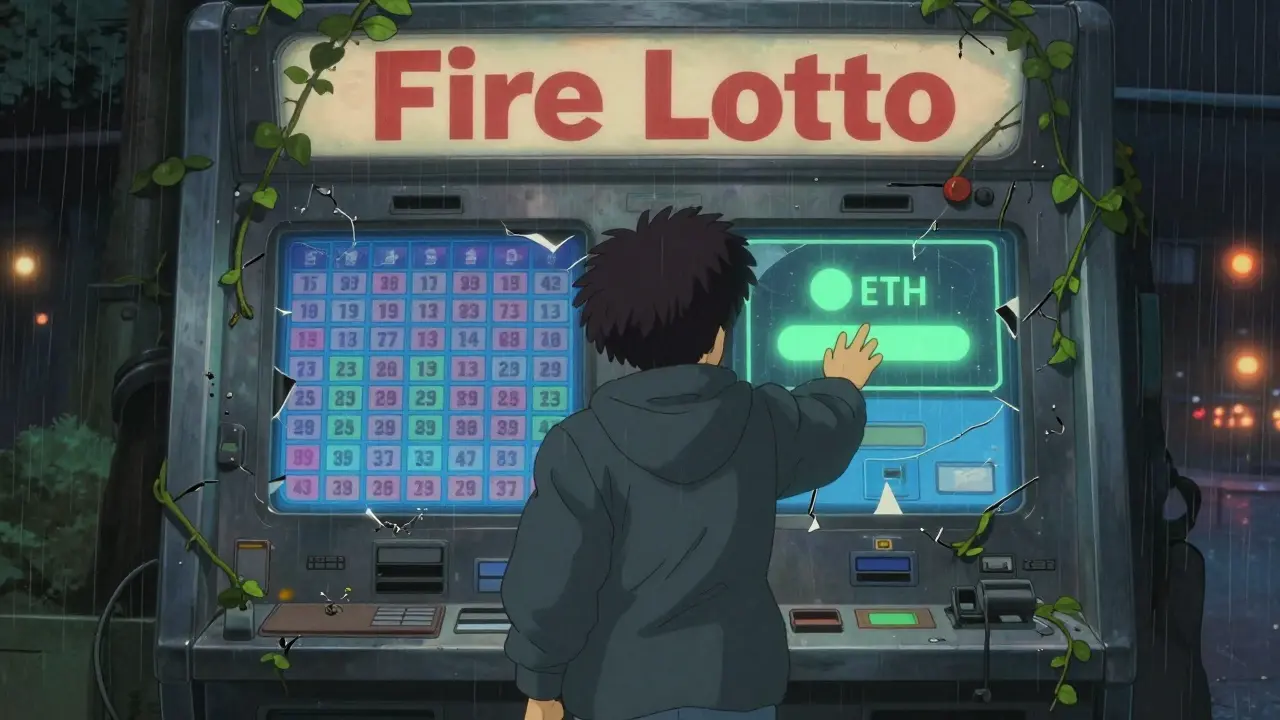
Is Fire Lotto Still Decentralized? The Truth
Fire Lotto’s biggest claim was decentralization. No central authority. No one in charge. But decentralization isn’t just a buzzword-it means real control is distributed.
Here’s the problem: the smart contracts were deployed by an anonymous team. No one knows who holds the keys to upgrade them. No one can prove the code hasn’t been altered. CertiK audited the platform in 2018 and found no critical bugs-but they didn’t verify decentralization. They just checked for code flaws.
And here’s the kicker: if the team wanted to, they could freeze wallets. They could change the prize pool. They could drain the contract. There’s no governance token. No DAO. No voting. Just a static piece of code with no one watching it.
That’s not decentralization. That’s a black box.
How to Buy FLOT (If You Really Want To)
You can still buy FLOT-but it’s not easy.
You need a Web3 wallet like MetaMask or Binance Wallet. You need ETH to pay for gas fees. You need to find a decentralized exchange (DEX) that lists FLOT-probably Uniswap or PancakeSwap. Then you have to manually enter the token contract address: 0x0493...22285f. One typo, and you lose your money.
According to CryptoCompare’s 2022 usability study, new users take an average of 47 minutes to complete their first FLOT trade. That’s almost twice as long as buying a more popular crypto. And if you don’t have enough ETH for gas, your transaction fails. No refund. No warning.
And forget using credit cards or PayPal directly on the site anymore. Those options were added in 2021 and have since stopped working for most users.

Why Fire Lotto Failed When Others Succeeded
Fire Lotto wasn’t the only blockchain lottery. PoolTogether, Lotto (LOTTO), and others came after it. And they’re still growing.
PoolTogether, for example, lets users deposit ETH into a savings pool. Every week, one person wins the interest earned. No buying tickets. No random draws. Just compound interest with a prize twist. It’s simple. It’s safe. It’s integrated with major DeFi protocols.
Fire Lotto tried to be flashy. Instant wins. Big jackpots. Credit card payments. But it ignored the basics: user experience, ongoing development, and trust.
It also didn’t adapt to regulation. In the U.S., online gambling is heavily restricted. In the EU, anti-money laundering rules require KYC. Fire Lotto claimed it couldn’t be banned-but that’s not the same as being legal. Many users in those regions simply stopped using it.
Should You Buy FLOT Today?
If you’re looking to invest-don’t.
FLOT has all the signs of a dead project: tiny market cap, no updates, zero trading volume, and no community. It’s not a cryptocurrency. It’s a digital artifact.
If you’re curious and want to experiment with a $5 token-go ahead. But treat it like a museum piece, not an investment. Don’t expect to cash out. Don’t expect support. Don’t expect growth.
Fire Lotto was a bold idea. But ideas alone don’t build lasting platforms. Execution does. And Fire Lotto failed to execute.
The blockchain lottery space is still young. Projects like PoolTogether are proving you can build fair, transparent, and profitable systems without needing to promise the moon. Fire Lotto didn’t just fall behind-it disappeared.
What Happens Next for FLOT?
Unless someone buys the smart contracts and rebuilds the platform from scratch, FLOT will keep drifting toward zero.
Its market cap is below $1 million. Its trading volume is under $1,000 per day. Its website hasn’t changed in four years. CryptoRank’s definition of a "dead project" fits FLOT perfectly.
There’s no team to revive it. No investors stepping in. No community pushing for change. The only thing left is the token contract-still sitting on Ethereum, quietly holding 27 million FLOT tokens nobody wants.
It’s not a scam. It’s not a Ponzi. It’s just… forgotten.



Comments
Alex Strachan
December 29, 2025 AT 19:41 PMFLOT is basically the crypto version of a ghost town with a neon sign that still flickers. 😅 I bought some in 2019 just to see if it’d work… turns out the only thing winning was the gas fees. RIP my $20.
Rick Hengehold
December 31, 2025 AT 01:51 AMThis isn’t a failure. It’s a lesson. Decentralization without maintenance is just a statue in a landfill.
Brandon Woodard
December 31, 2025 AT 22:04 PMLet me be clear: this is not a critique of blockchain technology. It is a lament for the absence of stewardship. Fire Lotto had potential. It had vision. But vision without accountability is merely theater. The smart contracts are still running. The code is still there. But the soul? The soul vanished when the last developer closed their laptop for the final time.
Antonio Snoddy
December 31, 2025 AT 22:06 PMYou know what FLOT really is? A mirror. It reflects our collective delusion that technology can solve human problems without human responsibility. We thought the blockchain was magic. We thought code was god. But code doesn’t care. Code doesn’t answer emails. Code doesn’t wake up at 3 AM to fix a broken payout. We didn’t build a lottery. We built a digital ghost. And now we’re haunting ourselves with it. 😔
Ryan Husain
January 2, 2026 AT 11:45 AMWhile the project appears dormant, it is important to acknowledge that the underlying infrastructure remains intact on the Ethereum blockchain. The token contract is immutable and transparent. This is not a failure of technology, but a failure of community engagement and sustained development. There is still value in the principle, even if the execution has stalled.
Rajappa Manohar
January 3, 2026 AT 07:04 AMflot still works if u use pancakeswap but gas is high and support is dead lol
prashant choudhari
January 5, 2026 AT 02:41 AMThe smart contracts are still live. The code is audited. The supply is fixed. That’s more than most crypto projects can say. FLOT is not dead. It is dormant. Waiting for someone with vision to pick it up.
Willis Shane
January 5, 2026 AT 18:26 PMI’ve seen too many of these. The team disappears after the ICO. The website goes dark. The Telegram group becomes a graveyard of desperate users asking for refunds. This isn’t innovation. This is exploitation dressed up as decentralization.
Jake West
January 7, 2026 AT 02:54 AMLmao imagine thinking this was ever going to work. You need a team. You need updates. You need to actually care. This isn’t crypto. It’s a digital tombstone with a QR code.
Shawn Roberts
January 7, 2026 AT 12:59 PMFLOT is like that one friend who said they’d start a band and then just kept practicing in their garage for 7 years 😅 still believe in the dream tho. Maybe someone will revive it. Who knows? The blockchain never forgets 🤞
Bianca Martins
January 7, 2026 AT 17:43 PMI used to play Fire Lotto back in 2019. Won $1.20 in ETH once. Took 8 months to get it. They finally sent it… with a note saying 'thanks for your patience'. I kept the FLOT tokens like a souvenir. Not for profit. For memory. It’s weird how something so broken can still feel meaningful.
alvin mislang
January 7, 2026 AT 18:57 PMThis is exactly why the government should regulate crypto. No one’s checking if these projects are real. People lose money. No one gets punished. This is why we can’t have nice things.
Monty Burn
January 9, 2026 AT 14:31 PMThe real tragedy isn't that FLOT died. It's that we thought it could live. We wanted to believe the machine was fair. We wanted to believe the code was honest. But the truth is we were always just betting on hope. And hope doesn't pay gas fees
Kenneth Mclaren
January 11, 2026 AT 00:57 AMI’ve been tracking this since 2018. The team behind FLOT? They’re the same people who ran the 'CryptoRoulette' scam that got shut down in Cyprus. The contract address? It’s been flagged by Chainalysis. The 'audit' by CertiK? They only checked for syntax errors. No one checked who owns the admin keys. This isn’t forgotten. It’s a landmine. And someone’s still stepping on it. Don’t touch it. Don’t even look at the contract. They’re watching.