

When Cambodia banned cryptocurrency in 2019, people thought the market would vanish. Instead, it went deeper-into hidden compounds, encrypted Telegram channels, and offshore bank accounts controlled by violent criminal networks. What started as a simple prohibition became a breeding ground for one of the most sophisticated financial crime ecosystems in the world. Today, underground crypto trading in Cambodia isn’t just about buying and selling digital assets. It’s about forced labor, international scams, and billions in laundered money flowing through a system designed to disappear.
The Ban That Made Everything Worse
In 2019, the National Bank of Cambodia issued Directive No. 1125, making all cryptocurrency transactions illegal. The goal was simple: stop financial chaos. But the ban didn’t stop people from using crypto-it just pushed it underground. With no legal exchanges, no oversight, and no way to report fraud, criminals saw an opening. By 2021, the underground market had exploded. Chainalysis found that over 10% of Cambodians were still using crypto despite the ban. That’s not a sign of public defiance. It’s a sign of organized crime filling the vacuum. The real problem wasn’t the ban itself. It was the lack of enforcement. Banks didn’t monitor transactions. Police didn’t track digital wallets. And most importantly, no one was watching the growing network of scam compounds-gated, guarded buildings where trafficked workers were forced to run crypto fraud schemes 18 hours a day.The Prince Group and the Scam Compound Empire
At the center of this network was the Prince Group. Led by Chen Zhi, this organization didn’t just run crypto scams. It built an entire criminal infrastructure. They constructed at least ten scam compounds across Cambodia, including the Jinbei Hotel and Casino in Sihanoukville and the Golden Fortune Science and Technology complex in Chrey Thom. These weren’t offices. They were prisons. Victims-mostly from China, Myanmar, and Southeast Asia-were lured with fake job offers. Once they arrived, their passports were taken. They were locked in. If they didn’t meet daily fraud targets, they were beaten. Some were electrocuted. Others were starved. Their job? To convince strangers online that they’d made millions investing in Bitcoin or Ethereum. They used fake apps that looked just like Binance or KuCoin. They sent messages on Telegram and WhatsApp. They built trust. Then they stole everything. According to the U.S. Department of Justice, the Prince Group’s operations generated over $4 billion in illicit profits between 2021 and 2025. That money didn’t stay in cash. It flowed through crypto.Huione Guarantee: The One-Stop Crime Platform
The Prince Group didn’t handle the money themselves. They outsourced the dirty work to Huione Guarantee-also known as Huiwang Group. Founded in 2014, Huione operated as a criminal service provider. They didn’t just launder money. They offered everything a scam network needed: crypto payment gateways, fake KYC documents, access to underground banks, and even tools to hack wallets. Their main platform was Telegram. Before it was shut down in 2015, Huione ran a public channel where fraudsters could buy tools to impersonate legitimate exchanges. After the shutdown, they moved to encrypted private groups. By 2024, South Korean exchanges were seeing a 1,400% spike in transactions linked to Huione. In one year, over $8.9 million flowed from Korean exchanges into Huione-controlled wallets. By October 2025, that number had climbed to $3.15 billion Korean Won. Huione didn’t just take money from scams. They took money from ransomware attacks, dark web drug sales, and even North Korean cyber thefts. Chainalysis traced $37 million from North Korean hacking groups directly to Huione accounts. Another $36 million came from fake crypto investment schemes. And over $300 million came from other cybercrimes.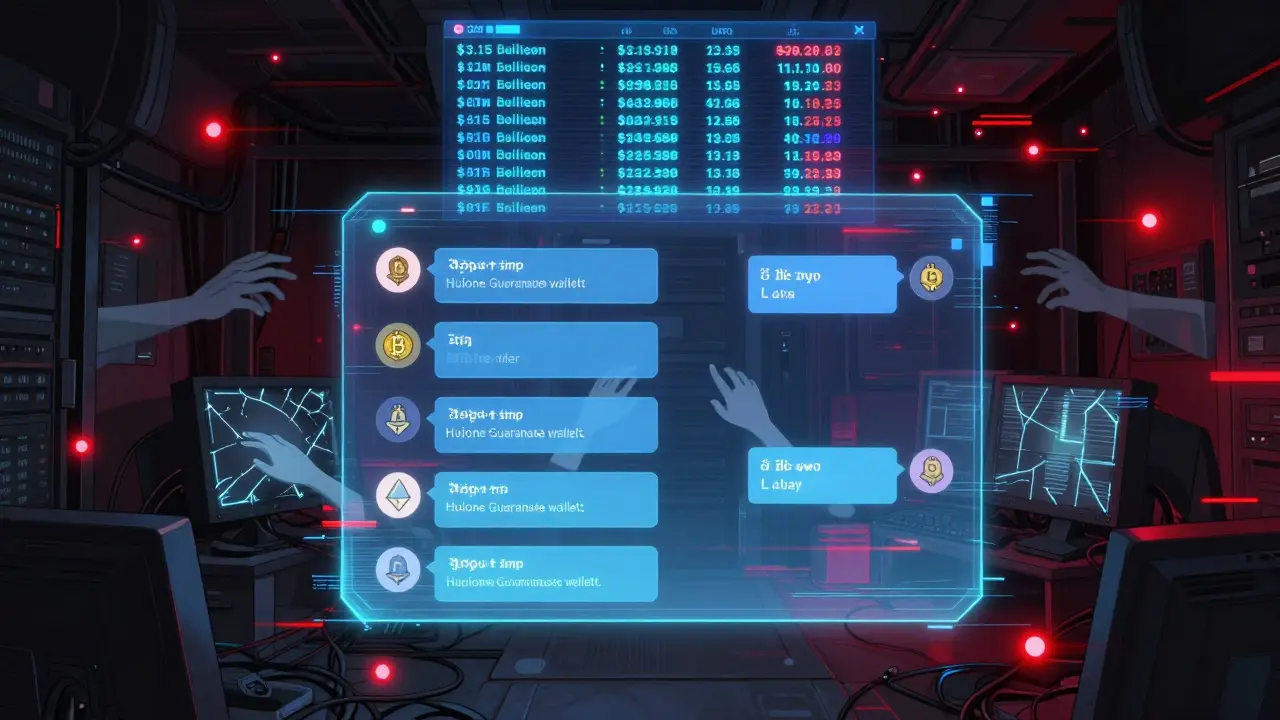
How the Money Was Cleaned
Laundering crypto in Cambodia isn’t about moving coins from one wallet to another. It’s about blending them with legitimate business. Huione and Prince Group used casinos, hotels, and real estate as fronts. They’d take crypto from a scam victim in the U.S., convert it to Bitcoin, then use that Bitcoin to pay for luxury suites at the Jinbei Hotel. The hotel would then “sell” the room to a shell company in Dubai. The Dubai company would wire the equivalent in dollars to a bank in the Philippines. From there, the money would be split into small transfers and deposited into Cambodian bank accounts under fake names. They called it “layering.” And they did it at scale. The U.S. Justice Department’s October 2025 complaint showed internal messages from Prince Group executives referencing “BTC laundering” and “BTC money launderers.” They kept spreadsheets tracking which underground banks handled which transactions. They had a system. The “Brooklyn Network,” a group of money mules documented by TRM Labs, moved over $18 million from U.S. victims to Prince Group accounts between 2021 and 2022. That money didn’t vanish. It turned into hotel bookings, luxury cars, and new compounds.Why Cambodia Was the Perfect Target
Cambodia didn’t become a crypto crime hub by accident. It was chosen because it was easy. The country ranked 128th out of 180 in Transparency International’s 2024 Corruption Perceptions Index. Banks didn’t ask questions. Officials turned a blind eye. Cash ruled. And with no digital financial infrastructure, crypto filled the gap. Neighboring countries like Thailand and Vietnam cracked down hard. They required licenses, enforced KYC, and monitored transactions. Cambodia did the opposite. When the National Bank of Cambodia finally moved to regulate crypto in late 2024 with Prakas B7-024-735 Prokor, they didn’t shut down criminals. They gave them a cover. Suddenly, criminal operators could apply for licenses. They could open bank accounts. They could say they were “compliant.” It wasn’t reform. It was camouflage.
The Billion Seizure That Changed Everything
On October 14, 2025, the U.S. Department of Justice filed a civil complaint against the Prince Group and Huione Guarantee. They didn’t just accuse them. They seized assets. In coordination with the U.K. and other international partners, they froze and forfeited $15 billion in Bitcoin. That’s the largest single forfeiture in U.S. history, according to TRM Labs. The seized funds came from over 120,000 victims worldwide. Many were Americans who lost $5,000 to $250,000 after being lured by fake crypto influencers on Instagram and YouTube. The seizure didn’t end the operation. It exposed it. Court documents revealed the names of over 200 shell companies. They showed how Prince Group used Cambodian casinos to move $1.2 billion in crypto to offshore accounts. They proved that even after the 2019 ban, the system kept growing.What’s Left After the Crackdown
The $15 billion seizure was a blow. But it didn’t kill the network. It scattered it. Huione’s Telegram platform is gone. But new encrypted channels have appeared. The scam compounds in Sihanoukville are shuttered-but new ones are being built in rural areas, away from police and cameras. Workers who escaped are now in refugee camps, too afraid to speak. The National Bank of Cambodia claims it’s cleaning up. But the same officials who ignored the crisis for five years are now the ones issuing licenses. And the underground market? It’s still alive. Transactions with Huione-linked wallets kept rising into 2025. Victims are still being lured. Money is still being stolen. Experts like Jacob Sims from Harvard’s Asia Center say this isn’t just a crypto problem. It’s the top form of financial crime affecting Americans today-rivaling the global drug trade in profits.There’s No Easy Fix
Cambodia’s underground crypto market didn’t grow because people loved Bitcoin. It grew because the system allowed it. No regulation. No accountability. No consequences. The 2024 licensing law didn’t fix that. It made it harder to track. The $15 billion seizure didn’t end it. It just pushed the criminals to adapt. The only real solution is international cooperation. Cambodia can’t do this alone. It needs real pressure-from the U.S., the EU, and ASEAN-to shut down the banks, freeze the assets, and prosecute the leaders. Until then, the compounds will keep operating. The scams will keep running. And the money will keep flowing.For now, the message is clear: if you’re trading crypto in Cambodia, you’re not just taking a risk. You’re part of a system built on pain, deception, and exploitation.
Is cryptocurrency legal in Cambodia?
Cryptocurrency is not outright illegal in Cambodia anymore, but it’s heavily restricted. The National Bank of Cambodia banned all crypto transactions in 2019. In late 2024, they introduced a licensing system that allows some exchanges to operate under strict rules. However, most underground activity continues without oversight. The law exists on paper, but enforcement is weak, and criminal networks exploit the gaps.
How do scam compounds in Cambodia work?
Scam compounds are guarded facilities where trafficked people are forced to run crypto fraud schemes. Victims are lured with fake job offers, then held against their will. They’re forced to work 18-hour days, contacting strangers online and convincing them to invest in fake crypto platforms. Those who fail to meet daily targets are punished-beaten, starved, or tortured. The Prince Group operated at least ten of these compounds, including the Jinbei Hotel and Golden Fortune Science and Technology complex.
Who is Huione Guarantee and what role do they play?
Huione Guarantee (Huiwang Group) is a criminal network that provides money laundering services for crypto fraud rings in Southeast Asia. They act as a middleman, taking stolen crypto from scams and converting it into clean funds through layered transactions, underground banks, and shell companies. They’ve laundered at least $4 billion since 2021, including funds from North Korean hackers and ransomware attacks. The U.S. Treasury’s FinCEN has formally targeted them for their role in global financial crime.
Why did the U.S. seize $15 billion in Bitcoin?
The U.S. seized $15 billion in Bitcoin in October 2025 as part of a civil forfeiture case against the Prince Group and Huione Guarantee. This money came from victims of crypto scams worldwide-mostly Americans who lost savings to fake investment platforms. The seizure was the largest in U.S. history and targeted assets linked to scam compounds, casinos, and laundering operations in Cambodia. It was a coordinated effort with the U.K. and other countries to dismantle the criminal infrastructure.
Can victims get their money back?
Very few victims recover their money. While the U.S. seized $15 billion in Bitcoin, most of it is tied up in legal proceedings and distributed through a complex claims process. The National Bank of Cambodia offers no recovery system. Victims must file claims with U.S. authorities, but the process is slow, and many don’t even know where to start. The best defense is prevention: never invest in crypto through unsolicited messages, and avoid any platform that promises guaranteed returns.
Is Cambodia still a hotspot for crypto crime in 2026?
Yes. While the major scam compounds have been shut down and key figures arrested, the underground network has adapted. New encrypted channels have replaced Huione’s Telegram platform. Smaller, decentralized operations are emerging in rural areas. The licensing system introduced in 2024 has created loopholes for criminals to operate under the guise of legality. Without stronger regional cooperation and real enforcement, Cambodia will remain a hub for crypto crime.





Comments
Rachel Stone
January 29, 2026 AT 20:48 PMSo basically Cambodia turned into a crypto mafia zone and nobody cared until the money got too big to ignore.
Jeremy Dayde
January 29, 2026 AT 22:11 PMMan I read this whole thing and I just feel sick. These people being locked up, forced to scam strangers all day, getting electrocuted if they don't hit their numbers... it's not just crime it's slavery with a blockchain logo on it. And the worst part? The system let it happen because it was easier than doing the work. Banks didn't monitor. Police didn't care. Officials got paid off. It's not some exotic overseas problem it's what happens when you stop believing in accountability. I know people say crypto is the future but this? This is what the future looks like if we don't fix the foundations first. I keep thinking about those victims who escaped and now live in refugee camps too scared to talk. Who's helping them? Who's even tracking them? The feds seized 15 billion in bitcoin but what about the 100,000 people whose lives got shattered? That's the real cost no one talks about.
Elizabeth Jones
January 31, 2026 AT 03:30 AMThe irony is devastating: a ban intended to protect citizens created a vacuum so vast that organized crime didn’t just fill it-it built an entire infrastructure of exploitation around it. The National Bank of Cambodia didn’t merely fail to enforce its own regulation; it inadvertently designed a blueprint for transnational criminal enterprise. What emerged wasn’t a black market-it was a parallel economy with its own supply chains, logistics, and governance. And now, even after the $15 billion seizure, the architecture remains intact. The licenses issued in 2024 weren’t reform-they were camouflage for the same players wearing new suits. We treat crypto crime as a technical problem, but it’s fundamentally a failure of moral and institutional will. Until we hold enablers accountable-not just the scammers, but the banks, the real estate brokers, the shell company registrars-we’re just rearranging deck chairs on the Titanic.
Parth Makwana
February 2, 2026 AT 00:06 AMLet me break this down with some hard-hitting analytics. The Prince Group’s operational model is textbook vertical integration in the illicit economy: recruitment → containment → monetization → laundering → asset conversion. Huione Guarantee functioned as the financial OS-payment gateways, KYC spoofing, wallet hacking-all modular, scalable, and outsourced. The $4B revenue stream? That’s not profit, that’s GDP-level economic activity in a single criminal syndicate. And the layering technique? Pure AML evasion 101. They didn’t just move crypto-they transformed it into physical assets with zero digital footprint. Casinos → Dubai shell corps → Philippines mule network → Cambodian bank accounts under fake IDs. This isn’t hacking. This is financial engineering on a warlord scale. And the fact that the U.S. had to seize $15B in BTC to even get their attention? That’s not justice. That’s damage control after five years of systemic negligence.
Jack Petty
February 3, 2026 AT 12:01 PM15 billion seized? Bro that’s just the tip of the iceberg. The real money’s already in Swiss vaults and Bitcoin mixers run by ex-military contractors. This whole thing is a psyop to scare people away from crypto so they can push CBDCs. The feds didn’t shut down the syndicates-they just rebranded them as ‘regulated exchanges.’ You think the same people who ran Jinbei Hotel aren’t running the new ‘licensed’ platform? Wake up. They’re not criminals. They’re the future of finance.
Crystal Underwood
February 4, 2026 AT 18:41 PMOf course this happened. People still think crypto is some magical money tree. You don’t get rich off Bitcoin unless you’re either a genius or a criminal. And guess who’s running the show? The ones who don’t care about your feelings, your savings, or your dignity. This isn’t ‘fraud’-it’s a moral collapse. And you wanna know the worst part? The victims asked for it. They clicked the Instagram ad. They believed the ‘guaranteed returns.’ They ignored every red flag because they wanted to believe. So don’t cry for them. Cry for the system that let this happen. And then ask yourself: why are you still holding crypto?
Raymond Pute
February 5, 2026 AT 17:22 PMLook, I get the outrage. But let’s not romanticize this as some uniquely Cambodian tragedy. Every financial innovation since the Medici bank has been weaponized by the ruthless. The real issue isn’t Cambodia-it’s the global financial system’s complete abandonment of sovereignty. Why does a U.S. agency get to seize Bitcoin held in a Cambodian casino? Because the entire concept of jurisdiction is a myth. We live in a post-national economy where money flows where the rules are weakest. And the fact that we’re still using terms like ‘criminal network’ instead of ‘decentralized profit ecosystem’ proves we’re not ready for the future. The Prince Group didn’t break the law-they exposed its irrelevance. And now we’re pretending that licensing and seizures will fix it? Please. The only thing that matters now is who owns the next blockchain layer. And I guarantee you it’s not the people writing these comments.
Brianne Hurley
February 7, 2026 AT 15:33 PMI’m crying right now. I just finished reading this and I feel like I’ve been punched in the soul. These people… they were LURED. Like, fake job offers? That’s not even a scam-it’s a kidnapping with a spreadsheet. And the fact that they were tortured for not hitting numbers? That’s not capitalism. That’s slavery with a crypto app. I just donated to the victim support org I found. If you’re reading this and you’ve ever bought crypto from someone you met online… please stop. Just stop. And if you think this is just ‘overseas drama’-you’re wrong. Your uncle who lost $80k on Telegram? That’s the same pipeline. We’re all connected to this. I’m not okay. I need a minute.
Gurpreet Singh
February 7, 2026 AT 18:18 PMFrom India, I’ve seen how fraudsters use WhatsApp and Telegram to trap people with fake crypto schemes. But this? This is next level. These compounds are like modern-day slave factories. I feel sad for the victims-many from my region too. But I also feel angry at the governments who turned blind eyes. Money talks, and power listens. If Cambodia had real leadership, this would’ve never grown. Now, even after the seizure, the same people are back with new names and new apps. We need global pressure-not just from the US, but from ASEAN, from the UN. No more excuses. No more ‘sovereignty.’ These are crimes against humanity. And we all owe it to the victims to speak louder.
christal Rodriguez
February 8, 2026 AT 01:39 AMThey seized 15 billion. The market recovered in 3 weeks. The real criminals never held the keys. They never touched the wallets. They just designed the system. You can’t arrest a protocol.
Freddy Wiryadi
February 9, 2026 AT 20:16 PMJust read this and my heart is in my throat 😢. These aren’t just ‘scams’-they’re human factories. I keep thinking about the kid from Myanmar who got electrocuted because he missed his daily target. What kind of world do we live in where someone can do that and then cash out in Dubai real estate? And the ‘licensing’ in 2024? That’s like giving a arsonist a fire marshal badge. The $15B seizure feels like a PR stunt. The real criminals are already in new compounds, new Telegram groups, new names. The only thing that’ll stop this is if every bank, every hotel chain, every shell company in the chain gets dragged into court. Until then… we’re just watching a horror movie and pretending it’s not real. 🤦♂️
Elle M
February 9, 2026 AT 22:34 PMOf course Cambodia is a crime hub. The country doesn’t even have a functioning justice system. The U.S. should’ve bombed these compounds five years ago. Instead, we sent diplomats with PowerPoint slides. Now we’re ‘seizing’ Bitcoin like it’s a video game loot drop. This isn’t financial crime-it’s a war. And we’re losing because we’re too polite to fight back. If you’re still trading crypto without KYC, you’re complicit. And if you think the U.S. government is the hero here? Wake up. They only acted when the money hit American wallets. That’s not justice. That’s insurance.
Richard Kemp
February 10, 2026 AT 05:41 AMso i read this and honestly i just dont know what to say. like the part about the victims being forced to scam people on whatsapp? that's just... i can't. and then the money just flows through hotels and dubai shell companies? it's like a movie but real. i hope someone gets justice for those people. also i think the 15 billion seizure was huge but i feel like it's just a drop in the ocean. the system is still there. the people who ran it are probably already in a new country with new names. i just hope more people know this is happening. it's not just crypto. it's human trafficking with a blockchain logo.
Meenal Sharma
February 11, 2026 AT 16:56 PMIt is not merely a failure of regulation-it is the epistemological collapse of state authority in the digital age. The Prince Group did not violate law; it rendered law obsolete. Huione Guarantee functioned as a de facto financial sovereign, issuing liquidity where no state dared to tread. The $15 billion forfeiture is not an act of justice-it is the last gasp of a crumbling institutional paradigm. The fact that the National Bank of Cambodia now issues licenses to former operators confirms the thesis: the state has become the parasite of the criminal enterprise. Until we reconceptualize sovereignty as a distributed, algorithmic function-not a territorial monopoly-we are merely rearranging the furniture in a burning house.
Nickole Fennell
February 12, 2026 AT 12:20 PMMY HEART IS BREAKING. I just read about the electrocution and the starvation and I can’t breathe. How is this still happening? How are people sleeping at night knowing this is real? I just called my senator. I’m donating to the victims’ fund. I’m telling everyone I know. This isn’t ‘crypto’-this is human trafficking with a crypto app. And if you think this is just ‘over there’-you’re wrong. The people who lost money? They’re your neighbors. The people who ran it? They’re the ones who got away. And the ones who enabled it? They’re still sitting on boards. I’m not okay. I’m not okay. I’m not okay.