
You’ve probably heard the hype. Web3 is supposed to be the next iteration of the internet, where you own your data, your money, and your identity without asking permission from a tech giant. It sounds like freedom. But if you try to actually use it today, you might feel more like you’re fighting a war against bad interfaces and hidden fees. As of late 2025, only about 480 million people globally are using Web3 technologies, which is just 6% of all internet users. That’s a tiny slice of the pie for something promised to change everything.
| Metric | Web3 (Ethereum/L1) | Web2 (Visa/Cloud) |
|---|---|---|
| Transactions Per Second (TPS) | 15-30 TPS | 65,000+ TPS |
| Average Transaction Cost | $1.20 - $100+ | Near $0.00 |
| Finality Time | Seconds to Minutes | Instantaneous |
| User Onboarding Steps | 3-5 Extra Steps | 1 Click/Login |
The Scalability Wall
Let’s start with the hard numbers because they don’t lie. If you send a payment on Ethereum, you’re waiting seconds or minutes for confirmation. Compare that to sending a Venmo transfer or buying coffee with Visa, which feels instant. The bottleneck is simple physics and code limits. Most major blockchains process fewer than 100 transactions per second (TPS). Ethereum, the backbone of most Web3 apps, handles roughly 15 to 30 TPS under normal conditions. Visa? They handle over 65,000 TPS. We aren’t even in the same league yet.
This isn’t just an inconvenience; it’s a business killer. When network traffic spikes, gas fees-the cost to process your transaction-explode. In August 2025, during peak congestion, fees hit $50 to $100 per transaction. Imagine paying $50 to buy a $5 sandwich. It doesn’t work. Layer-2 solutions like Arbitrum and Optimism have helped by batching transactions off the main chain, pushing speeds to 2,000-4,000 TPS. That’s better, but still nowhere near what billions of users need for seamless daily interaction. Until we hit 100,000 TPS with sub-second finality, Web3 will remain a niche playground rather than a global utility.
User Experience Is a Nightmare
If technical speed were the only problem, engineers could fix it. But the human element is messier. Have you ever tried to set up a new crypto wallet? You generate a seed phrase, write it down on paper, lose the pen, panic, reinstall the app, and hope you didn’t mistype a word. This friction drives people away. Studies show that Web3 applications require three to five extra steps for onboarding compared to traditional apps. Users have to manage private keys, understand network selection, and grasp concepts like "slippage" before they can even make their first purchase.
The result? High drop-off rates. Gaming platforms integrating Web3 elements see up to 83% of users bail out during the wallet setup phase. Trustpilot reviews for major wallets average a dismal 2.8 stars, with two-thirds of negative feedback citing confusing interfaces and lost funds due to user error. People don’t want to become IT support for their own finances. They want things to work. Until Web3 hides the complexity behind intuitive design-like one-click logins or social recovery wallets-mainstream users will stick to banks and apps they trust.
Security Risks and Lost Funds
Security is another massive hurdle. In Web2, if you forget your password, you click "Forgot Password," get an email, and reset it. In Web3, if you lose your private key, your money is gone forever. There is no customer service line to call. This absolute control comes with absolute responsibility, and many users aren’t ready for that burden.
Beyond user error, the infrastructure itself has vulnerabilities. Smart contracts-self-executing code on the blockchain-are prone to bugs. In Q3 2025 alone, hackers stole $1.2 billion through smart contract exploits. That’s more than three times the amount stolen from centralized Web2 platforms in similar periods. For regular people, this creates a fear factor. Why move your savings to a system where a single coding mistake can wipe out your portfolio? Until security audits become standard and insurance for digital assets becomes common, risk-averse users will stay on the sidelines.
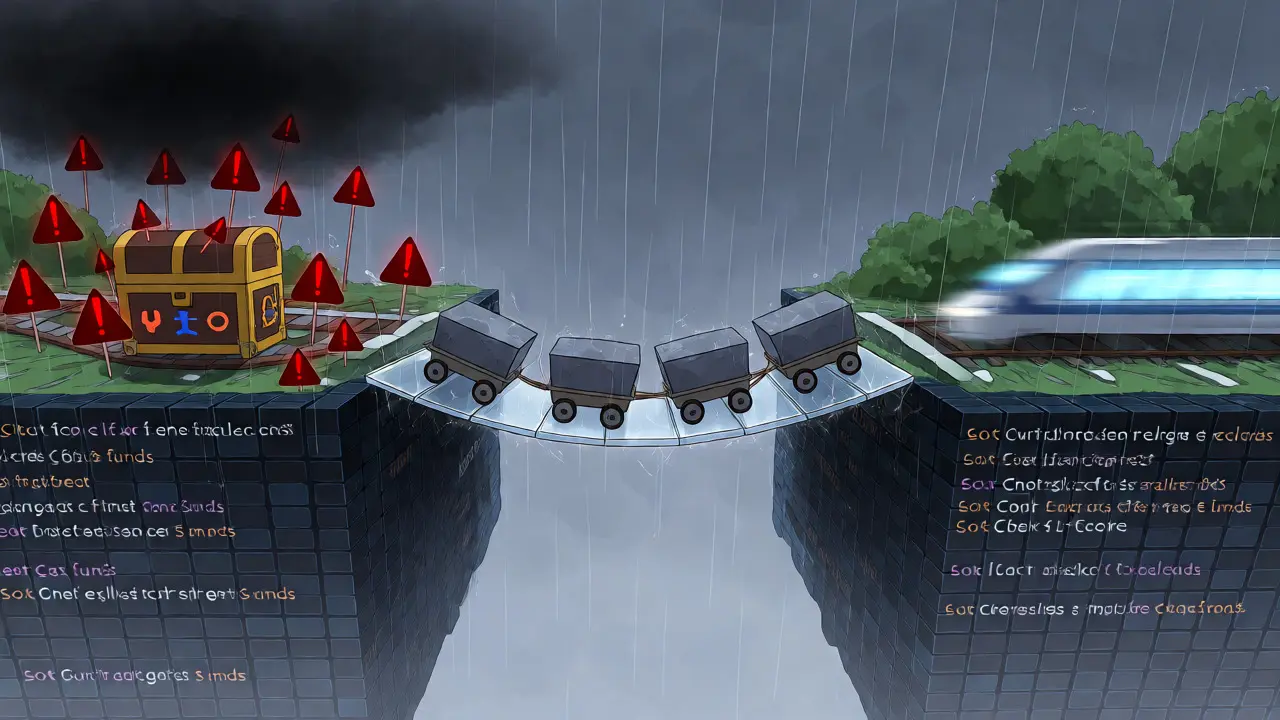
The Regulatory Fog
Businesses hate uncertainty, and right now, Web3 offers plenty of it. While 87 countries have defined cryptocurrency frameworks, they often contradict each other. A token sale might be legal in Switzerland but considered a security violation in the US. This patchwork makes it hard for companies to plan long-term strategies.
Deloitte reports that 78% of Fortune 500 companies have paused their Web3 initiatives specifically due to regulatory ambiguity. Enterprises want clear rules on taxation, data privacy (especially with GDPR), and asset classification. Without harmonized regulations across major economies, large-scale corporate adoption stalls. We need clarity on who owns what, how taxes apply to DeFi yields, and how consumer protections fit into a decentralized world. Until regulators catch up with technology, big brands will treat Web3 as an experiment rather than a core strategy.
Interoperability Silos
Imagine if every time you wanted to send an email from Gmail to Outlook, you had to convert the file format, pay a fee, and wait an hour. That’s essentially what cross-chain transfers look like today. Blockchains like Ethereum, Solana, and Polygon operate like isolated islands. Moving assets between them requires bridges, which are complex, slow, and risky.
Only 12% of potential asset transfers happen smoothly across chains due to technical incompatibilities. This fragmentation hurts user experience. You might hold assets on Solana but want to use a popular NFT marketplace on Ethereum. Bridging those assets involves multiple steps and significant fees. True mass adoption requires a unified layer where users don’t care which chain their asset lives on-it just works. Projects aiming for true interoperability are critical, but we’re still years away from a seamless multi-chain experience.

Education and Awareness Gaps
Finally, there’s the knowledge gap. Crypto jargon is intimidating. Terms like "DeFi," "yield farming," "Liquidity Pool," and "Gas Limit" confuse newcomers. Vugar, COO at Bitget, notes that lack of education plays a major role in stagnation. Many potential users are scared off by the perceived volatility and complexity.
It takes 120-150 hours of dedicated study to achieve basic proficiency in smart contract development, compared to 40-60 hours for equivalent Web2 skills. For non-developers, understanding why they should care about decentralization is equally tough. Most people don’t wake up wanting to fight censorship; they want convenience. Education needs to shift from explaining *how* blockchain works to demonstrating *why* it benefits them in plain language. Successful onboarding examples, like OpenSea’s simplified mobile interface, show that when you remove the jargon, adoption follows.
What Needs to Happen Next?
So, is Web3 dead? No. It’s maturing. The industry grew 32% year-over-year in 2025, reaching a $10.5 billion valuation. Enterprise pilots in supply chain and identity management are showing real value, with some trials reducing fraud by 63%. But these wins are buried under layers of friction.
To break through, developers must prioritize usability over novelty. Wallets need to be invisible. Fees need to be negligible. Regulations need to be predictable. And marketers need to stop selling dreams and start solving problems. The World Economic Forum predicts mainstream adoption won’t fully materialize until 2027-2030, assuming we hit specific performance benchmarks. Until then, Web3 remains a powerful tool for early adopters, not yet the default internet for everyone else.
Why is Web3 adoption so slow despite its benefits?
Adoption is slow primarily due to poor user experience, high transaction costs, and technical complexity. Unlike Web2 apps, Web3 requires users to manage private keys and understand blockchain mechanics, creating a steep learning curve that deters casual users.
How do transaction fees impact everyday users?
High gas fees make small transactions economically unviable. During network congestion, fees can spike to $50-$100, making it impossible to use Web3 for micro-payments or daily purchases, unlike traditional payment systems with near-zero costs.
Can Layer-2 solutions solve the scalability problem?
Layer-2 solutions like Arbitrum and Optimism significantly improve speed and reduce costs by processing transactions off the main chain. However, they still fall short of Web2 standards (e.g., Visa's 65,000 TPS) and introduce additional complexity for users moving assets between layers.
What is the biggest barrier for enterprise adoption of Web3?
Regulatory uncertainty is the primary barrier for enterprises. According to Deloitte, 78% of Fortune 500 companies have paused Web3 projects due to unclear laws regarding taxation, asset classification, and compliance across different jurisdictions.
Is Web3 secure enough for average consumers?
While the underlying blockchain is secure, the ecosystem faces risks from smart contract bugs and user error. Billions are lost annually to hacks and lost keys. Consumer-grade security features like account abstraction and insurance are still developing, making it riskier than traditional banking for novices.