

Smart Contract Event Explorer Simulator
Simulate a Transaction
When you send ETH to a DeFi protocol or mint an NFT, you’re not just clicking a button-you’re triggering a chain of code that runs on a public ledger. Every action, every change, every call between contracts leaves a permanent mark. But if you don’t know how to track it, you’re flying blind. Smart contract interaction tracking isn’t just for developers. If you’re using crypto wallets, staking tokens, or trading NFTs, understanding what’s happening on-chain makes all the difference.
What Exactly Gets Tracked When a Smart Contract Runs?
Smart contracts don’t run in a vacuum. Every time one is called-whether by a user, another contract, or a bot-it leaves behind a trail. This trail isn’t hidden. It’s written into the blockchain’s permanent record. But what’s actually recorded?
First, there’s the transaction itself. That includes who sent it (the sender’s wallet address), which function was called (like deposit() or transferFrom()), what data was passed in (like how many tokens), how much gas was used, and whether it succeeded or failed. If a contract reverts, that’s logged too.
Then there’s the state change. Smart contracts store data-balances, ownership, settings. When that data changes, the new value is saved in the blockchain’s world state. Tracking this means knowing what changed, when, and from what value. For example, if your wallet balance jumps from 10 to 15 ETH after interacting with a lending pool, tracking confirms that change was real and not a glitch.
And then there are events. These are like public announcements made by the contract during execution. They’re cheaper than storing data on-chain and designed to be indexed. Events can have up to four named parameters called topics, which let tools quickly search for specific actions-like Transfer(from, to, amount) or LoanTaken(borrower, amount). Developers use these to build dashboards, wallets, and analytics tools that show you exactly what’s happening.
Finally, there’s cross-contract interaction. Most real-world DeFi apps don’t run in one contract. A single swap on Uniswap might trigger calls to three or four other contracts: approval, token transfer, price oracle, liquidity pool. Tracking this path shows you the full flow-not just the surface action.
How Blockchain Platforms Handle Tracking Differently
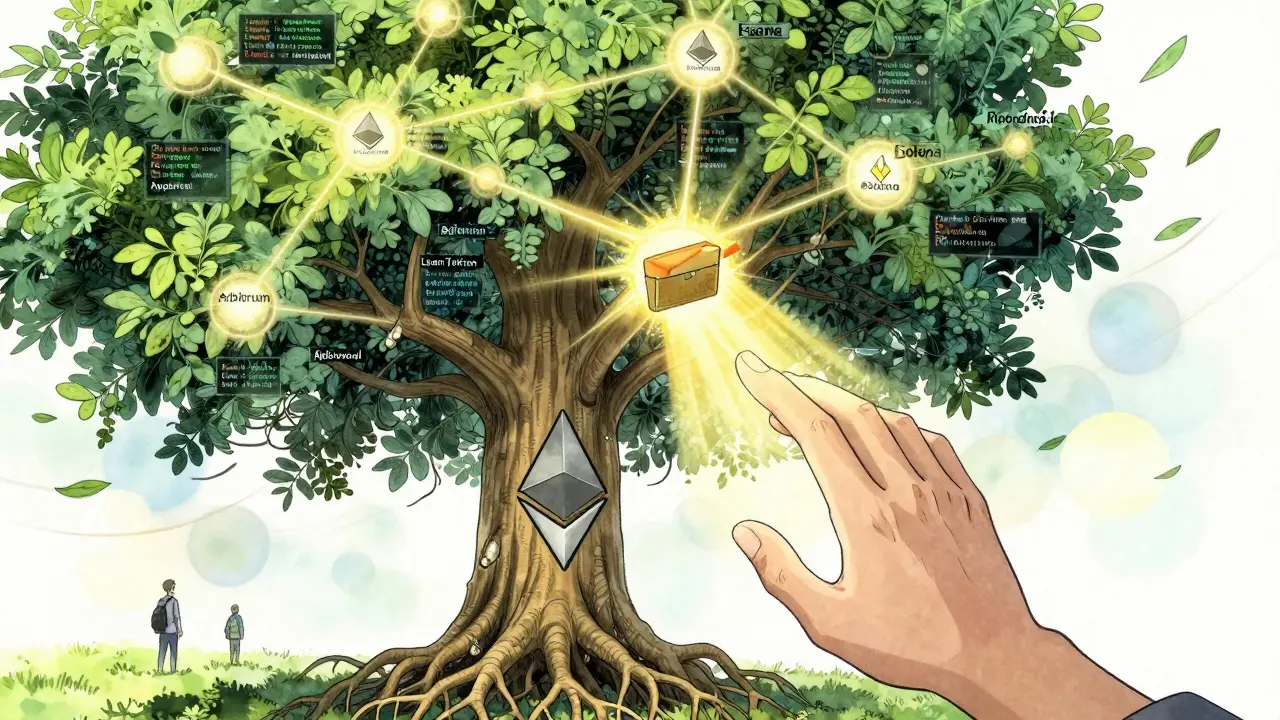
Not all blockchains track interactions the same way. Ethereum, the most common platform for smart contracts, uses something called the Ethereum Virtual Machine (EVM). When a contract emits an event, it uses a special opcode-LOG0 through LOG4. Each one allows for zero to four indexed topics. These logs are stored in the transaction receipt and are searchable forever. That’s why tools like Etherscan can show you every time someone claimed a reward or added liquidity.
Solana, on the other hand, uses a different architecture. Instead of logs, it relies on program logs and account changes. Every instruction executed by a smart contract (called a program in Solana) updates accounts, and those updates are recorded as transactions. Tracking here means following account state changes across multiple programs.
Hyperledger Fabric, used mostly in enterprise settings, doesn’t even use public blockchains. It’s permissioned. Tracking here is built into the endorsement and validation process. Every transaction must be signed by specific organizations before it’s committed. That means tracking isn’t just about what happened-it’s about who approved it.
Even within Ethereum, layer-2 networks like Arbitrum and Optimism handle tracking differently. They batch hundreds of transactions into one on Ethereum, so you need tools that can reconstruct the original interactions from the rollup data. That’s why simple explorers sometimes miss activity on L2s unless they’re specifically built to support them.
Tools That Make Tracking Practical
You don’t need to read raw blockchain data to track interactions. There are tools built for this.
Etherscan, BscScan, Polygonscan-these are the basics. Type in a contract address, and you’ll see every transaction, internal call, and event log. Great for checking if your transaction went through or if a contract emitted a specific event.
Chainalysis, Nansen, Dune Analytics-these go deeper. They connect wallet addresses to real-world identities (like exchanges or known DeFi users), track interaction patterns over time, and even flag suspicious behavior. For example, Nansen can show you if a wallet consistently interacts with known money laundering protocols.
Chainlens offers enterprise-grade tracking with custom dashboards. It works across Ethereum, Polygon, and Polkadot. If you’re running a DeFi protocol and need to monitor user behavior, detect front-running, or audit contract usage, this is where you turn.
And don’t forget custom scripts. Developers often write Python or JavaScript scripts using Web3 libraries (like Web3.py or ethers.js) to watch for specific events in real time. For example, a script could alert you the moment a new liquidity pool is created on a DEX you’re tracking.
Why Tracking Matters in DeFi, NFTs, and Supply Chains
In DeFi, tracking saves you money and risk. If you’re yield farming, you need to know if your staked tokens are being used correctly. If a contract suddenly starts calling an unknown address, it could be a hack in progress. Tracking lets you spot anomalies-like a contract draining funds after a small deposit-or confirm that your rewards are being calculated right.
For NFTs, tracking proves ownership and royalty payments. When an NFT sells, the contract should automatically send 5% to the original creator. If that doesn’t happen, tracking the transaction reveals whether it was a bug, a scam, or a broken marketplace. Platforms like OpenSea rely on this data to display accurate sales history and royalty compliance.
In supply chains, companies use smart contracts to track product movement. A shipment leaves a warehouse-contract updates location. It clears customs-another update. It reaches a store-final update. Anyone with access can verify the path. If a product is counterfeit, the tracking data shows where the chain broke.
Even in healthcare, pilot programs in New Zealand and Australia are testing smart contracts to securely share patient records between hospitals and insurers. Every access request is logged. No one can view data without permission. Tracking ensures compliance and auditability without exposing private details.
The Hidden Costs and Risks of Over-Tracking
More tracking isn’t always better. Every event you log costs gas. If your contract emits an event for every tiny change-like a user changing their profile name-it can make transactions prohibitively expensive.
And privacy? Big issue. If your business uses a public blockchain to track vendor payments, anyone can see how much you pay, when, and to whom. That’s why some enterprises use private chains or zero-knowledge proofs to hide sensitive data while still proving the interaction happened.
Then there’s scalability. Ethereum’s mainnet processes about 15 transactions per second. A popular NFT drop can flood the network with contract calls. Tracking tools get overwhelmed. Data gets delayed. You think your transaction failed, but it’s just stuck in the backlog.
And don’t forget cross-chain tracking. If your app works on both Ethereum and Solana, you need tools that can follow a user’s actions across both. Most platforms still treat chains as silos. That’s changing, but slowly.
What’s Next for Smart Contract Tracking?
The next wave is smarter tracking-not just more data, but better insights. AI-powered tools are starting to detect patterns: a wallet that consistently interacts with newly deployed contracts? Could be a bot. A contract that changes its behavior after a token price spike? Might be a rug pull.
Zero-knowledge proofs are also making headway. Imagine being able to prove you interacted with a contract without revealing which contract, how much you sent, or when. That’s the future: full transparency for auditors, full privacy for users.
Enterprise systems are also integrating blockchain tracking into ERP tools like SAP and Oracle. That means finance teams can see crypto transactions alongside bank transfers in one dashboard. No more manual reconciliation.
Real-time dashboards are becoming standard. If you’re running a DeFi protocol, you should be able to see live interaction heatmaps, top users, gas spikes, and failed transactions-all in one view.
How to Start Tracking Your Own Interactions
You don’t need to be a developer to start. Here’s how:
- Find the contract address of the DeFi app or NFT project you’re using.
- Go to Etherscan (or the relevant explorer for that chain).
- Click on the “Contract” tab, then “Read Contract” or “Events”.
- Look for common events:
Transfer,Deposit,Withdraw,Approval. - Use the filter to see only events from your wallet address.
For advanced users: Set up a simple script with Web3.js to listen for events in real time. Or use Dune Analytics to create a custom query that tracks your wallet’s activity across multiple protocols.
Remember: if you can’t track it, you can’t trust it. In crypto, visibility isn’t optional-it’s your safety net.
Can I track smart contract interactions without knowing how to code?
Yes. Tools like Etherscan, BscScan, and Nansen let you search contract addresses, view transaction histories, and filter events using simple interfaces. You don’t need to write code-just copy the contract address and explore the logs.
Why do some transactions show as "internal" in blockchain explorers?
Internal transactions happen when one smart contract calls another. They don’t appear as direct user actions, so they’re labeled "internal." Tools like Etherscan track them separately so you can see the full chain of execution-even if you didn’t initiate every step.
Is smart contract tracking private?
On public blockchains like Ethereum, all interactions are visible to anyone. There’s no privacy by default. If you need confidentiality, you’ll need to use private chains, zero-knowledge proofs, or mixers-though these come with trade-offs in transparency and compliance.
Can tracking help me avoid scams?
Absolutely. Scammers often deploy fake contracts that look like legitimate ones. By tracking interaction patterns-like whether a contract calls known malicious addresses or drains funds after a deposit-you can spot red flags before you send money. Tools like DeFiLlama and RugDoc use this data to warn users.
How much does it cost to track smart contract interactions?
Using a blockchain explorer like Etherscan is free. Writing your own script or using Dune Analytics is also free. But if you’re building a custom tracking system with real-time alerts and AI analysis, enterprise platforms like Chainlens or Nansen charge monthly fees-usually from $50 to $500+, depending on scale.



Comments
Andy Walton
December 12, 2025 AT 06:24 AMbro i just clicked "mint" and now my wallet is empty 😭 why does this feel like handing cash to a stranger in an alley?? 🤡
Kim Throne
December 12, 2025 AT 12:04 PMThe transaction receipt contains a log of all emitted events, which are indexed by the node software and made accessible via RPC endpoints. Developers should parse these logs using ABI definitions to reconstruct the semantic intent of contract interactions, ensuring fidelity in state validation and auditability.
Ian Norton
December 13, 2025 AT 21:43 PMMost people don't realize that 87% of DeFi interactions are just gas-guzzling bots. You think you're yield farming? Nah. You're feeding the machine. And Etherscan? It's just a pretty lie. The real data's buried in raw traces.
Sue Gallaher
December 14, 2025 AT 15:32 PMUSA built this tech not some other country so if you cant track your own transactions you deserve to lose everything stop crying and learn or get out
Stanley Machuki
December 15, 2025 AT 18:00 PMYou dont need to code to track this stuff. Just go to Etherscan paste the address and boom you see everything. Seriously its that easy. You got this
Jessica Eacker
December 16, 2025 AT 05:02 AMI started using Etherscan after I lost a small amount to a fake contract. Now I check every address before I interact. It's not scary once you know how. You're not alone in this.
Candace Murangi
December 17, 2025 AT 08:55 AMI use Dune to track my NFTs and it’s wild seeing how often my wallet interacts with different protocols. Sometimes I forget I even did something. It’s like a digital diary. Also, I’m from Kenya and we’re starting to use this for mobile credit tracking. Pretty cool to see it spread.
John Sebastian
December 18, 2025 AT 21:39 PMThe fact that you need to rely on third-party explorers at all is a design flaw. Blockchain was supposed to be trustless. Now we trust Etherscan like it's a bank. Pathetic.
Patricia Whitaker
December 20, 2025 AT 02:43 AMIf you're still using Etherscan in 2025 you're literally living in 2018. Nansen has a heatmap that shows your wallet's entire social graph. You're not even trying.
Sarah Luttrell
December 21, 2025 AT 19:41 PMOh sweetie you think you're tracking smart contracts? 😘 You're just reading what Etherscan lets you see. The real interactions? Hidden in L2 rollups. Your "transparency" is a corporate marketing slide. 💅