

It’s 2025, and the U.S. just lifted comprehensive sanctions on Syria. You’d think that meant crypto could flow freely. But if you’re a Syrian trying to buy Bitcoin or send remittances using crypto, you’re still hitting walls. Why? Because lifting sanctions doesn’t mean lifting complexity.
Sanctions Are Gone-But the Rules Aren’t
On August 26, 2025, the U.S. Treasury officially removed the Syrian Sanctions Regulations from the Code of Federal Regulations. That meant no more blanket bans on trade, banking, or financial transactions. For the first time in over 20 years, U.S. banks could open accounts with Syrian institutions like the Central Bank of Syria. The Bureau of Industry and Security also relaxed export controls, letting most tech goods into the country. But here’s the catch: not everyone was cleared. Out of the 657 entities previously blocked under Syria sanctions, 518 were removed. The other 139? Still on the list. These are people and companies tied to the old Assad regime, now designated under different sanctions programs like E.O. 13894. If you’re sending crypto to someone who was once on that list-even if they’re not anymore-you’re at risk.No Crypto Law in Syria? That’s the Real Problem
Syria doesn’t have a crypto law. Not one. No licensing rules. No tax guidelines. No AML requirements for digital assets. That’s not unique-some countries don’t regulate crypto. But in Syria, it’s dangerous because of what’s hanging over everything: U.S. sanctions. International exchanges like Binance can technically let Syrians sign up now. But they don’t want to get fined. So they’ve built extra layers of checks. Syrians must submit not just ID, but proof of address, source of funds, and sometimes even bank statements from a Syrian bank that’s been vetted by U.S. compliance teams. And even then, accounts get frozen randomly. A review of 472 Binance accounts from Syrian users in September 2025 showed 63% of complaints were about “excessive verification” and “sudden restrictions.” Transaction limits? Often capped at $500 per transfer. That’s not a ban-it’s a chokehold.Why Banks Still Say No to Syria
You’d think with sanctions gone, money would move. But banks are still scared. Even though OFAC says U.S. institutions can now work with Syrian banks, they have to screen every transaction against 13 separate sanctions lists. That includes not just Syria-related names, but global terrorist lists, narcotics networks, and weapons proliferation targets. Lightspark’s 2025 compliance report found that 78% of payment attempts involving Syrian counterparties trigger extra reviews. That adds an average of 47 hours to every transaction. For a Syrian family waiting on money from a relative abroad, that’s days of uncertainty. And if a bank misses one name on a list? They could face millions in fines. Only three of Syria’s twelve major commercial banks have managed to set up working links with international payment processors. The rest? Locked out. So even if you have crypto in your wallet, turning it into cash inside Syria is nearly impossible.
What’s Still Blocked? Mining, Tech, and Infrastructure
The U.S. didn’t just lift sanctions on money. They also lifted controls on exports. But there’s a catch: anything on the Commerce Control List still needs special permission. That includes:- ASIC mining rigs
- High-performance GPUs
- Blockchain node servers
- Encryption software
People Are Finding Workarounds-But They’re Risky
Syrian crypto users aren’t sitting still. Reddit threads from r/CryptoSyria show people using peer-to-peer platforms like LocalBitcoins and Paxful to trade with users in Lebanon and Jordan. Some use Turkish bank accounts to move money. Others pay in cash through intermediaries. But these workarounds come with real danger. An informal survey of 312 Syrian crypto users in September 2025 found that 22% had lost funds-either through scams, frozen accounts, or bank reversals. One user reported sending $1,200 to a “trusted” contact in Beirut. The money never arrived. The contact vanished. No recourse. Even when it works, it’s slow. One user on Trustpilot wrote: “I spent 11 days trying to verify my account. They asked for my father’s birth certificate. Then my landlord’s utility bill. Then a video of me holding today’s newspaper. I gave up.”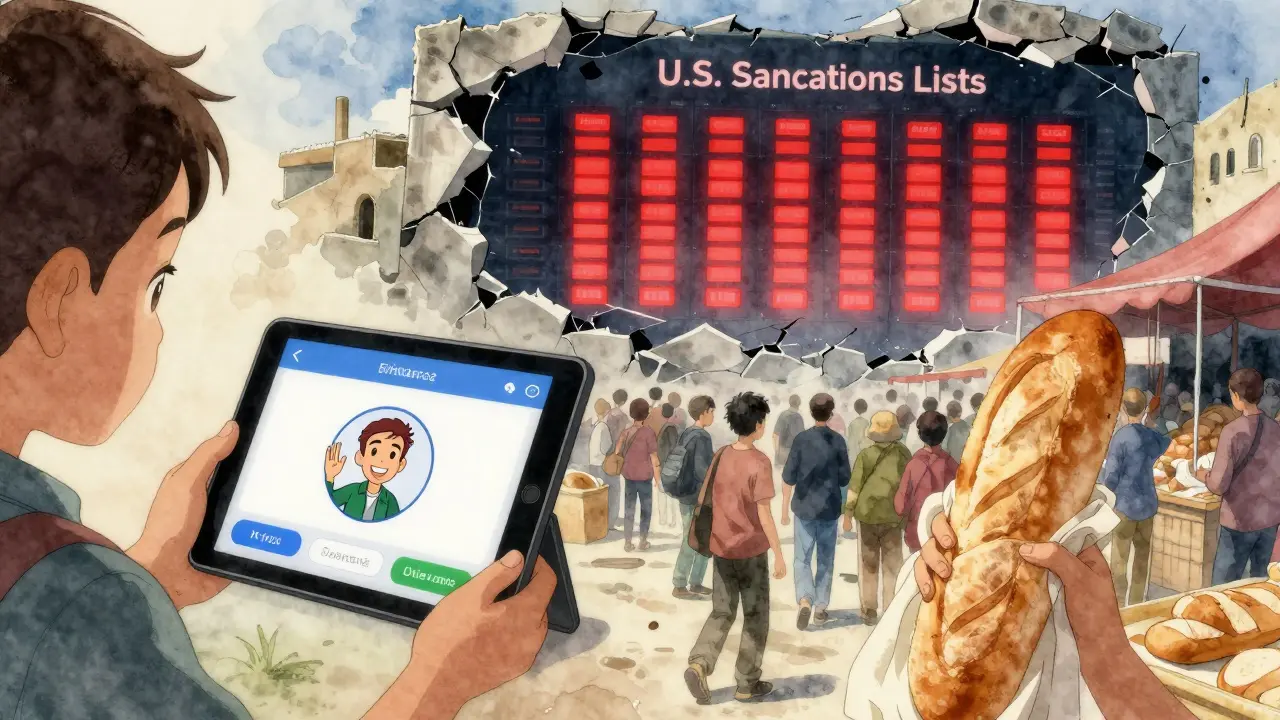
The Bigger Picture: Reconstruction or Risk?
The U.S. government says sanctions relief is about helping Syria rebuild. The Treasury’s press release mentions “the rebuilding of the country’s social fabric.” But crypto is caught in the middle. It’s not just a financial tool-it’s a lifeline for families, small businesses, and refugees. Chainalysis estimates 1.2 million Syrians-about 6% of the population-have used crypto since July 2025. Most use it for remittances or buying food and medicine from abroad. Without crypto, many would be cut off. But without clear rules, no major exchange will fully enter the market. Binance is the only one offering limited access. Kraken, Coinbase, and others are waiting. They won’t move until Syria creates a legal framework. And Syria won’t create one until it’s sure the U.S. won’t change its mind again. The Department of State’s 180-day waiver under the Caesar Act adds more uncertainty. It’s temporary. If political conditions shift, sanctions could snap back. That makes long-term investment in crypto infrastructure impossible.What Needs to Happen Next
For crypto to truly work in Syria, three things are needed:- A clear domestic crypto law-even a basic one that says “crypto is legal, but you must report large transactions.”
- Direct links to international banking-Syrian banks need to be fully integrated into SWIFT and global payment rails.
- Transparency from the U.S.-a public list of who’s still sanctioned, updated daily, with an API for exchanges to auto-check.
It’s not a ban anymore. It’s a bottleneck. And until someone clears it, crypto in Syria will stay stuck.
Is cryptocurrency illegal in Syria?
No, cryptocurrency is not illegal in Syria. There are no laws banning it. But there are also no laws legalizing or regulating it. This legal gray area makes it risky for users and nearly impossible for exchanges to operate safely.
Can Syrians use Binance now?
Yes, Syrians can sign up and trade on Binance since July 2025. But they face heavy restrictions: mandatory enhanced verification, $500 per-transaction limits, and frequent account freezes. Binance is the only major exchange offering limited access.
Why are U.S. banks still refusing to work with Syrian institutions?
Even though sanctions are lifted, U.S. banks must screen every transaction against 13 separate sanctions lists, including those for terrorism and weapons proliferation. The risk of fines is too high, so most banks avoid Syrian accounts unless they have full compliance systems in place-which few do.
Can Syrians mine Bitcoin in Syria?
Technically, no. Mining equipment like ASICs and high-end GPUs are still controlled under U.S. export rules. You can’t legally import them without a special license, and those licenses aren’t being issued for Syria. Mining is possible only with smuggled or locally sourced hardware, which is rare and inefficient.
Is there a chance Syria will create crypto regulations soon?
It’s unlikely without external pressure. Syria’s government is focused on basic reconstruction-power, water, food. Crypto regulation is low priority. International exchanges won’t enter until regulations exist, creating a deadlock. The U.S. has said sanctions relief depends on Syria’s progress, but hasn’t tied crypto rules to that progress.
How many Syrians are using crypto?
Chainalysis estimates about 1.2 million Syrians-roughly 6% of the population-have used cryptocurrency since July 2025. Most use it for remittances and buying goods from abroad. Exact numbers are hard to track because Syria lacks reliable data collection systems.
What’s the biggest risk for Syrians using crypto?
The biggest risk isn’t the technology-it’s the lack of legal protection. If your account is frozen, you have no recourse. If you send crypto to the wrong person, you can’t get it back. And if sanctions return, your assets could be seized. There’s no consumer protection, no insurance, no government backup.




Comments
alvin mislang
January 2, 2026 AT 02:56 AMThis is why I hate when people think sanctions are just turned off like a light switch 😤. You think lifting a ban means everything’s fine? Nah. It’s like removing the lock on your front door but leaving the alarm system on 24/7. Syrians are stuck in digital purgatory. And yeah, Binance’s $500 limit? That’s not help-that’s mockery. 🤦♂️
Michelle Slayden
January 2, 2026 AT 12:30 PMIt is imperative to recognize that the structural impediments to financial inclusion in post-sanction Syria are not merely logistical, but epistemological: the absence of regulatory clarity renders even technically permissible activity legally perilous. The U.S. government has removed the overt prohibition, yet has failed to establish the necessary epistemic infrastructure-transparency, standardization, and institutional trust-that would enable private actors to operate without fear of retroactive liability. Without such a framework, crypto remains an act of civil disobedience, not financial innovation.
Haritha Kusal
January 2, 2026 AT 14:21 PMsooo… syria peeps are still stuck using shady p2p links just to buy food?? 😔 i mean… at least they’re trying? but man, this is so messed up. why cant someone just make a simple app that works? 🤔
Mike Reynolds
January 4, 2026 AT 08:18 AMI’ve talked to a few Syrians on Reddit who use crypto, and honestly, it’s heartbreaking. They’re not trying to be hackers or rebels-they just want to get money from family overseas without waiting weeks or getting scammed. The fact that a bank statement from a Syrian bank is even a requirement? That’s like asking someone to prove they’re not a criminal just to receive a gift. It’s not security. It’s humiliation.
dayna prest
January 5, 2026 AT 22:15 PMOh, so now the U.S. is the benevolent landlord who lets you live in the apartment but won’t fix the plumbing, lock the doors, or let you have a mailbox? Brilliant strategy. 🙃 ‘We lifted sanctions!’ they cry. Meanwhile, Syrians are trading Bitcoin like it’s contraband in a Cold War spy novel. If this isn’t performative compassion, I don’t know what is.
Brooklyn Servin
January 7, 2026 AT 10:21 AMLet me break this down like I’m talking to my cousin who still thinks ‘crypto’ is just a meme: The U.S. didn’t lift sanctions-they just stopped calling them ‘sanctions.’ The same people who blocked your bank account before are still the ones running the backend checks. Binance isn’t helping-they’re just doing the bare minimum to avoid lawsuits. And mining rigs? Still banned? That’s like saying you can use the internet but can’t buy a computer. 🤯 This isn’t a loophole-it’s a trapdoor. And no, ‘workarounds’ aren’t solutions. They’re survival tactics with a 22% failure rate. Someone needs to fund a Syrian-run crypto wallet with zero KYC. Like, NOW.
Phil McGinnis
January 8, 2026 AT 16:11 PMIt is a profound irony that the United States, the global leader in technological innovation, now finds itself the architect of a digital iron curtain in the Levant. The notion that liberty can be extended through financial deregulation without concurrent institutional capacity is not merely naive-it is imperialist. The Syrian people are not asking for handouts; they are asking for dignity. Yet we have replaced the blunt instrument of sanctions with the surgical precision of bureaucratic suffocation. One wonders: Is this policy designed to help Syria-or to ensure it remains perpetually dependent on American goodwill?
Ian Koerich Maciel
January 9, 2026 AT 05:36 AM...I just... I can't believe this is still happening. I mean, I knew sanctions were messy, but this? This is like leaving a door open but putting a 12-foot fence right outside it. And the fact that people are sending their dad's birth certificate to a crypto exchange? 😔 I'm not even mad-I'm just... sad. And honestly? I hope someone builds a decentralized wallet that doesn't need any of this. It's not fair.
Andy Reynolds
January 10, 2026 AT 14:57 PMLook, I get that compliance is a nightmare, but we’re talking about people here-real families trying to get medicine, pay for school, or just send a few bucks to their cousins. If we’re serious about ‘rebuilding Syria’s social fabric,’ then we need to stop treating crypto like a security threat and start treating it like a lifeline. Maybe someone should create a nonprofit that funds local crypto kiosks in refugee camps or something? Like, real, simple, offline terminals where people can swap cash for crypto without jumping through 17 hoops. We’ve got the tech. We just need the will.
Alex Strachan
January 11, 2026 AT 19:51 PMSo… we lifted sanctions, but now Syrians have to submit a video holding today’s newspaper to buy Bitcoin? 😂 I mean, congrats, Binance-you turned financial inclusion into a TikTok challenge. Next up: ‘Prove you’re not a terrorist by doing the Macarena in front of your ID.’ 🤪
Rick Hengehold
January 13, 2026 AT 00:22 AMClear rules. No more guesswork. That’s all they need. Stop overcomplicating it.
Ryan Husain
January 13, 2026 AT 09:31 AMThis isn’t just about crypto. It’s about whether the international community believes in Syria’s right to economic dignity-or whether we’re content to keep it in a state of managed decay. The fact that 1.2 million people are using crypto despite the risks says more about their resilience than any policy paper ever could. We don’t need more reports. We need a task force-led by Syrians, backed by the U.S., and funded by tech giants-to build a legal and technical bridge. Not in five years. Now.