
It’s May 2026, and if you’re looking for a bustling marketplace to trade tokens on the Telos blockchain, you might have stumbled upon ApeSwap. On paper, it looks like a solid option. It’s an established brand with a friendly interface. But here is the hard truth: ApeSwap on Telos is currently a ghost town. The 24-hour trading volume sits at $0.00. That isn’t a typo. It means there is no one else trading there right now.
This review cuts through the marketing hype to tell you what actually happens when you connect your wallet to this specific version of the platform. We’ll look at the fee structure, the yield farming mechanics, and why, despite its technical capabilities, it remains largely inactive compared to other networks.
The Reality of Trading on ApeSwap (Telos)
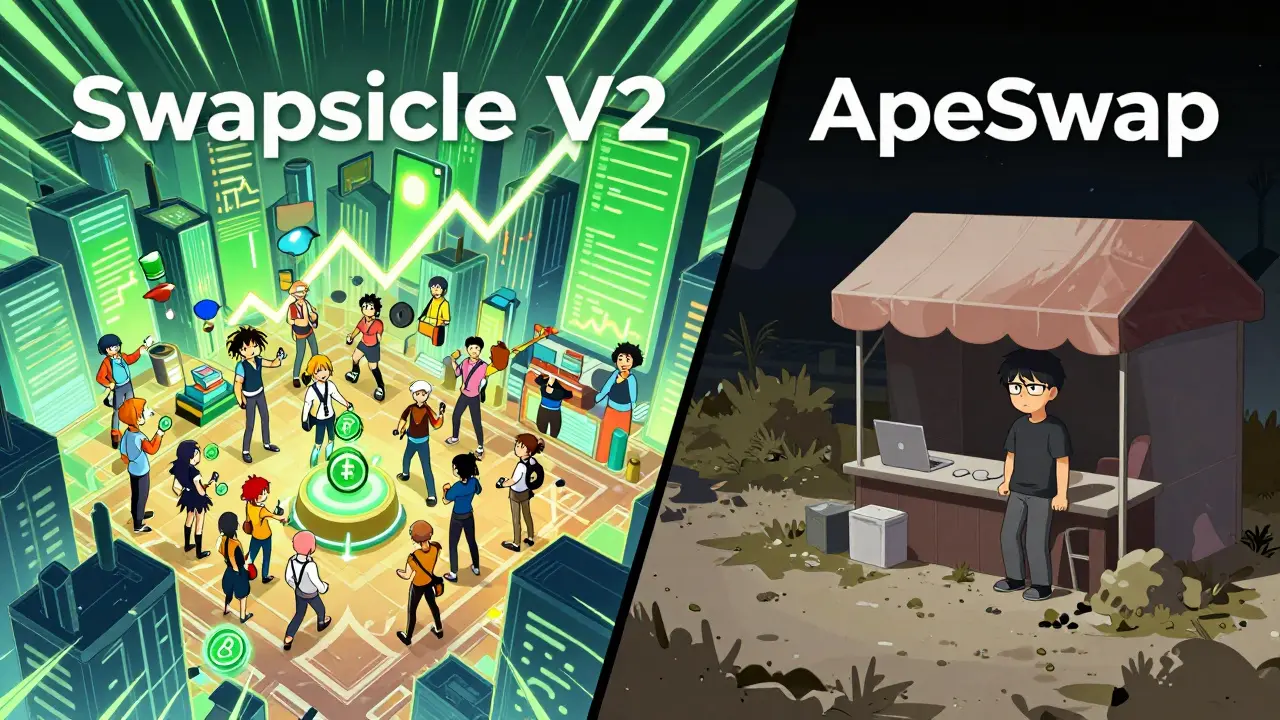
When you visit most major decentralized exchanges, you see constant updates, green price charts, and active order books. On ApeSwap’s Telos instance, you see silence. According to data from CoinGecko in 2025 and continuing into 2026, ApeSwap ranks 7th among DEXs on Telos, but it trails far behind leaders like Swapsicle V2, which captures over 64% of the market share.
Why does this matter to you? Liquidity is everything in DeFi. Without liquidity, you face two problems:
- High Slippage: If you try to swap a decent amount of TLOS for USDT, your trade might not execute at the expected price because there aren’t enough tokens in the pool.
- No Impermanent Loss Protection: Yield farming rewards are generated from trading fees. If no one trades, no fees are generated. If no fees are generated, your staked LP tokens earn nothing.
The total daily trading volume for the entire Telos DEX ecosystem is roughly $742. To put that in perspective, that’s less than the lunch budget for a small startup. In this environment, ApeSwap’s slice of the pie is effectively zero.
How the Fee Structure Works
Even though volume is low, the protocol still charges fees. Understanding these costs is crucial if you decide to provide liquidity or make large swaps. ApeSwap on Telos uses a standard Automated Market Maker (AMM) model with a 0.2% transaction fee. Here is exactly where that money goes:
| Recipient | Percentage | Purpose |
|---|---|---|
| Liquidity Providers | 0.05% | Rewards for those supplying assets to pools | Buybacks & Burns | 0.075% | Reduces BANANA supply to increase scarcity |
| ApeSwap Treasury | 0.0375% | Funds future development and operations |
| Telos Network | 0.0375% | Supports the underlying blockchain infrastructure |
This split was part of a strategic partnership announced in October 2022. At that time, both parties hoped to drive significant adoption. The agreement included a 12-month revenue-sharing arrangement where Telos received half of the post-buyback DEX revenue. That initial promotional period has long since ended. Now, the fees operate as a standard mechanism without extra incentives for users to choose Telos over other chains.
Yield Farming and Staking Opportunities
If trading is dead, what about earning? ApeSwap offers two main ways to try and generate income on Telos: Farms and Treasury Bills.
Telos Farms
You can stake Liquidity Provider (LP) tokens in the Farms section to earn rewards. Typically, these rewards come in the form of BANANA tokens or TLOS tokens. However, remember the source of these rewards. They are funded by the trading fees mentioned above. With $0.00 in volume, the Annual Percentage Rate (APR) for these farms is likely negligible or non-existent unless the protocol is subsidizing them from its treasury-a practice that is rarely sustainable long-term.
Treasury Bills
This feature allows users to vest TLOS at a discount by selling their LP positions. It’s a clever tool for reducing sell pressure on the token. But again, it requires active participation. If you don’t have LP tokens because you didn’t provide liquidity, or if you provided liquidity but earned no fees, this feature offers little value.
Comparing ApeSwap (Telos) to Other Options
You shouldn’t view ApeSwap on Telos in isolation. You need to compare it to alternatives available on the same network or similar networks.
| Platform | Market Share | Liquidity Depth | Best For |
|---|---|---|---|
| Swapsicle V2 | ~64.6% | High (Relative to Telos) | Active traders seeking lower slippage |
| ApeSwap | <1% | Very Low | BANANA holders wanting multi-chain exposure |
| Other Telos DEXs | Remaining ~35% | Moderate | Niche strategies |
If you are already deep into the ApeSwap ecosystem on Binance Smart Chain (BSC) or Polygon, using the Telos version might feel familiar. The interface is identical. The branding is consistent. But familiarity doesn’t pay bills. Swapsicle V2 has built a stronger community and deeper liquidity on Telos specifically. For pure trading efficiency, Swapsicle is the logical choice.
User Experience and Interface
Let’s give credit where it’s due. The user experience on ApeSwap is genuinely good. Reviews from 2025 praised the platform for being beginner-friendly. Even if you’ve never used a decentralized exchange before, the buttons are clear, the connection process with Web3 wallets is smooth, and the dashboard provides all the necessary information.
However, a pretty interface cannot hide empty pools. Users who tried ApeSwap on BSC reported "amazingly fast transactions" and "low gas fees." Those benefits apply to Telos as well-Telos is known for speed and low costs-but they are irrelevant if there is no one to trade with. The lack of user reviews on platforms like DappBay for the Telos version confirms this disinterest. There are simply too few active users to generate feedback.
Security and Governance
One area where ApeScore shines is security. The protocol has been audited by Paladin, a reputable security firm. This reduces the risk of smart contract exploits. Additionally, the platform is governed by the ApeSwap DAO, meaning decisions about fee structures, new pools, and partnerships are voted on by BANANA token holders.
On Telos, however, governance participation is likely minimal. Most DAO votes are driven by whales on BSC or Ethereum. Your vote on the Telos-specific parameters may carry little weight unless you hold a massive amount of cross-chain BANANA.
Should You Use ApeSwap on Telos?
Here is my honest recommendation based on current data:
Do NOT use it if:
- You want to trade large amounts of TLOS, ETH, or BTC. The slippage will eat your profits.
- You are looking for high-yield farming opportunities. The APRs are likely near zero due to lack of volume.
- You are new to DeFi and want a safe, liquid environment to learn. Go to a more active chain like BSC or Arbitrum instead.
Consider using it if:
- You already hold BANANA tokens and want to spread your liquidity across multiple chains for diversification.
- You are testing small transactions to understand how Telos works without worrying about complex interfaces.
- You believe in a long-term bet that Telos will explode in popularity and want to be early on a major DEX brand.
Final Thoughts on Multi-Chain Strategies
ApeSwap’s expansion to Telos in 2022 was a smart move at the time. The industry was obsessed with multi-chain presence. Protocols wanted to be everywhere. But three years later, the dust has settled. Users prefer concentrated liquidity. They go where the volume is. Right now, that isn’t Telos, and it certainly isn’t ApeSwap on Telos.
The platform remains functional, secure, and easy to use. It just lacks the most important ingredient: people. Until Telos attracts a larger DeFi ecosystem, ApeSwap will remain a quiet corner of the internet. Keep an eye on the volume metrics. If you see that $0.00 number start to climb, then it might be worth revisiting. Until then, treat it as a backup option, not a primary trading venue.
Is ApeSwap on Telos safe to use?
Yes, the smart contracts have been audited by Paladin, making the code itself secure. However, safety also depends on liquidity. Low liquidity can lead to unexpected price impacts during trades, which is a financial risk rather than a security hack.
Why is the trading volume on ApeSwap Telos so low?
The overall Telos blockchain has a very small share of the global DeFi market. Most users prefer networks with higher activity like Ethereum, BSC, or Solana. Within Telos, competitors like Swapsicle V2 have captured the majority of the limited available volume.
Can I bridge BANANA tokens from BSC to Telos?
Yes, ApeSwap supports multi-chain bridging. You can transfer BANANA tokens from Binance Smart Chain to Telos to participate in the local ecosystem, though the utility for doing so is currently limited due to low activity.
What are the fees for swapping tokens on ApeSwap Telos?
The standard swap fee is 0.2%. This is split between liquidity providers (0.05%), buybacks/burns (0.075%), the ApeSwap Treasury (0.0375%), and the Telos network (0.0375%).
Is it better to use Swapsicle V2 or ApeSwap on Telos?
For most traders, Swapsicle V2 is the better choice. It holds over 64% of the market share on Telos, meaning deeper liquidity, lower slippage, and potentially better yields for liquidity providers.