
Imagine trying to unlock your bank account by memorizing a 24-word phrase that you can never write down. If you forget it, or if someone steals it, your money is gone forever. This is the harsh reality of traditional blockchain wallets. For years, this friction has kept mainstream users away from crypto. But there is a solution changing the game: Account Abstraction.
Account Abstraction (AA) is not just a technical upgrade; it is a fundamental shift in how we interact with decentralized networks. It transforms rigid, key-based accounts into flexible, programmable smart contracts. By separating the user experience from the underlying cryptography, AA makes wallets smarter, safer, and significantly easier to use. In this guide, we will break down exactly why this technology matters for your security, your wallet balance, and your daily interactions with apps.
From EOAs to Smart Contract Wallets
To understand the benefits, you first need to know what we are moving away from. Traditional wallets like MetaMask rely on Externally Owned Accounts (EOAs). An EOA is controlled solely by a private key. It is simple but unforgiving. There is no "forgot password" link. There is no two-factor authentication built-in. If you lose the key, you lose access permanently.
Account Abstraction changes this by turning your wallet into a Smart Contract Wallet. Instead of a static key, your wallet is a piece of code that defines the rules for spending your funds. You decide those rules. Do you want biometric login? Social recovery? Multi-signature approvals? The contract handles it all. This was formalized in EIP-2938 in 2020 and later implemented via ERC-4337, which allows these features without needing to change the core Ethereum protocol immediately.
Security Without the Seed Phrase Stress
The biggest benefit of Account Abstraction is security. According to Ledger Academy, approximately $3.8 billion in cryptocurrency was lost between 2017 and 2022 due to lost or compromised private keys. That is money vanished because of human error or theft.
With AA, you eliminate the single point of failure. Here is how:
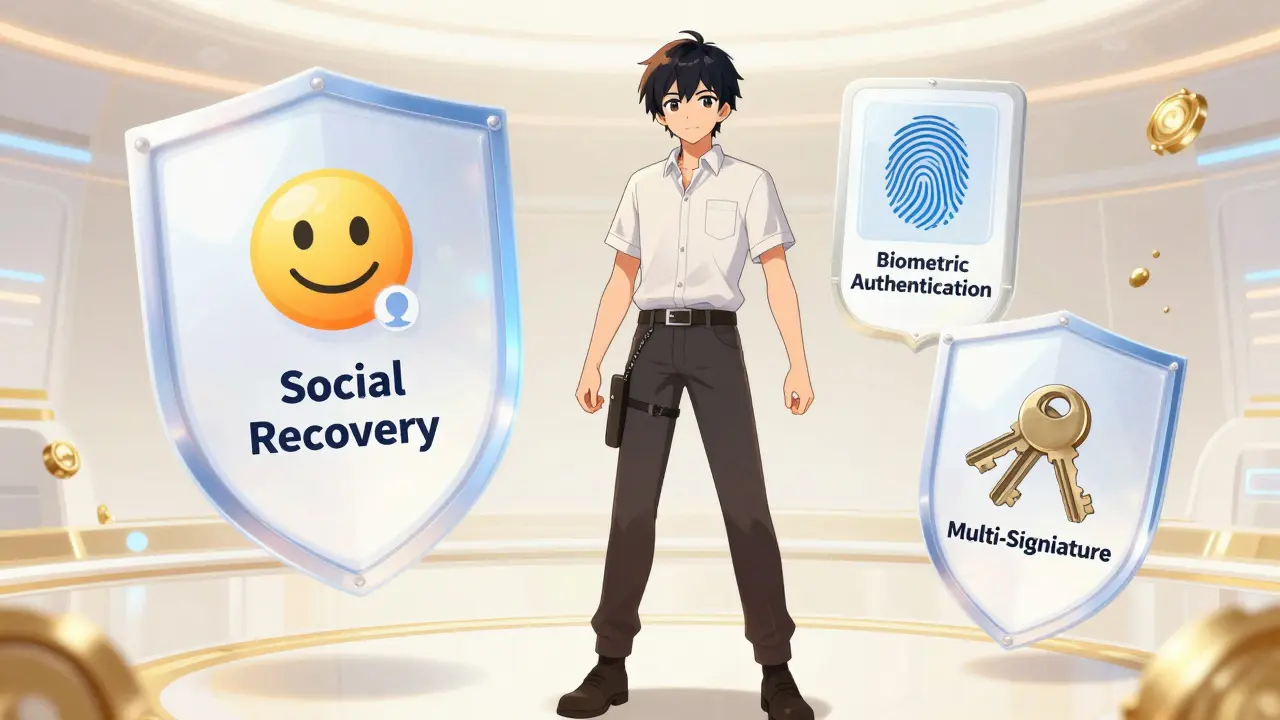
- Social Recovery: Instead of one secret phrase, you appoint trusted contacts (guardians). If you lose your phone, they can help you regain access. Argent Wallet reports a 98.7% success rate in recovering accounts using this method.
- Multi-Signature Support: You can require multiple signatures for large transactions. For example, setting up a rule where any transfer over $1,000 needs approval from two other devices or people.
- Biometric Authentication: Modern AA wallets integrate with your device’s secure enclave, allowing you to sign transactions with FaceID or fingerprints, removing the need to copy-paste hex strings.
This doesn't mean your funds are held by a company. You still own them. You just have a safety net that traditional EOAs simply cannot provide.
Gone Are the Days of Paying Gas in ETH
One of the most frustrating parts of using DeFi is gas fees. You always need the native token (like ETH on Ethereum) to pay for transactions. If you hold USDC but no ETH, you are stuck until you bridge or buy more ETH.
Account Abstraction solves this through Gas Abstraction. Your smart contract wallet can be programmed to pay transaction fees in any ERC-20 token, such as USDC or DAI. Even better, applications can pay your fees for you.
This is called Gas Sponsorship. Imagine logging into a gaming dApp. Instead of signing five different transactions and paying gas each time, the game pays the gas fee as part of its marketing budget. Gelato Network reported processing over 1.2 million sponsored transactions monthly in late 2023. For the user, the experience feels like Web2: click, play, done. No crypto math required.
Session Keys and Frictionless UX
Have you ever played a blockchain game only to get annoyed by constant signature requests? Every move requires a wallet confirmation. It breaks immersion and slows you down.
AA introduces Session Keys. You grant a temporary permission to an app for a specific period or scope. For instance, you might authorize a trading bot to execute trades under $50 for the next 24 hours. During that window, the bot acts on your behalf without asking for your signature every second. Once the session expires, the permissions vanish automatically.
This feature is crucial for mass adoption. It reduces the cognitive load on users. A Reddit user noted that session keys reduced their signing frequency from 15 times per gaming session to just once, saving significant time and frustration.
Cross-Chain Simplicity
In the current fragmented landscape, you often need separate wallets for Ethereum, Polygon, Arbitrum, and Starknet. Managing assets across chains is a logistical nightmare.
With Account Abstraction, a single smart account can manage assets across multiple blockchains. The contract logic handles the complexity of bridging and interacting with different chain environments behind the scenes. Conduit reported that cross-chain transactions using AA are 47% faster than traditional bridging methods because the transfers are programmed automatically within the wallet's logic.
| Feature | Traditional EOA (e.g., MetaMask) | Account Abstraction (e.g., Argent, Safe) |
|---|---|---|
| Recovery | None (Permanent loss if key lost) | Social Recovery / Guardians |
| Gas Payment | Native Token Only (ETH, MATIC) | Any Token or Sponsored by App |
| Login Method | Private Key / Seed Phrase | Biometrics, Email, Social Sign-In |
| Transaction Batching | No (Each action is separate) | Yes (Multiple actions in one tx) |
| Setup Time | ~5 minutes | ~25-45 minutes (Initial deployment) |

The Trade-Offs: Complexity and Cost
It is important to be realistic. Account Abstraction is not perfect yet. Because AA wallets are smart contracts, they require more computational power to deploy initially. Ledger Academy notes that AA wallets typically incur 15-20% higher gas costs for the initial setup compared to standard EOAs. However, subsequent transactions are often cheaper or comparable, especially when factoring in gas sponsorship.
There is also a learning curve. Setting up guardians and configuring multi-sig rules takes longer than generating a seed phrase. Consensys’ Q2 2023 report found that initial setup for AA wallets takes 25-45 minutes, compared to 5-10 minutes for standard wallets. Furthermore, developers face integration challenges. Implementing ERC-4337 requires 2-3 weeks of development time and rigorous auditing, as OpenZeppelin found that 27% of early AA implementations had critical vulnerabilities.
Despite these hurdles, the trajectory is clear. As Starknet’s blog post highlighted, AA makes non-custodial wallets capable of scaling to millions of mainstream users by combining Web2 simplicity with Web3 security.
Adoption Landscape in 2026
We are seeing rapid adoption. In Q2 2023, AA wallets represented only 0.3% of Ethereum activity. By mid-2023, that jumped to 8.2%, a 2,633% year-over-year growth. Major players are betting big on this technology:
- Ethereum: The Cancun-Deneb upgrade included enhancements like EIP-3074, paving the way for native AA support.
- Starknet: Launched full native AA support with StarkEx 5.0, processing millions of transactions.
- Polygon: Integrated AA features into Polygon ID for seamless identity management.
Messari projects that by Q4 2025, AA wallets will represent 35-40% of all Ethereum wallet activity. The shift is happening because users demand better experiences. They want security without sacrificing convenience.
How to Get Started
If you want to try Account Abstraction, you don't need to be a developer. Several user-friendly wallets already support it:
- Argent: One of the pioneers, offering social recovery and intuitive UI.
- Ambire Wallet: Known for strong biometric integration and session key support.
- Safe (formerly Gnosis Safe): Ideal for teams or individuals wanting enterprise-grade multi-sig control.
When choosing a wallet, look for transparency in their security audits and clarity in their recovery process. Ensure you understand who your guardians are and how they can help you. Remember, while AA adds safety, it relies on the trustworthiness of your chosen guardians.
Is Account Abstraction safe?
Yes, generally safer than traditional wallets. While it introduces smart contract complexity, features like multi-signature and social recovery reduce the risk of permanent fund loss due to lost keys. However, you must choose reputable, audited wallet providers.
Do I need ETH to use an AA wallet?
Not necessarily. Many AA wallets support gas sponsorship, meaning the app pays your fees. Others allow you to pay gas in stablecoins like USDC or DAI, so you don't need to hold the native chain token.
What happens if my guardians refuse to help me recover my account?
This is a social risk. You should choose guardians you trust implicitly, such as family members or close friends. Some wallets allow you to set up backup guardians or time-locked mechanisms to prevent malicious lockouts.
Are AA wallets compatible with all dApps?
Most major dApps are adapting, but some older protocols may not fully support AA standards yet. Compatibility is improving rapidly as ERC-4337 becomes the industry norm.
Why does setting up an AA wallet take longer than MetaMask?
Because an AA wallet deploys a unique smart contract on the blockchain for you. This requires more data verification and configuration of security settings like guardians and multi-sig rules, whereas an EOA is just a generated key pair.