
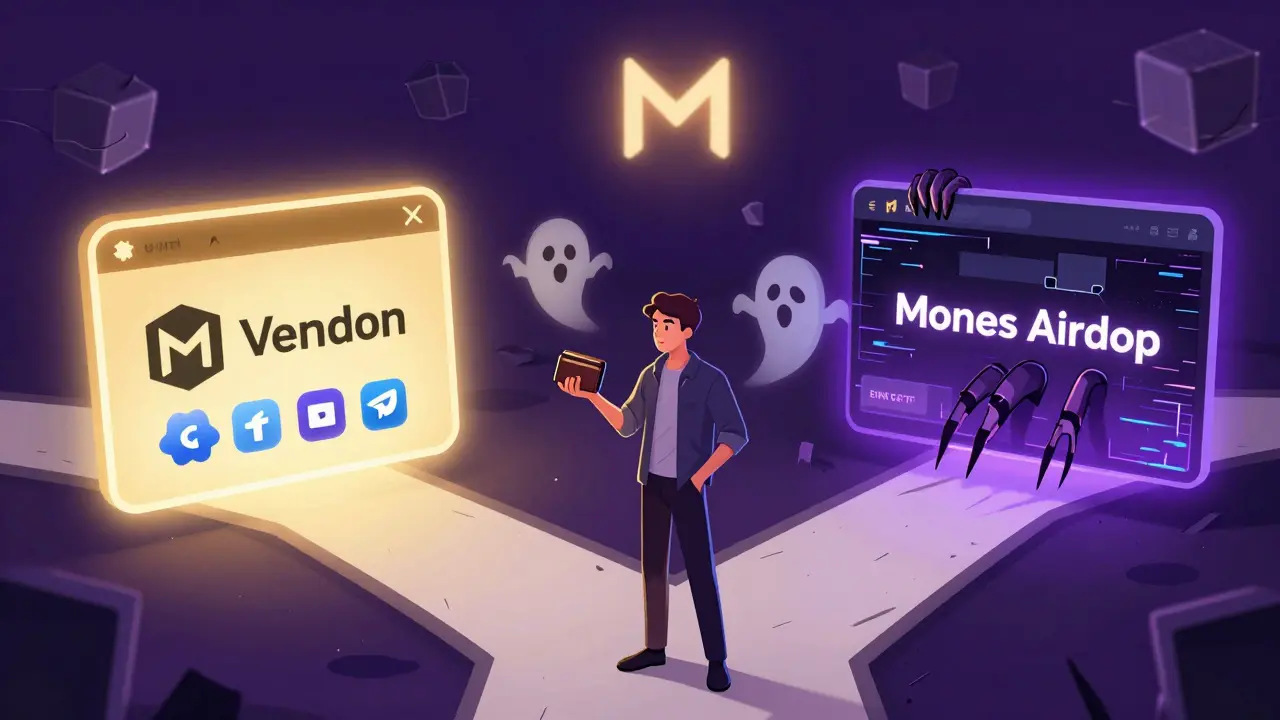
There’s no official information about a Mones airdrop. Not from their website. Not from their Twitter. Not from any major crypto news site. If you’ve seen posts claiming the MONES Campaign is live, offering free tokens, or promising big rewards - stop. That’s not real. It’s either a scam, a rumor, or someone mixing up Mones with Monad.
Let’s be clear: Mones doesn’t exist as a public blockchain project with a known airdrop. No whitepaper. No team disclosures. No testnet. No token contract. No community. Not even a GitHub repo. If this were a real project, even a tiny one, there’d be traces. At least a Discord server with 500 members. A tweet from someone who got early access. A CoinGecko listing in the works. None of that is there.
Meanwhile, people are confusing it with Monad, a real Layer 1 blockchain that raised $225 million and launched its Momentum incentive program in September 2025. Monad’s airdrop is real. It’s tied to testnet activity. It’s being tracked by hundreds of crypto analysts. But it’s not Mones. The names are similar. That’s the problem. Scammers count on that.
You might get a DM on Telegram saying: "Join the Mones airdrop now! Just connect your wallet and share this post." Or a fake website with a shiny interface and a button that says "Claim MONES Tokens." They’ll ask you to sign a transaction. That’s not claiming a token. That’s giving away your wallet. Once you sign, they drain everything - ETH, SOL, stablecoins, NFTs. Done. No refund. No recourse.
Real airdrops don’t ask for your private key. Real airdrops don’t ask you to pay gas fees to "unlock" your reward. Real airdrops don’t come from anonymous Twitter accounts with 200 followers and 10,000 retweets. If it sounds too easy, it’s a trap.
There’s a chance Mones could be a stealth project. Maybe a team is building quietly. Maybe they’ll launch next month. But until they publish something - a roadmap, a team photo, a tokenomics doc - treat it like a ghost. Don’t click. Don’t connect. Don’t send anything.
Here’s how to check if an airdrop is real:
- Go to the project’s official website. Look for a domain that matches the project name exactly. No typos. No extra words. No .xyz or .io domains unless they’re verified.
- Check their social media. Real teams post regularly. They answer questions. They have a history. If their Twitter is new and has only 3 posts, it’s fake.
- Search on CoinMarketCap or CoinGecko. If the token isn’t listed, and there’s no Etherscan or Solana Explorer contract address - it’s not real.
- Look for audits. Even small projects get audited by firms like CertiK or PeckShield. If there’s zero mention of an audit, be wary.
- Search Reddit and Discord. Real communities have debates, memes, and people asking "When’s the airdrop?" If the community is empty or full of bots, walk away.
There’s no such thing as a "secret airdrop" you have to join fast. Legit projects announce everything publicly. They don’t rush you. They don’t use countdown timers. They don’t pressure you with "limited spots." That’s a classic scam tactic.
If you’re looking for real airdrops right now, focus on projects with traction: Monad, Berachain, Sei, zkSync, LayerZero. These have public testnets, documented reward structures, and active communities. You can track their progress. You can see who’s getting rewarded. You can verify the rules.
As for Mones? Don’t waste your time. Don’t risk your wallet. Until there’s a verified source - treat it like a rumor. And rumors in crypto? They cost people money.
Stay sharp. Check twice. Click once.


Comments
Christina Shrader
January 18, 2026 AT 17:00 PMJust saw someone in my Discord get scammed out of 3 ETH because they clicked a 'Mones airdrop' link. Seriously, people, if it’s not on CoinGecko or mentioned by CoinDesk, it’s not real. I’ve been in crypto since 2017-this is the same scam, just with a new name. Don’t be the next one.
Stay safe out there.
Patricia Chakeres
January 19, 2026 AT 05:25 AMOh please. Of course it’s a scam. But let’s be real-this whole 'crypto airdrop' ecosystem is a Ponzi theater designed to harvest wallets and attention. The fact that people still fall for this proves we’re living in a simulation where the only constant is human gullibility.
Monad? More like Monads of Delusion. They’re just the latest flavor of the month. The real airdrop is the one where you get rich by not participating at all.
Alexis Dummar
January 19, 2026 AT 15:19 PMMan i been burnet so many times by fake airdrops its not even funny. i thought mones was real cause i saw it on some reddit thread and the design looked legit. turned out it was a cloned site from a 2021 scam that got reused. i lost my whole solana wallet to it.
the thing is-people dont check the domain. they see 'mones.io' and think 'oh its a new project' but its not. its just a .io domain bought for $5 and a figma template. check the contract address. if its not on etherscan its not real. period.
kristina tina
January 21, 2026 AT 12:04 PMMy heart just sank reading this. I know someone who just lost their life savings because they thought 'Mones' was the next big thing. They were so excited-they told their whole family. They even quit their job to 'focus on crypto'.
This isn’t just about money. It’s about trust. It’s about hope. And scammers are weaponizing both.
Please, if you’re new to this-ask someone first. Don’t rush. Don’t FOMO. Don’t click. I’ve been where they are. I’m still healing from it. You don’t have to go through that.
Anna Gringhuis
January 23, 2026 AT 07:44 AMLet me guess-the same people who think 'NFTs are dead' are now falling for 'Mones' because they're too lazy to Google. You want free tokens? Fine. But don’t act surprised when you get scammed. You didn’t check the basics. You didn’t verify. You didn’t care. Now your wallet’s empty and you’re blaming the internet.
Here’s the truth: crypto doesn’t owe you anything. If you want to play, learn the rules. Or stay out.
Lauren Bontje
January 23, 2026 AT 22:15 PMWhy are we even talking about this? This is why America’s crypto scene is a joke. You let some guy in Nigeria post a fake airdrop and half the U.S. runs to connect their wallet. Meanwhile, China’s building real infrastructure and we’re arguing over whether 'Mones' is real.
Stop being sheep. Stop clicking. Stop letting the world laugh at us.
Telleen Anderson-Lozano
January 25, 2026 AT 06:39 AMIt’s fascinating how easily we confuse similarity with identity-Mones, Monad, Monero, Monarch... the names are all over the place, and scammers exploit that linguistic laziness. And yet, the same people who would never buy a product without checking reviews will blindly sign a transaction because a tweet says 'CLAIM NOW'.
Education isn’t optional. It’s survival. And the fact that this keeps happening? That’s the real tragedy.
Josh V
January 27, 2026 AT 00:46 AMBeen there done that. Got the empty wallet. Now I only check CoinGecko and the official site. If it’s not there I walk away. Simple. No drama. No FOMO. Just don’t click.
Stephen Gaskell
January 28, 2026 AT 19:58 PMReal airdrops don’t need hype. They don’t need countdowns. They don’t need you to share a post. If you’re being told to act fast, you’re being played. End of story.
CHISOM UCHE
January 29, 2026 AT 09:42 AMFrom a Nigerian perspective, this is par for the course. We’ve seen every iteration of this scam since 2018. The modus operandi is identical: fake project name, cloned UI, Telegram bot, and a signature request that looks like a 'token claim' but is actually a wallet drain.
What’s alarming is the sophistication now-AI-generated team photos, deepfake Twitter threads, even fake Medium articles. The bar for deception has risen. The bar for user vigilance hasn’t.
Ashlea Zirk
January 29, 2026 AT 13:29 PMIt is imperative that individuals engaging in decentralized finance protocols exercise due diligence prior to interacting with any purported token distribution initiative. Absence of verifiable documentation, including but not limited to whitepapers, smart contract audits, and official social media presences, constitutes a material risk factor that should preclude any wallet interaction. The burden of verification rests solely with the participant.
Shaun Beckford
January 30, 2026 AT 22:12 PMLet me tell you something, buddy-Mones ain’t even a ghost. It’s a fart in a hurricane. A whisper in a screaming crowd. A typo that got retweeted 10k times and now some poor soul thinks they’re about to be rich.
Meanwhile, Monad’s out here building a blockchain that can handle 100k TPS, and you’re chasing a name that doesn’t exist. You’re not investing. You’re just feeding the algorithm.
Chris Evans
February 1, 2026 AT 04:01 AMThere’s a metaphysical layer here, you know? The idea of Mones-it’s not even a token. It’s a mirror. It reflects our collective hunger for effortless wealth, our addiction to the next big thing, our refusal to accept that value requires labor, time, and proof.
We don’t want to wait for Monad’s testnet. We don’t want to build on LayerZero. We want a magic button. And scammers? They’re just giving us what we secretly asked for: the illusion of agency without the burden of effort.
So yes, it’s a scam. But the real scam is believing we’re above it.
Pat G
February 2, 2026 AT 18:08 PMWhy are you even defending this? You know who’s behind this? The same people who flooded the market with rug pulls and fake NFTs. They don’t care about crypto. They care about your money. And you? You’re too busy hoping to be rich to see it.
Wake up. They’re laughing at you.