
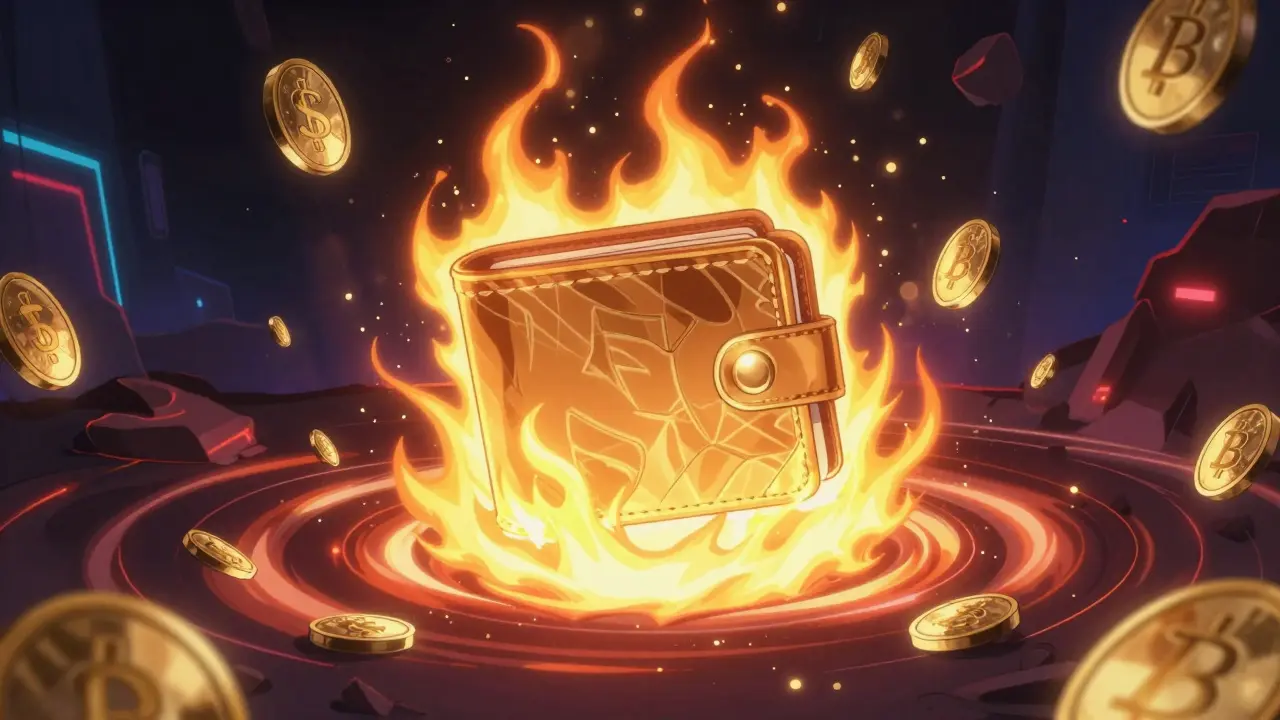
When you hear about a cryptocurrency project burning millions-or even trillions-of tokens, it might sound like a waste. But in crypto, destroying money can actually make it more valuable. That’s the idea behind token burning: permanently removing coins from circulation to create scarcity. It’s not magic. It’s economics. And it’s become one of the most common ways projects try to boost their token’s price without asking users to buy more.
How Token Burning Actually Works
Token burning isn’t about deleting files or wiping databases. It’s about sending tokens to a special wallet address that no one can access. These are called burn addresses. They look like regular crypto addresses-long strings of letters and numbers-but they have no private key. That means no one, not even the project founders, can ever spend or recover those tokens again. Once they’re there, they’re gone forever.The process is simple and transparent. Here’s how it typically happens:
- A project decides how many tokens to burn-maybe 1%, 5%, or even 10% of the total supply.
- The tokens are sent from the project’s wallet to a known burn address.
- The transaction is recorded on the blockchain for everyone to see.
- The project announces the burn, often sharing the transaction hash so anyone can verify it.
For example, Binance has been burning BNB tokens every quarter since 2017. Each time, they use a portion of their profits to buy back BNB from the open market and then send it to a burn address. As of 2023, over 48.5 million BNB tokens-worth roughly $34.2 billion-have been destroyed. That’s not just a marketing stunt. It’s a measurable reduction in supply.
Manual vs. Automatic Burning: Which Is Better?
There are two main ways tokens get burned: manually and automatically.Manual burning is when a team decides when and how much to burn. Binance does this. So does Ripple, which locks up XRP in escrow and occasionally burns portions of it. The advantage? Flexibility. Teams can time burns to coincide with bull markets or big product launches. The downside? Trust. If you’re not sure the team is being honest, you can’t be sure the burn really happened.
Automatic burning uses smart contracts to do the work. Ethereum’s EIP-1559, launched in 2021, burns a portion of every transaction fee. The more people use Ethereum, the more ETH gets destroyed. No human intervention needed. This approach is more trustworthy because the rules are coded into the blockchain and can’t be changed. A 2023 study by Crypto.com found that tokens with automatic burns had 17.3% less price volatility after burns than those with manual burns.
But automatic burns aren’t perfect. They’re harder and more expensive to build. Developers estimate Ethereum-based burn contracts cost between $5,000 and $20,000 to create. And if the code has a bug? You can’t undo it. That’s what happened with Waves in 2020, when an incorrect amount was burned-forcing the community to vote on a fix.
Does Token Burning Actually Raise Prices?
This is the big question. If you remove tokens from circulation, shouldn’t the price go up? The theory makes sense: less supply, same demand = higher price. But real-world results are mixed.A 2022 MIT study analyzed 214 token burns and found something surprising: burns smaller than 0.5% of total supply had almost no effect on price. But burns larger than 2%? Those correlated with an average 8.7% price increase over 30 days.
One of the most famous examples is Shiba Inu. In May 2021, the community burned 410 trillion SHIB tokens-about 4% of the total supply. Within a month, the price jumped 230%. But not all burns work like that. The TerraUSD (UST) collapse in 2022 showed how dangerous it is to rely on burns alone. UST tried to maintain its $1 peg by burning tokens when the price dropped. But without real reserves backing it, the system failed. Burning tokens didn’t fix a broken design-it just made things worse.
So burns don’t guarantee price gains. They only help if the project has real demand. If no one wants to use the token, burning 10% of the supply won’t matter. As Dr. Garrick Hileman from Blockchain.com puts it: "The market impact depends on whether the burn represents a meaningful percentage of total supply."

Who’s Using Token Burning-and Why?
Token burning isn’t just for meme coins. It’s now standard in top-tier projects.- Binance (BNB): Quarterly burns funded by profits. Over $34 billion burned since 2017.
- Ethereum (ETH): EIP-1559 burns transaction fees. Over 4.2 million ETH destroyed as of late 2023.
- Ripple (XRP): Uses escrow locks that function like burns when tokens expire.
- Paxos Gold (PAXG): Burns tokens when users redeem them for physical gold. Maintains a 99.87% peg since 2019.
- VeChainThor (VET): Uses conditional burns-only triggers when trading volume hits certain levels.
As of October 2023, 78% of the top 100 cryptocurrencies by market cap use some form of burning. That’s up from just 42% in 2020. Even enterprises are catching on. Deloitte’s 2023 survey found 63% of enterprise blockchain projects include burn mechanisms-though mostly for internal tokenomics, not public trading.
What Users Think About Token Burning
On Reddit’s r/CryptoCurrency, a November 2022 thread asked users if burns were meaningful. Of 1,200 respondents:- 62% believed burns helped long-term value.
- 28% thought they were just marketing.
- 10% were unsure.
Trust is key. Users who praise burns often mention transparency-like Binance publishing every burn transaction hash. Those who complain say burns are too infrequent or too small. One common complaint: "They burn 0.1% every quarter. That’s not a burn, that’s a snack."
On Trustpilot, exchanges offering burn features average 4.1/5 stars. But negative reviews often say: "I waited six months for a burn. Nothing happened."

What’s Next for Token Burning?
Token burning is evolving beyond simple supply cuts. New models are emerging:- Dynamic burns: Kadena adjusts burn rates based on market conditions-burn more when prices are high, less when they’re low.
- Conditional burns: VeChainThor only burns tokens if trading volume crosses a threshold. This ties destruction directly to usage.
- Real-world asset backing: PAXG’s burn mechanism is tied to gold redemption. Every token burned means one ounce of gold is delivered. That’s not speculation-it’s a direct link between digital and physical value.
Gartner predicts that by 2025, 95% of new crypto projects will include token burning. But experts warn: "As burns become common, their impact fades unless paired with real utility," says Dr. Aaron Wright of Cardozo Law School. A burn that doesn’t come with adoption, utility, or trust is just noise.
Should You Care About Token Burning?
If you’re holding a cryptocurrency, yes-you should care. But not because burns will magically make your coins worth more. Care because:- It tells you the project is thinking about long-term value, not just hype.
- It shows transparency-if they publish burn hashes, they’re not hiding anything.
- It’s a signal of tokenomics design. A project that burns 2% annually is more serious than one that burns 0.01%.
But don’t buy a coin just because it burns tokens. Look at the bigger picture: Is the project solving a real problem? Are people using it? Is the team credible? Burning tokens is a tool-not a magic wand.
Think of it like a company buying back its own stock. It doesn’t guarantee growth. But if the company is profitable, transparent, and growing, stock buybacks can reward loyal shareholders. The same logic applies in crypto.
What happens to burned tokens? Are they gone forever?
Yes. Once tokens are sent to a burn address-a wallet with no private key-they are permanently inaccessible. No one, not even the creators, can recover them. The tokens still exist on the blockchain as data, but they can never be spent, moved, or used again. They’re effectively destroyed from an economic standpoint.
Can anyone burn tokens, or only the project team?
Technically, anyone can send tokens to a burn address. But meaningful burns-those that affect market supply-are usually done by the project team or through automated smart contracts. Individual users can burn their own tokens, but unless it’s a large, coordinated effort, it won’t impact the overall supply. For example, the Shiba Inu burn in 2021 was community-driven, but it still required coordination among millions of holders.
Do token burns reduce the total supply permanently?
Yes. Unlike staking or locking, which temporarily restrict access, burning permanently reduces the circulating supply. The total supply number on sites like CoinGecko updates to reflect the burn. For example, after Binance’s quarterly burns, the max supply of BNB decreases. This is why burned tokens are considered deflationary.
Are token burns regulated by governments?
As of 2026, no government has banned token burns. The U.S. SEC has warned that burns could be seen as unregistered securities offerings if they’re designed to manipulate prices-but no enforcement actions have been taken. Most regulators treat burns as a technical feature of tokenomics, not a financial product. However, if a project promises price increases based on burns, that could cross into securities territory.
Can token burning cause a token to lose value?
Yes-if the burn is poorly designed or the project lacks utility. Burning tokens without demand creates a false sense of scarcity. The TerraUSD collapse showed this: burning UST tokens couldn’t fix the lack of reserves backing the stablecoin. Also, if a burn is too small (under 0.5% of supply), it has no effect. Worse, if users think a burn is a gimmick, it can damage trust and cause sell-offs.
How can I verify a token burn actually happened?
Look for the transaction hash on the project’s official blog or social media. Then check it on a blockchain explorer like Etherscan or BscScan. Enter the burn address (common ones are known, like 0x0000…dead for Ethereum) and confirm the tokens were sent there. If the project doesn’t provide this, it’s not transparent-and the burn may not be real.




Comments
george haris
January 22, 2026 AT 09:30 AMMan, I always thought burning tokens was just a gimmick until I saw how Binance does it every quarter. It’s not just about supply-it’s about showing you’re serious. Seeing that $34 billion burned? That’s not marketing, that’s commitment. I check the transaction hashes every time. No fluff, just proof.
Mark Estareja
January 23, 2026 AT 13:59 PMToken burning is just a deflationary mechanism embedded in the tokenomics layer to create artificial scarcity in the absence of intrinsic utility. EIP-1559 is the only sane implementation because it’s algorithmic, not discretionary. Manual burns are rug-pull vectors waiting to happen.
David Zinger
January 24, 2026 AT 23:45 PMUSA is the only country that gets crypto right. Canada? We just sit around and watch our neighbors make money. Burn 4% of SHIB? That’s not a burn, that’s a snack. Real burns are like Binance-quarterly, massive, and transparent. Stop pretending your 0.1% burn means anything. 🇺🇸🔥
Sara Delgado Rivero
January 26, 2026 AT 18:18 PMPeople who think burns increase value are just chasing hype. If you don’t have real adoption, burning tokens is like throwing your wallet into a volcano and hoping it comes back as gold. UST proved that. No one cares about supply if no one’s using the coin. You’re just playing with numbers. 🤦♀️
carol johnson
January 26, 2026 AT 22:17 PMOMG I literally cried when I saw the ETH burns after EIP-1559. It’s like… poetry. 💔🔥 The way it just… disappears. No one asked for it, no one begged for it, it just… happens. It’s beautiful. Like a silent sacrifice for the greater good of the blockchain. 🌌✨
Steve Fennell
January 27, 2026 AT 12:33 PMI appreciate how this post breaks down manual vs automatic burns. It’s easy to get caught up in the hype, but the real insight is in the transparency. If a project publishes the hash and you can verify it on Etherscan? That’s trust built on code, not promises. Respect to teams that do it right.
Heather Crane
January 29, 2026 AT 07:21 AMY’all are overthinking this. Burns aren’t magic, but they’re a sign that someone cares about long-term health-not just pumping and dumping. I’ve held BNB since 2019, and every burn felt like a little pat on the back from the team. Keep it up! 💪❤️
Catherine Hays
January 29, 2026 AT 12:53 PMToken burns are a scam for gullible retail. The same people who cheer for burns are the ones who bought SHIB at the peak. If you think burning coins makes you rich you’re not investing-you’re gambling. And you’re gonna lose. Period.
Melissa Contreras López
January 30, 2026 AT 21:04 PMHey, I just want to say-this is one of the clearest explanations I’ve read. I’m new to crypto and I thought burning was just deleting files. Now I get it: it’s like a company buying back shares, but on blockchain. And the fact that PAXG ties burns to actual gold? That’s next level. Keep sharing stuff like this. You’re helping people learn, not just hype.
Mike Stay
January 30, 2026 AT 23:39 PMIt is of considerable interest to observe that the phenomenon of token burning, while superficially resembling a deflationary monetary policy, is in fact a complex interplay between economic theory, cryptographic protocol design, and behavioral market psychology. The efficacy of such mechanisms is not solely contingent upon the magnitude of the burn, but rather upon the structural integrity of the underlying token economy, the credibility of the governing entity, and the presence of genuine network utility. Without these three pillars, even the most substantial burn becomes a mere syntactic artifact within the ledger, devoid of meaningful macroeconomic consequence. The case of Ethereum’s EIP-1559 demonstrates a paradigm shift wherein the burn function is not an isolated variable, but an embedded feedback loop that dynamically responds to network activity, thereby aligning incentives at the protocol level. This is not merely a technical adjustment-it is a philosophical evolution in the architecture of digital scarcity.