

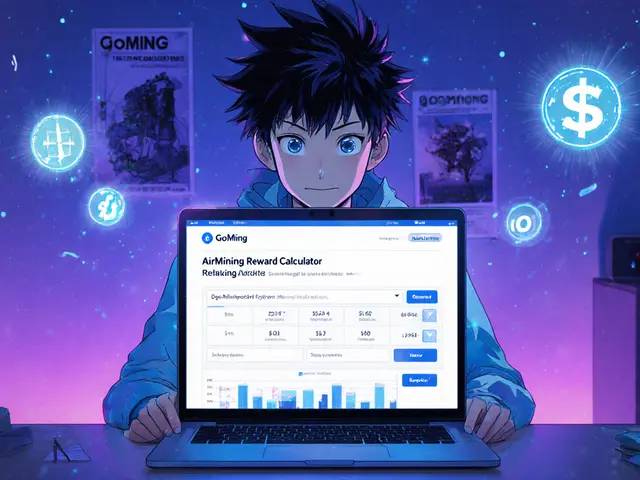
MOVR Staking Calculator
Estimate potential rewards from staking MOVR tokens based on current network conditions. MOVR staking rewards typically range between 8-15% annually.
Your estimated rewards will appear here after calculation.
Moonriver isn’t just another crypto coin. It’s a live testing ground where Ethereum developers build and break apps before they go live on Polkadot. Launched on August 26, 2021, Moonriver (MOVR) runs as a parachain on Kusama - the wild, experimental cousin of Polkadot. Think of it like a beta version of a software app, but instead of testing features on your laptop, you’re testing them on a real blockchain with real money at stake.
How Moonriver Works: Ethereum on Kusama
Moonriver lets you run Ethereum smart contracts - written in Solidity - without changing a single line of code. That’s because it’s fully compatible with the Ethereum Virtual Machine (EVM). If you’ve used MetaMask, deployed a DeFi app on Ethereum, or traded ERC-20 tokens, you already know how to use Moonriver. Your wallet, your tools, your contracts - they all work the same way.
But here’s what makes it different: Moonriver isn’t running on Ethereum’s network. It’s running on Kusama, which means it’s part of a multi-chain system built by Parity Technologies using the Substrate framework. This gives it access to Kusama’s shared security model. Instead of relying on its own miners or validators, Moonriver borrows security from the entire Kusama network. That’s a big deal. It means new projects get strong protection without having to build their own validator set from scratch.
What Is MOVR Used For?
The MOVR token is the lifeblood of the Moonriver network. It does four key things:
- Pays for transactions - Every time you send a token or interact with a smart contract, you pay a small fee in MOVR.
- Executes smart contracts - Running code on-chain costs computational power. MOVR measures and pays for that power.
- Incentivizes collators - These are the nodes that collect transactions and produce blocks. They earn MOVR rewards, which they share with people who stake their tokens.
- Enables governance - MOVR holders vote on upgrades, fee changes, and network improvements. No centralized team decides what happens next.
Unlike Ethereum’s ETH, MOVR isn’t mined. It’s earned through staking. If you hold MOVR, you can delegate it to a collator and earn a share of block rewards. It’s similar to staking on Ethereum 2.0, but with more control over who you trust with your tokens.
Moonriver vs. Moonbeam: The Testnet and Production Pair
Moonriver doesn’t exist in a vacuum. It’s the testnet for Moonbeam - its official counterpart on Polkadot. This is one of the smartest design choices in crypto.
Here’s how it works: A developer builds a DeFi app on Moonriver. They test it under real market conditions - with real price swings, real users, and real transaction fees. If it works, they deploy the same code to Moonbeam on Polkadot, where it runs with higher security and more stable economics. Moonriver is the sandbox. Moonbeam is the playground.
This setup lets the Polkadot ecosystem innovate fast. Kusama moves quicker than Polkadot. Upgrades happen every few weeks. Bugs get caught early. Developers don’t risk millions on Polkadot before proving their app works. Moonriver acts as a safety net.
Who Uses Moonriver?
Moonriver’s main users fall into two groups: developers and stakers.
Developers love Moonriver because it’s frictionless. If you’re an Ethereum dev, you can clone a Uniswap fork, deploy it on Moonriver using Remix IDE, and start testing in under an hour. No need to learn new languages. No need to rewrite logic. The 2022 Reddit case study of @CryptoBuilder89 shows how a team migrated a DEX to Moonriver in 48 hours - with zero code changes.
Stakers are attracted by the yield. MOVR staking rewards hover between 8% and 15% annually, depending on network participation. But it’s not as simple as clicking a button. Choosing the right collator matters. Some are run by reputable teams. Others are solo operators with low uptime. Reddit users warn that bad collators can slash your rewards or disappear. There’s no auto-compounding. You have to manually claim and re-stake. That’s a barrier for beginners.

How Does Moonriver Compare to Other Chains?
Let’s break it down against similar chains:
| Feature | Moonriver | Optimism / Arbitrum | Acala (Polkadot) |
|---|---|---|---|
| Network Type | Kusama parachain | Ethereum Layer 2 | Polkadot parachain |
| EVM Compatibility | Yes, full | Yes, full | Yes, partial |
| Security Model | Shared with Kusama | Relies on Ethereum | Shared with Polkadot |
| Transaction Speed | 15-20 TPS | 40-100+ TPS | 10-15 TPS |
| Best For | Testing before Polkadot | Scaling Ethereum | DeFi on Polkadot |
Moonriver isn’t trying to be the fastest or cheapest. It’s trying to be the most familiar. For Ethereum devs looking to enter the Polkadot world, it’s the easiest on-ramp. Other parachains like Acala or Interlay focus on native Polkadot features. Moonriver doesn’t. It’s all about bringing Ethereum’s ecosystem along for the ride.
Real-World Use Cases
As of December 2023, Moonriver hosts 1,842 active smart contracts. The breakdown looks like this:
- 63% DeFi - Decentralized exchanges, lending protocols, yield aggregators
- 28% NFTs - Art, collectibles, gaming assets
- 9% Infrastructure - Oracles (Chainlink), indexing tools (The Graph), identity services
Notable projects include:
- Moonsama - A popular NFT collection built entirely on Moonriver
- Polkaswap - A decentralized exchange that started here before moving to Moonbeam
- Chainlink’s VRF - Used for random number generation in games and lotteries
Enterprise adoption is still small - only 17 companies have partnered with Moonbeam Foundation - but it’s growing. Chainlink and Litentry are using Moonriver to test cross-chain identity systems. That’s a sign the network is being taken seriously.
Challenges and Risks
Moonriver isn’t perfect. Here’s what users struggle with:
- Low liquidity - MOVR’s daily trading volume is around $8.3 million. That’s tiny compared to Ethereum’s $15 billion. Slippage on large trades can be brutal.
- Staking complexity - Choosing collators is confusing. Trustpilot reviews from September 2023 show 63% of complaints are about unclear reward calculations.
- Wallet support - Mobile wallets like Trust Wallet don’t fully support Moonriver. You need MetaMask or a Polkadot.js extension. That’s a turnoff for casual users.
- Regulatory uncertainty - The U.S. SEC and EU regulators haven’t classified MOVR. Is it a security? A utility token? No one knows. That could impact exchanges listing it.
Performance is another concern. At 15-20 transactions per second, Moonriver can’t compete with Ethereum’s post-Merge throughput. For high-frequency trading or gaming apps, it’s too slow. But for testing DeFi apps? It’s plenty fast.

What’s Next for Moonriver?
The roadmap is clear:
- Q2 2024 - Upgrade to XCM v3 for faster, cheaper cross-chain transfers between Kusama and Polkadot
- Q4 2024 - EVM++ upgrade to support advanced Ethereum features like EIP-4844 (proto-danksharding)
- Q2 2025 - Experimental sharding to increase throughput
These upgrades could make Moonriver more than just a testnet. If sharding works, it might become a scalable chain in its own right. But experts are divided. The University of Edinburgh’s 2023 paper warns: “Moonriver’s future depends entirely on Kusama’s survival. If Polkadot 2.0 makes Kusama obsolete, Moonriver might vanish.”
That’s the risk. Moonriver’s value isn’t in its price. It’s in its role. It’s the canary in the coal mine for Polkadot. If Moonriver fails, Moonbeam might fail too. If it thrives, it proves Ethereum devs can live in a multi-chain world.
Should You Buy MOVR?
If you’re a developer - yes. If you’re a long-term believer in Polkadot’s ecosystem - maybe. If you’re looking for a quick flip - probably not.
MOVR’s price in December 2023 sat around $2.86, with a market cap of $142.7 million. That’s small. But it’s not random. It’s tied to the health of Moonbeam and Kusama. If Polkadot grows, Moonriver could rise. If Kusama fades, so does MOVR.
Changelly’s 2023 prediction of $25.53 by 2031 is optimistic. But it assumes Moonriver stays relevant. And that’s the big question. Will Moonriver become a standalone chain? Or will it be absorbed into a unified Polkadot testnet?
Right now, it’s the only place where Ethereum devs can safely test their apps in a live, incentivized environment. That’s unique. And that’s worth something.
How to Get Started
If you want to try Moonriver:
- Install MetaMask and switch the network to Moonriver (RPC:
https://rpc.moonriver.moonbeam.network) - Buy MOVR on Kraken, KuCoin, or Gate.io
- Use the Moonbeam Explorer to check contract addresses - never trust random links
- For staking, go to polkadot.js.org/apps and delegate your MOVR to a collator with high uptime
Pro tip: Always verify contract addresses on Moonbeam’s official explorer before interacting. Scammers copy popular DeFi apps and deploy fake versions on Moonriver. Reddit user @MoonriverNewbie says this has saved dozens of developers from losing funds.




Comments
Stanley Wong
December 9, 2025 AT 02:39 AMMoonriver is honestly the most underrated piece of the Polkadot puzzle
Most people chase the shiny new Layer 2s but forget that real innovation happens in the messy middle
Being able to deploy Solidity contracts without rewriting anything is a game changer
I’ve seen teams burn months trying to port to Substrate only to give up and go back to Ethereum
Moonriver lets you test the real deal without risking your mainnet funds
And the fact that it shares security with Kusama means you’re not alone out there
It’s like having a beta tester network backed by an entire blockchain ecosystem
Most devs don’t even realize how lucky they are to have this
Compare that to other testnets that are just glorified sandboxes with no economic incentives
Moonriver makes you care because your tokens are actually at stake
That’s why the projects that launch here tend to be way more robust
It’s not just a testnet it’s a proving ground
And honestly if you’re building on Ethereum and thinking about cross-chain
You’re doing yourself a disservice not to spend a week on Moonriver first
Trust me I’ve been there
The learning curve is flat and the payoff is huge
Kenneth Ljungström
December 11, 2025 AT 00:36 AMEveryone acts like Moonriver is some revolutionary breakthrough
It’s just Ethereum with a different gas token
And Kusama isn’t even stable enough to be a real testnet
Half the collators are run by guys who don’t even know what a RPC endpoint is
And don’t get me started on the liquidity
$8 million daily volume is a joke compared to what you get on Arbitrum
It’s a glorified playground for devs who can’t handle real blockchain development
Why not just use Sepolia and call it a day
There’s no magic here just marketing
Tom Van bergen
December 12, 2025 AT 22:38 PMMOVR isn’t a currency it’s a metaphor
It’s the price of admission to a philosophical experiment
Are we building blockchains for utility or for belief systems
Moonriver forces you to ask that question every time you stake
And the answer changes depending on whether your wallet is empty or full
It’s not about EVM compatibility
It’s about whether you trust a network built on consensus or one built on hype
And if you think Moonbeam is the endgame you’re missing the point entirely
The point is the tension between test and production
The point is the friction that makes innovation real
Not the smoothness that makes investors happy
Most people want blockchain to be easy
Moonriver refuses to let them have that
Sandra Lee Beagan
December 13, 2025 AT 11:50 AMJust wanted to say I’ve been staking MOVR for 8 months now and it’s been a wild ride 😅
At first I was so overwhelmed by choosing collators - so many options!
But I started reading Reddit threads and asking in the Discord and slowly it made sense
Found a collator run by a dev team from Toronto - super transparent with their uptime stats
My rewards are steady now and I’ve learned so much about how blockchains actually work
It’s not just passive income it’s like a crash course in decentralized infrastructure
Also the NFT scene on Moonriver is surprisingly vibrant - Moonsama is legit art
For anyone nervous about diving in - just start small
10 MOVR is enough to see how it feels
You don’t need to go all in right away
And if you get stuck - DM me I’ll help you navigate the UI 🫶
Jerry Perisho
December 14, 2025 AT 19:39 PMPeople keep comparing Moonriver to L2s but they’re missing the bigger picture
It’s not about speed or cost
It’s about ecosystem migration
Most Layer 2s are walled gardens that pull you deeper into Ethereum
Moonriver pulls you out
It’s the bridge between two worlds
And the fact that it’s built on Substrate means it can evolve independently
That’s huge
Imagine if Arbitrum had to upgrade its entire security model every time Ethereum changed
That’s not the case here
Moonriver gets the benefits of Ethereum tooling without being chained to its limitations
And that’s why I think it’ll outlast the next bear market
Madison Agado
December 15, 2025 AT 10:57 AMWhat if Moonriver isn’t meant to be a chain at all
What if it’s a mirror
A reflection of what Ethereum could become if it wasn’t afraid of its own complexity
It doesn’t try to fix anything
It just lets you see it clearly
And maybe that’s the real value
Not the token price
Not the TPS
But the clarity it gives you about what you’re really building
When you deploy on Moonriver
You’re not just testing code
You’re testing your assumptions
Nelson Issangya
December 17, 2025 AT 04:35 AMStop underestimating Moonriver
It’s the only place where real developers are building under pressure
Not in a simulated environment
Not with fake tokens
But with real money real users and real consequences
That’s why the projects that survive here are the ones that actually work
And yeah the liquidity is low
But that’s because the people here aren’t here to flip
They’re here to build
And if you think that’s not valuable you’ve never shipped anything that mattered
Moonriver doesn’t care about your FOMO
It only cares if your code holds up
That’s why I’m all in
Richard T
December 17, 2025 AT 20:52 PMFor anyone new to Moonriver - don’t use MetaMask alone
Pair it with Polkadot.js
Some contracts only show up properly on the extension
Also always check the contract address on the official Moonbeam explorer
I lost 0.5 MOVR last month to a fake Polkaswap clone
Took me 3 days to realize it wasn’t the real one
And yes staking is annoying
But once you find a good collator it’s smooth sailing
Just don’t trust the ones with 0% uptime history
Check their stats on the dashboard
It’s not hard just take 10 minutes before you delegate
jonathan dunlow
December 19, 2025 AT 15:04 PMGuys I just deployed my first DeFi app on Moonriver and I’m blown away
It took me 2 hours from opening Remix to having a working pool
No gas wars no failed transactions no waiting for confirmations
Just pure smooth sailing
And the collators are actually responsive on Discord
I asked a question about reward distribution and got a reply in 12 minutes
That’s not normal in crypto
Most projects ghost you
Moonriver feels alive
And the NFT community is so welcoming
I sold 3 of my art pieces and got DMs from 5 different devs asking if I’d collaborate
This isn’t just a testnet
This is a movement
And if you’re not on it you’re missing the future
Mariam Almatrook
December 20, 2025 AT 03:15 AMOne must question the epistemological foundations of MOVR’s utility as a token
Is it truly a medium of exchange or merely a symbolic representation of speculative capital
Its price volatility reflects not market inefficiency but the existential uncertainty of decentralized governance
One cannot reduce Moonriver’s value proposition to mere EVM compatibility
For to do so is to ignore the profound ontological shift it represents in the architecture of digital trust
Moreover the regulatory ambiguity surrounding its classification as a security versus a utility token introduces a non-trivial legal risk profile that demands careful fiduciary consideration
One must therefore approach this asset not with the enthusiasm of a retail investor but with the rigor of a systemic analyst
Chris Mitchell
December 20, 2025 AT 17:33 PMMoonriver is the quiet hero of Polkadot
No fanfare
No hype
Just developers building
And that’s enough
nicholas forbes
December 22, 2025 AT 17:14 PMStaking on Moonriver is a trap
Everyone says you earn 12%
But they never mention the slashing risk
One collator I trusted went offline for 72 hours
Lost 15% of my stake
And the team didn’t even reply
Now I only stake with collators that have 99.9% uptime and public audits
And even then I split my stake across three
Don’t be lazy
This isn’t Coinbase staking
It’s crypto
And crypto eats the careless
Regina Jestrow
December 23, 2025 AT 06:29 AMI just watched a guy lose $3,000 on a fake Moonsama NFT drop
He clicked the link from a Reddit post that looked legit
But the contract was deployed 3 hours ago
And the dev wallet was empty except for the gas fee
He cried in the Discord
And I felt sick
That’s why I always verify contracts manually
Always
And if you’re new
Don’t trust anyone’s link
Go to moonbeam.moonbeam.network
Search the project
Then copy the address yourself
It’s 5 extra minutes
But it’s the difference between losing everything and walking away
Scott Sơn
December 23, 2025 AT 20:07 PMMoonriver is the last honest place left in crypto
Not because it’s perfect
But because it doesn’t pretend to be
There’s no whitepaper with 47 charts
No celebrity influencer shilling it
No Telegram group full of bots saying ‘TO THE MOON’
Just devs with messy code
And collators who show up
And users who actually care
It’s raw
It’s ugly
It’s real
And that’s why I love it
Everyone else is selling dreams
Moonriver is just trying to build something that lasts
michael cuevas
December 24, 2025 AT 20:25 PMSo you’re telling me we’re supposed to be impressed because a blockchain lets you run Ethereum code
Wow
That’s revolutionary
Next you’ll tell me a Tesla can drive on roads
Meanwhile the real innovation is happening in Solana’s Jito MEV or EigenLayer’s restaking
But sure let’s keep pretending Moonriver is the future
It’s just Ethereum with a different gas token and worse liquidity
And you call that progress?
LOL