
Have you ever wondered why some crypto tokens vanish overnight while others stick around? If you’ve stumbled upon GAMA Coin, you’re likely looking for clarity in a noisy market. It’s not Bitcoin, and it’s certainly not Ethereum. So, what exactly is this thing?
GAMA Coin (GAMA) is a utility token powering the GAMA Web3 gaming platform, built on the Solana blockchain with a unique deflationary economic model where players earn rewards for winning and tokens are burned when they lose. Also known as GAMA Token, it launched to create scarcity through controlled supply reduction, aiming to reward skilled gamers while maintaining value. In simple terms, it’s a digital asset designed specifically for online gaming, where your performance directly impacts the token’s supply.
The Core Concept: Play-to-Earn Meets Deflation
Most play-to-earn games suffer from inflation. Everyone wins, everyone gets paid, and the token value crashes because there’s too much of it floating around. GAMA tries to fix this with a brutal but logical mechanic: deflation.
Here’s how it works:
- Winning: You earn GAMA tokens as rewards. This incentivizes skill and engagement.
- Losing: Tokens are burned. When you lose a game, a portion of your stake or entry fee is permanently removed from circulation.
This creates a zero-sum environment that theoretically protects the token’s value. As long as people keep playing, the total supply shrinks. According to data from late 2025, the total supply was capped at approximately 100 million tokens. However, if you look closely at different exchanges, you’ll see discrepancies. CoinGecko listed a max supply of over 100 million, while Binance confirmed a hard cap of 100.00M. These small differences matter when you’re calculating potential value.
The logic is sound on paper. Scarcity drives demand. But does it work in practice? That depends entirely on whether anyone actually wants to play the games.
Technical Foundation: Why Solana?
You can’t run a fast-paced gaming platform on a slow blockchain. Transactions need to be instant, and fees need to be near-zero. That’s why GAMA chose Solana.
Solana is known for high throughput and low costs. For a gaming token, this is non-negotiable. Imagine losing $5 in gas fees just to enter a free-to-play match. Nobody would do it. By building on Solana, GAMA ensures that micro-transactions-like buying an in-game item or entering a tournament-are cheap enough to be viable.
| Feature | GAMA Coin (GAMA) | Gala (GALA) | Immutable (IMX) |
|---|---|---|---|
| Blockchain | Solana | Ethereum/Layer 2 | Ethereum/Layer 2 |
| Economic Model | Deflationary (Burn on loss) | Inflationary (Node rewards) | NFT-focused Infrastructure |
| Market Cap (Dec 2025) | $0 - $181M (Disputed) | ~$1.2 Billion | ~$1.8 Billion |
| Primary Use Case | In-game rewards & burns | Platform governance & access | NFT minting & trading |
As you can see, GAMA is tiny compared to giants like Gala or Immutable. Those platforms have billions in market cap and massive ecosystems. GAMA is a niche player. It doesn’t try to be everything; it tries to be one specific thing: a fairer economy for competitive gamers.
The Data Problem: Conflicting Numbers Everywhere
If you’re researching GAMA, you’ll hit a wall immediately: the data is messy.
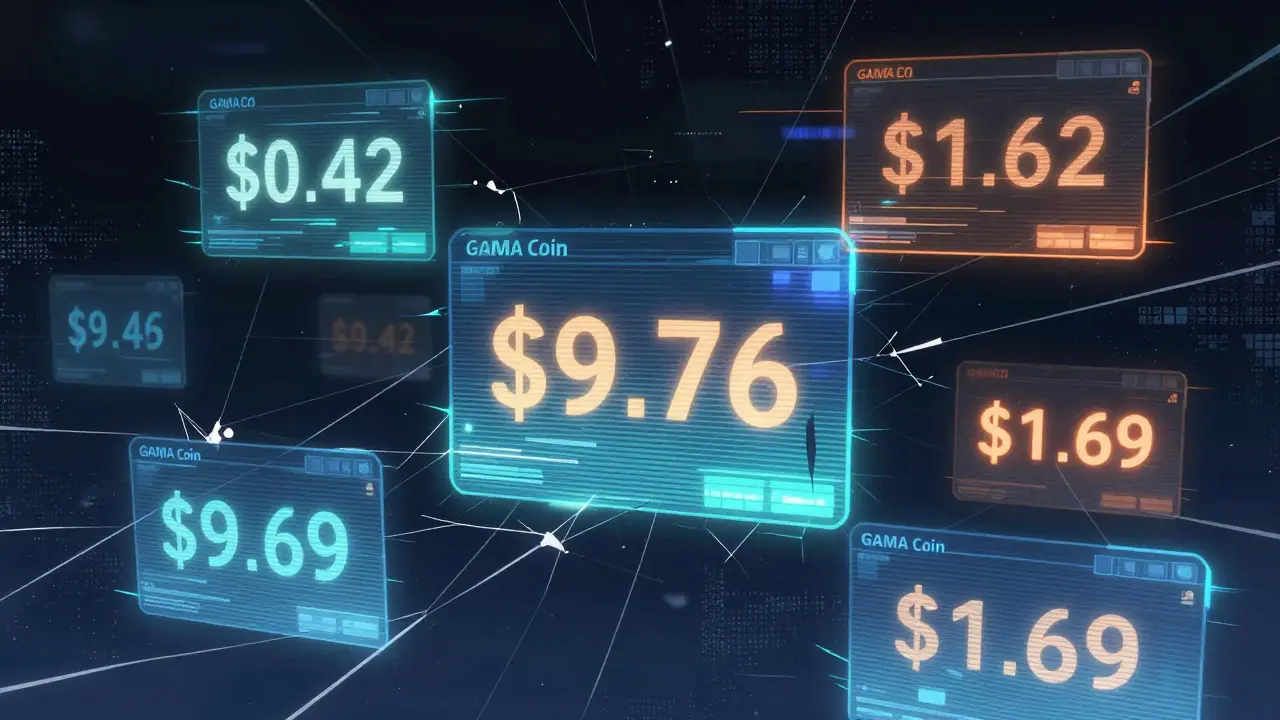
In December 2025, different major platforms reported wildly different prices and volumes for the same token:
- CoinMarketCap: Price ~$0.42, Volume ~$109K
- CoinGecko: Price ~$0.76, Volume ~$322K
- Binance: Price ~$0.65, Volume ~$315K (but reported circulating supply as 0)
- CoinStats: Price ~$1.69, Volume ~$18K
Why such a huge gap? Usually, this indicates low liquidity and market fragmentation. When a token trades on many small exchanges rather than one large one, prices don’t sync up perfectly. A buy order on WEEX might push the price to $1.69, while Binance sits steady at $0.65. This isn’t necessarily fraud, but it is risky. It means you could buy GAMA at $1.69 on one site and instantly lose 60% of its value if you tried to sell it on another.
Furthermore, historical lows are confusing. CoinMarketCap listed an all-time low of $0.00, which is technically impossible for a traded asset unless it delisted temporarily. CoinStats showed a more realistic low of $0.92. Always check multiple sources before making a move.
Contract Migration: A Red Flag or Necessary Step?
In January 2025, GAMA announced a migration to a new contract address. For crypto veterans, this phrase often triggers alarm bells. Contract migrations can be necessary for security upgrades or feature improvements, but they also open the door for scams.
When a project migrates, users must swap their old tokens for new ones. If the process isn’t transparent, users can get stuck with worthless "old" tokens. GAMA’s team stated this was to improve efficiency, but the lack of detailed whitepaper documentation makes it hard to verify. Always ensure you’re using the official, verified contract address from trusted aggregators like CoinMarketCap or CoinGecko, never from random social media links.

Is GAMA Coin Worth Your Attention?
Let’s be real. GAMA is not a blue-chip investment. It ranks between #3900 and #3934 in the global crypto market. That puts it in the "micro-cap" category. These coins are highly volatile and carry significant risk.
However, if you believe in the future of Web3 gaming and think the current play-to-earn models are broken due to inflation, GAMA offers an interesting experiment. Its deflationary burn mechanism is a direct response to the failures of earlier projects. If the gaming platform gains traction, the burning mechanism could drive up value naturally.
But beware of the hype. Some technical analysis tools, like those on WEEX, showed RSI levels indicating the token was "oversold," suggesting a potential bounce. Others, like Bitget, projected modest growth to $0.60 in 2026. These are guesses, not guarantees. The lack of community buzz on Reddit or Twitter suggests that mainstream adoption hasn’t happened yet.
Key Risks to Watch Out For
Before you buy any GAMA tokens, consider these risks:
- Liquidity Risk: Low trading volume means you might struggle to sell large amounts without crashing the price.
- Data Discrepancies: Inconsistent reporting across exchanges makes valuation difficult.
- Competition: Giants like Gala and Immutable dominate the space. GAMA needs a strong unique selling point to survive.
- Documentation Gap: The absence of a comprehensive whitepaper or detailed roadmap leaves investors guessing about future developments.
GAMA Coin represents a bold attempt to fix gaming economics through deflation. Whether it succeeds depends on user adoption and consistent development. Treat it as a high-risk speculative asset, not a safe haven.
What is the main use case for GAMA Coin?
GAMA Coin is primarily used within the GAMA Web3 gaming platform. Players earn GAMA as rewards for winning games, and tokens are burned (destroyed) when players lose, creating a deflationary supply model intended to maintain or increase token value over time.
Which blockchain does GAMA Coin operate on?
GAMA Coin is built on the Solana blockchain. This choice allows for fast transaction speeds and low fees, which are essential for a gaming ecosystem where frequent micro-transactions occur.
Why are there different prices for GAMA on different websites?
The price discrepancies are likely due to low liquidity and market fragmentation. Because GAMA trades on several smaller exchanges rather than one dominant platform, prices can vary significantly depending on local supply and demand on each exchange.
Did GAMA Coin migrate its contract?
Yes, in January 2025, GAMA Coin migrated to a new contract address. Users were required to swap their old tokens for the new version. Always verify the current contract address on reputable tracking sites like CoinMarketCap or CoinGecko.
Is GAMA Coin a good investment in 2026?
GAMA is considered a high-risk, micro-cap asset. While its deflationary model is innovative, it faces stiff competition from larger tokens like Gala and Immutable. Investors should exercise caution due to low liquidity, inconsistent data reporting, and limited community engagement.
What is the total supply of GAMA Coin?
The total maximum supply of GAMA Coin is generally reported as 100 million tokens. However, circulating supply figures vary across platforms, with some reporting lower numbers due to ongoing token burns.
How does GAMA differ from other gaming tokens?
Unlike many gaming tokens that rely on inflationary reward systems, GAMA uses a deflationary model. Tokens are permanently removed from circulation when players lose games, aiming to create scarcity and potentially support price stability.