
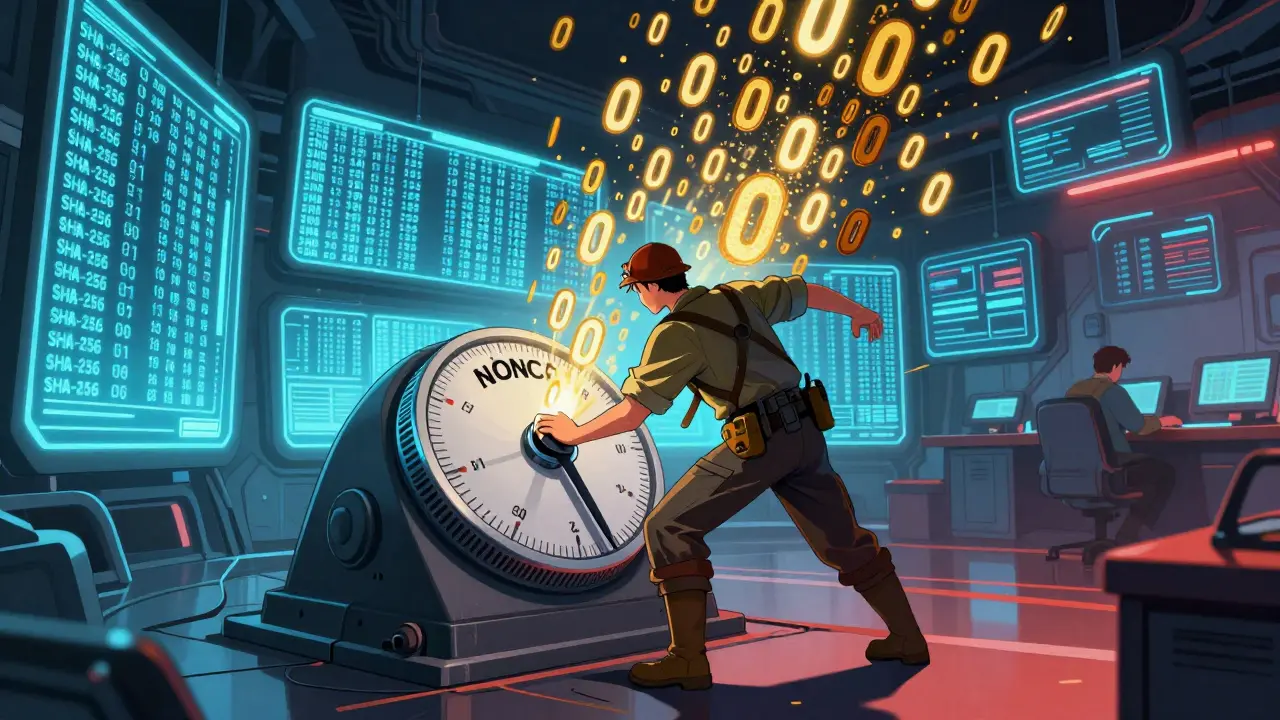
Every time a new block gets added to Bitcoin’s blockchain, a secret number is quietly calculated - one that no one can guess ahead of time. This number is called a nonce. It’s not fancy. It doesn’t look like anything special. But without it, Bitcoin wouldn’t work. And neither would any other blockchain using proof of work. So what exactly is a nonce, and why does it matter so much?
What Is a Nonce?
The word "nonce" is short for "number used once." It’s a random number that miners tweak over and over again until they find the right one. Think of it like a combination lock. You don’t know the code, so you start turning the dial - 0, 1, 2, 3 - until the lock clicks open. That’s mining. The nonce is the number you’re turning.
In Bitcoin, every block has a header. That header includes:
- The hash of the previous block
- A timestamp
- The Merkle root (a summary of all transactions in the block)
- And the nonce
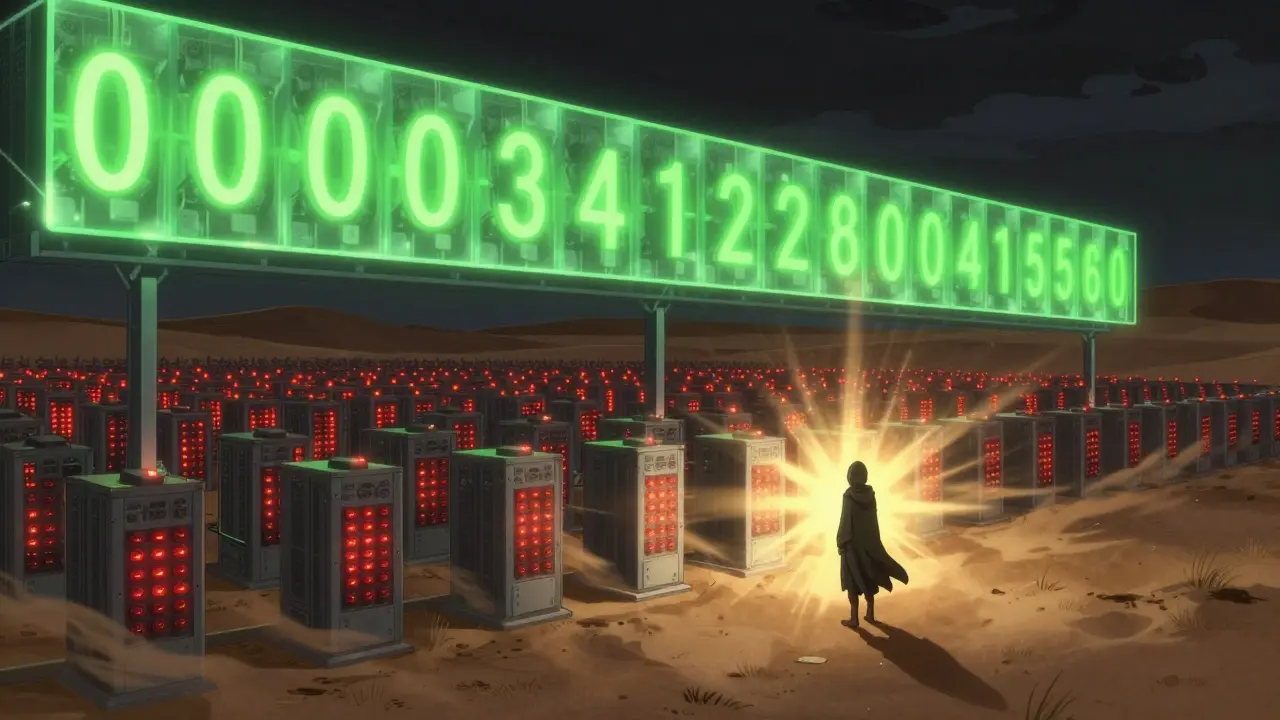
Miners take all of this data and run it through a mathematical function called SHA-256. The result? A 64-character string of letters and numbers - the block’s hash. But here’s the catch: the network doesn’t just want any hash. It wants a hash that starts with a certain number of zeros.
Right now, Bitcoin requires a hash with at least 20 leading zeros. That means out of trillions of possible hashes, only a tiny fraction are valid. The only way to find one is to try different nonces - one after another - until you get lucky.
How Does the Nonce Make Blockchains Secure?
Here’s the genius part: it’s easy to check if a nonce is right. But nearly impossible to guess it ahead of time. If you change even one letter in a transaction, the whole hash changes. Completely. That’s what makes blockchain tamper-proof.
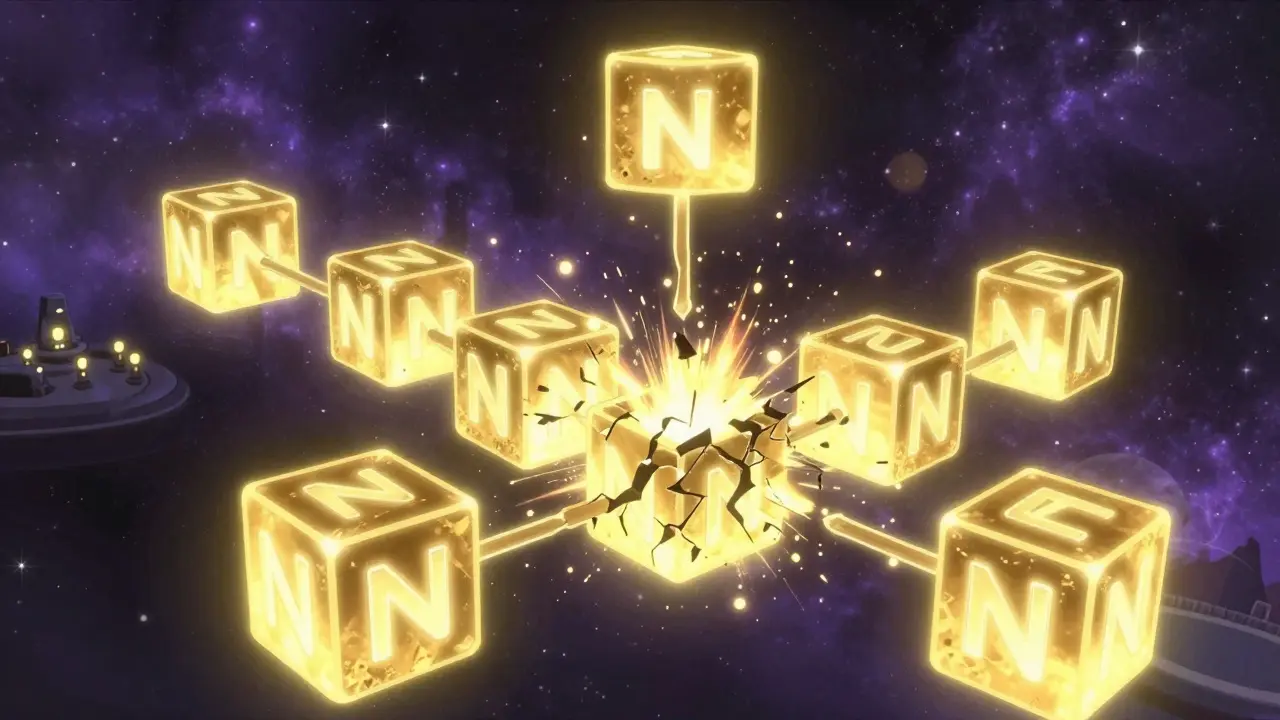
Let’s say someone tries to go back and change a transaction from three blocks ago. They’d have to recalculate the hash for that block. But that changes the block’s hash, which breaks the link to the next block. So they’d have to recalculate the next block’s nonce too. And the one after that. And the one after that. All the way to the current block.
That’s not just hard. It’s astronomically expensive. You’d need more computing power than the entire Bitcoin network combined. And even then, you’d have to do it faster than everyone else is adding new blocks. That’s why no one has ever successfully hacked Bitcoin’s history.
The nonce creates a cost. Real, measurable, physical cost - electricity, hardware, time. And that cost is what protects the network. It’s not magic. It’s math. And it’s been tested for over 15 years.
Why Do Miners Even Bother?
Because they get paid. When a miner finds the right nonce, they broadcast the new block to the network. Everyone checks it. If it’s valid, the block gets added. And the miner gets rewarded - currently 3.125 BTC per block (as of 2026), plus transaction fees.
But it’s not a lottery you can enter with your laptop anymore. In 2026, Bitcoin mining is dominated by ASICs - custom-built chips designed for one thing: crunching SHA-256 hashes as fast as possible. Some machines do over 100 trillion calculations per second. That’s why home mining died out years ago.
It’s also why mining farms exist in places like Texas, Kazakhstan, and Paraguay - where electricity is cheap. The nonce doesn’t care where you mine. It only cares that you’re trying hard enough.
Proof of Work vs. Proof of Stake
Not all blockchains use nonces. Ethereum, for example, switched from proof of work to proof of stake in 2022. Instead of miners solving puzzles, validators lock up their own ETH to propose and confirm blocks. No nonce. No hashing. Less energy.
But here’s the trade-off: proof of stake relies on economic incentives - you’re punished if you cheat. Proof of work relies on physical reality - you have to spend real money to attack the network.
Proof of work’s security isn’t theoretical. It’s been battle-tested. Bitcoin has never been hacked. Not because it’s perfect. But because breaking it would cost billions, and no one has that kind of money - or the willingness to lose it.
That’s why, even as newer blockchains try to be greener or faster, Bitcoin still holds the throne. The nonce is its backbone.
The Difficulty Adjustment - Keeping Things Fair
Bitcoin doesn’t let mining get too easy or too hard. Every 2,016 blocks - roughly every two weeks - the network automatically adjusts the difficulty. If miners are solving blocks too fast (because more hardware joined the network), the number of required leading zeros increases. If miners drop off, it gets easier.
This keeps the average block time at 10 minutes. Always. No matter how many ASICs are running. No matter where they’re located. The nonce system adapts. It’s self-correcting. That’s another layer of resilience.
What Happens If You Guess Wrong?
Most of the time, you do. A miner might try 10 billion nonces in a second and never find the right one. That’s normal. That’s expected. The system is designed that way. The odds are astronomically low. That’s the point.
It’s not about being smart. It’s about being persistent. And having the hardware to keep trying. That’s why mining pools exist - groups of miners who combine their computing power and split the reward. No one person is likely to find a block alone anymore. But together, they can.
Is the Nonce Just for Bitcoin?
Bitcoin was the first, but it’s not the only one. Litecoin, Dogecoin, Bitcoin Cash - all use the same nonce-based proof of work. Even newer blockchains that claim to be "innovative" often borrow Bitcoin’s model because it works. It’s simple. It’s clear. It’s proven.
Some projects have tried to tweak it - like using different hash functions or changing block sizes. But none have matched Bitcoin’s security record. The original nonce system, unchanged since 2009, still outperforms everything else.
What’s Next for Nonces?
There’s no sign that Bitcoin will abandon proof of work. The network has too much at stake. Over $1 trillion in market value relies on this system. And every day, billions of dollars in transactions are secured by nonces.
Future improvements won’t replace the nonce. They’ll work around it. The Lightning Network, for example, lets users send payments off-chain. But the final settlement? Still anchored to Bitcoin’s nonce-secured blockchain.
As long as people need a system that can’t be corrupted, manipulated, or reversed - the nonce will be there. Not because it’s perfect. But because it’s the most reliable thing we’ve ever built.
What does "nonce" stand for?
"Nonce" stands for "number used once." It’s a one-time value that miners change in each attempt to find a valid block hash. Once a block is accepted, that nonce is locked in and never reused.
Why can’t you just calculate the right nonce ahead of time?
Hash functions like SHA-256 are one-way. You can turn "hello" into a hash, but you can’t turn the hash back into "hello." There’s no formula to reverse-engineer the nonce. The only way is to try every possibility - brute force.
Do all blockchains use nonces?
No. Only blockchains using proof of work. Bitcoin, Litecoin, and Dogecoin use them. Ethereum, Solana, and Cardano use proof of stake and don’t need nonces. The choice depends on whether the network prioritizes security (proof of work) or efficiency (proof of stake).
How long does it take to find a nonce?
On average, Bitcoin finds a new block every 10 minutes. But for an individual miner with consumer hardware, it could take years. That’s why mining is done by large farms with thousands of ASICs working together.
Can the nonce be manipulated after a block is confirmed?
No. Once a block is added to the blockchain, the nonce is part of its permanent record. Changing it would require recalculating every single block that comes after it - which is impossible with current technology and resources.



Comments
Ananya Sharma
March 22, 2026 AT 00:19 AMNonce is just a number you keep changing till the hash matches the target. It’s not magic. Just brute force with a purpose. Simple and effective.
Kayla Thompson
March 23, 2026 AT 21:24 PMI still can’t believe people treat this like it’s some profound innovation. It’s a glorified guess-and-check. The entire crypto world is built on a loop that runs until it wins. We call it blockchain. It’s just a while loop with a reward.
Brijendra Kumar
March 25, 2026 AT 03:08 AMYou’re missing the point entirely. It’s not about the nonce-it’s about the cost. The energy, the hardware, the time. That’s the security. Anyone who thinks this is just ‘guessing’ doesn’t understand economics. This isn’t a game. It’s a tax on chaos.
Pradip Solanki
March 25, 2026 AT 05:16 AMProof of work is dead. Ethereum moved on. Bitcoin’s just clinging to a 2009 idea like it’s holy scripture. The nonce is a relic. We don’t need to burn electricity to prove a transaction happened. We need efficiency not theatrics.
Tammy Stevens
March 25, 2026 AT 18:12 PMThe beauty of PoW isn’t in the nonce itself but in how it enforces decentralization. ASICs are expensive. Only serious players can compete. That filters out the flaky actors. The nonce is the gatekeeper. It doesn’t care who you are. Only how much power you can bring. That’s why Bitcoin’s still standing while every altcoin with a ‘better’ consensus model keeps failing.
Brad Zenner
March 27, 2026 AT 04:20 AMI’ve been mining since 2014. The nonce hasn’t changed. The math hasn’t changed. What changed is the scale. Back then, a GTX 1080 could compete. Now? You need a warehouse full of ASICs running 24/7. The nonce didn’t evolve. The world did.
Leona Fowler
March 28, 2026 AT 21:25 PMIt’s easy to look at the nonce and think it’s just a number. But it’s the only thing standing between a tampered ledger and total chaos. Every time a miner finds it, they’re not just earning a reward-they’re locking in history. That’s not tech. That’s trust made physical.
Jackie Crusenberry
March 30, 2026 AT 13:52 PMSo basically, we’re paying people to count? And this is what secures trillions? I mean… wow. I thought we were building the future. Turns out we’re just letting robots play dice.
Kevion Daley
March 31, 2026 AT 20:53 PMNonce? More like ‘no chance’ lol 🤡
Tony Phillips
April 2, 2026 AT 14:07 PMI used to think mining was just for tech bros. Then I saw how it actually works-miners in Texas, Kazakhstan, even Paraguay, all running machines nonstop just to solve this one number. It’s not glamorous. But it’s real. And honestly? That’s kind of beautiful.
Abhishek Thakur
April 2, 2026 AT 23:19 PMSHA-256 is deterministic. Change one bit, hash changes completely. Nonce lets you tweak input without altering transaction data. That’s why tampering fails. Not because of encryption. Because of physics.
Lorna Gornik
April 4, 2026 AT 13:22 PMi luv how the nonce just… sits there. like a silent guardian. no fanfare. no drama. just 00000000000000000000xxxxxxxxxx. chill af. 🤘
Florence Pardo
April 5, 2026 AT 19:06 PMI’ve been reading about this for weeks now, and honestly, I think the real genius isn’t the nonce itself-it’s the feedback loop. The difficulty adjustment. Every two weeks, the network says ‘you’re too fast’ or ‘you’re too slow’ and adjusts the target. It’s like the blockchain is breathing. It’s self-regulating. It’s alive. And that’s why it hasn’t collapsed yet. Not because of the math. Because of the rhythm.
Aman Kulshreshtha
April 7, 2026 AT 10:21 AMIn India, we call this ‘jugaad’-making something work with whatever’s available. Miners aren’t scientists. They’re tinkerers. They patch rigs, use solar, steal power, run in monsoon heat. The nonce doesn’t care. It just wants a valid hash. And somehow, they deliver.
Mohammed Tahseen Shaikh
April 8, 2026 AT 20:35 PMNonce? More like ‘no way in hell you’re gonna guess this’ 😈. You think you’re smart? Try cracking 2^256 combinations with a toaster. That’s the beauty. It’s not a hack. It’s a wall. And Bitcoin built it out of pure math and sweat.
Annette Gilbert
April 10, 2026 AT 17:46 PMSo we’re paying people to do math so we can send memes on the blockchain? Brilliant. Truly. The future of finance is a bunch of dudes in air-conditioned warehouses sweating over ASICs while the planet burns. I’m so proud.
vu phung
April 11, 2026 AT 10:05 AMThe nonce is the silent hero. No one talks about it. No one gives it a medal. But without it, every transaction is a lie waiting to happen. It’s the reason your Bitcoin hasn’t been stolen. Not because it’s untraceable. Because it’s immutable.
Anand Makawana
April 12, 2026 AT 03:14 AMThe elegance of the nonce lies in its simplicity. It requires no trust. No central authority. No legal framework. Just a mathematical constraint that forces honesty through computational expenditure. This is not a protocol. This is a philosophical statement: Work is the foundation of value.
Alicia Speas
April 13, 2026 AT 22:21 PMI appreciate how this system respects physical reality. Unlike digital-only systems, PoW demands tangible resources-electricity, hardware, time. That’s not a flaw. That’s a feature. It anchors value in the real world. The nonce is the bridge between bits and atoms. And that’s why, despite all the hype around PoS, Bitcoin still holds its ground.