
Smart contracts on Ethereum aren’t magic. They’re just code - but code that runs on a global, unstoppable computer. No banks. No lawyers. No middlemen. Just rules written in software, locked onto the blockchain, and executed automatically when conditions are met. If you’ve heard terms like DeFi, NFTs, or DAOs, you’ve seen smart contracts in action. They’re the engine behind all of it.
What Exactly Is a Smart Contract?
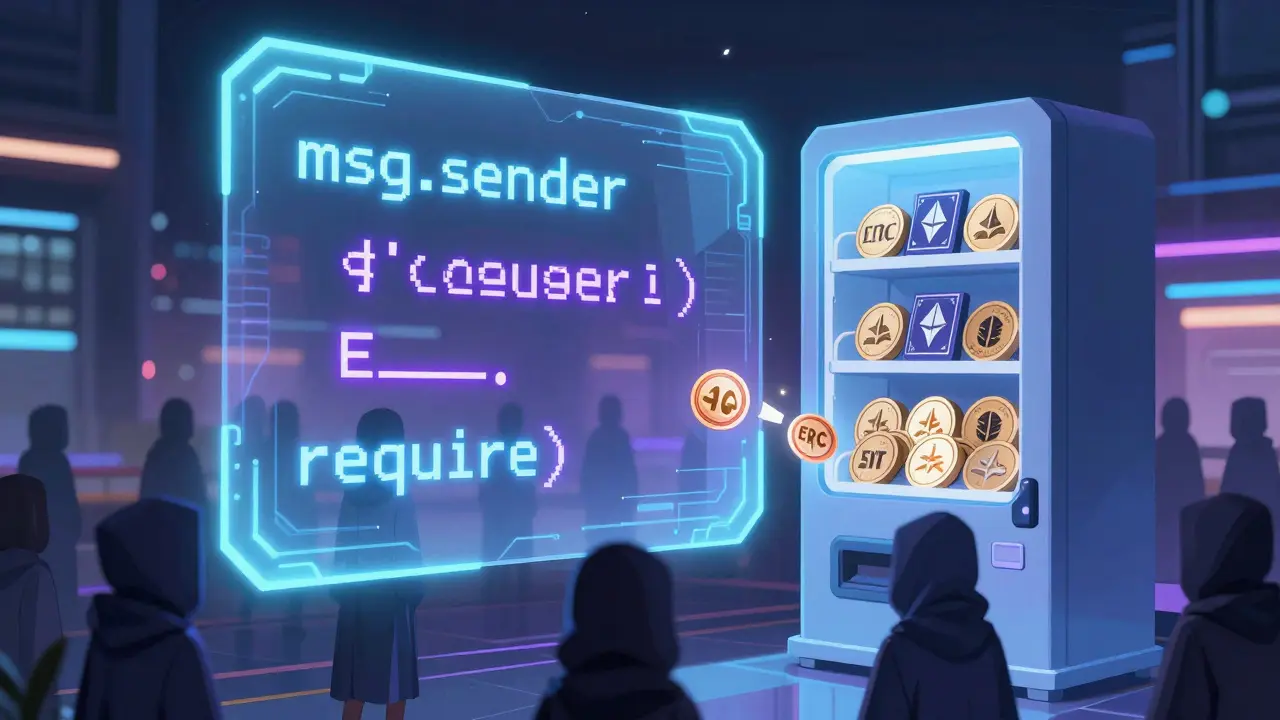
A smart contract is a program stored on the Ethereum blockchain. It doesn’t run on your laptop or a company server. It runs on thousands of computers around the world, all agreeing on what happens next. Think of it like a vending machine: you put in the right amount of money (or ETH), press a button (call a function), and out comes your snack (a token, a payment, a digital asset). No human needs to be involved.
These contracts are made up of two things: code and data. The code defines the rules - like "if Alice sends 1 ETH, then send her 100 tokens." The data is the state - like how many tokens are left, who owns them, or how much ETH is locked in the contract right now. Once deployed, this code can’t be changed. That’s the whole point.
How Do They Run? The Ethereum Virtual Machine
Smart contracts don’t run on regular computers. They run inside something called the Ethereum Virtual Machine, or EVM. The EVM is like a global computer that every Ethereum node runs. It doesn’t care if you’re in New Zealand, Nigeria, or Japan. As long as your node is connected, it runs the same code the same way.
This is why smart contracts are so trustworthy. No single person controls them. No server can crash. No company can shut them down. The EVM executes every instruction exactly as written. If a contract says "send 5 ETH to Bob when the price of ETH hits $3,500," it will do it - even if Bob is anonymous and the price change happens at 3 a.m.
Inside the code, you can use special variables like msg.sender (who called the contract), tx.gasprice (how much they paid in fees), and block.timestamp (the current time on the blockchain). These let contracts react to real events on the network - without needing outside help.
How Are Smart Contracts Written?
You don’t write smart contracts in Python or JavaScript. You use languages built for the EVM: Solidity and Vyper. Solidity is by far the most popular. It looks a bit like JavaScript, but with strict rules for handling money and state changes.
Here’s a simple example:
pragma solidity ^0.8.0;

contract SimpleStorage {
    uint256 private count = 0;

    function increment() public {
        count += 1;
    }

    function getCount() public view returns (uint256) {
        return count;
    }
}
This contract has one number (count), a function to increase it, and another to read it. The view keyword means getCount() only reads data - it doesn’t change anything, so it’s free to call. The public function can be triggered by anyone.
You also use require() to enforce rules. For example:
require(msg.sender == owner, "Only the owner can reset");This stops anyone but the contract creator from resetting the count. It’s like a digital keycard.

Deploying a Smart Contract
Writing code isn’t enough. You have to deploy it. That means sending a special transaction to the Ethereum network that includes your compiled code. This costs gas - ETH paid to miners (or validators) to include your contract on the blockchain.
Deployment is expensive. A simple contract might cost $5-$20 in gas. Complex ones? $50 or more. That’s why developers test first on testnets like Sepolia or Goerli, where ETH is free.
To deploy, you use tools like Remix (browser-based), Hardhat, or Foundry. You connect your wallet (like MetaMask), compile your code, click "Deploy," and confirm the transaction. Once it’s mined, the contract gets a permanent address - like 0x742d35Cc6634C0532925a3b844Bc454e4438f44e. From then on, anyone can interact with it.
What Can Smart Contracts Do?
They’re not just for sending money. They power entire systems:
- DeFi loans: Lock ETH as collateral, borrow USDC, repay with interest - all automatically.
- NFTs: Each NFT is a unique token governed by a smart contract that tracks ownership and royalties.
- DAOs: Voting on proposals, releasing funds, changing rules - all done through code.
- Supply chains: Release payment only after a shipment is confirmed on-chain.
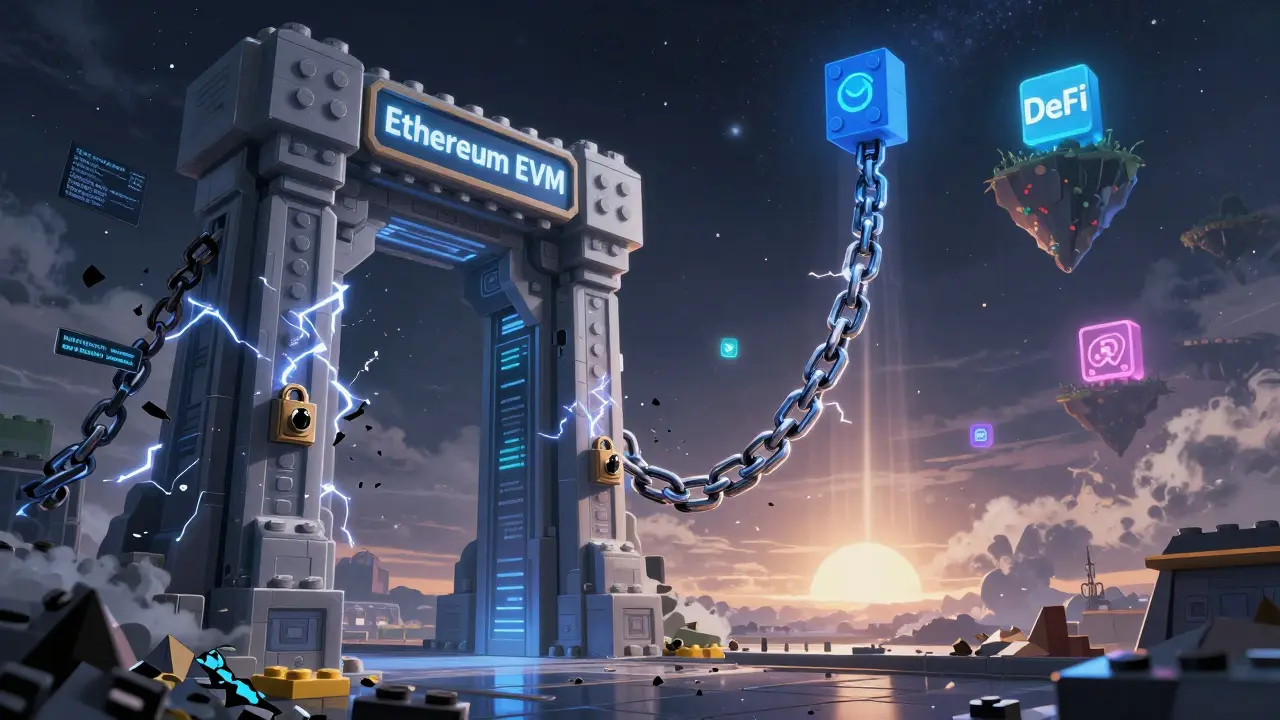
They can even call other contracts. Imagine a contract that checks a price oracle, then triggers a loan repayment, then sends a reward to a staker - all in one chain of events. That’s called composability. It’s why Ethereum is so powerful. Contracts are like LEGO blocks. You snap them together to build bigger things.
Limitations - What Smart Contracts Can’t Do
Smart contracts are powerful, but they’re not perfect.
They can’t talk to the real world on their own. If you want to know the price of Bitcoin, the weather in Tokyo, or whether a flight was delayed, the contract can’t look it up. That’s where oracles come in - trusted third-party services that feed real-world data onto the blockchain. Chainlink is the most popular one.
They have size limits. Ethereum restricts contracts to 24KB of code. If you go over, deployment fails. Developers work around this using patterns like the Diamond Pattern, which splits large contracts into smaller, modular pieces.
They’re immutable - for better or worse. If you find a bug after deployment, you can’t fix it. You have to deploy a new contract and migrate users. That’s why audits are critical. Many high-profile hacks happened because someone missed a tiny logic error in the code.
Precompiled Contracts and Standards
Ethereum includes built-in functions called precompiled contracts. These are at special addresses like 0x01 to 0x0a. They’re not written in Solidity - they’re hardcoded into the EVM for efficiency. Examples: SHA256 hashing, ECDSA signature verification. Using them saves gas.
Then there are standards - rules everyone agrees to follow. The most famous:
- ERC-20: For fungible tokens (like USDC or DAI). Everyone uses the same functions:
transfer(),balanceOf(),approve(). - ERC-721: For NFTs. Each token is unique. Has functions like
ownerOf()andtokenURI()(which links to metadata like an image).
These standards make everything interoperable. Your wallet can read any ERC-20 token. A marketplace can sell any ERC-721 NFT. No custom coding needed.
Why This Matters
Smart contracts remove trust from human hands and put it into math. You don’t need to trust the other person. You just need to trust the code - and the network that runs it.
They’ve enabled a new kind of economy: one that’s open, global, and automated. You can lend money to someone on the other side of the world without a bank. You can buy digital art and know the artist gets paid every time it’s resold. You can vote on how a company is run - without giving up your identity.
It’s not perfect. Gas fees are still high. Bugs still happen. But the core idea - code as law - is changing how we build systems. And it’s all built on Ethereum.
What’s Next?
Ethereum is evolving. Layer-2 solutions like Arbitrum and Optimism are making contracts cheaper and faster. New versions of the EVM are being tested. Tooling is improving. Developers can now simulate contracts locally, test them with automated scripts, and even simulate attacks before deploying.
The future isn’t about replacing banks. It’s about replacing middlemen. Smart contracts are the tool that makes that possible.
Can smart contracts be hacked?
Yes. Smart contracts are code, and code can have bugs. If a contract doesn’t properly check who called it, or if it has a reentrancy flaw, attackers can drain funds. High-profile hacks like The DAO (2016) and Parity Wallet (2017) happened because of these flaws. That’s why audits by firms like CertiK or Trail of Bits are essential before deploying.
Do I need to know how to code to use smart contracts?
No. You don’t need to write code to use apps built on smart contracts - like Uniswap, OpenSea, or Aave. You just connect your wallet and click buttons. But if you want to create your own contract or understand what’s really happening behind the scenes, learning Solidity is necessary.
How much does it cost to deploy a smart contract?
It varies. A simple contract like a token might cost $5-$15 in gas on Ethereum mainnet. Complex ones with lots of logic or storage can cost $30-$100+. On Layer-2 chains like Polygon or Arbitrum, deployment can cost less than $1. Always test first on a testnet - it’s free.
Can smart contracts be updated after deployment?
Not directly. Once deployed, the code is permanent. But developers use upgrade patterns - like proxy contracts - that point to a new version. The user interacts with the same address, but the underlying code changes. This is risky, though, because it introduces trust. Some projects avoid upgrades entirely to stay fully decentralized.
Are smart contracts only used on Ethereum?
No. Many blockchains now support EVM-compatible smart contracts - like Binance Smart Chain, Polygon, Avalanche, and Arbitrum. They run the same Solidity code. But Ethereum remains the most secure and widely used. Other chains are faster or cheaper, but Ethereum has the biggest ecosystem and most audited contracts.




Comments
SUMIT RAI
December 28, 2025 AT 06:29 AMlol smart contracts are just vending machines?? 😂 I've seen more reliable ATMs. Also why is everything on Ethereum so expensive?? 🤡💸
surendra meena
December 28, 2025 AT 13:25 PMThis is why crypto is a SCAM!! No one should trust code that can't be fixed!! What if I accidentally send ETH to the wrong address?? You think the blockchain cares?? NO!! It just eats your money and laughs!!
Andrew Prince
December 28, 2025 AT 17:03 PMWhile I appreciate the pedagogical structure of this exposition, one must interrogate the foundational epistemological assumptions underlying the assertion that 'code is law.' The ontological primacy granted to immutable, decentralized execution environments presumes a level of epistemic neutrality that is demonstrably false. The EVM, far from being an impartial arbiter, is a sociotechnical artifact shaped by the priorities of its developers, the gas fee economics of its miners, and the hegemony of its standardization bodies. To equate smart contract execution with justice is to commit a category error of the highest order.
prashant choudhari
December 29, 2025 AT 15:23 PMSolidity is the way to go. Clean, predictable, and if you write it right, it just works. No fluff. Just logic. Learn the basics, test on Sepolia, then deploy. Simple.
Willis Shane
December 31, 2025 AT 14:46 PMI find it profoundly concerning that the author glosses over the ethical implications of deploying unchangeable financial instruments. When a user loses funds due to a logic flaw, the system offers no recourse. This is not innovation-it is institutionalized negligence masked as decentralization.
Jake West
January 2, 2026 AT 14:04 PMLMAO so you're telling me I need to pay $20 just to make a counter that increments? I could do that in Excel for free. This whole thing is a glorified PowerPoint slide deck with gas fees.
Gavin Hill
January 4, 2026 AT 10:11 AMThere's something beautiful about code that can't be undone. It forces you to think deeper. To plan. To care. Not everything needs to be editable. Sometimes permanence is the feature, not the bug.
Kevin Gilchrist
January 4, 2026 AT 22:52 PMI just watched my entire life savings get drained by a reentrancy attack and now I'm crying into my ramen. This isn't finance. This is digital Russian roulette with a 3am hacker on the other side. 🥲💔
Khaitlynn Ashworth
January 5, 2026 AT 13:04 PMOh wow, you actually think people don't know about the DAO hack? Congrats, you discovered the internet in 2017. And yes, I know you're gonna say 'but audits!'-yeah, right, like CertiK got paid to ignore the bug because their client paid in ETH. 😴
NIKHIL CHHOKAR
January 6, 2026 AT 05:31 AMI respect the effort, but let's be real-most people deploying contracts have zero idea what they're doing. I've seen contracts with public functions that let anyone drain the wallet. It's not a revolution. It's a dumpster fire with a whitepaper.
rachael deal
January 6, 2026 AT 23:06 PMThis is so cool!! I just used Uniswap for the first time and it felt like magic! No bank, no forms, no waiting. Just click and go. The future is here and it’s decentralized and it’s awesome!! 🚀💖
Jordan Fowles
January 8, 2026 AT 14:54 PMThe real innovation isn't the code. It's the shift in mindset. We're moving from 'who do I trust?' to 'what can I verify?' That change is bigger than any token or chain. It's about rebuilding trust from the ground up.
Steve Williams
January 8, 2026 AT 15:06 PMThe potential of this technology to empower underserved communities is immense. In Nigeria, where banking access is limited, smart contracts enable peer-to-peer lending without intermediaries. This is not just code-it is economic liberation.