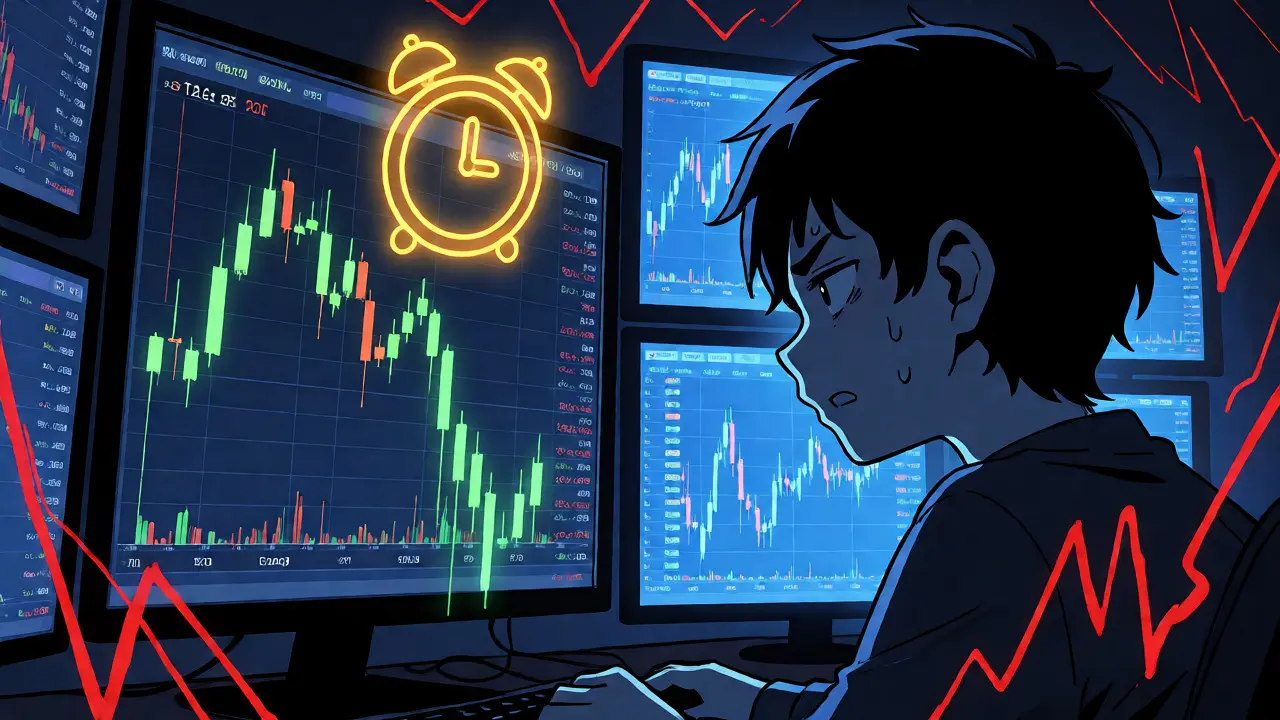
You just bought Bitcoin at $60,000. It spikes to $65,000 while you're asleep. By the time you check your phone, it's back down to $61,000. You missed the profit window because you were trying to guess when to sell. This is the classic trader's dilemma: greed keeps you holding, fear makes you sell too early, and exhaustion means you can't watch the screen 24/7. The solution isn't better intuition; it's a take-profit order. It’s a pre-set instruction that automatically closes your position once the price hits a specific target. Think of it as setting an alarm clock for your money. If the price rings the bell, you get paid. If not, you keep waiting. No emotions, no panic, no missed opportunities.
What Exactly Is a Take-Profit Order?
A take-profit (T/P) order is a conditional instruction given to your exchange or broker. You tell them: "If the price reaches X, sell my asset." Unlike a market order, which sells immediately at whatever price is available, a T/P order waits for a specific condition to be met. It transforms a speculative hold into a disciplined exit strategy. When the trigger price is hit, the order executes, converting your paper gains into realized cash (or stablecoins). This mechanism is crucial in volatile markets like cryptocurrency, where prices can swing 10% in minutes. Without this tool, you are essentially gambling on your ability to react faster than the market.
The core function is automation. Once you place the order, it sits in the exchange's order book, invisible until the price touches your level. Most platforms treat these as Good-Till-Canceled (GTC) orders, meaning they stay active indefinitely until filled or manually deleted. This persistence is vital for traders who don't want to babysit their charts all day. Whether you are trading Ethereum, Solana, or traditional stocks, the logic remains identical: define your success criteria beforehand, let the system handle the execution.
Why Manual Selling Fails Traders
Human psychology is terrible for trading. We suffer from loss aversion, where the pain of losing is twice as powerful as the pleasure of gaining. But we also suffer from the "greed gap"-the belief that the next candle will always be higher. When you trade manually, you are fighting your own brain. You might see a 20% gain and think, "Just 5% more," only to watch the price crash back to your entry point. Conversely, you might panic-sell during a minor dip, locking in a tiny profit while missing the main rally.
Automated exits remove this emotional noise. A take-profit order doesn't care about news headlines or Twitter hype. It cares about one number: your target price. This discipline creates consistency. Instead of wondering if you should have sold earlier, you follow a predefined plan. Over hundreds of trades, this systematic approach beats sporadic, emotion-driven decisions almost every time. It frees up mental bandwidth, allowing you to focus on finding new setups rather than agonizing over existing ones.
How to Calculate Your Target Price
Setting a random number for your take-profit is a recipe for disaster. You need a method. Most successful traders use technical analysis to find natural resistance levels. These are price points where sellers historically step in, pushing the price back down. Common tools include:
- Support and Resistance Lines: Look at past price action. Where did the price reverse before? Set your T/P slightly below that peak to ensure execution.
- Fibonacci Extensions: After a pullback, prices often extend to 1.272 or 1.618 times the previous move. These are standard targets for trend-following traders.
- Risk-Reward Ratios: If you risk $100 (your stop-loss), aim for at least $200 or $300 in profit. A 1:2 or 1:3 ratio ensures that even if you lose half your trades, you remain profitable.
Let's look at a concrete example. You buy 1 ETH at $2,000. You set a stop-loss at $1,900 (risking $100). Based on chart patterns, you identify resistance at $2,300. You place a take-profit order at $2,250. Why not $2,300? Because liquidity thins out near round numbers, and slippage could prevent a fill. By aiming slightly lower, you increase the probability of getting filled. If the price hits $2,250, you make $250. That’s a 2.5:1 reward-to-risk ratio. Solid math, not magic.

Take-Profit vs. Stop-Loss: The Dynamic Duo
You cannot have one without the other. A take-profit order defines your upside; a stop-loss order defines your downside. Together, they create a bracket around your trade. Trading experts often refer to this combination as OCO (One Cancels the Other) or simply a bracket order. When one triggers, the other cancels automatically. This prevents a scenario where you accidentally end up with two open positions after a whipsaw market movement.
| Feature | Take-Profit Order | Stop-Loss Order | Market Order |
|---|---|---|---|
| Purpose | Lock in profits | Limit losses | Immediate entry/exit |
| Execution Trigger | Price rises to target | Price falls to limit | Instantly upon submission |
| Emotional Impact | Low (automated) | Low (automated) | High (requires decision) |
| Best For | Trend continuation | Capital preservation | Urgent liquidation |
Using both allows you to sleep soundly. You know exactly how much you stand to lose and how much you stand to gain. If the market moves against you, the stop-loss saves you from ruin. If it moves in your favor, the take-profit secures the bag. There is no ambiguity. This clarity is what separates professional traders from gamblers.
Common Pitfalls and How to Avoid Them
Even with automation, things can go wrong. The biggest enemy of take-profit orders is slippage. In highly volatile crypto markets, especially during news events, the price can jump over your target. If you set a limit-style take-profit at $50,000, but the price gaps from $49,000 to $51,000, your order might not execute if the bid never touched $50,000 precisely. To mitigate this, some traders use market-style take-profits (if supported by the platform) or widen their target slightly. However, most exchanges treat T/P as limit orders by default to guarantee price control.
Another mistake is setting targets too close to the entry price. Scalpers might do this, but for swing traders, a tight take-profit gets triggered by normal market noise. You get stopped out for pennies, then watch the price run away without you. Always give your trade room to breathe. Analyze the Average True Range (ATR) of the asset to understand typical volatility. If Bitcoin moves $500 daily on average, setting a $50 take-profit is unrealistic. Aim for multiples of that volatility.

Implementation Across Platforms
Different exchanges handle take-profits differently. On centralized exchanges like Binance or Coinbase, you usually select "Limit" as the order type and enter your target price. Some advanced interfaces offer a dedicated "TP/SL" button that lets you set both simultaneously. Decentralized Exchanges (DEXs) are trickier. Many DEXs lack native stop-loss or take-profit functionality because they rely on smart contracts that require gas fees for every interaction. Here, traders often use third-party bots or keep funds on centralized exchanges specifically for automated exits.
Mobile apps have improved significantly. You can now drag lines on a chart to set your take-profit visually. This intuitive design reduces errors. Just remember: setting an order is not enough. You must monitor its status. Did it fill? Did it get canceled due to insufficient balance? Regular checks ensure your automation is working as intended.
Strategic Adjustments for Different Market Conditions
Not all markets behave the same way. In a strong bull run, rigid take-profits might leave money on the table. In these scenarios, consider using a trailing stop instead. A trailing stop moves your exit price up as the asset rises, locking in profits while letting winners run. If the price reverses, the trailing stop locks in the gain. This hybrid approach combines the security of a take-profit with the flexibility of a manual hold.
In sideways or choppy markets, fixed take-profits work best. Prices oscillate between clear boundaries. Buying support and selling resistance with fixed T/P orders captures consistent small wins. Trying to catch the "top" in a range-bound market is futile. Accept the middle of the move. Consistency beats perfection.
Do take-profit orders cost extra fees?
Generally, no. Most exchanges charge the same trading fee whether you use a market, limit, or take-profit order. However, some platforms may charge for placing and canceling orders repeatedly, so frequent adjustments can add up. Always check your specific exchange's fee schedule.
What happens if the price skips my take-profit level?
If the price gaps over your take-profit level (e.g., jumps from $100 to $110 without trading at $105), a limit-based take-profit order may not execute. To avoid this, some traders use market-on-touch orders if available, or set their target slightly lower than the expected breakout point to ensure liquidity.
Can I change my take-profit order after placing it?
Yes, you can modify or cancel a take-profit order anytime before it triggers. Simply go to your open orders tab, edit the price level, or delete the order entirely. This flexibility allows you to adapt to changing market conditions.
Is a take-profit order the same as a limit order?
Technically, a take-profit order is a type of limit order used for exiting positions. While a standard limit order can be used for both buying and selling, a take-profit is specifically designated for closing a profitable position. The mechanics are similar, but the intent differs.
Should I always use a take-profit order?
For most retail traders, yes. It enforces discipline and protects gains. Exceptions might include long-term HODLers who believe in infinite upside and don't mind volatility, or scalpers who prefer manual control for micro-movements. But for the vast majority, automation is safer.
Mastering take-profit orders isn't about getting rich quick. It's about staying in the game long enough to compound your wins. Start small. Pick one coin. Set a logical target based on resistance. Walk away. Let the algorithm do its job. You'll be surprised how much stress disappears when you stop trying to predict every tick.