
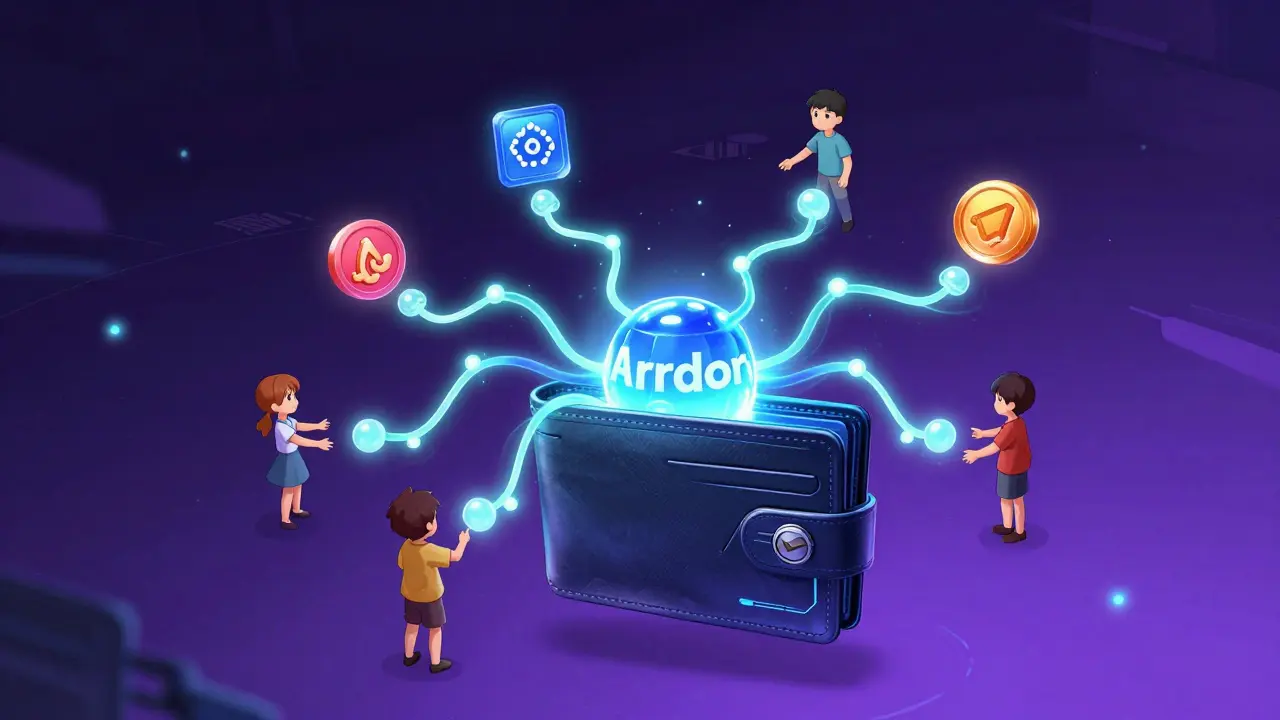
Most people looking for a decentralized exchange (DEX) think of Uniswap, PancakeSwap, or dYdX. But there’s another player in the space that doesn’t shout as loud-Ardor DEX. It’s not the biggest, and you won’t see it trending on Twitter. But if you’re already in the Ardor ecosystem or tired of paying high fees on crowded blockchains, it might just be the quiet alternative you didn’t know you needed.
What Is Ardor DEX?
Ardor DEX isn’t a standalone app like Uniswap. It’s built right into the Ardor blockchain, a multi-chain system designed by Jelurida-the same team behind Nxt. Think of it like a Swiss Army knife with a built-in trading blade. You don’t need to switch wallets, connect to a dApp, or approve dozens of transactions. Everything happens inside the Ardor Wallet: sending coins, creating tokens, and trading them-all in one place. The magic lies in its architecture. Ardor uses a parent-child chain model. The main Ardor chain handles security, consensus, and transaction validation using proof-of-stake. Child chains, on the other hand, manage everything else: token issuance, smart contracts, and yes, decentralized trading. This separation means trading on Ardor DEX doesn’t slow down the whole network. It’s a smarter way to scale than forcing every DEX onto a single chain like Ethereum.How It Works
To use Ardor DEX, you start with the Ardor Wallet. It’s available as a mobile app (Android) and desktop software. Once you install it, you’ll need ARDR-the native token of the Ardor network. You can’t pay fees in Bitcoin, Ethereum, or even stablecoins. You need ARDR. That’s the first hurdle. If you don’t own any, you’ll have to buy it on a centralized exchange first. Once you have ARDR, you can create your own token, send it to others, or trade it directly on the built-in DEX. The interface is simple: pick the token you want to sell, pick the one you want to buy, enter the amount, and confirm. No slippage settings, no liquidity pools to manage. It’s more like a basic order book than a constant product market maker (CPMM) like Uniswap. Trades settle in about a minute. That’s faster than Bitcoin, slower than Solana, but solid for a platform that doesn’t rely on flash-in-the-pan hype. Transaction fees? Around 0.01 ARDR per trade-roughly $0.0007 at current prices. That’s cheaper than most DEXs, even on layer-2 solutions.Pros and Cons
Pros
- Ultra-low fees: At $0.0007 per trade, you’re saving hundreds of dollars a year compared to Ethereum-based DEXs.
- No gas wars: Since trading happens on child chains, you’re not competing with DeFi bots or NFT minters.
- Integrated wallet: No need to juggle MetaMask, Trust Wallet, and a dozen other apps. Everything’s in one place.
- High security: The parent chain’s proof-of-stake validators secure every child chain. No separate security model needed.
- Privacy-focused: No KYC. No personal data collected. Just public keys and transactions.
Cons
- Low liquidity: There’s no way around it-Ardor DEX doesn’t have the volume of Uniswap or PancakeSwap. You won’t find major tokens like USDT, ETH, or SOL here.
- Only ARDR for fees: If you don’t own ARDR, you can’t trade. That’s a barrier for newcomers.
- Limited token listings: Most tokens on Ardor DEX are native to the Ardor ecosystem. Don’t expect Bitcoin or Dogecoin.
- Small community: Reddit threads? Almost none. Twitter chatter? Barely any. You’re on your own more than you’d be on other DEXs.
- UI feels dated: Some users report the interface isn’t as smooth or modern as newer DEX apps. It works, but it doesn’t dazzle.

How It Compares to Other DEXs
| Feature | Ardor DEX | Uniswap (Ethereum) | PancakeSwap (BNB Chain) | dYdX (Order Book) |
|---|---|---|---|---|
| Trading Volume (Daily, 2025) | Not publicly reported (likely under $1M) | $1.72 billion | $892 million | $1.1 billion |
| Fees | 0.01 ARDR (~$0.0007) | $5-$20+ (gas) | $0.50-$5 | $0.02-$0.10 (maker/taker) |
| Settlement Time | ~1 minute | ~15 seconds | ~3 seconds | ~10 seconds |
| Token Support | Primarily Ardor ecosystem tokens | 10,000+ ERC-20 | 500+ BEP-20 | 50+ major assets |
| User Interface | Functional, outdated | Modern, intuitive | Modern, mobile-friendly | Professional, exchange-like |
| Best For | Low-cost trading within Ardor ecosystem | High-volume DeFi trading | BNB Chain users | Advanced traders, futures |
Bottom line: If you want to trade Bitcoin or Ethereum, Ardor DEX isn’t for you. But if you’re building or holding tokens on the Ardor network, or you just want to avoid $10 gas fees on every swap, it’s one of the most cost-effective options out there.
Who Should Use Ardor DEX?
You should consider Ardor DEX if:- You’re already using the Ardor blockchain for asset creation or enterprise solutions.
- You’re tired of paying high gas fees and want to trade without breaking the bank.
- You value privacy and don’t want to link your wallet to a centralized exchange.
- You’re experimenting with token issuance and want a seamless way to trade your own tokens.
- You’re a long-term HODLer of ARDR and want to use your holdings for more than just staking.
You should avoid Ardor DEX if:
- You want to trade major cryptocurrencies like BTC, ETH, or SOL.
- You need deep liquidity or tight spreads for active trading.
- You prefer sleek, modern interfaces with charts, order books, and margin trading.
- You’re new to crypto and want a simple, beginner-friendly DEX.

The Bigger Picture
The DEX market is exploding. In 2025, decentralized exchanges handled over $4.9 billion in daily volume, up from $4 billion in 2023. By year-end, that number could hit $3.48 trillion. But here’s the catch: 80% of that volume is concentrated in just five platforms. Ardor DEX isn’t competing for that pie. It’s carving out its own slice. It’s not trying to be the next Uniswap. It’s trying to be the backbone for businesses, developers, and communities who want to issue and trade custom tokens without relying on Ethereum’s congestion or BNB Chain’s centralization risks. The ARDR token itself trades around $0.068 as of late 2025. Its RSI sits at 41.40-neutral. Not booming, not crashing. That tells you something: Ardor isn’t a hype coin. It’s a utility coin. And its value comes from real use inside its ecosystem.Final Thoughts
Ardor DEX isn’t flashy. It doesn’t have celebrity investors, viral memes, or a $100 million VC round. But it does something rare: it works quietly, reliably, and cheaply. For most users, it won’t replace their main DEX. But for those building on Ardor-or just looking to escape high fees-it’s a hidden gem. If you’ve ever been burned by a $15 gas fee on a $20 trade, or if you’re tired of waiting for Ethereum to clear, give Ardor DEX a shot. Download the wallet, buy a little ARDR, and try swapping two tokens you already hold. You might be surprised how satisfying it feels to trade without paying a fortune.It’s not the future of DeFi. But for a certain kind of user, it’s already the best version of it.



Comments
Dana Sikand
March 1, 2026 AT 06:59 AMI've been using Ardor DEX for about 6 months now and honestly? It's changed how I think about fees. I used to trade on Uniswap and was always shocked at how much I was paying just to swap a few tokens. Now I just hop into the Ardor wallet, use my ARDR, and trade for less than a penny. No stress, no waiting. It's like the internet was supposed to be - fast, cheap, and quiet. Seriously, if you're into token creation or just want to avoid gas wars, this is the hidden tool you didn't know you needed.
Also, the fact that it's all in one wallet? Game changer. No more juggling 7 different apps just to send a token.
Molley Spencer
March 1, 2026 AT 14:36 PMArdor DEX? Cute. A niche toy for people who still think blockchain is about ‘decentralization’ and not about scalability. You’re trading tokens on a chain with less daily volume than a single Uniswap pool. The UI looks like it was designed in 2014. And don’t get me started on the ‘ARDR only’ fee model - that’s not innovation, that’s a walled garden with a broken gate. If you’re not trading ETH or SOL, you’re not trading crypto. You’re doing accounting.
John Fuller
March 2, 2026 AT 19:07 PMLow fees yes. But no liquidity. Why bother?
Cameron Pearce Macfarlane
March 2, 2026 AT 22:37 PMOf course it’s cheap. It’s also irrelevant. Nobody cares about a DEX that only works if you already own the token that pays for the transaction. That’s not a feature - it’s a trap. You’re locked in. And let’s be real, if you’re building on Ardor, you’re probably building something no one else wants. This isn’t innovation. It’s isolation.
Amanda Markwick
March 3, 2026 AT 01:13 AMI love how people dismiss Ardor because it doesn’t have 10k tokens or a viral meme. That’s not the point. The point is: what if you could trade your own asset without paying $5 every time? What if you didn’t have to beg for liquidity from bots? What if the system just… worked? Ardor isn’t trying to be the center of the crypto universe. It’s trying to be the quiet foundation for people who actually build things.
I’ve issued three tokens on Ardor. Traded them. Sent them to collaborators. All for less than $0.10 in fees. That’s not a gimmick. That’s real utility. And yeah, the UI is dated - but it works. And sometimes, that’s more valuable than a glowing gradient and a Discord server full of influencers.
Sean Logue
March 4, 2026 AT 22:05 PMAs someone who’s lived in 5 countries and traded crypto everywhere - I’ve seen a lot of ‘alternative’ chains. Ardor’s the first one that actually made me pause and think: ‘Wait, this might be the real deal.’ Not because it’s flashy. But because it’s consistent. No drama. No hype. Just clean, simple, cheap transactions. I use it for small business token swaps. My clients love it. No KYC. No panic. Just send and receive. It’s like crypto from 2015 - but without the chaos.
Elizabeth Smith
March 6, 2026 AT 05:48 AMYou people are so naive. Ardor is just another government-backed blockchain disguised as ‘decentralized.’ The Jelurida team? They’re connected. You think they don’t have ties to the Fed? The ‘parent-child chain’ model? That’s centralized control with extra steps. And ARDR? It’s not a currency - it’s a surveillance token. You’re being tracked. Every trade. Every address. They’re building the infrastructure for CBDCs. Wake up.
Lucy Simmonds
March 6, 2026 AT 14:34 PMI tried Ardor. I bought ARDR. I tried to trade. It took 3 tries just to send a token. The app crashed twice. The UI is like a 2010 Android app. And now I have 0.8 ARDR stuck in limbo because I can’t withdraw it? I’m not buying into this ‘quiet alternative’ nonsense. It’s a graveyard for lost coins. If you’re not on Ethereum or Solana, you’re not trading - you’re donating to a hobby project.
Maggie House
March 8, 2026 AT 01:55 AMI’m new to crypto and I stumbled on Ardor by accident. I was scared to try anything because I thought I’d lose money. But the wallet was so simple. I didn’t need to understand gas or slippage. I just picked two tokens, clicked swap, and it worked. I didn’t even know what ARDR was at first - I just bought a little to get started. Now I’m hooked.
It’s not flashy, but it’s kind and patient. It doesn’t yell at you. It doesn’t make you feel dumb. And honestly? That’s rare. I’m so glad I didn’t listen to the people saying it’s ‘useless.’ It helped me learn. And that’s worth more than any meme coin.
Carl Gaard
March 9, 2026 AT 03:20 AMI’m not a dev. I’m not a trader. I just like to hold tokens I believe in. I bought ARDR because I liked the idea of a blockchain that doesn’t scream. And now I use Ardor DEX to swap between my own little tokens. It’s slow. It’s quiet. But it’s mine. No ads. No bots. No drama. Just me and my coins.
And yeah, the UI is clunky. But I don’t care. I’m not here for TikTok crypto. I’m here for peace. And honestly? That’s the most valuable thing crypto has lost. 😊
Jessica Carvajal montiel
March 10, 2026 AT 12:44 PMArdor DEX? That’s just a front. They’re using it to collect wallet data and sell it to surveillance firms. The ‘child chains’? They’re honeypots. Every trade is logged. Every address is tagged. The ‘low fees’? That’s because they’re not paying for security - they’re outsourcing it to shadow validators. And ARDR? It’s not a currency. It’s a key. A key to your financial identity. You think you’re free? You’re just a data point in a corporate blockchain empire. Wake up. They’re building the next layer of the matrix. And you’re handing them the password.