
Trading crypto on Ethereum can feel like paying a premium for the privilege of moving your money. With gas fees often spiking above $10 per transaction, many traders are looking for cheaper alternatives. That is where MoonSwap, the native decentralized exchange on the Moonriver blockchain, comes into play. It promises near-instant swaps with fractions of a cent in fees. But does it actually deliver on that promise, or is it just another niche platform with thin liquidity?
This review breaks down what MoonSwap is, how much it costs to use, and whether it makes sense for your trading strategy in 2026. We will look at the real numbers behind its performance, compare it to giants like Uniswap and PancakeSwap, and help you decide if this Polkadot-based DEX belongs in your portfolio.
What Is MoonSwap?
MoonSwap is an automated market maker (AMM) built specifically for the Moonriver network. Think of it as the local marketplace for assets within the Polkadot ecosystem. Launched in late 2021, it was designed to be permissionless. This means anyone can list a token by simply adding liquidity to a pool. There is no central team approving projects, which makes it incredibly attractive for new developers launching tokens.
Moonriver itself acts as a 'canary network' for Moonbeam. It allows developers to test smart contracts in a live environment before deploying them to the main Polkadot chain. Because Moonriver is EVM-compatible (Ethereum Virtual Machine), it feels familiar to anyone who has used MetaMask or other Ethereum wallets. You don't need to learn a completely new interface; you just connect your wallet and start swapping.
The platform supports over 2,500 token pairs. While this number sounds impressive, it is important to understand the quality of that depth. Many of these pairs are for smaller, experimental tokens rather than blue-chip assets like Bitcoin or Ethereum. For most users, MoonSwap serves two main purposes: testing new DeFi strategies without high costs and accessing early-stage tokens from the Polkadot ecosystem.
Costs and Performance: The Real Numbers
The biggest selling point of MoonSwap is cost. On Ethereum, a simple swap might cost you $1.25 or more during busy periods. On MoonSwap, the average gas fee is approximately 0.00015 MOVR. At current prices, that translates to about $0.00045 per transaction. That is effectively free for most retail traders.
Speed is another factor. Moonriver processes blocks every 12 to 15 seconds. While this is slower than Solana's sub-second finality, it is fast enough for casual trading and significantly more predictable than Ethereum's congestion-dependent speeds. Here is how MoonSwap stacks up against major competitors:
| Feature | MoonSwap (Moonriver) | Uniswap (Ethereum) | PancakeSwap (BSC) |
|---|---|---|---|
| Average Gas Fee | $0.00045 | $1.25+ | $0.05 |
| Block Time | 12-15 seconds | ~12 seconds (variable) | 3 seconds |
| Daily Volume (Avg) | $8.2 million | $1.2 billion | $420 million |
| Cross-Chain Native Support | Yes (15+ chains) | No (requires bridges) | Limited |
Notice the volume difference. Uniswap handles billions daily because it has deep liquidity. MoonSwap handles around $8.2 million. This matters because low liquidity leads to slippage. If you try to swap a large amount-say, $50,000-for a token with less than $1 million in pool depth, you could see slippage exceeding 5%. For small trades under $1,000, this is rarely an issue. For whales, it is a dealbreaker.
User Experience and Setup
Getting started with MoonSwap is straightforward if you already use DeFi. You need an Ethereum-compatible wallet like MetaMask, Trust Wallet, or Ledger. The setup involves adding Moonriver as a custom network in your wallet settings using Chain ID 1285. For experienced users, this takes about 8 minutes. For complete beginners, expect to spend closer to 22 minutes following guides.
Once connected, the interface is clean and familiar. It mirrors the design of Uniswap V2, which means if you have swapped tokens there before, you will feel right at home. The dashboard provides real-time metrics, including liquidity pool depths and historical price charts. However, the documentation for advanced strategies is sparse. If you want to do complex yield farming or concentrated liquidity provisioning, you will likely need to rely on community Discord channels rather than official tutorials.
A common pain point is bridging funds. To trade on MoonSwap, you need MOVR tokens for gas. You cannot pay fees with ETH or USDC directly. Most users buy MOVR via centralized exchanges or use fiat on-ramps like MoonPay. This extra step adds friction compared to networks where you can pay gas with stablecoins.
Liquidity and Token Availability
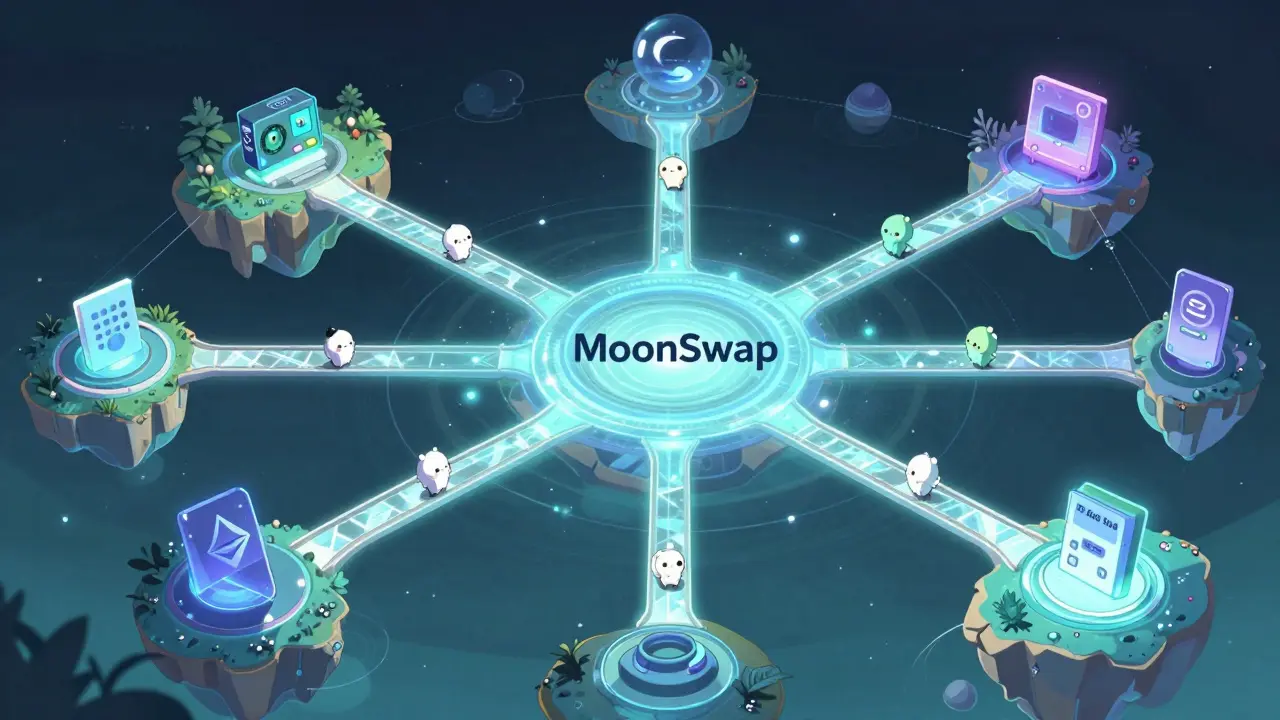
Liquidity is the lifeblood of any DEX. Without it, you cannot execute trades efficiently. MoonSwap excels in one specific area: cross-chain assets within the Polkadot ecosystem. Thanks to Moonbeam's XC-20 standard, you can swap tokens from Ethereum, Binance Smart Chain, and other networks directly on MoonSwap without intermediate bridging steps. This seamless integration is a unique advantage not found on most competing DEXs.
However, for mainstream pairs like USDC/MOVR or ETH/MOVR, liquidity can be thin. User reviews frequently cite slippage issues when swapping larger amounts of stablecoins. One user reported 7.2% slippage on a USDC to MOVR swap, which is unacceptable for anything beyond speculative bets. If you are looking to park significant capital in stablecoin pools, you might find better yields and depth on established platforms like Curve or Aave.
On the flip side, MoonSwap is a paradise for developers. In Q4 2025 alone, 327 new projects launched liquidity pools here. The permissionless model means you can deploy a token pool in under 5 minutes with zero listing fees. This attracts early-stage gems but also increases the risk of encountering low-quality or rug-pull projects. Always do your own due diligence before interacting with obscure tokens.
Pros and Cons Summary
To help you make a quick decision, here is a breakdown of the strengths and weaknesses of using MoonSwap in 2026.
- Pros:
- Extremely low transaction fees ($0.00045 avg).
- Seamless cross-chain swaps within the Polkadot ecosystem.
- Permissionless listings allow access to early-stage projects.
- Familiar EVM-compatible interface for Ethereum users.
- Strong developer support and active community.
- Cons:
- Low liquidity for large trades causes high slippage.
- Limited fiat on-ramp options require manual bridging.
- Dependent on MOVR price volatility for gas costs.
- Smaller user base compared to Ethereum or BSC DEXs.
- Lack of advanced features like stop-loss orders.

Who Should Use MoonSwap?
MoonSwap is not for everyone. If you are a high-frequency trader executing thousands of small trades, the 12-15 second block time might feel sluggish compared to Solana or Polygon. If you are managing millions in assets, the lack of deep liquidity will hurt your execution prices.
It is ideal for:
- DeFi Developers: Testing smart contracts and launching new tokens with minimal overhead.
- Polkadot Enthusiasts: Users who hold assets across multiple parachains and want to swap them easily.
- Small Retail Traders: Those making occasional swaps under $1,000 who want to avoid Ethereum gas fees.
- Yield Farmers: Looking for higher APYs (4.2% to 18.7%) in niche liquidity pools.
If you fall into these categories, MoonSwap offers a compelling value proposition. For everyone else, sticking to larger ecosystems might provide better security and liquidity.
Future Outlook and Risks
The future of MoonSwap is tightly linked to the success of the broader Polkadot and Moonbeam ecosystems. The upcoming Polkadot 2.0 upgrade aims to improve cross-chain messaging, which could expand MoonSwap's addressable market by 83%. However, risks remain. If MOVR prices drop significantly, effective gas costs for non-MOVR transactions rise proportionally. A 30% drop in MOVR could double your relative trading costs.
Additionally, competition is heating up. Aggregators like Rango Exchange are capturing share by offering similar cross-chain functionality across multiple networks. MoonSwap must continue to innovate, particularly in user experience and educational resources, to retain its niche. As of late 2025, development momentum remains strong with 28 active contributors, suggesting the platform is far from stagnant.
Is MoonSwap safe to use?
MoonSwap is a decentralized protocol, meaning there is no central server to hack. However, safety depends on the code integrity of the smart contracts and the tokens you interact with. While the core protocol has been audited, interacting with unverified or new tokens carries inherent risks. Always verify contract addresses and be cautious of phishing sites.
How do I get MOVR for gas fees?
You can purchase MOVR on centralized exchanges like Binance or Kraken and withdraw it to your Moonriver wallet address. Alternatively, you can use fiat on-ramps integrated into some wallets or bridge assets from Ethereum using the Moonbeam Bridge. Ensure you keep a small amount of MOVR in your wallet separate from your trading assets to cover gas.
Can I trade Bitcoin on MoonSwap?
Not directly. You would need to use wrapped versions of Bitcoin, such as WBTC, which are bridged onto the Moonriver network. These wrapped assets represent Bitcoin on the Ethereum-compatible chain, allowing you to trade them against MOVR or other tokens on MoonSwap.
Why is my swap showing high slippage?
High slippage occurs when there is insufficient liquidity in the trading pair. If you are trying to swap a large amount for a token with a small pool, the price impact will be significant. Try breaking your trade into smaller chunks or choosing a different liquidity pool with deeper reserves.
Does MoonSwap charge a fee?
Yes, MoonSwap charges a standard 0.3% fee on all swaps. Of this, 0.05% goes to the Moonriver treasury, and the remaining 0.25% is distributed to liquidity providers. This is typical for AMMs and helps incentivize users to provide capital to the pools.