
What Mining Difficulty Actually Means
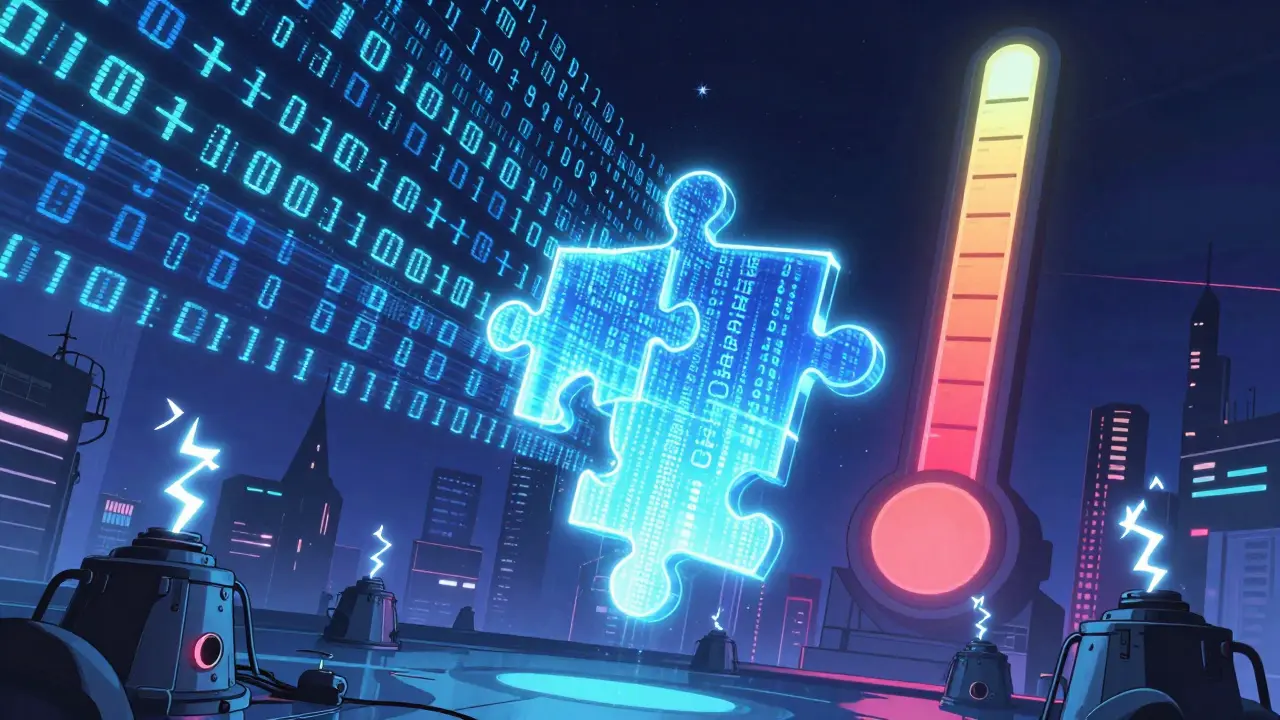
Miners don’t just guess random numbers to find a new Bitcoin block. They’re solving a math puzzle that gets harder or easier based on how much computing power is on the network. That’s where mining difficulty comes in. It’s not a fixed number-it’s a dynamic target that tells miners how hard they need to work to find a valid hash. The higher the difficulty, the more attempts it takes to win the block reward.
Every 2,016 blocks-roughly every two weeks-the Bitcoin network checks how long it took to mine those blocks. If it took less than 20,160 minutes (10 minutes per block), difficulty goes up. If it took longer, difficulty drops. This keeps the block time stable, no matter how many miners join or leave. As of January 2026, the difficulty was around 52.39 trillion. That means, on average, miners had to try 52.39 trillion different hash values before one of them found the right answer.
What Hash Rate Really Measures
While difficulty sets the target, hash rate measures the actual power behind the search. Think of it like the number of people flipping coins at once. If 100 people flip, you’ll get heads faster than if only 10 people are flipping. In Bitcoin, hash rate is the total number of hash calculations per second all miners are making. It’s measured in hashes per second, but because the numbers are huge, we use units like exahashes per second (EH/s).
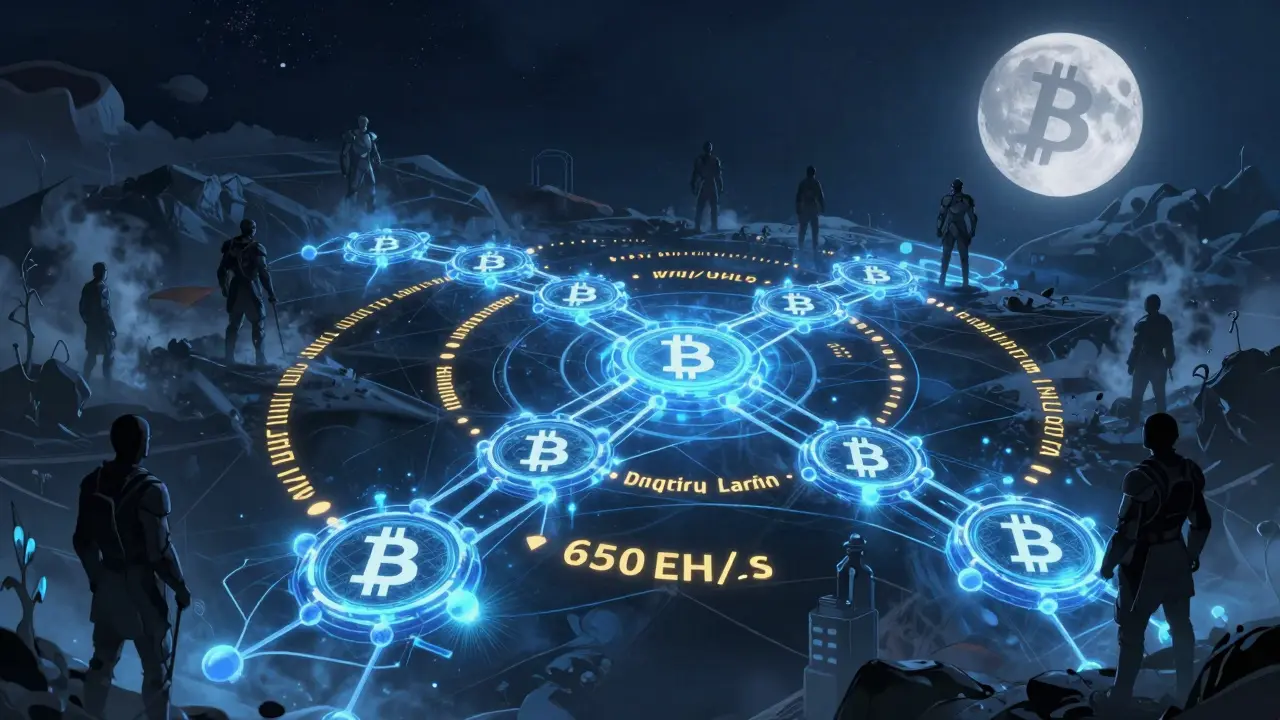
In January 2026, Bitcoin’s hash rate hit 650 EH/s. That’s 650 quintillion calculations every second. To put that in perspective, that’s more than the combined computing power of the top 500 supercomputers in the world. This number doesn’t stay constant. When Bitcoin prices rise, more miners buy machines and plug them in. When prices drop, some shut off. But the network doesn’t care-it just adjusts difficulty to keep the 10-minute rhythm.
The Direct Link Between Difficulty and Hash Rate
The relationship is simple: more hash rate → higher difficulty. Less hash rate → lower difficulty. It’s automatic. You can’t change it manually. The code does it. The formula is straightforward: if the last 2,016 blocks were mined faster than expected, the next difficulty is multiplied by a factor greater than 1. If slower, it’s multiplied by something less than 1.
Here’s the math behind it: the expected number of hashes to solve a block at difficulty D is roughly D × 2^32 / 600. At difficulty 1, that’s about 7 million hashes. At 52.39 trillion, you’re looking at over 650 EH/s to maintain the 10-minute average. The system is self-correcting. If hash rate suddenly doubles, difficulty will double two weeks later to bring the block time back to 10 minutes. If half the miners go offline, difficulty drops to compensate.
This is why Bitcoin stays secure. An attacker would need to control more than 50% of the total hash rate to manipulate the chain. The higher the hash rate, the more expensive and harder that becomes. Difficulty ensures that even if miners come and go, the security level stays high.

Why This Matters for Miners
For individual miners, difficulty isn’t just a number-it’s profit or loss. When difficulty jumps 8%, and your hardware hasn’t changed, your daily Bitcoin earnings drop. That’s what happened to many small miners after the January 2026 adjustment. One Reddit user reported his Antminer S21’s daily payout fell from 0.00012 BTC to 0.00011 BTC. That’s a 8.3% drop in income, with no change in electricity cost.
Big miners handle this better. Companies like Riot Platforms bought thousands of new ASICs before the November 2025 halving. When difficulty rose 15% after the halving, they were already equipped. Small miners, running under 1 PH/s, don’t have that luxury. Data from MiningPoolStats shows 68% of them say difficulty swings are their biggest problem. They’re caught between rising electricity prices and sudden difficulty spikes.
That’s why the best miners don’t just buy hardware-they watch trends. They track historical difficulty curves, study power contracts, and sometimes even move their rigs to regions with cheaper electricity. Core Scientific runs miners across 12 U.S. states to spread risk. Iris Energy in Australia uses hybrid power deals that adjust with Bitcoin’s price. These aren’t lucky guesses-they’re calculated moves.
How Mining Pools and Big Players Control the Game
It’s not just about individual miners. The top five mining pools-Antpool, F2Pool, ViaBTC, Foundry USA, and Binance Pool-now control 63.7% of Bitcoin’s total hash rate. That’s up from 58.2% in 2024. Why? Because scaling matters. Bigger pools can afford better hardware, negotiate lower electricity rates, and absorb difficulty spikes better than solo miners.
When difficulty jumps sharply, smaller miners often get squeezed out. The Bitcoin Suisse report from January 2026 found that difficulty increases over 10% in one adjustment cycle lead to 87% of mining power consolidating into the top 10 pools. It’s not conspiracy-it’s economics. The cost of running a miner is fixed. If your reward drops but your electricity bill doesn’t, you shut down. The big players just keep going.
Institutional miners have another trick: hedging. As of January 2026, 78% of publicly traded mining companies (like MARA and RIOT) use financial tools to lock in future Bitcoin prices or hedge against difficulty volatility. That cuts their revenue swings by 41% compared to 2024. They’re not just mining-they’re managing risk like hedge funds.
What’s Changing in 2026 and Beyond
Bitcoin’s difficulty adjustment has worked for 15 years, but it’s not perfect. The system only looks at the last 2,016 blocks. If there’s a sudden surge or crash-like during the 2021 China ban-it takes two weeks to react. That’s too slow. During that time, miners can over-invest or lose money.
Some developers are working on solutions. The Bitcoin Core team is testing something called Difficulty Adjustment Smoothing (DAS), which would use a 48-hour moving average instead of waiting for 14 days. Simulations show it could reduce difficulty swings by 37%. But there’s a catch. Faster adjustments might open up new attack vectors. If difficulty drops too fast after a hash rate crash, a malicious actor could temporarily flood the network and take control.
Dr. Pieter Wuille, a top Bitcoin Core contributor, says any change must preserve the original security model. That’s why nothing’s been implemented yet. The network values stability over speed.
Looking ahead, the 2028 halving will likely cause another big shakeup. Bitcoin’s block reward will drop again, and many miners won’t be profitable. Industry forecasts predict a 23-28% drop in hash rate right after. Then, two weeks later, difficulty will fall to match. It’ll be the biggest profitability test since 2021.
Why This System Is Brilliant
Bitcoin’s difficulty and hash rate system isn’t just technical-it’s economic. It’s a self-regulating market. When Bitcoin is valuable, more miners join. That raises difficulty, which makes it harder to profit. That pushes out inefficient miners. When the price drops, miners leave. Difficulty falls. The survivors keep going. It’s natural selection, coded into the protocol.
Compare this to other blockchains. Litecoin adjusts every 3.5 days. Zcash uses weighted averages. Ethereum’s old system had a “difficulty bomb” that made mining harder over time. Bitcoin’s approach is simple, predictable, and slow to change. That’s the point. It doesn’t need to be fancy. It just needs to work.
As of 2026, the network has processed over 1 billion blocks. Not one has been successfully attacked because of difficulty manipulation. That’s the real test. And it’s still standing.
What You Should Watch Next
If you’re mining, track difficulty trends. Use tools like Bitcoin.com’s difficulty chart or MiningPoolStats. Know your break-even point. If your electricity cost is above 5 cents per kWh, you’re already on thin ice. If it’s under 3.5 cents, you’re in the safe zone.
If you’re just holding Bitcoin, understand this: every time difficulty rises, the network gets more secure. More hash rate means more miners defending the chain. That’s good for long-term value.
The next big move? Watch for the 2028 halving. That’s when the real stress test begins.





Comments
Michael Sullivan
February 3, 2026 AT 22:34 PMSo let me get this straight - we’ve built a global financial system that adjusts itself like a thermostat, and people still think crypto is ‘not real money’? 😂
Deeksha Sharma
February 5, 2026 AT 11:58 AMThis is why I love Bitcoin. It’s not just tech - it’s evolution. Nature doesn’t beg for balance, it just *finds* it. Same here. 🌱
Mrs. Miller
February 6, 2026 AT 23:25 PMI once had a neighbor who thought mining was just ‘people typing on computers.’ I showed him the power bill for a single ASIC. He cried. Then he bought a dog. We’re all just trying to survive capitalism, honestly.
David Bain
February 8, 2026 AT 00:52 AMThe implicit assumption in the difficulty adjustment algorithm is that hash rate is a continuous, differentiable function - yet in practice, it exhibits discontinuities due to macroeconomic shocks (e.g., China ban, regulatory crackdowns). The 2-week lag is not a bug, it’s a feature of Byzantine fault tolerance under non-stationary conditions.
Nathaniel Okubule
February 8, 2026 AT 21:14 PMFor anyone thinking of starting mining: calculate your break-even point with electricity, hardware depreciation, and cooling costs. Then double it. If you’re still in, go for it. But don’t blame the network when your rig turns into a space heater.
Shruti Sharma
February 10, 2026 AT 17:46 PMidk why ppl make this so hard its just like if u have more people playin the game the prize gets harder to win lol
Alisha Arora
February 11, 2026 AT 17:27 PMYou think small miners are struggling? Try being a single mom in Texas with a 10-year-old Antminer in your garage trying to pay for insulin. This isn’t ‘natural selection’ - it’s a rigged casino where the house always wins.
Freddie Palmer
February 12, 2026 AT 11:27 AMWait, so if hash rate doubles, difficulty doubles... but what if someone just... turns off a bunch of miners? Like, on purpose? And then, like, reactivates them later? Could you game the system? I mean, technically? Just... hypothetically?
Taybah Jacobs
February 13, 2026 AT 10:27 AMThe elegance of Bitcoin’s design lies not in its complexity, but in its restraint. It does not seek to optimize for speed, efficiency, or user-friendliness. It seeks to endure. And in doing so, it has outlasted every other digital currency ever created.
Robin Ødis
February 14, 2026 AT 02:19 AMI’ve been tracking this since 2017 and I can tell you - this whole ‘self-regulating’ thing is a lie. The big pools control the hash rate. They’re the ones who decide when to turn on and off. The ‘market’ doesn’t decide anything - the oligarchs do. And now they’re using hedge funds to hedge against their own mining profits? This isn’t decentralization - it’s Wall Street with ASICs.
Joshua Herder
February 15, 2026 AT 21:51 PMOkay, but what if the next difficulty adjustment happens during a global blackout? Or a solar flare? Or if the entire U.S. power grid goes down for a week? Do you think the network will just... wait? Or will it collapse? Because if it’s so ‘self-correcting,’ why does it need 650 EH/s just to keep a digital ledger running? Why not 10 EH/s? Why not 1? Why do we need this much energy to verify transactions? This isn’t innovation - it’s insanity. We’re building a cathedral out of lightning and calling it progress.
Brittany Novak
February 17, 2026 AT 08:43 AMThey’re lying about the hash rate. The real number is 200 EH/s. The rest is fake mining from centralized pools that don’t even mine - they just report fake numbers to keep the difficulty low so they can front-run the market. The Fed’s behind it. They need Bitcoin to look strong so people don’t run to gold. I’ve seen the spreadsheets.
Reda Adaou
February 18, 2026 AT 17:21 PMI used to think mining was just for tech bros. Then I met a guy in rural India who runs a small rig powered by solar panels. He says he’s saving up to send his daughter to college. He doesn’t care about the hash rate or the difficulty. He just knows that every Bitcoin he mines is one step closer to a future that doesn’t depend on a bank. That’s the real story here.