

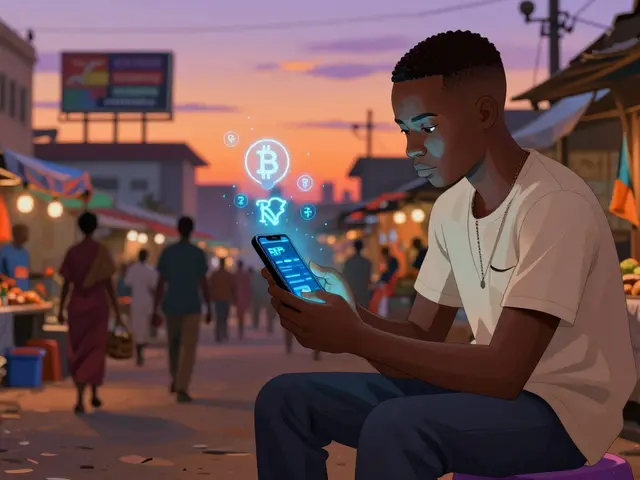
Imagine trying to send money to your family across the border, only to lose 15% of it in fees and wait two weeks for the cash to arrive. For millions of people in developing nations, this isn't a hypothetical nightmare; it's their Tuesday. While traditional banking systems struggle to reach the estimated 1.4 billion unbanked adults globally, Cryptocurrency is emerging as a practical workaround. It doesn't require a physical branch, a minimum balance, or a credit history. You just need a smartphone and an internet connection. This shift isn't just about tech enthusiasts trading Bitcoin. It's about survival and economic participation. From farmers in rural Kenya to migrant workers in Southeast Asia, crypto is filling the gaps left by underdeveloped financial infrastructure. But is it a silver bullet? Not quite. It comes with its own set of hurdles, from regulatory uncertainty to the sheer complexity of managing private keys. Let’s look at how this technology is actually changing lives on the ground, where it shines brightest, and what still stands in the way of mass adoption.
The Gap Traditional Banking Leaves Behind
To understand why crypto matters here, you have to look at what's missing. In many developing regions, the definition of "banking" is outdated. It assumes you live near a branch, have formal identification, and earn a steady income. In Sub-Saharan Africa, for instance, only about 49% of adults held bank accounts as of recent data. The rest are excluded not because they lack value, but because the system lacks access points for them.
Traditional banks demand extensive documentation and physical presence. If you live three hours from the nearest branch, going to deposit a paycheck or check a balance is a logistical and financial burden. Crypto flips this model. A digital wallet can be created in minutes without identity verification (in permissionless networks) or geographic constraints. This low barrier to entry is the core mechanism driving adoption among those who have been historically ignored by the formal economy.
Remittances: The Biggest Win
If there is one area where crypto has proven its worth immediately, it is cross-border remittances. For many developing economies, remittances are a critical pillar of GDP. Yet, the traditional channels-money transfer services and wire transfers-are notoriously expensive and slow.
- Traditional Fees: Often range from 6% to 15% of the transfer amount.
- Processing Time: Can take days or even weeks.
- Crypto Fees: Typically under 1% of transaction value on efficient networks.
- Processing Time: Near-instantaneous, depending on network congestion.
Consider a worker in Dubai sending $300 home to Nigeria. Through a traditional service, the family might receive $260 after fees. With a stablecoin or low-fee cryptocurrency, that same $300 could arrive almost instantly with minimal loss. For families living on thin margins, saving $40 per month is the difference between buying extra food or skipping a meal. This direct cost reduction is the primary driver behind grassroots adoption in regions like South Africa, Nigeria, and Kenya.
Hedging Against Inflation
Beyond moving money, crypto serves as a shield against local currency collapse. Many developing nations suffer from chronic high inflation, which erodes the purchasing power of savings held in local currencies. When your national currency loses 50% of its value in a year, keeping cash in a bank account feels like watching your wealth disappear.
Cryptocurrencies like Bitcoin offer a different proposition: fixed supply and global pricing. They aren't controlled by a single central bank that might print more money to cover deficits. For citizens in countries experiencing currency crises, holding a portion of their wealth in crypto provides a hedge. It’s not perfect-the price of Bitcoin itself fluctuates-but it decouples personal wealth from the instability of the local fiat currency. This function has become particularly valuable in nations where banking systems are fragile and trust in government monetary policy is low.

Barriers to Entry: Why Adoption Isn't Universal
It would be easy to paint a utopian picture, but the reality is messier. A comprehensive 2025 literature review identified four main obstacles preventing wider adoption:
- Regulatory Uncertainty: Many governments haven't defined the legal status of crypto. Is it property? Currency? A security? This ambiguity scares off users and limits mainstream integration.
- Infrastructure Gaps: You need internet and a smartphone. While mobile penetration is high, reliable, affordable data remains inconsistent in rural areas.
- Technical Complexity: Managing private keys and understanding wallet security is daunting for those with limited digital literacy. Lose your key, and your money is gone forever. There is no customer support line to call.
- Market Volatility: Low-income users cannot afford large swings in value. If the asset they're using to save drops 20% overnight, it undermines the very stability they were seeking.
Complementing, Not Replacing, Banks
A common misconception is that crypto will destroy traditional banking in these regions. Expert analysis suggests the opposite: crypto works best when it complements existing infrastructure. Georgetown University researchers note that crypto is most effective for the unbanked and for cross-border payments. For those already in the system, banks can integrate crypto capabilities to offer better services.
Think of it as layers. The base layer is the community needing basic access. Crypto fills that gap. As infrastructure improves, banks can step in to provide regulated, user-friendly interfaces that sit on top of blockchain rails. This hybrid approach reduces risk for users while leveraging the efficiency of distributed ledger technology (DLT). Central banks in places like Ghana and Nigeria are already testing digital currencies designed specifically to enhance inclusion, signaling that the future is likely a mix of public and private digital assets.
| Feature | Traditional Banking | Cryptocurrency |
|---|---|---|
| Access Requirement | Physical branch, ID, Credit History | Smartphone, Internet Connection |
| Transaction Speed (Cross-Border) | Days to Weeks | Minutes to Seconds |
| Typical Fees (Remittance) | 6% - 15% | < 1% |
| Inflation Protection | Low (Subject to Local Policy) | Medium-High (Global Pricing/Fixed Supply) |
| User Risk | Bank Failure, Account Freeze | Key Loss, Price Volatility, Scams |

The Road Ahead: What Needs to Happen
For crypto to truly transform financial inclusion, several things need to align. First, regulations must clarify. Users need to know their rights. Second, education must scale. We need simple, localized tutorials that explain how to secure a wallet without technical jargon. Third, infrastructure must improve. Cheaper data and better connectivity in rural areas are non-negotiable prerequisites.
Furthermore, innovation is expanding beyond simple transfers. Asset tokenization is allowing small businesses in developing countries to raise capital from global investors, bypassing local lending restrictions. This creates jobs and generates tax revenue, making the case for crypto stronger in the eyes of policymakers. The goal isn't just to move money faster; it's to unlock economic potential for millions who have been locked out of the game for decades.
Frequently Asked Questions
Do I need a computer to use crypto for financial inclusion?
No. Most modern crypto wallets are designed for mobile phones. As long as you have a smartphone and an internet connection, you can store, send, and receive cryptocurrency. This is crucial in developing regions where desktop computer ownership is low.
Is crypto safer than keeping cash in a bank in unstable economies?
It depends on the risk profile. Crypto protects against hyperinflation and bank insolvency but introduces new risks like hacking, lost private keys, and price volatility. For many, a mixed strategy-holding some local currency for daily needs and some crypto for long-term savings-is the most prudent approach.
Which cryptocurrencies are best for remittances in developing countries?
Stablecoins (like USDT or USDC) are often preferred for remittances because they are pegged to the US dollar, reducing price volatility. However, low-fee networks like Solana or Polygon are also gaining traction because they make transactions cheap and fast. Bitcoin remains popular for its brand recognition and perceived safety as a store of value.
What happens if I lose my phone with my crypto wallet?
If you have backed up your recovery phrase (a list of 12 or 24 words), you can restore your wallet on any new device. If you don't have the backup, your funds may be permanently lost. This is why education on seed phrase management is critical for financial inclusion initiatives.
Are governments in developing countries banning crypto?
Not generally. While some countries have imposed strict regulations, most are moving toward clarification rather than outright bans. Countries like Nigeria and El Salvador have actively embraced crypto. The trend is toward integrating crypto into the financial system to capture economic benefits, provided consumer protections are in place.


Comments
nic c
August 27, 2026 AT 06:54 AMOh, look at you all, clapping for the digital opium of the masses while ignoring the fact that this is just a glorified casino with extra steps and a higher risk of total annihilation than your local bank. The article paints this rosy picture of 'financial inclusion' but let's be real, it's mostly just tech bros finding new ways to extract value from people who are already on the bottom rung of the ladder, using buzzwords like 'decentralization' to mask what is essentially a massive, unregulated transfer of wealth from the uninformed to the informed. You think a farmer in rural Kenya cares about 'blockchain rails'? No, he cares that his phone battery died before he could send the money and now his family is hungry, or that he lost his seed phrase because he wrote it on a piece of paper that got wet in the rain. It’s a beautiful narrative, truly, if you ignore the catastrophic failure rates of human error involved in self-custody, which is the primary mode of operation here. They talk about bypassing banking barriers, but they’re really just replacing one set of opaque, predatory systems with another set of opaque, volatile ones, and calling it freedom. The regulatory uncertainty isn't a bug, it's a feature; it keeps the rules flexible enough for the sharks to swim freely while the minnows get eaten. So go ahead, celebrate the 'innovation,' but don't pretend it's charity, it's extraction with a better PR team.
Steve Sulley
August 28, 2026 AT 23:31 PMtypo alert: its not just extraction, its survival. i live in nigeria and we dont have time for your fancy western banking drama. my uncle sends money from dubai via usdt and it hits his wallet in mins. no waiting 2 weeks, no losing 15% to the guy at the counter who looks like he wants to charge you for breathing. yes the naira is trash so we hedge in stablecoins. you call it volatility, we call it keeping our food on the table. stop reading articles written by guys who never left their air conditioned office in san francisco and start looking at reality. the 'risk' of losing keys? well the risk of inflation eating your savings is 100% certain. choose your poison. also, the internet is getting better, even in the villages. give it a decade.
Trista Dennis
August 30, 2026 AT 15:24 PMOh, how quaint. We are supposed to feel warm and fuzzy about 'bypassing barriers' when the actual barrier is that half the population can't afford a smartphone with decent data plans, let alone understand what a private key is without crying. It’s not 'inclusion,' it’s exclusion by technicality. You’ve simply moved the gate from a physical branch to a digital one that requires a degree in computer science to open. And let’s not pretend the fees are negligible; gas wars on Ethereum or network congestion on Solana make the 'under 1%' claim sound like a fairy tale told by venture capitalists trying to sell their next ICO. The 'survival' aspect is romanticized until the moment someone loses their recovery phrase and their life savings vanish into the ether, forever. It’s a high-stakes game where the house always wins, and the players are too poor to afford the insurance policy. Beautifully efficient poverty management, wouldn’t you say?
Rebecca Springer
August 31, 2026 AT 21:28 PMI think there is a lot of truth in both sides here. In my experience working with international development NGOs, the biggest issue isn't the technology itself, but the lack of localized education. When we introduced mobile money in East Africa, it was a huge success, but crypto adds a layer of complexity that many users find intimidating. However, I agree that for cross-border remittances, the cost savings are undeniable. I’ve spoken to families in Ghana who use USDT specifically because the exchange rate fluctuation in the cedi makes holding cash risky. It’s not perfect, and the fear of losing funds is very real, but for those who have access to reliable internet and some basic digital literacy, it has genuinely changed their economic outlook. It’s less about replacing banks and more about providing an alternative rail for those who are currently underserved. The key, as the post mentions, is complementary infrastructure. If governments can provide clear regulations and perhaps subsidized data access, the adoption curve will likely smooth out significantly over the next few years.
Kevin Payette
September 2, 2026 AT 11:29 AMYou're all missing the point. This isn't about 'inclusion.' It's about control.
The elites know that fiat currency is a leash. Crypto cuts the leash. But who holds the knife? The miners. The exchanges. The VC firms.
It's a trap. A shiny, digital trap. You think you're free? You're just in a different cage. One made of code instead of brick. And when the code breaks, or the price crashes, you're back to square one, poorer than before. The 'volatility' argument is weak. Poor people need stability. Stability comes from government bonds, not speculative assets. Let the rich play with their Bitcoin. The rest of us should stick to the boring, predictable, safe world of traditional banking. Anything else is just gambling with your rent money.
J Shepherd
September 3, 2026 AT 08:45 AMLook, let's break down the UX friction here. The core value prop is low-latency settlement for cross-border flows. For the unbanked, the onboarding flow needs to be abstracted away. We're seeing a shift towards custodial solutions wrapped in non-custodial interfaces, which reduces the 'lost key' anxiety significantly. The regulatory arbitrage is actually driving innovation in compliance tech (KYC/AML) that is more efficient than legacy banking stacks. If you optimize for the user journey-specifically the off-ramp to local fiat-you see a net positive utility gain. The volatility risk is mitigated by stablecoin dominance in these corridors. It's not about ideology; it's about reducing transaction costs and increasing liquidity access. The infrastructure gap is closing faster than most realize due to mobile-first design patterns.
Alan Hawkins
September 4, 2026 AT 13:47 PMI totally agree with the sentiment here. It's great to see people recognizing the potential. I've been following this space for a while and it's exciting to see the progress being made in developing regions. The technology is definitely maturing and becoming more accessible. It's a win-win situation for everyone involved, really. Just keep up the good work!
Linda Jevne
September 5, 2026 AT 02:13 AMThere is a profound philosophical tension here between autonomy and security. We often view financial tools through the lens of Western individualism, where 'ownership' means absolute control. But in many communal societies, money is a shared resource, managed collectively. Crypto forces an individualistic model onto a collective culture, which creates friction. Is it truly 'inclusion' if it demands a level of solitary responsibility that contradicts social norms? Perhaps the future lies in multi-sig wallets or community-managed treasuries on-chain, blending the best of both worlds. We must ask ourselves: are we building tools for the people, or are we building people to fit the tools? The answer dictates whether this revolution is liberating or merely a new form of alienation.
Carey Thornton
September 6, 2026 AT 22:09 PMExquisite analysis, though slightly lacking in nuance, as is typical of such broad-brush strokes. The notion that 'anyone' can participate is a delightful fiction, akin to saying anyone can paint if given a brush. One must possess the cognitive bandwidth to navigate the labyrinthine depths of cryptographic security. Most of these 'unbanked' individuals are not seeking 'financial freedom'; they are seeking a way to move a few dollars without being extorted by middlemen. To call this a 'revolution' is hyperbolic; it is merely a marginal efficiency gain for a specific demographic, dressed up in the garb of utopian promise. The 'barriers' mentioned are not bugs to be fixed by code, but symptoms of a deeper societal malaise that no amount of blockchain magic can cure. Do not mistake convenience for liberation.
Ellie Brooks
September 6, 2026 AT 23:07 PMThis is such a hopeful perspective! I love how it highlights the real-world impact on families. It's inspiring to think that a simple smartphone can bridge such a huge gap in economic opportunity. I've seen stories about teachers in Latin America using crypto to save for retirement because their local pension system was unreliable, and it gave me chills in the best way possible. It's not just about the money; it's about dignity and having a say in your own financial future. If we can scale this properly with better education and support, we could really change the trajectory for millions of lives. It makes me want to volunteer with some of these grassroots organizations that are teaching people how to secure their wallets. The energy around this topic is just electric right now!
Dave Worth
September 8, 2026 AT 21:51 PMWake up sheeple 🐑🚨 They are coming for your privacy! You think you're saving money on fees? Nah, you're just feeding the surveillance state. Every transaction is tracked on the blockchain. It's public record. The Fed doesn't need to print money anymore, they just need to hack the smart contracts. 📉💸
El Salvador is a test case for the New World Order. Once they get the CBDC fully integrated, you won't even be able to buy coffee without a credit score check. The 'stablecoins' are just dollar-denominated IOUs controlled by Wall Street banks. 🏦🕵️♂️
Keep your cash under the mattress. That's the only true freedom. #CryptoWinterIsComing #FiatIsDeadButNotBuried
Matt Reckdenwald
September 10, 2026 AT 17:28 PMIt’s easy to dismiss the risks when you aren’t the one living with them. For many in these regions, the choice isn't between 'crypto' and 'banking'; it's between 'crypto' and 'informal money lenders' who charge 20% interest per week. When you frame it that way, the risk profile changes entirely. Yes, losing a seed phrase is terrifying, but so is debt bondage. The empathy gap in these discussions is often vast. We need to listen to the voices of the users themselves, not just the analysts in boardrooms. Their resilience is remarkable, and their adoption is driven by necessity, not hype. That distinction matters. It’s a quiet revolution, fueled by desperation and hope in equal measure.
Emmanuel Ogbomo
September 11, 2026 AT 01:20 AMI observe this from the Nigerian side. The adoption is organic, not forced. People use it because it works. The 'complexity' argument is valid for the elderly or those with very low literacy, but for the youth, it's second nature. They grew up with smartphones. The real barrier is still the off-ramp. Converting USDT to Naira at a fair rate is the hardest part. If P2P markets remain unstable, adoption will plateau. But for now, it's a lifeline. I don't see it replacing banks soon, but it's a strong parallel track. Time will tell if the regulators step in to help or hinder. Neutral observation: the tech is ready, the humans are ready, the laws are lagging.
Melanie Armijo
September 12, 2026 AT 20:01 PMIsn't it fascinating how we define 'value'? In a hyperinflationary environment, value isn't stored in the currency, it's stored in the trust of the network. Crypto shifts that trust from a central authority to a mathematical proof. It's a subtle but profound shift in how we perceive ownership. We are moving from a world of 'permission' to a world of 'proof'. Whether that's good or bad depends on who you ask, but it's certainly a new chapter in human history. We are writing the rules as we go, and that's both thrilling and terrifying.
Ashwin Bhandurge
September 13, 2026 AT 06:28 AMGreat points everyone! From an Indian perspective, we saw similar waves with UPI (Unified Payments Interface). It wasn't crypto, but it solved the same problem: instant, cheap, accessible payments. The lesson is that the technology is secondary; the user experience is primary. If crypto can achieve that 'UPI-like' simplicity for cross-border transactions, it will explode in popularity. We need to focus on interoperability and seamless off-ramps. The potential for job creation in fintech services in these regions is massive. Let's encourage collaboration between global developers and local communities. Together, we can build a more inclusive financial ecosystem. Keep the momentum going!