
Picture this: you buy a JPEG of a monkey for $600,000. Your friends think you’ve lost your mind. You feel like you’re holding onto thin air. This was the reality for many during the peak NFT boom, but it also highlights the biggest question in digital ownership today: why does any of this have value?
If you’ve been watching the crypto space since 2021, you know the market has cooled down significantly. The wild speculation is mostly gone, replaced by a more mature, utility-driven ecosystem. But that doesn’t mean the assets are worthless. In fact, understanding NFT pricing now requires looking past the hype and focusing on concrete mechanics like scarcity, utility, and community strength.
This isn’t about convincing you to buy the next big thing. It’s about explaining the actual levers that determine what an NFT costs and why someone would pay for it. Whether you’re a creator trying to mint your first collection or a collector wondering if your portfolio is healthy, these are the rules of the game right now.
The Core Concept: Digital Scarcity and Uniqueness
To understand value, you first have to understand what makes an NFT different from a regular file on your hard drive. An NFT, or Non-Fungible Token, is a unique certificate of ownership stored on a blockchain, most commonly Ethereum. Unlike Bitcoin, where one coin equals another (fungible), every NFT is distinct. You can’t swap one Bored Ape for another and expect them to be identical in value because their traits differ.
This uniqueness creates digital scarcity, which is the artificial limitation of supply to increase demand and perceived value. In the physical world, scarcity is natural-there are only so many original Van Gogh paintings. In the digital world, copying is free and instant. So, creators impose scarcity through code. They might mint only 10,000 items, or even just one single piece.
Think of it like limited-edition sneakers. The shoe itself isn’t magically better than a standard pair, but the fact that only 500 exist makes people fight over them. For NFTs, the blockchain proves who owns the "original" token linked to that image or asset. Without that proof of authenticity and scarcity, the file is just data. With it, it becomes a collectible asset class.
Floor Price: The Baseline of Market Sentiment
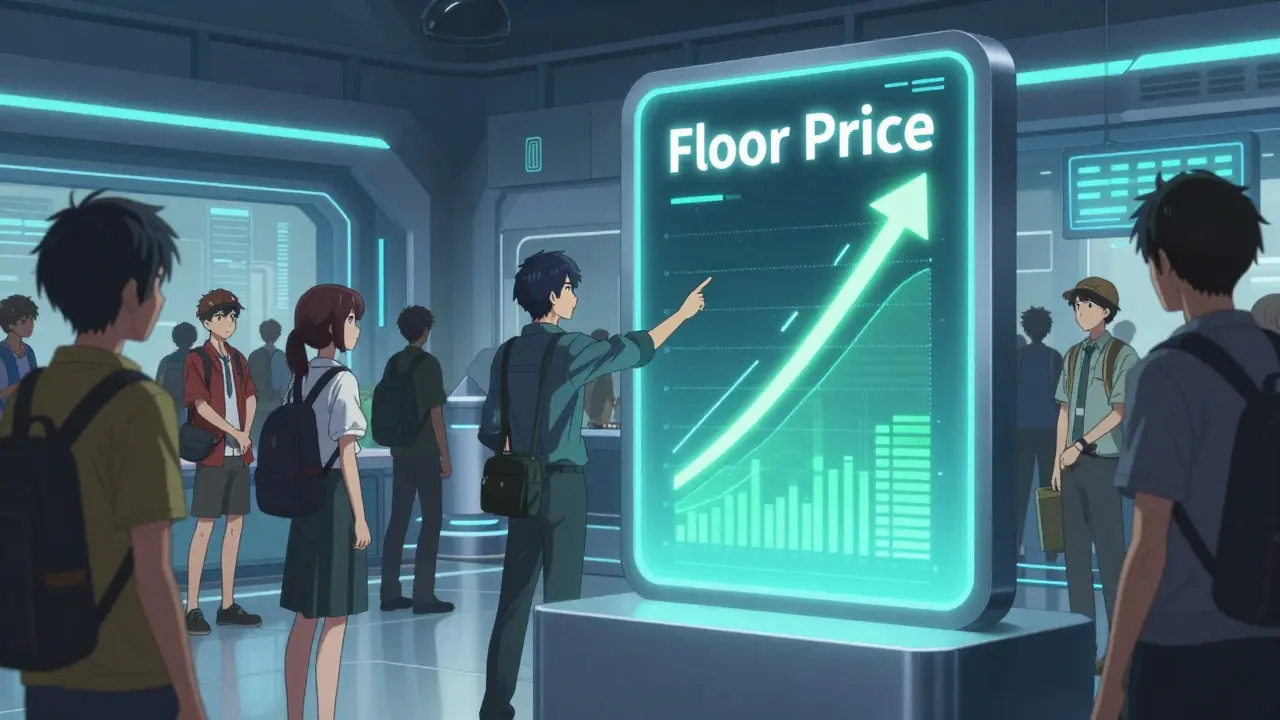
If you look at any major NFT marketplace like OpenSea or Blur, you’ll see a metric called the "floor price." This is the lowest listing price for any single item within a specific collection. It’s the minimum entry cost to own something from that project.
The floor price is crucial because it acts as a real-time barometer for market sentiment. If a collection’s floor price is climbing steadily, it means buyers are willing to pay more than the previous owners asked, indicating confidence and demand. Conversely, if the floor drops rapidly, it signals panic selling or loss of interest.
| Scenario | Market Signal | Action for Collectors |
|---|---|---|
| Floor Price Rising Slowly | Healthy demand, organic growth | Consider buying; low risk of immediate crash |
| Floor Price Spiking Suddenly | Hype, FOMO, or whale activity | Cautious; could be a bubble ready to burst |
| Floor Price Dropping Gradually | Loss of interest, market correction | Wait for stabilization before entering |
| Floor Price Crashing | Panic, rug pull, or bad news | Avoid; high risk of total loss |
It’s important to note that the floor price represents the *cheapest* item. Rare items with special traits often sell for multiples of the floor price. So, while the floor tells you the baseline value, it doesn’t tell the whole story of a collection’s potential.
Utility: Beyond Just Looking at Art
In the early days, NFTs were mostly profile pictures (PFPs). Now, value is increasingly tied to utility, which refers to the practical benefits or functions an NFT provides to its owner beyond mere ownership. An NFT that does something is worth more than one that just sits in a wallet.
Here are common forms of utility that drive pricing:
- Access Passes: Owning an NFT grants entry to exclusive Discord channels, private events, or beta software tests.
- Gaming Assets: Characters, weapons, or land in blockchain games that can be used to earn rewards or improve gameplay.
- Virtual Real Estate: Plots of land in metaverse platforms like Decentraland or The Sandbox, which can generate income through ads or hosting experiences.
- Intellectual Property Rights: Some projects transfer commercial rights to the owner, allowing them to create merchandise or content based on the artwork.
When evaluating an NFT’s price, ask yourself: "What do I get for owning this?" If the answer is "nothing," you’re betting purely on speculation. If the answer includes tangible benefits, the valuation has a stronger foundation.
Creator Reputation and Community Strength
Who made it matters. In traditional art, a painting by Banksy sells for millions, while a similar style by an unknown artist sells for pennies. The same logic applies to NFTs. Established artists, brands, or developers with a proven track record command higher prices because collectors trust they will deliver on promises.
But reputation isn’t just about fame; it’s about consistency. Has the team released updates? Do they engage with their community? A strong, active community is perhaps the most undervalued asset in NFTs. Projects with vibrant Discords, active Twitter spaces, and regular interactions tend to hold their value better during market downturns.
Community acts as a support network. When prices drop, a loyal community may step in to buy the dip, stabilizing the floor. Without that social glue, projects often collapse once the initial hype fades. Look for signs of genuine engagement, not just bot-generated likes.
Rarity and Trait Combinations
Within a collection, not all NFTs are equal. Most collections use algorithms to assign random traits-like background color, hat type, or eye shape-to each token. Some combinations are extremely rare, occurring in less than 1% of the supply.
Rarity tools analyze these traits to give each NFT a score. A "rare" monkey with a golden fur and laser eyes might sell for 10x the floor price, while a common one with basic traits sells near the floor. This internal hierarchy allows collectors to hunt for bargains or invest in high-value pieces within the same project.
However, rarity alone doesn’t guarantee value. If no one wants the collection overall, a rare trait won’t save it. Rarity amplifies demand; it doesn’t create it from scratch.

Market Liquidity and Trading Volume
Liquidity refers to how easily you can buy or sell an NFT without drastically affecting its price. High liquidity means there are many buyers and sellers, making transactions smooth. Low liquidity means you might struggle to find a buyer, forcing you to lower your price significantly.
Research from ETH Zurich highlighted that trading volume and liquidity are strong predictors of NFT prices. Collections with consistent daily trades maintain more stable valuations. Sporadic sales suggest a dormant market, which increases risk.
When assessing an NFT’s price, check its trading history. Has it changed hands recently? Are there multiple listings available? If the last sale was six months ago, the listed price might be outdated. Always compare recent sales data, not just current listings, to gauge true market value.
Technical Factors: Gas Fees and Blockchain Choice
The blockchain you choose affects both cost and accessibility. Ethereum remains the dominant platform for high-value NFTs due to its security and large user base, but it comes with high transaction fees, known as gas fees. During busy periods, these fees can exceed the value of cheaper NFTs, deterring casual buyers.
Alternative blockchains like Polygon, Solana, or Flow offer lower fees and faster transactions, making them popular for gaming and mass-market collections. However, they may have smaller communities and less liquidity than Ethereum. The choice of blockchain influences the target audience and, consequently, the pricing strategy.
Additionally, smart contract features like royalties allow creators to earn a percentage of secondary sales. While controversial, royalties can incentivize long-term project development, indirectly supporting value retention.
Current Market Reality: Maturation Over Hype
As of 2026, the NFT market has shed much of its speculative excess. Trading volumes have stabilized at lower but more sustainable levels. Institutional players, museums, and major brands have entered the space, bringing professional valuation methods and regulatory scrutiny.
This maturation means pricing is now driven by fundamentals rather than fear of missing out (FOMO). Collectors are more discerning, focusing on projects with clear roadmaps, active development, and real-world utility. The era of flipping random JPEGs for quick profits is largely over.
For new participants, this presents an opportunity. With fewer speculators, undervalued assets with strong potential can be identified more easily. Success now requires patience, research, and a focus on long-term value rather than short-term gains.
Do NFTs still have value in 2026?
Yes, but the definition of value has shifted. Instead of speculative hype, value is now derived from utility, community strength, and creator reputation. NFTs serve as access passes, gaming assets, and digital identity markers, providing tangible benefits beyond mere ownership.
How is the floor price determined?
The floor price is the lowest active listing price for any item in a specific NFT collection. It fluctuates in real-time based on seller behavior and market demand. It serves as a baseline indicator of a collection’s current market value.
Why do some NFTs cost thousands while others are free?
Price differences stem from scarcity, creator fame, utility, and rarity. High-value NFTs often come from established artists, offer exclusive benefits, or possess rare traits. Free or low-cost NFTs typically lack these drivers and rely on volume rather than individual prestige.
Does social media popularity affect NFT prices?
Interestingly, research suggests a negative correlation between direct social media activity and sustained NFT prices. While initial hype can spike prices, long-term value depends more on community engagement, utility, and consistent trading volume than viral trends.
Is it better to buy on Ethereum or other blockchains?
Ethereum offers higher liquidity and prestige but comes with high gas fees. Other blockchains like Polygon or Solana provide lower costs and faster transactions, suitable for gaming or frequent trading. Your choice should depend on your budget, risk tolerance, and intended use case.