

When you think of blockchain, you probably think of Bitcoin transactions or Ethereum smart contracts. But what if your data could be processed on a public blockchain - without anyone seeing it? That’s the core idea behind Phala Network (PHA), a crypto project built not just to move money, but to protect secrets.
Phala Network isn’t just another token - it’s a privacy engine
Most blockchains are transparent by design. Every transaction, every contract, every bit of data is visible to everyone. That’s great for trust, but terrible for privacy. If you’re running a DeFi trading bot, analyzing medical records, or managing AI models, you don’t want your competitors - or even network operators - peeking at your inputs.
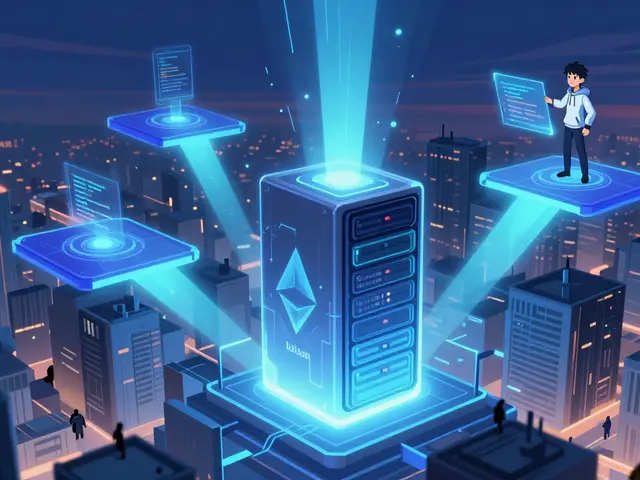
Phala Network solves this with Trusted Execution Environment (TEE) hardware-based secure zones that isolate data during computation, even from the nodes running the system. Think of it like a locked vault inside a public library. Anyone can see the library is open, but only authorized people can open the vault - and even the librarians can’t peek inside.
This isn’t science fiction. Phala uses real silicon technology - Intel SGX and AMD SEV - to create these secure enclaves. The data never leaves the enclave. The computation happens inside. The result is sent out. No one else sees what was inside. Not the miner. Not the validator. Not even Phala’s own team.
How Phala works: Two networks, one purpose
Phala doesn’t try to do everything on-chain. It splits the job:
- The Blockchain Network - handles payments, governance, and consensus. It’s built on Substrate, the same framework as Polkadot.
- The Computation Network - runs all the private tasks. This is where your confidential data gets processed.
The two networks talk to each other through a bridge called Pherry a secure messenger that translates data between the blockchain and the TEE enclaves. It’s like a bouncer at a club: it checks IDs, lets data in and out, but never touches what’s inside.
What makes this powerful is that Phala doesn’t force you to choose between decentralization and privacy. You get both. Other projects might offer privacy, but they rely on centralized servers. Phala’s entire architecture is decentralized - no single company controls it.
Phat Contracts: The secret sauce
Most blockchains use smart contracts - self-executing code that runs on-chain. But they’re slow, expensive, and completely open. If you write a trading bot on Ethereum, everyone can see your strategy. Phala changes that with Phat Contracts off-chain smart contracts that run in secure enclaves and remain private even from network participants.
Here’s what Phat Contracts can do that regular smart contracts can’t:
- Connect to real-world APIs (like Gmail, Amazon Cloud, or stock market data) without exposing your login keys.
- Run complex AI models on private user data - say, analyzing your medical records to suggest treatments - without ever uploading the raw data.
- Power automated trading bots that execute trades based on your portfolio, while hiding your holdings from everyone else.
- Handle real-time gaming logic or metaverse interactions without lag or central servers.
Imagine a DeFi platform that auto-rebalances your portfolio every week. On Ethereum, it’s public - everyone knows your strategy. On Phala, only you know. The contract runs in a secure box. It pulls your wallet data, checks market trends, executes trades, and sends back the result. No one else sees a thing.

PHA token: More than just a currency
PHA is the native token of Phala Network. With a maximum supply of 1 billion, around 672 million are currently in circulation. It’s not just a speculative asset - it’s the fuel for the whole system.
Here’s how PHA is used:
- Payment - Developers pay PHA to run computations. Businesses pay to deploy Phat Contracts.
- Staking - Node operators (called Workers) stake PHA to provide computing power. Gatekeepers stake PHA to manage encryption keys.
- Rewards - Workers earn PHA for uptime and performance. Stakers earn passive income by delegating to Workers.
- Governance - PHA holders vote on upgrades, fee changes, and network rules.
- Cross-chain bridge - PHA moves between Polkadot, Ethereum, and Binance Smart Chain, acting as a liquidity connector.
Unlike many tokens that rely on hype, PHA’s value is tied to real usage. More people using Phala’s cloud = more PHA paid in fees = more demand for the token. It’s a self-reinforcing loop.
Real-world uses: Where Phala is already making an impact
Phala isn’t theoretical. It’s being used today:
- Confidential DeFi - Trading bots that hide strategies from front-runners and competitors. No more losing trades because someone copied your algorithm.
- AI Privacy - Hospitals can analyze patient data without exposing personal info. Insurance companies can assess risk without storing raw records.
- Decentralized AI Agents - AI assistants that learn from your behavior, but never upload your data to a central server.
- Gaming & Metaverse - Real-time physics, inventory management, and dynamic event triggers without lag or centralized servers.
- Enterprise Data - Companies use Phala to run internal analytics on blockchain - without leaking sensitive business metrics.
One concrete example: A hedge fund uses Phala to run a quantitative trading model. The model pulls data from CoinGecko, Binance, and Twitter sentiment. It analyzes patterns, executes trades, and sends back profits. All of this happens in a secure enclave. No one - not even the fund’s own employees - can access the raw data or logic. That’s the power of Phala.
Who’s behind Phala Network?
Phala was co-founded by Marvin Tong a former product manager at Tencent and Didi and Hang Yin creator of Bitcoin Gold. The team has deep roots in both tech giants and crypto innovation.
The network is a parachain on Polkadot, meaning it benefits from Polkadot’s security and cross-chain messaging (XCMP). But it also connects to Ethereum and Binance Smart Chain via bridges - making it one of the few privacy-focused platforms that works across major ecosystems.
Phala has integrated with big names like The Graph (for data indexing) and Uniswap (for DeFi access). It’s also working with Web2 services like Gmail and Amazon Cloud - letting users connect their existing accounts securely.

Phala World: Gamifying participation
One of the most creative parts of the ecosystem is Phala World a gamified layer that tracks user activity through soul-bound NFTs. Every time you stake PHA, vote on a proposal, or share content on social media, you earn points. These points become attributes on your personal NFT - like a reputation score on-chain.
It’s not just for fun. Phala World turns passive users into active participants. The more you engage, the more influence you have in governance. It’s a clever way to build long-term community loyalty without relying on token giveaways.
Why Phala matters now
As AI, DeFi, and Web3 grow, so does the need for privacy. Governments are pushing for surveillance. Corporations are hoarding data. Blockchains are transparent by default.
Phala flips the script. It says: You should own your data - even when using decentralized tools.
It’s not the only privacy project. But it’s one of the few that combines:
- Real hardware security (TEE)
- True decentralization
- Cross-chain compatibility
- Practical use cases (not just theory)
- A token with real utility, not just speculation
If you’re a developer, PHA gives you a way to build private apps without sacrificing decentralization. If you’re a user, it lets you protect your data while still using Web3 services. And if you’re an investor, PHA’s value is tied to actual network growth - not hype cycles.
Is PHA coin a good investment?
Whether PHA is a good investment depends on your view of privacy in Web3. If you believe that decentralized systems must also be private to be sustainable, then PHA has strong fundamentals. Its token is used for payments, staking, governance, and cross-chain bridging - not just trading. The circulating supply is still growing, and demand is tied to real network usage. But like all crypto, it’s volatile. Don’t invest more than you can afford to lose.
Can I stake PHA tokens?
Yes. You can stake PHA directly or delegate to a Worker node. Stakers earn rewards in PHA for helping secure the network. The rewards come from computation fees paid by developers. You don’t need special hardware - just a wallet and some PHA. The network automatically assigns your stake to active Workers.
Where can I buy PHA?
PHA is listed on major exchanges including Binance, MEXC, and OKX. You can trade it against BTC, ETH, USDT, and other major cryptocurrencies. Always use a secure wallet to store your tokens - never leave them on an exchange long-term.
How is Phala different from other privacy coins like Monero or Zcash?
Monero and Zcash focus on hiding transaction amounts and sender/receiver addresses. Phala hides the content of computations. It’s not about making transactions private - it’s about letting you run apps, AI models, or trading bots without exposing your data. Phala is a platform, not just a currency.
Do I need technical skills to use Phala?
Not to use it. If you’re staking PHA or using a dApp built on Phala, you just need a wallet. But if you’re a developer wanting to build on Phala, you’ll need some coding knowledge. The network offers low-code templates to help beginners get started quickly.
Final thoughts
Phala Network isn’t trying to replace Bitcoin or Ethereum. It’s trying to fix a blind spot: if everything on a blockchain is public, then privacy becomes impossible. Phala says: let’s make privacy part of the infrastructure. And it’s doing it with real tech, real partnerships, and a token that actually powers something.
PHA might not be the flashiest crypto out there. But if you care about keeping your data safe - even in a decentralized world - it’s one of the most important projects building today.




Comments
Chelsea Boonstra
March 12, 2026 AT 05:40 AMThis is the most overhyped privacy project I've seen in years. TEEs are broken. Intel SGX has been exploited since 2018. AMD SEV isn't much better. You're trusting silicon vendors to not backdoor your data? That's not privacy - that's theater.
Zephora Zonum
March 12, 2026 AT 22:20 PMPhala is trying to solve a problem that doesn't exist for 99% of users
Most people just want to send crypto and not get hacked
They don't care if their trading bot logic is visible
This is a solution looking for a problem
And don't get me started on Phat Contracts
Off-chain doesn't mean private
It just means unverifiable
And if you can't verify it on chain
Then what's the point
It's all just vaporware wrapped in buzzwords
Alex Thorn
March 14, 2026 AT 17:39 PMI appreciate the technical depth here, but I think we're missing the bigger picture.
Privacy isn't just about hiding data - it's about reclaiming agency.
Phala doesn't just encrypt computations - it gives users control over who can access their inputs, when, and under what conditions.
That's revolutionary.
Most blockchain projects treat users like data sources.
Phala treats them like owners.
That shift - from surveillance to sovereignty - is what makes this worth paying attention to.
Even if the tech is imperfect, the philosophy is right.
Jenni James
March 14, 2026 AT 20:16 PMOh, another ‘decentralized privacy’ project that relies on proprietary Intel hardware.
Let me guess - if Intel discontinues SGX tomorrow, Phala collapses?
How is this any different from AWS offering ‘private cloud’ services?
It’s not decentralized - it’s just obfuscated corporate infrastructure with a blockchain sticker on it.
And ‘Phat Contracts’? Please. That’s just a fancy name for serverless functions with a crypto tax.
The real innovation here is marketing.
Not engineering.
Lindsay Girvan
March 16, 2026 AT 02:24 AMStop pretending this is about privacy
This is about making DeFi trading bots invisible to ME
So hedge funds can front-run me without me knowing
That’s not privacy
That’s cheating
And you’re celebrating it
Tom Jewell
March 17, 2026 AT 17:02 PMThere’s something deeply poetic about running code in a locked vault inside a public library.
It’s like whispering a secret in a crowded room - and knowing no one can hear you, not even the janitor.
Phala doesn’t just encrypt data - it restores dignity to computation.
We’ve been told that transparency is sacred in blockchain.
But what if sacred transparency is just another form of surveillance?
What if the real rebellion isn’t in making everything visible - but in protecting the quiet, the personal, the human?
Phala dares to ask: Can we be decentralized… and still be private?
And maybe… that’s the most radical idea of all.
vishnu mr
March 18, 2026 AT 03:58 AMbro this is actually fire 🤯
i staked my pha last week and got 8% apy
and my ai bot is running private on phala now
no one can see my trades not even my gf 😅
love how it works with eth and dot
finally something real in crypto
Craig Gregory
March 19, 2026 AT 16:28 PMThe tokenomics are a disaster.
672M circulating supply with no clear deflationary mechanism.
Staking rewards are subsidized by computation fees - which are negligible today.
If adoption doesn't spike in the next 18 months, the token becomes a dead asset.
And don’t tell me about ‘real utility’ - utility without demand is just a ledger entry.
This isn’t a project.
It’s a Ponzi with a whitepaper.
Douglas Anderson
March 20, 2026 AT 06:45 AMFor anyone wondering if this is usable - yes, it is.
I built a simple Phat Contract that pulls my bank statement (via Plaid API) and auto-splits savings based on my budget rules.
No one sees my income, my spending habits, or my thresholds.
Just a result: ‘$200 transferred to emergency fund’.
The whole thing runs on my phone.
It’s slow, yes.
But it works.
And that’s more than I can say for 90% of ‘privacy’ projects.
Grace van Gent-Korver
March 22, 2026 AT 02:17 AMI'm from the Netherlands and we have strict privacy laws here.
Phala feels like the first crypto project that actually respects that.
Not just ‘we don’t store your data’ - but ‘we can’t even see it’.
That’s different.
And honestly? It gives me hope.
Anthony Marshall
March 23, 2026 AT 13:43 PMSTOP OVERCOMPLICATING THIS.
Phala lets you run private AI on blockchain.
That’s it.
No more ‘trust me bro’ privacy.
No more centralized AI APIs.
If you’re a dev - try it.
If you’re a user - stake it.
If you’re a skeptic - wait and watch.
But don’t hate what you haven’t touched.
Tina Keller
March 24, 2026 AT 00:35 AMI’ve spent years watching crypto promise privacy and deliver vapor.
Phala is the first time I’ve seen a team build something that doesn’t just talk about trust - it builds it into the silicon.
It’s not perfect.
But it’s honest.
And in a world of rug pulls and anonymous devs… that’s worth more than any token price.
I’m not buying PHA to get rich.
I’m buying it because I want the internet to be a place where secrets can still exist.
Brandon Kaufman
March 25, 2026 AT 08:31 AMJust wanted to say thanks for writing this.
I’m not a dev.
I’m not a trader.
I’m just someone who doesn’t want my medical records, my finances, or my thoughts turned into data points for someone else’s profit.
Phala feels like a quiet rebellion.
And I’m in.
Jenni James
March 25, 2026 AT 23:51 PMAnd now the author responds: ‘PHA’s value is tied to real usage.’
Real usage? How many Phat Contracts are live?
How many enterprises are deploying?
How many users are staking beyond speculative bots?
Numbers, please.
Or is this just another ‘visionary’ pitch with zero metrics?