

Imagine you're playing a multiplayer game and the developers decide to change the rules. In some cases, you just download a small update and keep playing with everyone. In other cases, the update is so radical that the game splits into two different versions: one where the old rules still apply and one where the new world begins. This is exactly what happens in the world of blockchain is a distributed ledger technology that records transactions across a network of computers. When a network needs an upgrade, it doesn't just happen with a click of a button; it requires a "fork."
Whether you're a casual investor or a tech enthusiast, understanding the difference between a hard fork and a soft fork is key to knowing why your favorite coin might suddenly split into two different assets or why a network update is taking months to roll out. At its core, a fork is simply a change in the protocol-the set of rules that all computers (nodes) in the network follow to agree on which transactions are valid.
| Feature | Soft Fork | Hard Fork |
|---|---|---|
| Compatibility | Backward-compatible | Non-backward-compatible |
| Network Split | No (stays as one chain) | Likely (creates two chains) |
| Node Requirement | Optional update | Mandatory update |
| Risk Level | Low / Incremental | High / Radical |
What Exactly is a Soft Fork?
A Soft Fork is a backward-compatible upgrade. Think of it like a software update for your phone that adds a new feature but still lets you open apps from the previous version. In technical terms, a soft fork introduces stricter rules for validating transactions, but these new rules are still recognized as valid by nodes that haven't updated yet.
Because they don't force everyone to upgrade immediately, soft forks are the preferred way to handle routine maintenance, bug fixes, and security patches. They keep the community together and prevent the network from fragmenting. For a soft fork to work, it needs a majority of the network's hashing power or stakeholders to agree to the new rules. If the majority supports it, the chain continues as one single entity.
A great real-world example is Segregated Witness (also known as SegWit). This was a soft fork implemented in Bitcoin to fix a problem called transaction malleability and to increase the number of transactions the network could handle. Since it was a soft fork, users didn't have to scramble to update their software to keep their coins safe, and the Bitcoin network didn't split into two different currencies.
The Power and Peril of Hard Forks
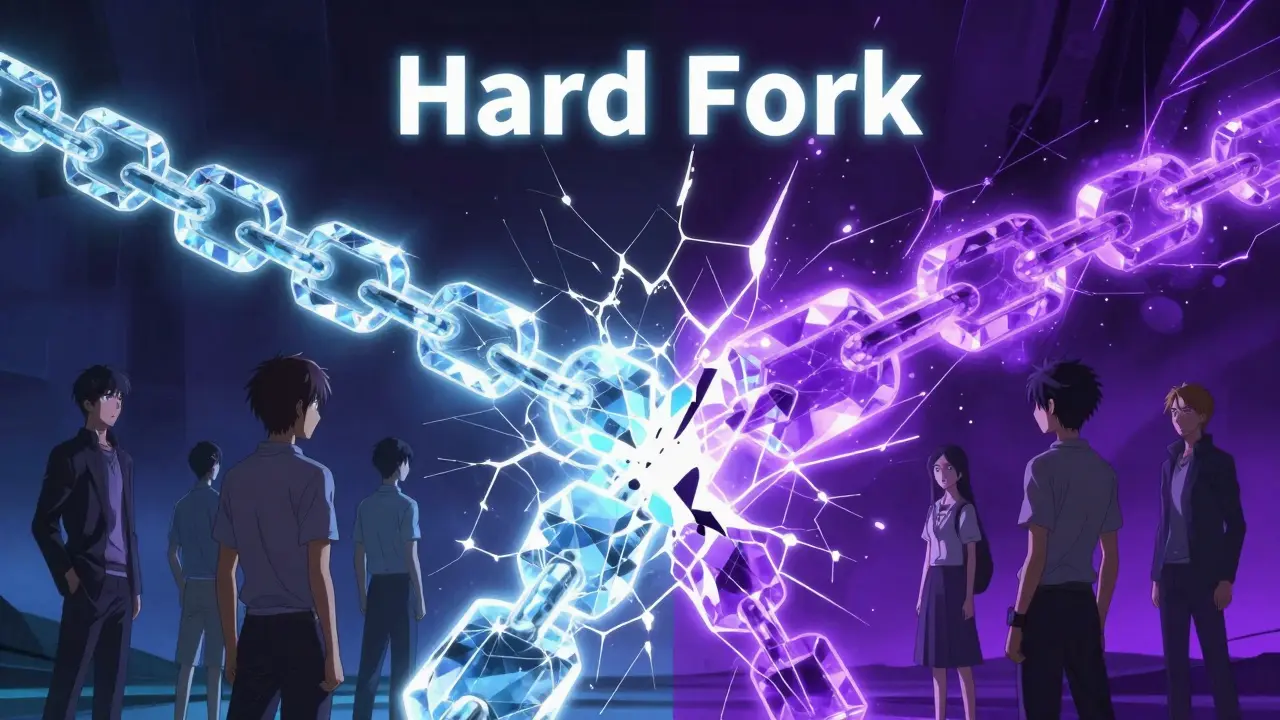
When a change is too big for a soft fork-like changing the fundamental way blocks are mined or drastically increasing the block size-a Hard Fork is required. This is a non-backward-compatible change. If you don't upgrade your software to the new rules, your node will essentially be speaking a different language than the rest of the network. It will no longer be able to communicate or validate transactions on the updated chain.
This is where things get interesting (and sometimes messy). If some people refuse to upgrade, they can continue running the old software. Because the new rules are incompatible with the old ones, the blockchain splits into two separate paths. Now you have two independent blockchains operating side-by-side, each with its own set of rules and its own community.
We've seen this happen with some of the biggest names in crypto. For instance, Bitcoin Cash was born from a contentious hard fork of Bitcoin in 2017. A group of developers and miners wanted larger blocks to allow for faster, cheaper transactions, while others disagreed. The result? A permanent split that created a whole new asset.
Another famous case is Ethereum Classic. In 2016, a massive project called "The DAO" was hacked. To recover the stolen funds, the community decided to "roll back" the chain via a hard fork. Some people felt this violated the core principle of "code is law" and refused to move, staying on the original chain, which became Ethereum Classic, while the rest moved to the current Ethereum network.
Why Choose One Over the Other?
If hard forks allow for more radical innovation, why aren't they used more often? It comes down to risk and stability. Every time a hard fork occurs, there is a risk of "replay attacks," where a transaction on one chain can be maliciously duplicated on the other. This can lead to loss of funds if exchanges and wallets aren't prepared.
Moreover, hard forks can polarize a community. When a network splits, the liquidity and hash power are divided, which can potentially make the resulting chains less secure than the original single chain. Soft forks avoid this drama entirely by allowing for an incremental evolution of the protocol.
Generally, developers follow a rule of thumb: if you can achieve the goal with a soft fork, do it. Reserve hard forks for emergency security breaches or fundamental shifts in how the network functions. For example, the transition of Ethereum from Proof of Work to Proof of Stake (known as "The Merge") was a massive structural shift that required a coordinated hard fork because the entire mechanism of reaching Consensus changed.
The Process: How a Fork Actually Happens
Forks don't happen overnight. They usually follow a very specific, often slow, social and technical process:
- Proposal: A developer or group proposes a change, often through a formal document like a BIP (Bitcoin Improvement Proposal) or EIP (Ethereum Improvement Proposal).
- Community Debate: This is where the drama happens. Miners, developers, and node operators debate the merits of the change on forums, GitHub, and social media.
- Development and Testing: Code is written and tested on "testnets" to ensure the new rules don't accidentally crash the network. For soft forks, this takes about 3-6 months; hard forks often take 6-12 months.
- Activation: The update is pushed. In a soft fork, the network activates once enough nodes signal their support. In a hard fork, a specific block height is usually set as the "split point."
Impact on Investors and Users
If you're just holding coins in a wallet, a soft fork is almost invisible. Your coins stay where they are, and the network just gets slightly better. Hard forks, however, can be a windfall or a headache. When a hard fork creates a new coin (like Bitcoin Cash), anyone who held the original coin at the time of the split usually receives an equal amount of the new coin. This is essentially a "free" asset, though its value depends on whether the market actually wants the new version of the chain.
However, you have to be careful about where your coins are stored. If you keep your assets on an exchange, the exchange decides whether or not to support the fork. If they don't, you might not get your new coins. This is why the phrase "not your keys, not your coins" is so popular during fork events; having your own private keys gives you total control over the assets on both chains.
Will a soft fork split my coins into two different currencies?
No. A soft fork is backward-compatible, meaning it updates the rules without creating a separate version of the blockchain. Your coins remain on a single, unified chain.
Do I need to do anything when a hard fork happens?
If you run your own node, yes-you must update your software to the latest version to stay on the main chain. If you use a wallet or an exchange, the service provider usually handles the technical side, but you should check if they support the fork if you want to claim any new assets created by the split.
Which type of fork is safer for the network?
Soft forks are generally considered safer because they don't risk splitting the community or the network's computing power. They are used for gradual improvements. Hard forks are more powerful but riskier, as they can lead to fragmentation and security vulnerabilities during the transition.
What is a "replay attack" during a hard fork?
A replay attack happens when a transaction on one chain is valid on the other chain too. A malicious actor could take a transaction you sent on the new chain and "replay" it on the old chain to steal your funds. This is why developers use "replay protection" to make the two chains distinct.
Can a hard fork be reversed?
Technically, no. Once a hard fork happens and blocks are mined on the new chain, you can't simply "undo" it. The only way to merge them back would be another hard fork that everyone agrees to, which is extremely rare and difficult to coordinate.





Comments
James Bone
April 13, 2026 AT 11:22 AMMost people just treat this like a magic trick where they get free coins, but they don't realize it's basically just a failure of consensus. If a network actually needs to split to survive, it means the original vision was a lie or the developers are just incompetent. The irony is that the 'code is law' crowd always flips when their bags are at risk. It's just a digital circus with better marketing.
Terrance Hausmann
April 14, 2026 AT 04:02 AMIt's really all about finding common ground in the end.
Adam Auksel
April 15, 2026 AT 14:12 PMThis is such a helpful breakdown! 🚀 I think a lot of people get intimidated by the technical jargon, but the game analogy makes it so much easier to digest. Keeping the community informed is the only way we grow 📈✨
Aaliyah BROTHERS
April 16, 2026 AT 21:36 PMWAKE UP PEOPLE!!! These "updates" are just excuses for the elites to manipulate the ledger and hide where the money is actually going!!! 🚨🚨 It's a total sham designed to keep us chasing crumbs while they control the switches!!! Absolutely RIDICULOUS that anyone trusts this system without seeing the hidden strings!!! 😡😤
Will Dixon
April 17, 2026 AT 16:58 PMi didnt even know about the btc cash thing lol thx for explaning it simply
Prasanna Shembekar
April 18, 2026 AT 09:27 AMomg the drama with the dao hack is actually insane
Jessie Tayaban
April 20, 2026 AT 06:52 AMOmg i remember the panic during the last hard fork!! It was absolute chaos and i think i almost lost my mind trying to find a wallet that worked properly lol!! 😱 Just totaly stresfull stuff
Amanda Faust
April 20, 2026 AT 23:24 PMthe replay attack section is the only part that actually matters here most users are too clueless to realize they are leaving money on the table or risking it by using unverified exchanges
Rebecca Violette
April 22, 2026 AT 08:51 AMi feel like this is just way to much info my head hurts lol
EDOZIEM MICHAEL
April 22, 2026 AT 23:45 PMthe split of a chain is like a mirror reflecting the duality of man some seek progress while others seek purity
jennelle williams
April 23, 2026 AT 04:37 AMjust keep your keys safe
Tyler Webb
April 23, 2026 AT 12:38 PMI really appreciate the warning about exchanges. It's a stressful situation when you're not in control of your own assets :)
Scott Fenton
April 24, 2026 AT 11:17 AMIt is imperative to note that the security of a hard fork is significantly dependent on the remaining hash power of the original chain to prevent 51% attacks.
Mikayla Murphy
April 24, 2026 AT 13:54 PMIt's interesting how these technical decisions often reflect the cultural values of the people building the software.
Stanly Hayes
April 26, 2026 AT 06:50 AMWhy are we even talking about this when the US is the only place making this stuff actually work anyway? Get on board or get left behind!
Lane Montgomery
April 28, 2026 AT 01:47 AMWhich wallet you using?
Lauren Abrams
April 28, 2026 AT 10:33 AMI wonder if there's a way to predict which chain will be more successful after a hard fork based on the community sentiment during the debate phase. It seems like a lot depends on the social side of things rather than just the code itself. If a large group of influential miners move, the network effect usually follows them regardless of whether the technical change was actually "better".
James Bone
April 29, 2026 AT 14:07 PMOh look, another "philosopher" trying to find patterns in a random walk.
Listen, the only thing that predicts success in a fork is greed. Pure and simple. People don't care about "community sentiment" or the "social side"; they care about the price chart. If the new coin pumps, everyone pretends they supported the fork from day one. It's a pathetic cycle of cognitive dissonance. You see it every time a new shitcoin forks from an established project. They claim it's about "scaling" or "efficiency" but it's actually just a pump-and-dump scheme wrapped in a technical whitepaper. The airdrop is just a lure to get more people to hold a useless asset. The whole industry is built on this kind of delusion where a few lines of changed code are treated like a religious schism. It's honestly hilarious how people fall for it. Just admit you want a free lottery ticket and move on. The technicals are just window dressing for the casino. Stop trying to make it sound intellectual. It's just money moving from the gullible to the opportunistic. That's the only "law" in crypto.