
You’ve probably seen the frog. It’s everywhere on Twitter, Reddit, and your friend’s portfolio screenshot. But what exactly is Pepe ($PEPE) an Ethereum-based ERC-20 meme cryptocurrency token inspired by the "Pepe the Frog" internet meme? If you’re wondering whether this green amphibian has any real teeth or if it’s just another hype cycle waiting to burst, you’re in the right place.
Let’s cut through the noise. PEPE isn’t trying to solve global supply chains or replace banks. It launched in April 2023 with a singular, cheeky mission: to make meme coins great again. With a fixed supply of 420,690,000,000,000 tokens-a number that screams internet culture-it quickly climbed to become one of the top three meme coins by market cap, trailing only Dogecoin and Shiba Inu. But before you throw your life savings at a picture of a frog, let’s look at how it actually works, where it came from, and why people are trading billions of dollars worth of it every day.
The Origin Story: From Comic Strip to Blockchain
To understand PEPE, you have to go back to the early 2000s. American artist Matt Furie created Pepe the Frog for his comic series Boy’s Club. Over time, Pepe became one of the most recognizable memes on the internet, often associated with irony, humor, and sometimes controversial political commentary.
Fast forward to April 17, 2023. A group of anonymous developers decided to tokenize this cultural phenomenon. Unlike many projects that promise revolutionary tech, PEPE was born as a pure speculative asset. There was no presale, no venture capital backing, and no complicated roadmap. It was a "fair launch," meaning the entire supply was minted at once. This approach resonated with crypto natives who were tired of insider deals and hidden unlocks. They wanted transparency, even if that transparency revealed there was no underlying utility.
How PEPE Works: The Technical Basics
At its core, PEPE is an ERC-20 token a standard technical specification for implementing fungible tokens on the Ethereum blockchain. What does that mean for you? It means PEPE lives on the Ethereum network. It inherits Ethereum’s security model, which currently uses proof-of-stake consensus. You can store PEPE in any wallet that supports Ethereum, like MetaMask, Trust Wallet, or Ledger.
Here’s the kicker: the total supply is fixed at 420.69 trillion tokens. That’s not a typo. Because the supply is so massive, the price per token is incredibly small-often fractions of a cent. For example, if PEPE trades at $0.000011, buying 1 million PEPE costs about $11. This psychological pricing trick makes investors feel like they own a huge chunk of something, even though the actual dollar value might be modest.
| Attribute | Value | Implication |
|---|---|---|
| Total Supply | 420,690,000,000,000 | Fixed supply; no new tokens will ever be minted. |
| Circulating Supply | ~420.69 Trillion (100%) | All tokens are unlocked; no future vesting cliffs. |
| Blockchain | Ethereum | High liquidity but subject to ETH gas fees. |
| Launch Date | April 17, 2023 | Recent entrant compared to DOGE or SHIB. |
| Liquidity Mechanism | Uniswap Pool + Burned LP Tokens | Reduces risk of "rug pulls" by locking liquidity permanently. |
The "Fair Launch" Strategy: Why It Matters
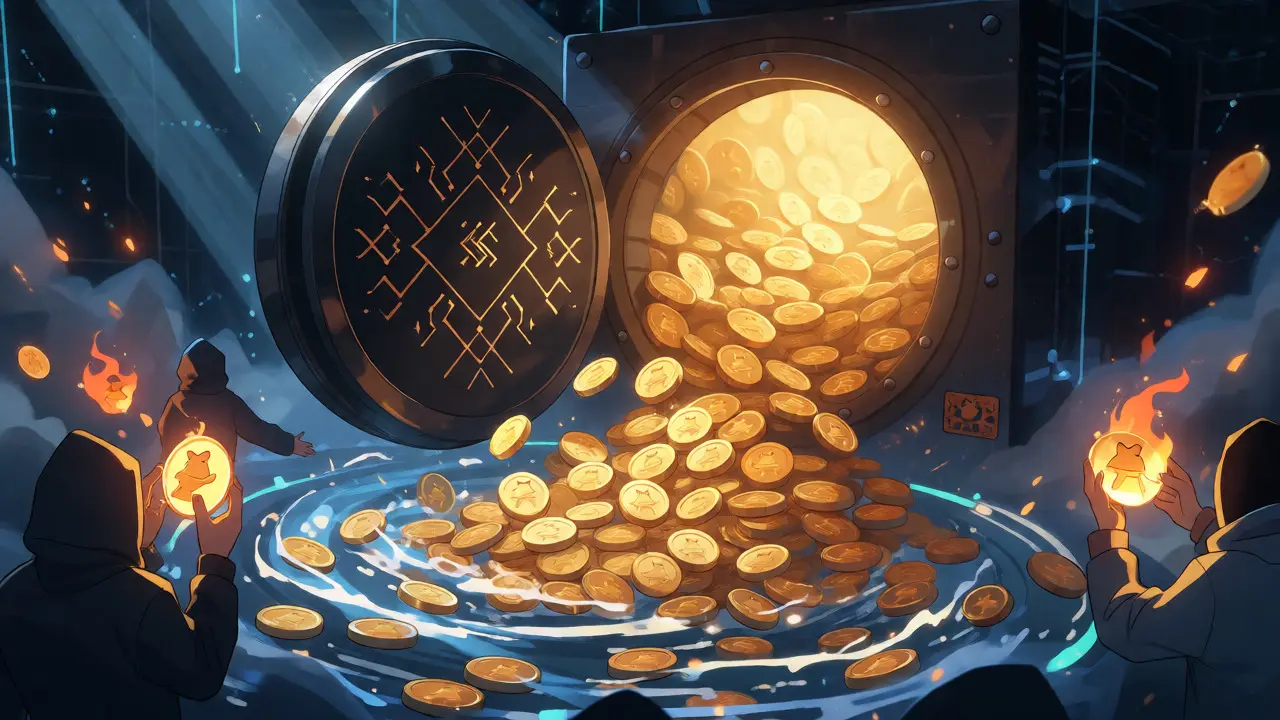
One of the biggest selling points of PEPE is its distribution model. When it launched, 93.1% of the total supply was dumped into decentralized exchange liquidity pools, primarily on Uniswap. Crucially, the Liquidity Provider (LP) tokens were burned. In plain English, this means the developers couldn’t withdraw the money backing the token pool later. It locked the liquidity in place, reassuring traders that insiders wouldn’t pull the rug under their feet.
The remaining ~6.9% went into a multi-signature wallet for marketing and listings. By September 2026, data from trackers like Etherscan and Coinbase shows that virtually 100% of the supply is in circulation. There are no hidden team allocations unlocking over five years, which often creates sell pressure in other projects. This clean slate appeals to traders who prefer betting on pure market sentiment rather than worrying about when a VC firm decides to cash out.
Utility vs. Speculation: Does PEPE Do Anything?
Be honest: do you buy PEPE because you want to use it to pay for coffee? Probably not. Unlike Bitcoin, which aims to be digital gold, or Ethereum, which powers smart contracts, PEPE has no native utility. It doesn’t offer staking rewards, governance rights, or transaction fee discounts built into the protocol itself.
Its value is derived entirely from community sentiment and meme virality. Think of it like a trading card or a piece of art. Its worth depends on what others believe it’s worth. As of late September 2026, PEPE sits comfortably as the third-largest meme coin by market cap, hovering around $2 billion. This places it behind giants like Dogecoin and Shiba Inu, but ahead of thousands of smaller altcoins.
Some exchanges label PEPE as "deflationary," hinting at potential burns. However, unlike Shiba Inu, which has a robust ecosystem of games and exchanges, PEPE remains a straightforward speculative vehicle. If the meme culture fades, the price likely follows. There’s no product revenue to cushion the fall.
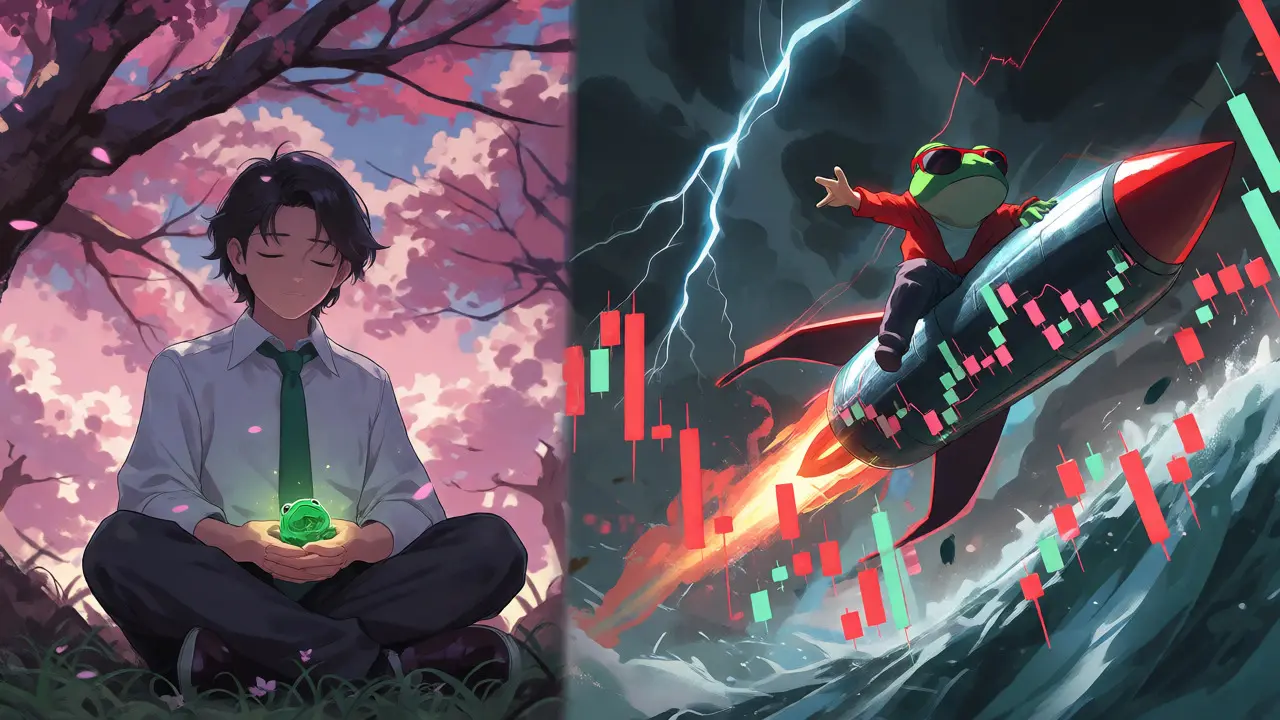
Risks and Rewards: Should You Buy?
Investing in PEPE is high-risk, high-reward. On good days, you might see double-digit percentage gains in 24 hours. On bad days, those gains can evaporate just as quickly. Volatility is the name of the game. Because the price is so low, small movements in absolute terms translate to huge percentage swings. A move from $0.000010 to $0.000011 is a 10% gain, but it looks insignificant on a chart compared to Bitcoin moving $500.
Here are the main risks:
- No Fundamental Value: If the meme loses popularity, demand drops.
- Market Sentiment: PEPE correlates strongly with broader crypto trends, especially Bitcoin’s performance.
- Regulatory Uncertainty: Governments are still figuring out how to treat meme coins. Sudden regulations could impact trading availability.
On the flip side, the upside is driven by social media momentum. Platforms like X (formerly Twitter) and TikTok can send PEPE soaring overnight if a viral trend takes off. For short-term traders, this volatility offers opportunities. For long-term holders, it requires strong conviction in the longevity of meme culture.
How to Buy and Store PEPE
Getting started with PEPE is easier now than it was in 2023. Initially, you had to navigate Uniswap manually, paying high gas fees. Today, major centralized exchanges list PEPE directly. You can buy it on Binance, Coinbase, Kraken, and Gemini using fiat currency (like USD, EUR, or NZD) or stablecoins like USDT.
If you prefer self-custody, transfer your PEPE to an Ethereum-compatible wallet like MetaMask. Remember, since PEPE is an ERC-20 token, you’ll need some ETH in your wallet to cover gas fees for transactions. Keep in mind that while gas fees on Ethereum have decreased with recent upgrades, they can still spike during network congestion.
Is Pepe a good investment?
Whether PEPE is a "good" investment depends on your risk tolerance. It has shown significant growth since its 2023 launch, reaching multi-billion dollar valuations. However, it lacks fundamental utility, making it highly volatile and dependent on social sentiment. It is best suited for speculative portfolios rather than conservative long-term holdings.
Can I stake PEPE to earn interest?
The PEPE token itself does not have native staking mechanisms built into its contract. However, you can find third-party platforms or DeFi protocols that offer yield farming or lending options for PEPE. These are external services, not part of the official PEPE protocol, so always research the platform's reputation before depositing funds.
Why is the supply of PEPE so high?
The supply is set at 420,690,000,000,000 to align with meme culture numbers (420 and 69). A high supply keeps the individual token price very low, which psychologically encourages retail investors to buy larger quantities. It also ensures high liquidity and accessibility for small-budget traders.
Does PEPE have a CEO or founder?
PEPE was launched anonymously. There is no publicly known CEO or central foundation managing the project in the traditional sense. The development and community management are largely decentralized, relying on community volunteers and contributors rather than a corporate entity.
Is PEPE different from Dogecoin?
Yes, though both are meme coins. Dogecoin has been around since 2013, has its own blockchain, and gained mainstream attention via Elon Musk. PEPE launched in 2023 on Ethereum, relies on the Ethereum ecosystem, and markets itself specifically on the "Pepe the Frog" meme aesthetic. PEPE also features a fully circulating supply with no mining or inflation.