

Most blockchains are like glass houses. Everyone can see everything happening inside. That transparency is great for trust in some cases, but it’s a nightmare for privacy. If you want to keep your financial data, health records, or business secrets safe, traditional public ledgers fall short. Enter Partisia Blockchain, which uses multiparty computation (MPC) and zero-knowledge proofs to let you process data without ever revealing the raw information itself. The native fuel for this engine is the MPC token. But what exactly does this coin do, and why should you care?
This isn’t just another privacy coin that hides transactions from regulators. It’s an infrastructure play designed to solve the blockchain trilemma: balancing security, scalability, and decentralization while adding a fourth pillar-true privacy during computation. Whether you’re a developer looking to build private smart contracts or an investor curious about the tokenomics of a project with a hard cap of one billion tokens, understanding the mechanics behind Partisia is key.
The Core Problem: Privacy at Rest vs. Privacy in Use
Let’s clear up a common misconception first. Most privacy solutions only protect data when it is stored (at rest) or sent across networks (in transit). Once that data hits a server or a blockchain node for processing, it has to be decrypted. That moment of decryption is where leaks happen. Hackers target servers; insiders peek at databases. In a standard blockchain, every validator sees every transaction detail before it’s added to the ledger.
Multiparty Computation (MPC) changes this equation entirely. Imagine three people wanting to know their average salary without telling each other how much they make. With MPC, they can perform a mathematical calculation together using encrypted fragments of their data. The result-the average-is revealed, but the individual salaries remain secret. Partisia brings this concept on-chain. It allows organizations to run computations on shared data without any single party seeing the inputs. This is huge for industries like healthcare, where patient data must stay anonymous, or finance, where rival firms might want to collaborate on risk models without exposing trade secrets.
How the MPC Token Works: Utility Over Speculation
The MPC token is the backbone of the network’s security and governance. Unlike many cryptocurrencies that rely on proof-of-work mining or simple proof-of-stake voting, Partisia uses a nuanced staking model tied directly to node roles. There is a strict supply cap of 1 billion MPC tokens, meaning no inflationary pressure will dilute value over time.
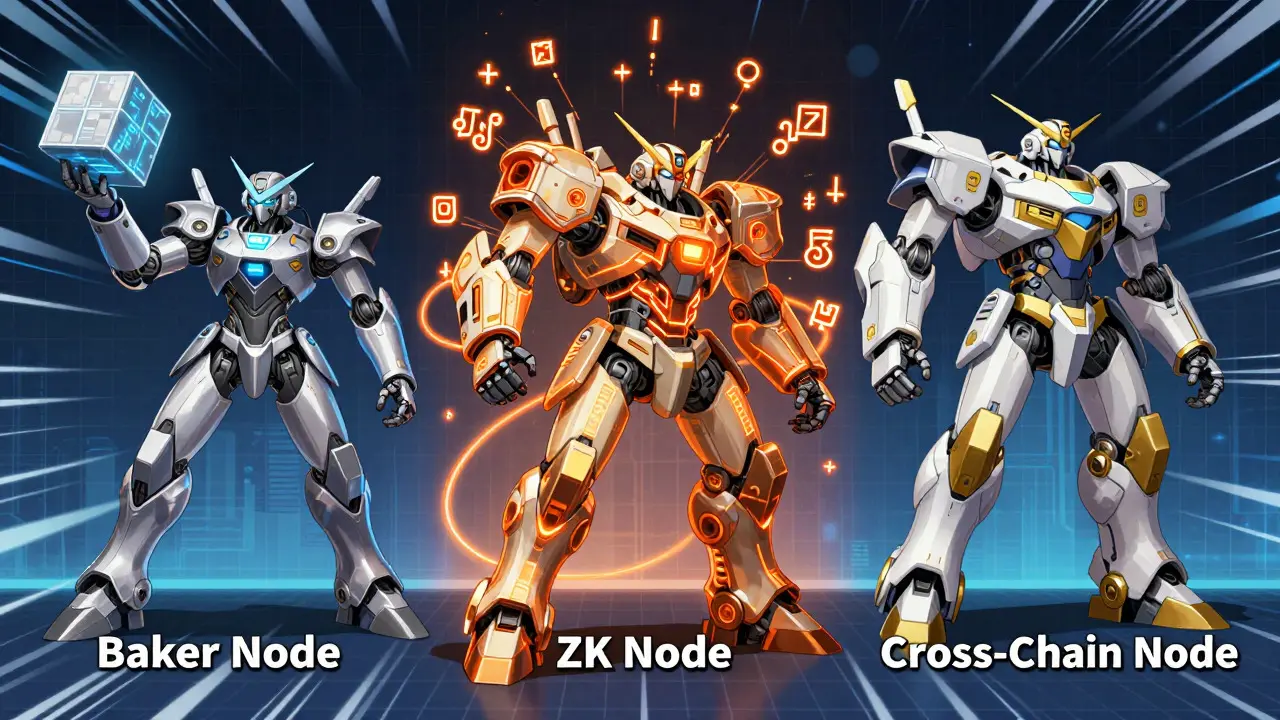
To participate in securing the network, you need to stake tokens. However, not all nodes are created equal. The network divides operators into three distinct tiers based on their responsibilities and minimum stake requirements:
- Baker Nodes: These are the basic block producers. They sign and produce blocks. Minimum stake: 25,000 MPC tokens.
- ZK Nodes: These nodes handle the heavy lifting of zero-knowledge computations alongside block production. They require more resources and thus a higher stake: 100,000 MPC tokens.
- Cross-Chain (BYOC) Nodes: Also known as Bring Your Own Coin nodes, these act as oracles tracking deposits and withdrawals from other chains. They ensure the bridge remains secure. Minimum stake: 250,000 MPC tokens.
A critical rule here is that each participant or organization can only operate one node per category. This prevents large entities from dominating the network by running thousands of nodes, ensuring a more decentralized distribution of power. You don’t just hold the token; you use it to earn the right to validate specific types of work.
Consensus Mechanism: Eager FastTrack
Speed matters in blockchain. If transactions take minutes to finalize, the technology becomes impractical for everyday commerce. Partisia addresses this with its proprietary consensus mechanism called Eager FastTrack. It operates on a “trust but verify” principle.
Here is how it works in plain English: When a transaction is signed, it is added to the ledger immediately. Nodes execute it peer-to-peer. As soon as a node receives signatures from at least two-thirds of all other nodes, it registers a proof-of-justification (PoJ). At that point, the block is considered final. There is no waiting for long confirmation chains. This results in lightning-fast finality, making the network viable for high-frequency applications like payments or real-time asset transfers.
Interoperability via BYOC Bridges
One of the biggest hurdles in crypto today is fragmentation. Your assets on Ethereum aren’t easily usable on Solana or Bitcoin without complex, often risky, wrapped tokens. Partisia solves this with its Bring Your Own Coin (BYOC) collateralized token bridge.
This isn’t a typical bridge that relies on a small group of trusted validators who could theoretically collude to steal funds. Instead, it uses a double bookkeeping system similar to traditional banking. Here is the breakdown:
- Small Oracle: A select set of nodes holds sufficient MPC tokens as collateral. They manage epochs (regularly expiring time windows) to synchronize information between blockchains.
- Large Oracle: All available Baker nodes form a larger group that selects the Small Oracles using an MPC-based signature scheme.
- Dispute Mechanism: Any MPC token holder can stake tokens to initiate a dispute if they suspect fraud. Because the Small Oracles have skin in the game (their staked MPC), economic incentives align against malicious behavior.
This structure allows users to bring their preferred tokens onto Partisia Blockchain securely. You can even pay transaction fees using liquid coins like Ethereum or USD, which are bridged onto the network, promoting flexibility for users who don’t necessarily want to hold MPC for gas fees.
MOCCA: Institutional-Grade Custody
In January 2024, the Partisia team unveiled MOCCA (MPC On-Chain Custody Advanced solution) at the World Economic Forum in Davos. This was a significant milestone because it moved MPC from theoretical tech demos to practical institutional application.
MOCCA is a cross-chain custody and asset-management system. It secures assets on their native chains using MPC within the Partisia ecosystem. Why is this important? Traditional custodians hold private keys in cold storage. If those keys are compromised, funds are lost. MOCCA splits private keys among multiple parties using threshold-signature schemes. No single entity holds the full key. Smart contracts can program conditions for transactions-for example, requiring multi-sig approval for large withdrawals or integrating NFTs with special permissions. This makes it highly attractive for regulated financial institutions that need programmable, compliant, and ultra-secure custody solutions.

Developer Experience: Zero-Knowledge Smart Contracts
For developers, the barrier to entry for cryptography has historically been massive. Writing secure zero-knowledge proofs requires deep mathematical expertise. Partisia aims to abstract this complexity away through its Zero-Knowledge Smart Contracts (ZKSC) system.
The platform provides a unified language that coordinates both public and private computations. Developers can write logic that utilizes MPC-as-a-service without needing to understand the underlying cryptographic primitives. Think of it like using a library function in Python-you call `encrypt_data()`, and the framework handles the complex math. This simplification is crucial for mass adoption. It allows teams to focus on building user-centric applications rather than reinventing the wheel for every privacy feature.
| Node Type | Primary Function | Minimum Stake (MPC) | Key Responsibility |
|---|---|---|---|
| Baker Node | Block Production | 25,000 | Signs and produces blocks; forms Large Oracle |
| ZK Node | Computation + Blocks | 100,000 | Performs zero-knowledge calculations |
| Cross-Chain (BYOC) | Oracle/Bridging | 250,000 | Tracks cross-chain deposits/withdrawals; acts as Small Oracle |
Tokenomics and Supply Dynamics
Understanding the economics of the MPC token is vital for long-term holders. The total supply is fixed at 1 billion tokens. This scarcity model contrasts with inflationary protocols that mint new tokens indefinitely to reward validators. Partisia’s approach relies on transaction fees and staking rewards distributed from existing pools or initial allocations.
The unlocking schedule for presale participants and team allocations is structured to prevent massive sell-offs. Tokens are released gradually, aligning the interests of early supporters with the long-term health of the network. Additionally, the ability to pay fees in bridged assets (like ETH or USDC) means demand for MPC is driven primarily by staking needs and governance participation, rather than just gas consumption. This creates a stable utility profile where the token’s value is tied to the security budget of the network.
Real-World Applications Beyond Crypto
While crypto natives love the tech, the real potential lies in enterprise adoption. Consider these scenarios:
- Healthcare: Hospitals can share anonymized patient data to train AI models for disease detection without violating HIPAA or GDPR regulations. The data never leaves the hospital’s control in readable form.
- Finance: Banks can collaborate on anti-money laundering (AML) checks. They can query each other’s customer databases to identify suspicious patterns without revealing non-matching customer details to competitors.
- Supply Chain: Companies can verify the authenticity of goods using blockchain immutability while keeping pricing and supplier negotiations private.
These use cases highlight why Partisia positions itself as a privacy-preserving, blockchain-agnostic platform. It doesn’t just compete with Ethereum; it complements it by offering layers of privacy that general-purpose chains struggle to provide natively.
Is the MPC token mineable?
No, the MPC token is not mineable in the traditional Proof-of-Work sense. It has a fixed supply of 1 billion tokens. Participation in the network is achieved through staking MPC tokens to become a Baker, ZK, or Cross-Chain node operator.
Can I use MPC tokens to pay for transactions on other chains?
Directly, no. MPC is the native token for Partisia Blockchain. However, thanks to the BYOC bridge, you can bring assets like Ethereum or USD onto Partisia to pay fees. Conversely, MPC can be bridged out to other ecosystems, allowing for cross-chain liquidity.
What is the difference between Partisia and Monero?
Monero focuses on hiding transaction details (sender, receiver, amount) for personal privacy. Partisia focuses on enabling private *computation* for enterprises and developers. While Monero obscures data, Partisia allows data to be used collaboratively without being revealed, which is essential for B2B applications and regulatory compliance.
How does the Eager FastTrack consensus improve speed?
Eager FastTrack achieves instant finality by registering a proof-of-justification (PoJ) once two-thirds of nodes sign off. Transactions are executed immediately upon signing, eliminating the need for multiple confirmation blocks required by older consensus mechanisms like Nakamoto consensus.
What is MOCCA and how does it relate to MPC?
MOCCA is a product built on Partisia Blockchain that offers advanced cross-chain custody. It uses MPC technology to split private keys, ensuring that no single entity controls access to assets. It enhances the utility of the MPC network by attracting institutional clients who need secure, programmable asset management.
Do I need to be a cryptographer to build on Partisia?
No. Partisia provides Zero-Knowledge Smart Contracts (ZKSC) with a unified language that abstracts complex cryptography. Developers can integrate MPC-as-a-service into their apps without writing low-level cryptographic code from scratch.