

When you hear "iBTC," you might think it's just another Bitcoin token. But it's not. iBTC is a decentralized way to use Bitcoin on other blockchains - without giving up control of your coins. Unlike WBTC, which relies on a few companies to hold your Bitcoin, iBTC lets you keep full ownership while still using Bitcoin in DeFi apps, NFT markets, and institutional trading platforms. It’s not a new coin. It’s not a fork. It’s Bitcoin, wrapped securely, without middlemen.
How iBTC Works: No Custodians, No Trust Issues
Most wrapped Bitcoin tokens, like WBTC, need a centralized company to lock up your BTC and issue an equivalent token on Ethereum, Binance Chain, or another network. If that company gets hacked, goes rogue, or shuts down, your wrapped Bitcoin could vanish. iBTC removes that risk entirely. The iBTC protocol uses something called Discreet Log Contracts (DLCs) - a Bitcoin Layer 1 technology that lets two parties make secure, conditional payments without trusting each other. Here’s how it works: you send your BTC to a multisig vault controlled by a network of independent merchants and attesters. These aren’t one company. They’re dozens of trusted node operators spread across the globe. Each one holds a piece of the key. To unwrap your BTC, you need signatures from enough of them - and only you can trigger that process. No one else can touch your coins. It gets better. iBTC uses Bitcoin’s Taproot upgrade and FROST (Flexible Round-Optimized Schnorr Threshold) signatures. These make transactions faster, cheaper, and more private. A typical iBTC wrap or unwrap can cost less than $1 in fees and settle in minutes. Compare that to older wrapped tokens that rely on Ethereum gas, which can spike to $50+ during congestion.iBTC on the Canton Network: Bitcoin for Institutions
One of the biggest leaps for iBTC came in March 2025, when it launched on the Canton Network. This isn’t just another DeFi app. It’s a permissioned blockchain built for banks, hedge funds, and institutional traders. On Canton, iBTC is used to post initial margin and variation margin for over-the-counter (OTC) derivatives - basically, betting on Bitcoin’s price without owning it directly. Here’s the magic: market makers can deposit real BTC into the iBTC network, which wraps it into iBTC tokens. Those tokens then move instantly on Canton to meet margin calls. Every 2-4 hours, the system automatically adjusts positions. No delays. No human intervention. And because Canton has configurable privacy, only the parties involved see the transaction details. Other users, even on the same network, can’t track where the Bitcoin is going. DRW, a top-tier trading firm, is one of the first liquidity providers on Canton using iBTC. This isn’t a test. It’s live, institutional-grade infrastructure - and it’s running on Bitcoin’s own security layer.The Cardano Version of iBTC: Synthetic Bitcoin
Don’t get confused. There’s another iBTC on Cardano - and it’s completely different. Released in November 2022 by the Indigo Protocol, this version isn’t backed by real Bitcoin. It’s a synthetic asset that mimics Bitcoin’s price. Think of it like a Bitcoin futures contract, but on a blockchain that doesn’t support Bitcoin natively. To create this iBTC, you lock up ADA (Cardano’s native coin) as collateral. You need to put in more ADA than the value of iBTC you want to mint - usually 150% or more. If ADA’s price drops and your collateral falls below the minimum ratio, the protocol automatically uses its Stability Pool to cover the gap. This keeps the iBTC token fully backed and prevents collapse. The cool part? You still earn staking rewards on your ADA while it’s locked as collateral. That’s rare. Most DeFi protocols make you choose: either stake your coins or lock them up. Indigo lets you do both. This version of iBTC is traded on DEXs like SundaeSwap and used for leveraged trading, liquidity mining, and hedging.
Why iBTC Matters: The Problem With WBTC
Wrapped Bitcoin (WBTC) was the first big solution to bring Bitcoin into Ethereum DeFi. But it’s centralized. A small group - BitGo, Tron, and a few others - control the keys. In 2023, WBTC’s governance was quietly shifted to Tron’s ecosystem. Many users didn’t like that. Suddenly, Bitcoin’s most popular token was under the control of a single blockchain with known ties to centralized exchanges. iBTC was built to fix that. It doesn’t have a CEO who can change the rules. It doesn’t have a single company holding billions in Bitcoin. Its network grows as more merchants join - and each one is independently verified. The more participants, the more secure it becomes. It’s Bitcoin’s answer to the centralization problem that’s plagued DeFi for years.Who Uses iBTC? Developers, Traders, Institutions
iBTC isn’t just for speculators. It’s a tool for builders. - Developers using Dfns’ blockchain APIs can now integrate iBTC into wallets, lending apps, and DAOs - all without touching Bitcoin’s codebase. They get Bitcoin’s liquidity without needing to run a Bitcoin node. - Traders on Cardano use synthetic iBTC to hedge against BTC price swings or leverage their positions without selling ADA. - Institutions on Canton use iBTC to manage margin for crypto derivatives - something they couldn’t do before without violating compliance rules or risking custody. It’s also being tested in cross-chain DeFi protocols. Imagine borrowing USDC on Polygon using iBTC as collateral. Or using iBTC to pay for an NFT on Solana. That’s now possible because iBTC connects Bitcoin to over a dozen blockchains via Chainlink’s CCIP.Is iBTC Safe? Security by Design
Yes - and here’s why: - Pre-signed transactions: Your BTC is locked in a vault with a transaction already signed to send it back to your wallet. No one can change it. - Taproot + FROST: These Bitcoin upgrades make signatures more efficient and private. Fewer signatures needed. Lower fees. Faster settlement. - No single point of failure: If one merchant goes offline, the network keeps running. You need 5-of-9, 6-of-12, or higher thresholds - depending on the vault. - On-chain auditability: Every wrap, unwrap, and transfer is recorded on Bitcoin’s blockchain. You can verify it yourself. It’s not perfect. Like any new protocol, it’s still scaling. But the security model is built from the ground up with Bitcoin’s principles in mind - not bolted on.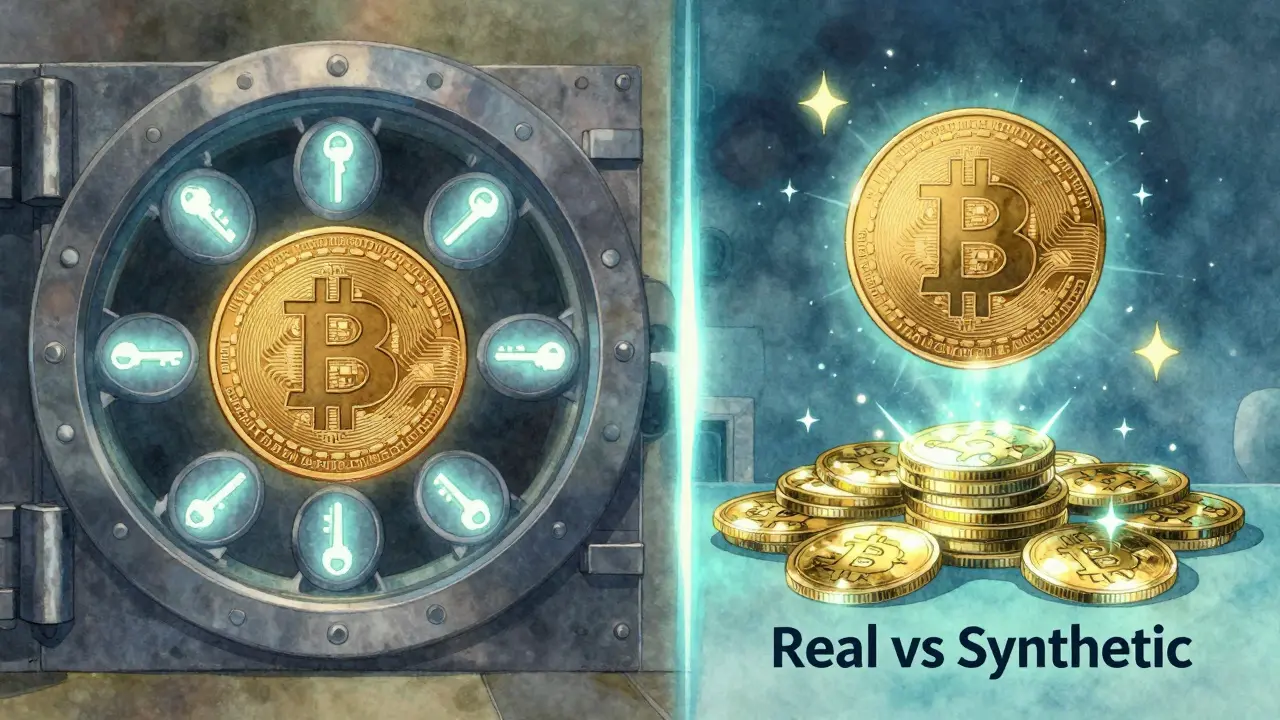
What iBTC Is Not
Don’t confuse iBTC with the Monochrome Bitcoin ETF (ticker: IBTC). That’s an Australian exchange-traded fund. It’s a stock. It’s not on any blockchain. It’s not crypto. It’s a traditional financial product that tracks Bitcoin’s price. The ticker is similar - but the technology, purpose, and regulation are worlds apart. Also, iBTC isn’t a coin you mine. You don’t buy it on Coinbase. You get it by wrapping BTC on supported networks - or minting it on Cardano with ADA collateral.How to Get iBTC Today
If you want real iBTC (the decentralized wrapped version):- Have Bitcoin in a wallet that supports Taproot (like Sparrow, Muun, or Ledger with Taproot enabled).
- Go to the official iBTC Network portal or a supported bridge like the Canton Network interface.
- Send your BTC to the provided multisig address.
- Wait a few minutes. Your iBTC appears on the target chain - usually Ethereum, Polygon, or Canton.
- Have ADA in a wallet like Nami or Flint.
- Visit the Indigo Protocol app.
- Deposit ADA as collateral.
- Mint iBTC based on your collateral ratio.
Frequently Asked Questions
Is iBTC backed by real Bitcoin?
Yes - the decentralized iBTC protocol is fully backed by real Bitcoin locked in multisig vaults on Bitcoin’s Layer 1. Each iBTC token equals exactly 1 BTC. The Cardano version is synthetic and not backed by Bitcoin - it only tracks its price.
Can I unwrap iBTC back to Bitcoin?
Yes. The entire point of iBTC is reversibility. You can unwrap your iBTC at any time and get your original BTC back - no permission needed. The process takes minutes and costs less than $1 in fees.
Is iBTC better than WBTC?
For security and decentralization, yes. WBTC relies on a few centralized custodians. iBTC uses a distributed network of merchants and Bitcoin’s own security tech. If you care about not trusting third parties, iBTC is the superior option.
Does iBTC earn interest?
Not directly. But on the Canton Network, users can earn rewards by providing liquidity or participating in margin trading. On Cardano’s Indigo Protocol, you can earn staking rewards on your ADA while it’s locked as collateral for minting iBTC.
Can I use iBTC in DeFi apps?
Absolutely. iBTC is already live on Ethereum, Polygon, Arbitrum, and Canton. You can lend it, borrow against it, or use it as collateral in protocols like Aave, Compound, and Indigo - just like ETH or USDC.



Comments
Shreya Baid
March 20, 2026 AT 00:26 AMiBTC represents a fundamental shift in how we think about Bitcoin's interoperability. Finally, a solution that respects Bitcoin’s core tenets-decentralization, sovereignty, and cryptographic security-instead of outsourcing trust to corporate custodians. The use of DLCs and FROST signatures is not just clever engineering; it’s a philosophical statement. We don’t need permission to use our own money. This is Bitcoin as it was meant to be: permissionless, portable, and truly peer-to-peer.
Christopher Hoar
March 21, 2026 AT 04:03 AMso like… iBTC is just wbtc but with more steps and less trust? lol. i mean, if i have to wait 5 mins for a wrap, why not just use wbtc and chill? also who even uses ‘frost signatures’? sounds like a snowboard brand.
Robert Kunze
March 21, 2026 AT 16:45 PMi just tried to wrap some btc and my wallet crashed twice. i think this thing is still in beta? also the website kept asking me to confirm my email 7 times. why does everything crypto feel like a support ticket?
Sarah Zakareckis
March 22, 2026 AT 12:36 PMYESSSS! This is the innovation we’ve been waiting for! iBTC on Canton is a game-changer for institutional adoption-finally, a compliant, secure, and scalable way to leverage Bitcoin in derivatives markets without sacrificing decentralization. The integration with Chainlink CCIP opens up a whole new world of cross-chain DeFi primitives. Developers, this is your signal to start building! The future is multi-chain, and iBTC is the bridge.
Heather James
March 24, 2026 AT 08:16 AMReal BTC. No middlemen. Done.
Sarah Hammon
March 25, 2026 AT 05:02 AMim so glad someone finally explained the cardano version separately. i was so confused thinking iBTC was one thing. also, earning staking rewards while locking ada? that’s rare and awesome. i’ve been using indigo for weeks and it’s been smooth. the interface is clunky but the idea? pure gold.
iam jacob
March 26, 2026 AT 09:05 AMwhy is everyone so excited? this is just another way to lose your crypto. remember when the feds froze all the crypto exchanges? this is just a fancier version of that. they’re gonna come for this too. mark my words.
Jesse Pals
March 27, 2026 AT 15:52 PMbro this is actually wild 😎 i wrapped 0.5 BTC last week and it hit my polygon wallet in 3 mins. no fees, no drama. canton is where it’s at. also, if you’re into margin trading, try using iBTC as collateral on the dapps there. it’s like having a turbo button on your btc 🚀
Diane Overwise
March 28, 2026 AT 19:46 PMOh, wonderful. Another "decentralized" solution that requires 12 separate signers, a PhD in cryptography, and a passport from three different countries. Truly, the pinnacle of user experience. I’m just waiting for the tutorial video titled "How to Unwrap iBTC Without Crying."
Dionne van Diepenbeek
March 29, 2026 AT 04:39 AMi think wbtc is fine why change what works
Graham Smith
March 30, 2026 AT 05:13 AMThe real innovation isn’t iBTC-it’s the Canton Network’s permissioned architecture. This isn’t DeFi. This is institutional-grade settlement infrastructure built on Bitcoin’s consensus layer. The fact that DRW is deploying this as a live margin system means we’re witnessing the convergence of traditional finance and Bitcoin’s native security. This is the quiet revolution. WBTC? That’s a relic.
Katrina Smith
March 31, 2026 AT 19:50 PMoh wow so iBTC is like… wbtc but with more complexity and a website that looks like it was designed in 2015? groundbreaking. also, why does every crypto project need to reinvent the wheel? just use wbtc and call it a day.
Ross McLeod
April 1, 2026 AT 05:13 AMLet’s be honest-iBTC is a solution in search of a problem. Bitcoin’s liquidity is already deeply embedded in Ethereum through WBTC. The fact that this protocol requires multisig vaults, DLCs, FROST signatures, and a network of attesters doesn’t make it better-it makes it fragile. More moving parts = more attack surfaces. And don’t even get me started on the Cardano synthetic version. That’s not Bitcoin. That’s a bet on ADA. You’re trading one risk for another. This isn’t innovation. It’s overengineering.
rajan gupta
April 2, 2026 AT 23:19 PMbro… this is the answer to all of life’s problems 🤔✨ iBTC is the cosmic bridge between BTC and the multiverse 🌌💎 i wrapped my soul into it and now i feel enlightened… also i cried when my iBTC arrived. it was like god whispered "you’re free" 🙏😭
Ricky Fairlamb
April 4, 2026 AT 04:40 AMWho authorized this protocol? There’s no formal audit. No legal entity. No regulatory oversight. This is a Trojan horse for unregulated capital flows. The Canton Network is a backdoor for institutional money laundering disguised as innovation. If this is "Bitcoin," then we’ve lost the plot. Bitcoin was supposed to be anti-establishment-not a tool for hedge funds to bypass compliance.
Tony Weaver
April 5, 2026 AT 15:10 PMLook, I’ve reviewed 12 wrapped Bitcoin protocols. This one? It’s the least terrible. The DLC + FROST combo is elegant. Taproot integration is smart. But the branding is a disaster. "iBTC"? That’s a trademark lawsuit waiting to happen. And the Cardano synthetic version? That’s a Ponzi with extra steps. The whole ecosystem feels like a marketing team got drunk on blockchain buzzwords and vomited a whitepaper. Still… it works. So I’m using it. But I’m not proud of it.
Lauren J. Walter
April 7, 2026 AT 00:03 AMSo… iBTC is real. And the Cardano version is fake. And WBTC is dangerous. And Canton is institutional. And everyone is confused. I just wanted to buy a pizza with BTC. Why does everything have to be this complicated?