Imagine building a decentralized lending platform where users can borrow money against their Bitcoin. How does the smart contract know the current price of BTC? It can't look up Google Finance. It needs an oracle that connects the real world to the blockchain. This is exactly what DIA (Decentralised Information Asset) does. It is a trustless oracle network that provides transparent, auditable financial data to decentralized applications (dApps). If you are wondering whether DIA is just another meme coin or if it has actual utility in the crypto ecosystem, this guide breaks down how it works, why it matters, and what you need to know before buying or integrating it.
The Core Problem: Blockchains Are Blind
To understand DIA, you first have to understand the "oracle problem." Blockchains like Ethereum or Bitcoin are closed systems. They can verify transactions inside their own ledger, but they cannot see outside data. They don’t know the weather, stock prices, or the value of other cryptocurrencies unless someone tells them. In the early days of DeFi, this was risky. A single centralized API could be hacked or manipulated, causing billions of dollars in losses (remember the bZx hack?).
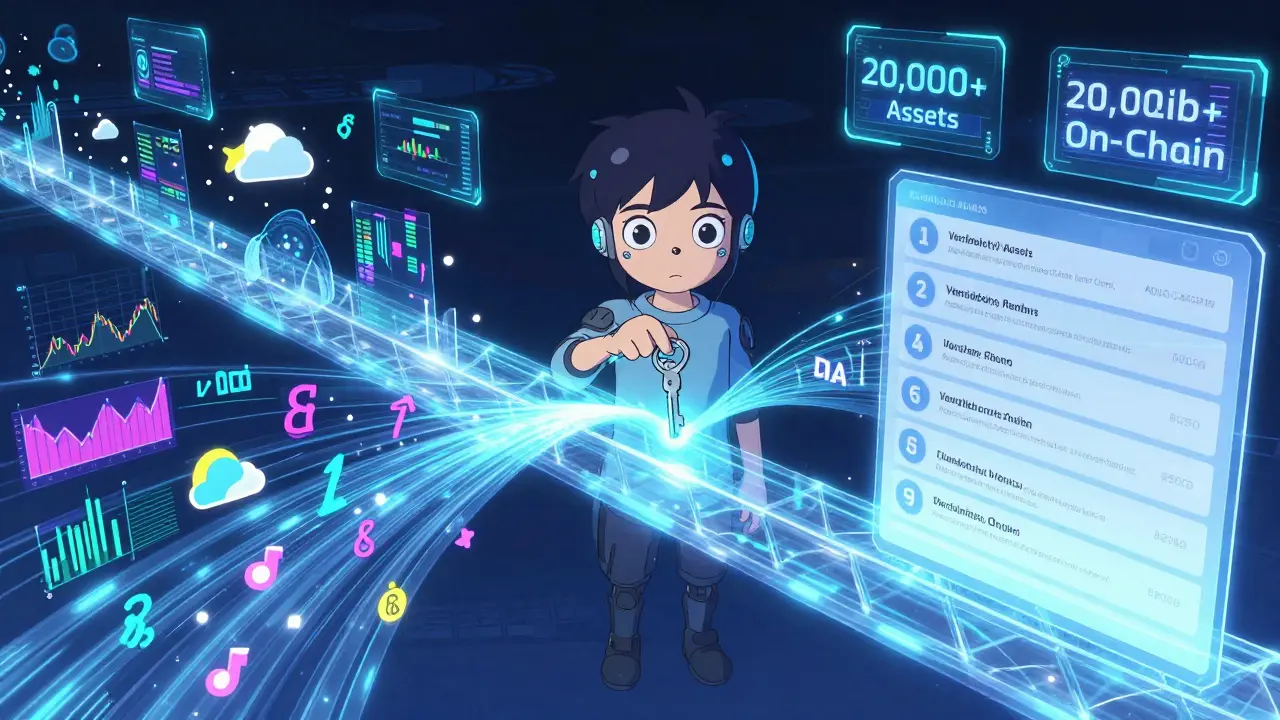
DIA was created to solve this by providing a decentralized, verifiable source of truth. Instead of relying on one central server, DIA aggregates data from over 100 centralized exchanges (CEXs) and decentralized exchanges (DEXs). It then processes this raw trade and order book data into standardized price feeds that any smart contract can query. The key differentiator here is transparency. You can audit the underlying transactions and calculations yourself. This makes it a "trustless" oracle-you don’t have to trust the provider; you can verify the math.
Who Created DIA and What Is Its History?
The project wasn’t built by faceless developers in a basement. It was launched in May 2018 by a team of four crypto entrepreneurs: Michael Weber, Paul Claudius, Samuel Brack, and Carl Bruns. Their goal was specific: improve the reliability of market data for on-chain applications.
In August 2020, the team conducted an Initial Coin Offering (ICO). Over three days, they sold 30 million DIA tokens, raising $15 million. This represented 15% of the total maximum supply of 200 million tokens. Since then, the project has evolved from a simple price feed provider into a comprehensive cross-chain oracle platform. By 2026, DIA had expanded its coverage to include not just crypto prices, but also Real-World Assets (RWAs), commodities, and foreign exchange rates. It now supports over 20,000 individual assets.
How Does the DIA Token Work? (Utility vs. Speculation)
Many people buy crypto hoping for a price pump, but DIA is designed as a utility token. Understanding its use cases is crucial for evaluating its long-term value. The DIA token serves three primary functions within the ecosystem:
- Governance: Holders can propose and vote on changes to the protocol. This includes deciding which new data feeds to add or adjusting security parameters. It’s a democratic way to steer the network’s development.
- Staking: Users can stake DIA tokens to help secure data feeds. In return, they earn rewards. This mechanism aligns incentives: participants are financially motivated to provide accurate data because bad actors risk losing their staked tokens (slashing).
- Access Rights: Think of DIA as a key. Developers and institutions pay in DIA to access verifiable oracle services. It acts as "gas" for oracle computations. Importantly, the project explicitly states that the token does not constitute an investment contract or financial claim, positioning it firmly as a utility asset to navigate regulatory landscapes.
DIA vs. Chainlink: Why Choose DIA?
If you’ve been in crypto for a while, you’ve heard of Chainlink. It’s the giant in the room. So why does DIA exist? And why might a developer choose it?
| Feature | DIA | Chainlink |
|---|---|---|
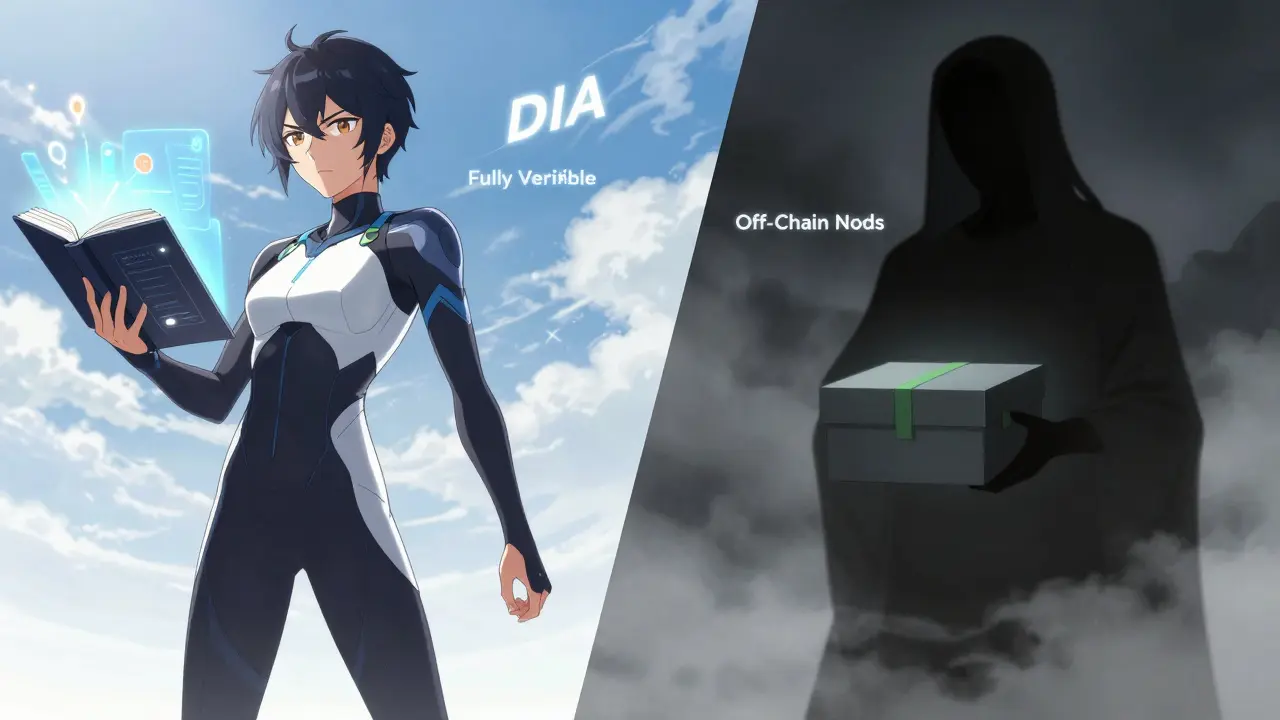
| Data Source Transparency | Fully verifiable on-chain; open-source methodology | Relies on off-chain node operators; less granular on-chain verification |
| Asset Coverage | 20,000+ assets (including niche altcoins and RWAs) | Focuses on top-tier assets (BTC, ETH, major pairs) |
| Market Cap (Approx.) | $15M - $20M | $Billions |
| Primary Use Case | Niche dApps, Bitcoin L2s, custom data feeds | Mainstream DeFi protocols, institutional adoption |
Chainlink is excellent for high-volume, mainstream assets. However, if you are building a niche dApp that needs price feeds for obscure altcoins, commodities, or specific Real-World Assets, Chainlink might not have those feeds yet-or they might be too expensive. DIA’s modular, rollup-based design allows for rapid deployment of custom feeds. It also emphasizes "Bitcoin-based DeFi," providing proof-of-reserve data for wrapped BTC and Bitcoin-native assets, a space where traditional oracles have been slower to adapt.

Tokenomics: Supply and Circulating Metrics
Let’s look at the numbers. As of mid-2026, DIA has a hard cap of 200 million tokens. During the 2020 ICO, 30 million were sold. Today, approximately 119.7 million to 120 million DIA tokens are in circulation. This means about 60% of the total supply is actively trading on the market.
The remaining tokens are allocated to the team, ecosystem incentives, and reserves. While exact vesting schedules require checking the latest whitepaper, the fact that nearly half the supply is already circulating reduces the immediate inflationary pressure compared to newer projects with large unlock events looming.
In terms of price, DIA trades in the range of $0.12 to $0.17 depending on the exchange. With a market capitalization hovering around $15-20 million, it ranks roughly #820 among all cryptocurrencies. This places it in the "mid-cap altcoin" category-high volatility, but with established infrastructure.
How to Buy and Store DIA
If you decide to invest in DIA, here is the practical workflow. First, you need an account on a supported exchange. DIA is listed on several major platforms, including Binance, OKX, Coinbase, Kraken, and Crypto.com. You can also swap for it via non-custodial services like ChangeNOW if you prefer privacy.
- Create an Account: Sign up on a reputable exchange like Kraken or Binance. Complete the KYC (Know Your Customer) verification process.
- Deposit Funds: Add fiat currency (USD, EUR) or cryptocurrency (BTC, ETH, USDT) to your wallet.
- Trade for DIA: Search for the DIA/USDT or DIA/BTC pair. Place a limit or market order to acquire DIA tokens.
- Withdraw to Cold Storage: For long-term holding, move your tokens to a self-custody wallet. Since DIA is an ERC-20 token on Ethereum, wallets like MetaMask, Ledger, or Trezor work perfectly.
Remember, leaving assets on an exchange carries counterparty risk. If you plan to stake DIA for governance rewards, you may need to keep some on-chain in a compatible wallet.

Risks and Considerations
No crypto investment is without risk. Here is what you need to watch out for with DIA:
- Competition: The oracle space is crowded. Chainlink, Band Protocol, and API3 are strong competitors. DIA must continuously prove its value proposition of superior transparency and broader asset coverage to gain market share.
- Volatility: Like most altcoins, DIA’s price can swing wildly. A drop from $0.17 to $0.12 represents a significant percentage loss. Only invest what you can afford to lose.
- Adoption Rate: While DIA has integrations, it doesn’t have the same level of widespread adoption as Chainlink. Its success depends on more developers choosing its verifiable feeds over established alternatives.
The Future of DIA: Bitcoin DeFi and RWAs
Where is DIA heading? The team is heavily focused on two emerging trends: Bitcoin Layer-2 solutions and Real-World Assets (RWAs). As Bitcoin DeFi grows, there is a massive need for reliable price feeds that don’t rely on Ethereum-centric infrastructure. DIA’s ability to provide "fair value pricing" for wrapped BTC and proof-of-reserve data positions it well in this niche. Additionally, as institutions bring stocks, bonds, and real estate on-chain, they will need oracles that can handle complex, non-crypto data. DIA’s architecture is designed to support this expansion.
In summary, DIA is not just a speculative token. It is a critical piece of infrastructure for the decentralized web. By offering transparent, verifiable data from over 100 sources, it solves a fundamental problem in blockchain technology. Whether you are a developer building the next big dApp or an investor looking for utility-driven assets, understanding DIA’s role in the oracle ecosystem is essential.
Is DIA a good investment in 2026?
Whether DIA is a "good" investment depends on your risk tolerance and belief in its utility. It has a working product, active development, and a clear niche in transparent oracles and Bitcoin DeFi. However, it faces stiff competition from larger players like Chainlink. Always do your own research (DYOR) and consider its market cap and volatility before investing.
What is the difference between DIA and Chainlink?
The main difference lies in transparency and coverage. Chainlink relies on a network of node operators, while DIA offers fully verifiable, on-chain data feeds where you can audit the source transactions. DIA also covers a wider range of niche assets (20,000+) compared to Chainlink's focus on major pairs.
Can I stake DIA tokens?
Yes. DIA holders can stake their tokens to support the network’s operations and earn rewards. Staking helps secure the data feeds and gives participants a say in the network’s governance. Check the official DIA dashboard for current APY rates and lock-up periods.
Which exchanges list DIA?
DIA is available on several major centralized exchanges, including Binance, OKX, Coinbase, Kraken, and Crypto.com. You can also swap for it using non-custodial services like ChangeNOW.
What is the maximum supply of DIA?
The maximum supply of DIA is capped at 200 million tokens. As of mid-2026, approximately 120 million tokens are in circulation, meaning about 60% of the total supply is actively trading.