

Every year, over $91 billion in cryptocurrency flows into Vietnam. That’s not a typo. It’s more than the GDP of some small countries. And yet, the government doesn’t allow crypto as legal tender. No banks process it. No ATMs spit out Bitcoin. You can’t pay for pho with Ethereum. So how does this happen? And why hasn’t it been shut down?
How $91 Billion Gets In Without Being Legal
Vietnam’s crypto market doesn’t operate in the shadows-it operates in plain sight, just under a different name. People aren’t breaking laws. They’re using loopholes built into how the system works. The $91 billion isn’t cash deposited in banks. It’s peer-to-peer trades on platforms like Binance, Bybit, and local exchanges. It’s payments for online services, freelance gigs, and digital goods. It’s the winnings from play-to-earn games like Axie Infinity, where millions of Vietnamese players earn crypto daily just by playing.The government calls it a "pilot program"-a five-year trial that lets crypto trading happen under strict rules. But those rules don’t ban ownership. They don’t ban transfers. They ban banks from touching it. That’s the trick. People buy crypto with cash at local exchange shops, send it to overseas wallets, and trade it globally. No bank account needed. No paperwork. Just a phone, a QR code, and a Wi-Fi connection.
Why Vietnam Leads Asia in Crypto Adoption
Vietnam isn’t just big-it’s unique. In 2024, over 21 million adults owned or used crypto. That’s more than 20% of the entire adult population. Compare that to the U.S., where adoption is around 16%, or China, where it’s nearly zero due to total bans. Vietnam’s growth didn’t come from Wall Street investors. It came from students, factory workers, and farmers who needed a better way to save and earn.When Axie Infinity exploded in 2021, it didn’t just bring gamers-it brought financial independence. A player in rural Vietnam could earn $5-$15 a day playing a game, enough to cover meals, school fees, or medical costs. That’s real value. And it spread fast. By 2024, Vietnam ranked third in Asia-Pacific for crypto adoption, behind only India and Pakistan. But unlike those countries, Vietnam has a deep tech talent pool: over 560,000 IT professionals, most under 35. They’re not just users-they’re builders. Local teams created DeFi protocols, wallet apps, and blockchain infrastructure used worldwide.
The Hidden Infrastructure: Mobile-First, Cash-Based
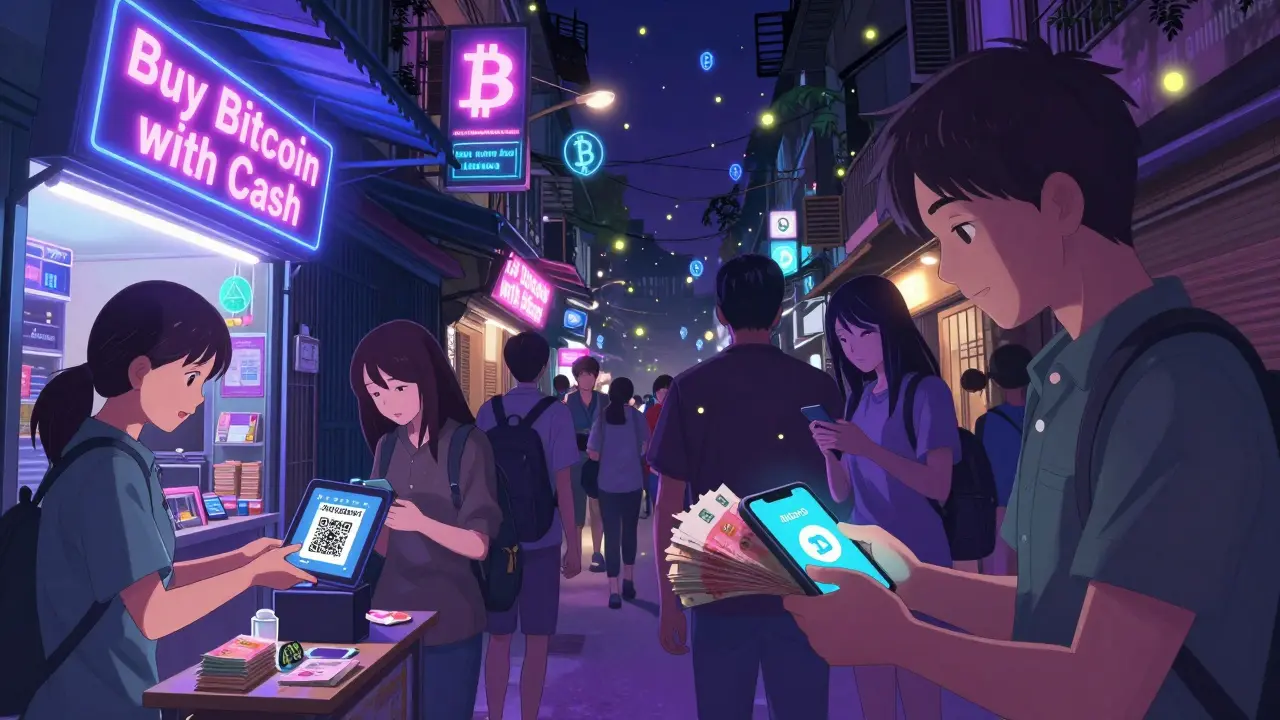
You won’t find crypto ATMs in Hanoi. But you’ll find hundreds of small shops with signs saying "Buy Bitcoin with Cash." These aren’t shady operations-they’re licensed exchange points. You walk in, hand over 5 million VND (about $200), and get a QR code for your wallet. The shop owner gets a cut. The system works because it’s simple, fast, and doesn’t need a bank.Mobile payments dominate Vietnam. Over 80% of the population uses ZaloPay or Momo. Crypto adoption piggybacked on that. Apps like Trust Wallet and Phantom let users send and receive crypto directly from their phones. No ID checks. No KYC if you’re under $1,000 a day. That’s why daily trading volumes hit $600 million in 2025. It’s not speculation-it’s daily commerce.
What the Government Really Wants
The Vietnamese government doesn’t hate crypto. It fears chaos. It saw how unregulated crypto in 2021 led to scams, pyramid schemes, and people losing life savings. So instead of banning it, they created a controlled sandbox. The five-year pilot program lets trading happen-but only under oversight. Exchanges must register. Large transfers are flagged. Tax reporting is coming. But for now, the door is open, just with a lock.They’re watching. They’re learning. And they’re preparing for the next step: a digital dong. Vietnam is testing a central bank digital currency (CBDC) that could eventually replace cash. Crypto might be the training ground. If people can handle Bitcoin, they can handle a digital dollar.
Why Restrictions Are Actually Helping
Most countries that ban crypto see adoption go underground-and get dangerous. Vietnam’s restrictions are the opposite. By keeping banks out, they forced innovation. People built tools that work without them. They created a parallel financial system that’s more resilient than the official one.Compare Vietnam to Thailand, where crypto is legal but tightly controlled. Thai users pay high fees, deal with long verification times, and can’t easily move money abroad. Vietnamese users? They trade globally, earn in crypto, and spend locally. They’re not waiting for permission. They’re building their own rules.
The result? A market that’s growing at 9.4% per year, projected to hit $22 billion by 2033. And it’s not driven by hype. It’s driven by need. People use crypto because it works better than the alternatives.

What’s Next? The Tightrope Walk
The next three years will decide Vietnam’s crypto future. If the government moves too fast-imposing heavy taxes, forcing KYC on all trades, or banning peer-to-peer exchanges-they’ll crush the ecosystem. If they move too slow, they risk losing control to underground networks or foreign exchanges.Right now, they’re walking the line. They’re allowing trading but cracking down on scams. They’re letting developers build but requiring licenses. They’re letting users earn crypto but preparing to tax it. It’s messy. But it’s working.
The $91 billion isn’t a loophole. It’s a signal. Vietnam has built a crypto economy that’s too big to ignore, too useful to ban, and too innovative to control with old rules. The government’s job now isn’t to stop it-it’s to guide it.
What This Means for You
If you’re a trader, investor, or developer: Vietnam is not a gamble. It’s a laboratory. It’s the only country where crypto adoption is driven by real economic need, not speculation. The tech talent, the mobile infrastructure, the user base-it’s all here. And it’s growing.If you’re from a country with strict crypto bans: Vietnam shows it’s possible to coexist. You don’t have to choose between control and freedom. You can create space for innovation without chaos.
If you’re just curious: Look at the numbers. 21 million people. $91 billion a year. $600 million daily. This isn’t a trend. It’s a transformation.





Comments
Helen Pieracacos
December 20, 2025 AT 12:17 PMSo let me get this straight - the government bans crypto but lets people buy it with cash from corner shops like it’s street-corner herbal tea? 🤦♀️
Brilliant. Just brilliant. The only thing more ironic is that they’re calling it a 'pilot program' like this isn’t already a full-blown experiment in chaos.
Dustin Bright
December 20, 2025 AT 21:06 PMthis is actually kinda beautiful 😭
people in rural vietnam are playing games to feed their families and the gov just... watches? no bank drama, no red tape, just qr codes and wifi. i wish we had this in the us. we’re stuck in kyc hell while they’re building a new economy on their phones 💚📱
Melissa Black
December 21, 2025 AT 17:24 PMThis is a textbook case of emergent monetary sovereignty. The state’s attempt at regulatory containment has failed because it misidentified the vector of adoption - not financial institutions, but mobile-first, peer-to-peer utility. The $91B isn’t speculative capital; it’s transactional liquidity born of necessity. The CBDC is not the endgame - it’s the state’s attempt to co-opt the infrastructure they couldn’t suppress. This isn’t crypto adoption. It’s economic evolution.
And yes, I’m aware this sounds like a TED Talk. It’s supposed to.
Sophia Wade
December 22, 2025 AT 04:05 AMOne cannot help but admire the quiet defiance of a people who have constructed an entire financial ecosystem outside the sanctioned corridors of power. The Vietnamese have not rebelled with barricades - they have done so with smartphones, QR codes, and an unshakable belief that dignity lies in autonomy. The state’s restraint, though born of fear, has inadvertently nurtured a form of financial poetry - elegant, unlicensed, and profoundly human.
Brian Martitsch
December 22, 2025 AT 13:06 PM21 million users? LOL. Most are probably just farming Axie tokens while their parents think it's a 'new online job'.
And no, this isn't innovation - it's regulatory arbitrage wrapped in a TikTok trend. Real economies don't run on QR codes and wishful thinking. 🤷♂️
Rebecca F
December 22, 2025 AT 15:34 PMThey’re not building a future they’re building a trap
One day the government will come for the wallets
One day the apps will vanish
One day the kids who played Axie for food will be left with nothing but a phone full of ghost coins
And no one will care
Rachel McDonald
December 24, 2025 AT 01:38 AMI just cried reading this. I mean... imagine being a single mom in the Mekong Delta and your only way to pay for your kid’s medicine is by winning a daily game? That’s not crypto. That’s survival. And the government? They’re just watching like it’s a nature documentary. I’m so mad I’m shaking. 😭
Vijay n
December 25, 2025 AT 18:55 PMThis is all part of western financial colonisation disguised as decentralisation. The usa and china are using crypto to drain asia's wealth under the guise of innovation. Vietnam is being manipulated. The government is naive. The 91 billion? It's not flowing in - it's being siphoned out. And the so-called 'tech talent'? They're just coding for foreign VC firms. The real winners are in san francisco. Not hanoi.
Alison Fenske
December 27, 2025 AT 10:03 AMi just love how normal this is for them. like imagine walking into a shop, handing over cash, getting a qr code, and then buying dinner with ethereum like it’s no big deal. in the us we need 17 forms and a notary to buy a coffee with paypal. they’re living in the future and we’re still arguing about whether crypto is ‘real money’ 😅
Amit Kumar
December 29, 2025 AT 03:43 AMBro in india we can't even buy crypto without a 3-day KYC nightmare and 18% tax. here in vietnam they just walk into a shop, hand over cash, and boom - you're a blockchain node. I’m jealous. Like, legitimately jealous. We have 1.4 billion people and zero innovation. They have 100 million and they built a parallel economy while we were busy filing GST returns. Respect.
chris yusunas
December 29, 2025 AT 15:20 PMThis is the future. Not the metaverse. Not NFT monkeys. This. Real people. Real cash. Real phones. No banks. No permission. Just need + tech = freedom. The west thinks they’re the innovators. Nah. Vietnam’s doing the real work. I’m here for it. 🌍✊
Naman Modi
December 30, 2025 AT 18:47 PMThey’re gonna crash. Mark my words. When the CBDC drops, they’ll freeze all wallets. People will riot. The government will blame 'foreign actors'. The same thing happened in Venezuela. This isn’t freedom. It’s a time bomb. 🕒💣