
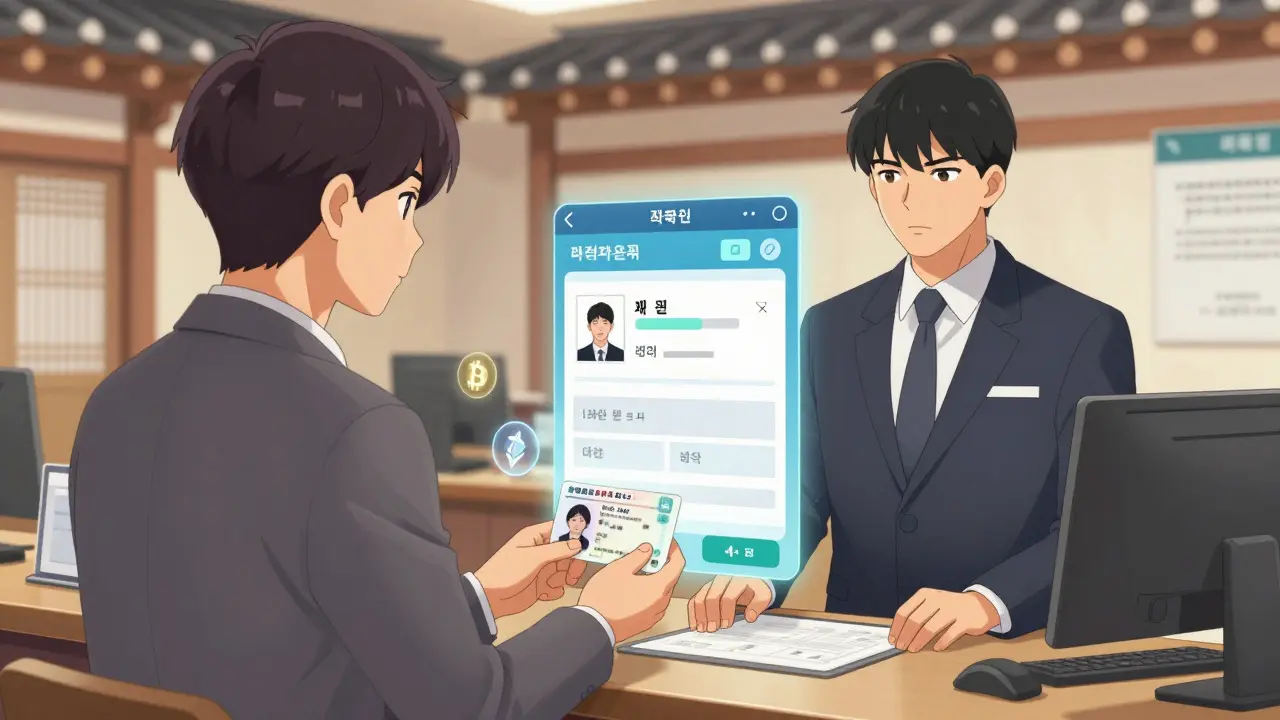
South Korea Crypto Account Eligibility Checker
Check if you qualify to open a real-name bank account for crypto trading in South Korea based on your residency status and documentation requirements.
Eligibility Results
Your eligibility will appear here after checking.
South Korea doesn’t let you trade crypto unless your bank account matches your ID. No aliases. No offshore wallets. No anonymous deposits. If you want to buy Bitcoin, Ethereum, or any other digital asset in Korea, you must use a real-name bank account linked to your government-issued ID. This isn’t a suggestion-it’s the law. And it’s one of the strictest crypto rules in the world.
Why Does South Korea Force Real Names on Crypto Traders?
In 2017, South Korea’s crypto market exploded. Trading volumes surged. People were buying crypto with cash, using unverified accounts, and moving money through shell companies. The government got worried. Money laundering. Tax evasion. Fraud. All of it was getting harder to track. By early 2018, the Financial Services Commission (FSC) stepped in. They didn’t ban crypto. Instead, they forced exchanges to tie every trade to a real person’s bank account.
The goal? Transparency. Before this rule, you could open a crypto account with a fake name and trade freely. Now, every deposit, withdrawal, and trade is logged under your legal name. Banks and exchanges share data. If something looks off-like sudden large transfers or mismatched names-the system flags it. The government didn’t want to kill crypto. They wanted to clean it up.
How the Real-Name System Actually Works
It’s not complicated, but it’s rigid. Here’s the flow:
- You open a bank account in your real name at one of the approved Korean banks: Shinhan, K-Bank, Kookmin, Kakao, or Woori.
- You sign up with a crypto exchange that has a partnership with that same bank.
- You link your bank account to your exchange profile.
- When you deposit KRW, the money must come from and go back to that exact bank account.
- Exchanges send your transaction data to your bank daily. Banks can freeze accounts if they see suspicious activity.
That’s it. No exceptions. If your bank account is under Park Ji-hoon, your crypto account must be too. No using your cousin’s account. No using a friend’s account. Even if you’re married, you can’t pool funds under one name unless both parties are registered on the same account.
There are only five exchanges that have full approval to operate with real-name bank accounts: Upbit (K-Bank), Bithumb (Kookmin Bank), Korbit (Shinhan Bank), Coinone (Kakao Bank), and Gopax (Woori Bank). All others are either unlicensed or operating without bank access-meaning they can’t accept Korean Won deposits. That’s a big deal. Most people in Korea trade in KRW. If you can’t deposit won, you can’t trade.
Who Can Use This System? (It’s Not for Everyone)
South Korean citizens? Easy. Just go to any bank, show your ID, open an account, and link it to an approved exchange. Done.
Foreigners? Not so much.
To open a real-name bank account in Korea as a non-citizen, you need:
- A valid long-term visa (not tourist)
- An Alien Registration Card (ARC)
- A Korean mobile number
- Proof of address in Korea
Most tourists, digital nomads, or short-term visitors can’t meet these requirements. Even if you’re living in Korea on a work visa, the bank might still reject your application if your employment contract is less than a year. Some banks require a minimum deposit of 1 million KRW (around $750) just to open the account.
And here’s the kicker: international exchanges like Binance, Coinbase, or Kraken can’t connect to Korean banks. You can’t use your U.S. bank account to buy crypto on Upbit. You can’t use your credit card. You can’t use PayPal. The only way in is through a Korean bank account. That means if you’re not a resident, you’re locked out.

What Happens If You Try to Bypass the System?
People try. Always do. Some use peer-to-peer platforms. Others use fake IDs or borrowed accounts. Some even hire locals to open accounts for them.
Here’s what happens when you get caught:
- Your bank account gets frozen.
- Your crypto exchange account is suspended.
- You may be reported to the Financial Intelligence Unit (FIU).
- In serious cases, you could face fines or criminal charges under the Foreign Exchange Transaction Act.
There’s no gray area. The system is automated. Banks and exchanges cross-check names, IDs, and transaction patterns in real time. Even small discrepancies-like a typo in your surname or a mismatched birthdate-can trigger a freeze.
How Do You Deposit KRW? (Step-by-Step)
If you’re eligible, here’s how to actually get money into your crypto account:
- Log into your approved exchange (e.g., Upbit).
- Select “Deposit KRW” or “Deposit Korean Won.”
- The system will show you a unique deposit account number and bank name (e.g., K-Bank).
- Open your mobile banking app (Shinhan, Kookmin, etc.) and select “Transfer.”
- Enter the account number and amount. Make sure the recipient name matches your legal name exactly.
- Send the transfer. It usually takes 10-30 minutes to reflect in your exchange wallet.
Withdrawals work the same way in reverse. You can’t withdraw to a different bank account. It has to go back to the one you linked.
What’s Changing in 2027? (Tax Time Is Coming)
Right now, crypto profits in Korea are not taxed. But that’s about to change.
In 2027, the government will start taxing individuals on capital gains from crypto trading. If you make a profit selling Bitcoin or Ethereum, you’ll owe income tax-up to 45% depending on your total earnings. Corporations will pay 24.2% on crypto-related income. This isn’t just a future policy-it’s already written into law.
Experts predict this will push some traders to cash out before 2027. Others will move to offshore platforms. But here’s the catch: if you’re using a real-name bank account, your transactions are already tracked. The government knows how much you made. Avoiding taxes won’t be easy.

Is This System Good or Bad?
It’s both.
On the plus side: Korea’s crypto market is one of the safest in the world. Scams are rare. Exchange hacks are almost unheard of. Users trust the system because they know their money isn’t going to vanish overnight. Institutional investors are starting to take notice. By 2030, the market is expected to hit $635 million in revenue.
On the downside: it’s exclusionary. It blocks out foreigners, students, expats, and even some Koreans who don’t want their bank linked to crypto. It’s also slow. New exchanges can wait years to get approved. The process is bureaucratic. And if you’re not a resident, you’re basically invisible to the market.
Compared to the U.S., where you can trade on Coinbase with just a U.S. bank account and ID, Korea feels like a walled garden. In Japan, you can use pseudonymous accounts. In Singapore, you can use foreign bank transfers. In Korea? Only real names. Only local banks. Only approved exchanges.
What If You’re a Foreigner Who Still Wants to Trade in Korea?
Short answer: you can’t-not legally, and not easily.
If you’re serious, your only real path is to get a long-term visa, apply for an Alien Registration Card, open a Korean bank account, and then link it to an approved exchange. It takes months. It requires paperwork. And even then, you might get rejected.
Some try using local agents or friends to open accounts for them. That’s risky. If the bank finds out, both you and the person who opened the account could be penalized. It’s not worth it.
The smart move? Stick to global exchanges that accept your home currency. You won’t get access to the Korean market, but you’ll avoid legal trouble.
What’s Next for Korea’s Crypto Rules?
The government isn’t done. They’re still adding more VASPs (Virtual Asset Service Providers) to the registry-28 have filed so far. But only five have bank access. That gap is growing. More companies want to enter, but the bar is too high.
Some experts think Korea will eventually allow foreign bank integrations. Others believe the real-name system will stay locked down to protect domestic financial stability.
One thing’s certain: Korea isn’t trying to be the crypto capital of the world. It’s trying to be the safest. And that’s a trade-off most Koreans are willing to make.
Can I use a foreign bank account to trade crypto on Korean exchanges?
No. Korean exchanges only accept deposits and withdrawals from real-name bank accounts at approved Korean banks. Foreign bank accounts, even those in USD or EUR, cannot be linked. You must have a Korean bank account under your legal name to trade on Upbit, Bithumb, or any other approved exchange.
Do I need to be a South Korean citizen to open a real-name bank account for crypto?
No, but you need to be a legal resident. Foreigners can open accounts if they have a long-term visa, an Alien Registration Card (ARC), a Korean mobile number, and proof of address. Tourists, short-term visitors, and digital nomads without residency status cannot open these accounts.
Which exchanges can I use with a real-name bank account in Korea?
Only five exchanges currently have full approval and bank partnerships: Upbit (K-Bank), Bithumb (Kookmin Bank), Korbit (Shinhan Bank), Coinone (Kakao Bank), and Gopax (Woori Bank). All other exchanges cannot accept Korean Won deposits and are effectively blocked from the domestic market.
Will I be taxed on my crypto profits in South Korea?
Starting in 2027, yes. The government has passed laws taxing individual crypto gains under the Income Tax Act. Rates can reach up to 45% depending on your total income. Corporations will pay 24.2% on crypto-related profits. All transactions are tracked through real-name accounts, so tax evasion will be difficult.
Can I use a friend’s or family member’s bank account to trade crypto?
No. The system is automated and cross-checks your name on the bank account, your exchange profile, and your government ID. If they don’t match exactly, the transaction will be blocked. Using someone else’s account is illegal and can lead to account freezes, fines, or criminal charges.
Why are only five exchanges approved for bank links?
The Financial Intelligence Unit (FIU) requires strict compliance with KYC, security audits, and financial reporting. Most exchanges fail to meet these standards. Only those with proven track records, strong internal controls, and full cooperation with regulators receive bank partnerships. The process can take over a year.



Comments
Kelly Burn
December 10, 2025 AT 09:02 AMKorea’s crypto rules are wild but kinda genius? 🤯 No more rug pulls, no more ghost wallets-just clean, traceable trades. I’m lowkey jealous of how safe this feels.
Nicholas Ethan
December 11, 2025 AT 11:21 AMThe regulatory framework exhibits a high degree of structural integrity and risk mitigation efficacy. Non-resident exclusion is not discriminatory but rather a necessary compliance boundary.
Rakesh Bhamu
December 12, 2025 AT 03:26 AMI’ve seen this play out in India too-when crypto went wild, the government panicked and overcorrected. Korea’s approach is actually balanced. They didn’t ban it, they just made it honest. Respect.
Hari Sarasan
December 12, 2025 AT 04:31 AMThis is not regulation-it’s financial apartheid. A global asset class being gated behind bureaucratic moats. The FIU has turned crypto into a citizenship test. This isn’t security-it’s exclusion disguised as compliance.
Candace Murangi
December 12, 2025 AT 17:15 PMI lived in Seoul for a year. Tried to open a bank account. They asked for my employment contract, my lease, my Korean phone number, and my blood type. Jk about the blood type. But seriously-what’s next? A fingerprint scan just to buy Dogecoin?
Patricia Whitaker
December 14, 2025 AT 08:46 AMSo let me get this straight-you can’t use your US bank to buy Bitcoin in Korea? That’s not a crypto rule. That’s a ‘we hate foreigners’ rule. And now they’re gonna tax you too? Cool. I’ll just buy on Binance and call it a day.
Caroline Fletcher
December 14, 2025 AT 19:52 PMThey’re not trying to stop crime. They’re trying to stop YOU. The government knows you’re trading crypto so they’re forcing you to report it. This is surveillance with a smiley face.
Steven Ellis
December 15, 2025 AT 12:14 PMI get why people hate this system, but let’s be real-Korea has one of the lowest crypto fraud rates in the world. No one’s getting hacked on Upbit. No one’s losing life savings to fake tokens. That safety comes at a cost, and honestly? Worth it.
Sue Gallaher
December 16, 2025 AT 23:39 PMAmerica lets anyone trade crypto with a credit card and a vape shop ID. Meanwhile Korea’s out here building a fortress. Guess which one’s gonna be around in 10 years?
Jeremy Eugene
December 18, 2025 AT 21:34 PMThe real-name system is a logical extension of existing financial transparency norms. It aligns with FATF recommendations and mitigates systemic risk. The exclusion of non-residents is consistent with jurisdictional banking sovereignty.
Kathy Wood
December 19, 2025 AT 14:04 PMSo… you can’t use your cousin’s account? WHAT IF I’M JUST TRYING TO HELP MY FAMILY?! THIS IS TERRIBLE! I’M GOING TO MOVE TO EL SALVADOR AND BUY BITCOIN WITH TACOS!
Stanley Machuki
December 21, 2025 AT 00:13 AMDon’t sleep on this model. Most countries are still in the ‘let’s ban it’ phase. Korea’s already in ‘let’s make it safe and taxable.’ That’s leadership. 2027 tax hit? Bring it. I’ll be ready.
Lynne Kuper
December 21, 2025 AT 13:20 PMYou think this is harsh? Try living in a country where your bank account gets frozen because you sent $500 to a crypto exchange and your name had a typo. This system catches EVERYTHING. It’s not perfect-but it’s honest.
John Sebastian
December 21, 2025 AT 13:56 PMI don’t care how safe it is. If I can’t trade without jumping through 17 hoops, then the system is broken. Crypto is supposed to be free. Not tied to your Korean residency card.
Andy Walton
December 22, 2025 AT 23:38 PMthis is just the beginning 😭 they’re gonna start tracking your crypto wallet like your social security number. next thing you know they’ll know what nft you bought and judge you for it. #wokecapitalism
Albert Chau
December 24, 2025 AT 00:00 AMForeigners whining about not being able to trade? You don’t live there. You don’t pay taxes there. You don’t use their hospitals or schools. Why should you get access to their financial system? Get a visa. Work there. Earn it.
Madison Surface
December 24, 2025 AT 14:03 PMI’m a woman of color who moved to Korea on a work visa. It took 6 months, 3 bank visits, and a notarized letter from my employer just to open an account. But once I did? I felt seen. Like the system finally recognized me as real. That’s powerful.
Tiffany M
December 26, 2025 AT 10:02 AMKorea’s being called ‘authoritarian’ but guess what? Their exchanges haven’t been hacked since 2018. Meanwhile, US exchanges get raided like they’re bank vaults. Maybe safety isn’t the enemy of freedom. Maybe it’s the price of it.
Ian Norton
December 27, 2025 AT 21:18 PMYou think this is bad? Try getting a bank account in the U.S. without a SSN. At least in Korea, you’re not being asked to prove your identity to a 19-year-old at a crypto ATM who thinks ‘blockchain’ is a new energy drink. This system works. It’s just not for lazy tourists.