
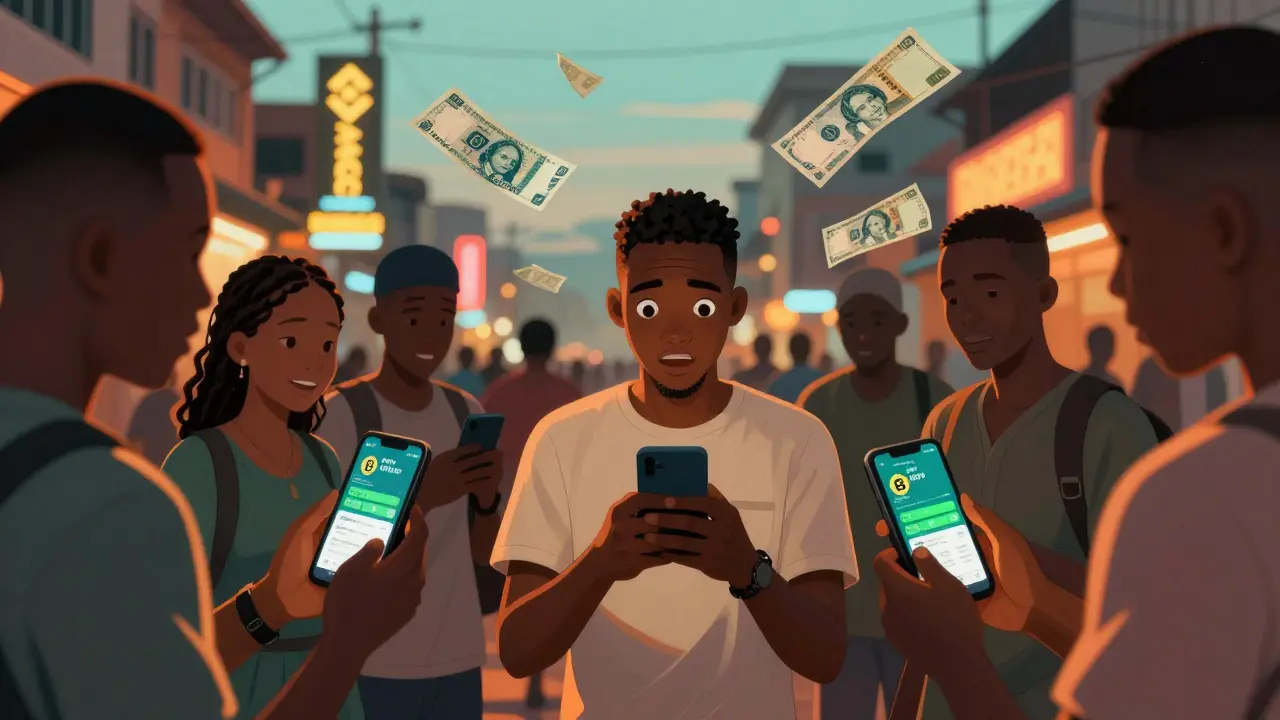
When the Nigerian Naira lost over 75% of its value against the US dollar since 2016, people didn’t just wait for banks to fix things. They turned to something faster, cheaper, and more reliable: peer-to-peer (P2P) crypto trading. Today, in 2026, Nigeria isn’t just using crypto - it’s leading the world in P2P adoption. Nearly 36% of adults here are unbanked, and millions rely on digital assets to buy groceries, send money home, or save against inflation that hit 24% in 2023. This isn’t a fringe trend. It’s the new financial backbone of a country that had no choice but to build its own system.
Why Nigeria Chose P2P Over Banks
In 2021, the Central Bank of Nigeria (CBN) told banks to cut off all crypto-related accounts. That should’ve killed the movement. Instead, it made it stronger. People started trading directly - buyer to seller, Naira for Bitcoin, no middleman. No bank fees. No delays. No frozen accounts. By 2023, the CBN reversed course and allowed licensed platforms to operate. But the real turning point came in early 2025 with the Investments and Securities Act (ISA 2025). For the first time, the Securities and Exchange Commission (SEC) became the official regulator of digital assets. Suddenly, crypto wasn’t illegal - it was regulated. And that made all the difference.Before ISA 2025, scams ran wild. Fake sellers, fake escrows, stolen bank details - it was a minefield. Now, platforms must be licensed, undergo audits, and implement real-time monitoring. Scam reports dropped by 63% in just six months. That’s not just progress - it’s a revolution.
The Top 6 P2P Platforms in Nigeria (2026)
There are now over a dozen licensed platforms, but six dominate the market. Here’s what they actually do - not what their websites claim, but what users experience daily.
- Binance P2P: Still the giant. It handles about 45% of all P2P trades in Nigeria. With 519 cryptocurrencies and over 20 payment methods - including direct bank transfers, mobile money, and even USSD - it’s the go-to for volume. Its dispute system works: 89% of users say their issues were resolved fairly. But new users report longer verification times - up to 40% slower than before. And in March 2025, a 37-hour outage knocked out 28,000 users. It’s powerful, but not flawless.
- Bybit: If you speak Yoruba, Igbo, or Hausa, this is your platform. Bybit is the only one offering full 24/7 customer support in local languages. That’s huge. Most platforms only have English or basic chatbots. Bybit also integrates deeply with Nigerian banks, making deposits and withdrawals 12-15% faster than global competitors, according to crypto journalist Shennon Hewa. Its interface is clean, fees are 0.1%, and it supports the same 519 coins as Binance. Many users switch from Binance to Bybit just for the language support.
- YellowCard: This one’s built for education. With over 120 tutorial videos in Nigerian languages, 85% of users finish them. It’s zero-fee trading, instant Naira deposits, and it’s licensed across 20 African countries. But here’s the catch: its mobile app crashes during peak hours in 43% of stress tests. If you’re trading large amounts at 7 PM on a Friday, you might get stuck. Still, 4.2/5 on Trustpilot from 3,850 Nigerian users says it’s trusted.
- Busha: The first SEC-licensed exchange in Nigeria. It’s fast, secure, and built for daily traders. You can set recurring buys, use limit orders, and swap between 15 cryptocurrencies in one click. Its mobile app has 4.6/5 stars from 28,500 reviews. But customer support takes 47 minutes on average during busy times. If you’re trading small amounts, it’s perfect. If you need help fast? Not so much.
- Breet: Speed king. 98% of transactions finish in under 5 minutes. That’s faster than most bank transfers in Nigeria. Users love it for instant payouts. But it’s not for beginners. The interface is minimal, support is limited, and it only supports Bitcoin and a few major coins. If you just want to sell your Bitcoin and get Naira in your account - now - this is your platform.
- Quidax: Security-first. It uses cold storage for 95% of funds, runs monthly penetration tests, and has an internal compliance team. It’s not the flashiest, but it’s the most secure. If you’re holding more than ₦1 million ($650), this is where you want to trade. Its main downside? Slower processing - 10-15 minutes on average. But for safety, most users say it’s worth it.

What Users Actually Care About
It’s not about which coin you trade. It’s not even about the fees. According to a survey of 1,200 Nigerian crypto users, here’s what matters most:
- Speed: 73% prioritize how fast they get paid. A 15-minute delay? That’s a deal-breaker.
- Reliability: 68% say they avoid platforms with a history of frozen escrows or long hold times.
- Local support: Platforms with Yoruba, Igbo, or Hausa support see 30% higher retention.
- Security features: 2FA is mandatory, but 68% of users disable it because SMS verification fails too often. That’s a huge vulnerability.
One Reddit user, u/NaijaCryptoGuru, summed it up: “I don’t care if it’s Binance or Busha. I care if my money moves when I need it to. If it doesn’t, I switch.”
The Hidden Risks
Yes, the system is better. But it’s not safe. Scammers are adapting. In Q2 2025, 22% of fraud cases involved fake sellers impersonating verified users. One user lost ₦500,000 ($328) on Paxful because the buyer used stolen bank credentials. Escrow accounts still freeze for up to 72 hours during CBN compliance checks. And rural users - 31% of the population - struggle with poor internet, making P2P trading nearly impossible.
Even licensed platforms aren’t immune. YellowCard’s app crashes. Binance had a major outage. And while the SEC requires real-time monitoring by December 2025, not all platforms are ready. The system is improving - but it’s still fragile.

Who’s Using This?
The average Nigerian P2P trader is male, 18-34 years old, and trades under ₦500,000 ($328) per transaction. But the real story? The women. Female participation is at 22% - up from 11% in 2023. Why? Because P2P lets them trade without walking into a bank, asking for permission, or dealing with gender bias. One user in Lagos told me: “I started with ₦10,000 to buy Bitcoin. Now I pay my staff’s salaries in USDT. No one questions me.”
Community support is massive. There are 147 active Telegram groups with over 1,200 members each. Thirty-two YouTube channels teach P2P trading in local languages. If you’re new, you’re not alone. There’s a guide, a video, or a chat group for every step.
What’s Next?
The market is projected to hit $5.1 billion by 2027. The SEC expects 35-40 licensed platforms by year-end - up from just 12 today. Institutional investors are watching. Banks are starting to partner with platforms. Binance’s “Naira Direct” feature, launched in August 2025, cut transaction steps from five to two and sped things up by 38%. That’s the future: seamless, fast, regulated.
But the biggest change? Mindset. Nigerians aren’t waiting for permission anymore. They built their own financial system - out of necessity, not curiosity. And now, the world is watching.



Comments
Anshita Koul
March 12, 2026 AT 03:34 AMIt’s fascinating-how necessity becomes innovation, isn’t it? People don’t wait for permission to survive; they build systems out of chaos. Nigeria didn’t just adapt to crypto-they redefined what financial autonomy means. And yet, no one in the West is talking about this as the quiet revolution it is. We’re still stuck in debates about regulation, while they’re already living it. The real question isn’t ‘Can it work?’-it’s ‘Why haven’t we all done this already?’
Adam Ashworth
March 13, 2026 AT 16:18 PMThis is the most coherent, data-driven piece on P2P crypto I’ve read in years. The 63% drop in scams post-ISA 2025? That’s not luck-it’s policy done right. And the language support from Bybit? Genius. If you’re building a financial system for a multilingual population, you don’t just translate-you localize. Kudos to the writers for highlighting what actually matters: speed, trust, and accessibility-not hype.
Allison Davis
March 14, 2026 AT 12:31 PMYellowCard’s app crashes during peak hours? That’s a red flag. No platform with 4.2/5 ratings should have a 43% crash rate under stress. It’s one thing to be popular, another to be reliable. If you’re paying your staff in USDT, you need uptime-not optimism. The SEC’s oversight is good, but if the tech can’t keep up, the system still fails the people it’s meant to serve.
karan narware
March 16, 2026 AT 05:39 AMOf course the women are thriving. Banks were never meant for them. Men built the system, then acted surprised when women didn’t trust it. Now? They’re trading, paying salaries, building wealth-without asking anyone’s permission. And you wonder why Nigeria’s crypto scene is unstoppable? Because it was never about money. It was about dignity.
Michael Suttle
March 18, 2026 AT 04:50 AMSEC oversight? LOL. You think they’re protecting you? They’re just making it easier to track you. Every licensed platform is a honeypot for surveillance. And Binance’s 37-hour outage? That wasn’t a glitch-it was a test. They wanted to see how many people would panic. Spoiler: millions kept trading anyway. The real revolution isn’t crypto-it’s that people stopped believing in ‘authorities’.
Jenni James
March 18, 2026 AT 07:21 AMLet me be perfectly clear: this entire narrative is dangerously romanticized. You call it a ‘revolution’? It’s a desperate workaround. A country with 36% unbanked adults shouldn’t be celebrated for turning to Bitcoin-it should be shamed for failing its citizens. And let’s not pretend these platforms are safe. 68% disabling 2FA because SMS fails? That’s not innovation-it’s negligence dressed up as progress.
Chelsea Boonstra
March 18, 2026 AT 18:13 PMWait-so Binance had a 37-hour outage and you’re still calling it the ‘giant’? And you think people are ‘trusting’ these platforms? That’s like calling a leaking boat ‘the best vessel in the fleet’. The whole system is held together by duct tape and hope. If you’re trading large amounts, you’re gambling. Not investing. Gambling. And the fact that users are still using SMS for 2FA? That’s not a feature-it’s a suicide pact.
Alex Thorn
March 19, 2026 AT 21:56 PMLet’s pause for a second and recognize what’s happening here. Nigeria didn’t just adopt crypto-they created a new social contract. No bank. No bureaucracy. Just people trusting each other, with tech as the bridge. That’s profound. And yes, the systems are fragile. But so was the internet in 1995. The point isn’t perfection-it’s persistence. Every crash, every scam, every outage? It’s teaching them. And they’re learning faster than anyone else on Earth.
Howard Headlee
March 19, 2026 AT 23:06 PMSpeed is king? Hell yes. Breet’s 98% under 5 minutes? That’s not a feature-it’s a lifeline. I’ve waited 3 days for a bank transfer in the U.S. Imagine if your rent depended on a 15-minute delay. That’s daily life for millions in Lagos. And the women? They’re not just trading-they’re rewriting gender economics. One user pays her staff in USDT? That’s not finance. That’s revolution with a payroll app.
Tom Jewell
March 20, 2026 AT 07:14 AMThere’s a quiet poetry here. A nation, stripped of institutional trust, turned to decentralized code-not because they loved Bitcoin, but because they needed something that wouldn’t lie to them. The CBN banned crypto, and the people didn’t protest-they coded around it. They built Telegram groups, YouTube tutorials, local-language support. They didn’t ask for permission. They just… did. And now, the world watches, confused, because this isn’t a tech story. It’s a human story. A story of resilience written in blockchain, not legislation. No one in Silicon Valley could’ve predicted this. Because they were too busy optimizing ads, not survival.