

Imagine a world where a global organization with thousands of members needs to agree on a rule change, but no one trusts a central CEO or a board of directors. In the blockchain world, this isn't a hypothetical-it's a daily reality. This is where On-Chain Governance and off-chain governance come into play. One uses code as law, while the other relies on human conversation and social consensus. Choosing the wrong one can lead to a "hard fork," where a community splits in two, or worse, a network that becomes too rigid to evolve.
The Core Split: What Are We Actually Talking About?
At its heart, blockchain governance is just the system for making decisions. When a network needs an upgrade, a bug fix, or a change in how rewards are distributed, the community has to decide how to proceed. On-Chain Governance is a system where rules, voting, and execution happen directly on the blockchain via smart contracts. If a proposal passes, the code updates itself automatically.
Then you have Off-Chain Governance, which is a more traditional approach where discussions and voting happen outside the protocol-think forums, emails, or social media. The actual implementation of the decision is then done by developers who update the software, which the network participants must then choose to run.
Quick Comparison: At a Glance
| Attribute | On-Chain Governance | Off-Chain Governance |
|---|---|---|
| Execution | Automatic (Smart Contracts) | Manual (Developer Updates) |
| Transparency | Absolute (On-ledger) | Variable (Forum-based) |
| Cost | High (Gas/Transaction fees) | Low (External platforms) |
| Speed of Debate | Slower (Formal proposals) | Faster (Conversational) |
| Privacy | Low (Publicly visible) | Higher (Private channels) |
How On-Chain Governance Actually Works
On-chain systems are designed to be trustless. They operate on a few non-negotiable principles: decentralization, transparency, and immutability. When you use a DAO (Decentralized Autonomous Organization), you're seeing this in action. A member submits a proposal, other token holders vote using their tokens as weight, and if the threshold is met, the Smart Contract executes the change.
One of the coolest features here is delegation. Not everyone has the time to read a 40-page technical proposal on tokenomics. Delegation allows a token holder to lend their voting power to a trusted expert. This keeps the system inclusive without requiring every single person to be a blockchain engineer.
But there's a catch. On-chain governance can be incredibly expensive. If you're using a Layer 1 network like Ethereum, every single vote is a transaction. When gas fees spike, only the "whales" (people with huge amounts of money) can afford to vote, which ironically hurts the decentralization the system was built for.

The Human Element: Off-Chain Governance
Off-chain governance is essentially "social consensus." It's how Bitcoin handles things. There is no built-in voting mechanism in the Bitcoin protocol. Instead, developers propose changes (called BIPs or Bitcoin Improvement Proposals), and the community discusses them on forums and Twitter. If the majority of miners and node operators agree, they start running the new software version.
The big advantage here is flexibility. You can have a nuanced debate, change your mind mid-way, and avoid paying a dime in transaction fees to express an opinion. It also offers better privacy. You can discuss a sensitive security patch in a private group before announcing it to the world, preventing attackers from gaming the system while the fix is being voted on.
The downside? It's not trustless. You have to trust that the developers will actually implement the will of the community and that the discussions aren't being manipulated by a few loud voices in a forum. It's more like a representative democracy than a direct one.
Security, Scalability, and the Cost Trade-off
When we talk about security, on-chain governance wins on integrity. Once a vote is cast and the result is written to the ledger, it's nearly impossible to fake or reverse. The validation layer provided by nodes ensures that no one is voting twice or spoofing results. However, this rigidity can be a liability. If a malicious proposal passes due to a flash-loan attack (where someone borrows a massive amount of tokens to swing a vote), the network might automatically execute a disastrous change before anyone can stop it.
Off-chain governance handles scalability much better. Because it doesn't clog the blockchain with "Yes/No" transactions, it can support millions of participants without slowing down the network. To bridge this gap, some projects use Layer 2 solutions or State Channels. These allow people to vote off-chain and then post only the final result to the main chain, combining speed with security.
Consider the cost of data. Storing a detailed proposal with images and long explanations on a public blockchain is prohibitively expensive. A few kilobytes of data on Ethereum can cost a fortune. This is why you'll almost never see the full text of a proposal living on-chain; usually, only a hash (a unique digital fingerprint) of the document is stored on-chain, while the actual text stays on a site like GitHub or a community forum.
Real-World Application: The Hybrid Approach
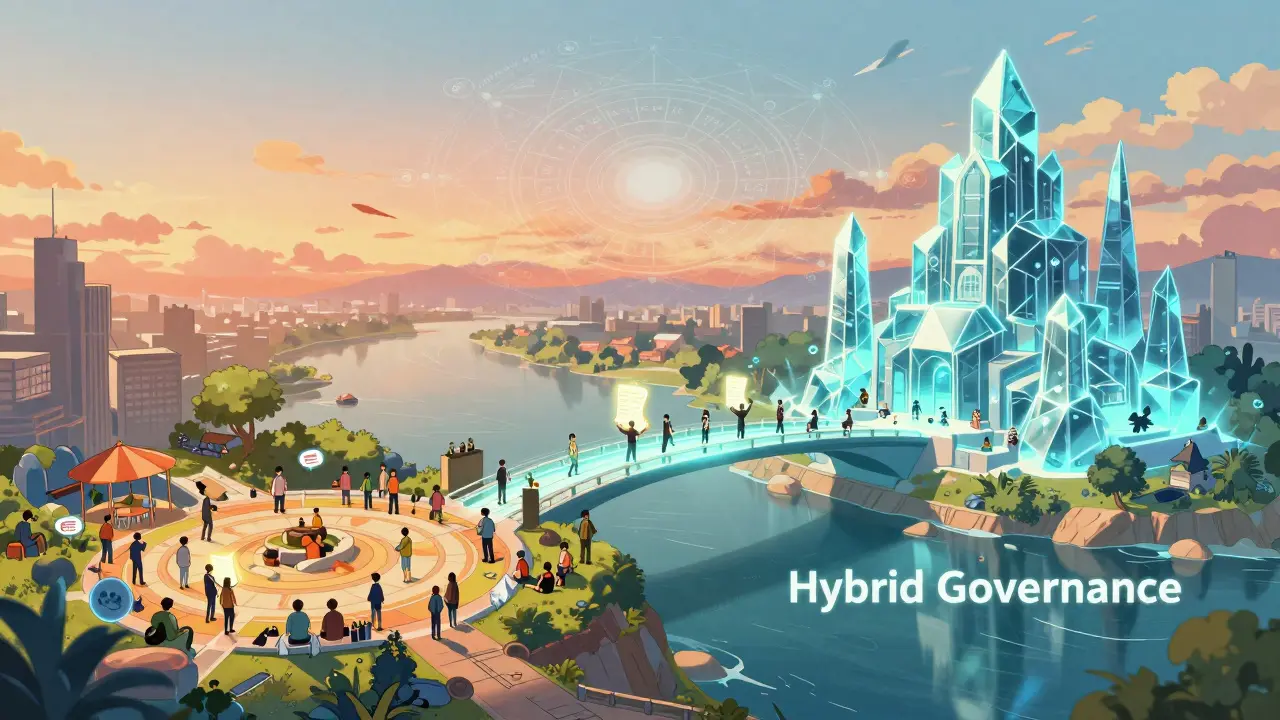
Most successful projects have realized that choosing one or the other is a mistake. Instead, they use a hybrid model. Take DeFi giants like Aave or Compound. They use on-chain mechanisms for the "mission-critical" stuff-like adjusting interest rates or moving funds-because those actions need to be verifiable and trustless.
However, they handle the early stages of a proposal off-chain. The community brainstorms on forums, refines the idea, and reaches a rough consensus before the formal, expensive on-chain vote is triggered. This saves money, reduces congestion, and ensures that by the time a vote hits the blockchain, it's likely to pass.
We're also seeing the rise of Zero-Knowledge Proofs (ZK-Proofs). This technology could eventually allow users to vote privately (off-chain) while proving to the network that their vote was valid (on-chain) without revealing who they are or how they voted. It's the holy grail of governance: privacy and transparency in one package.
Is on-chain governance more decentralized?
Technically, yes, because it removes the need for intermediaries like developers to implement a change. However, in practice, it can lead to "plutocracy," where a few wealthy token holders (whales) control all the decisions, whereas off-chain governance allows for more social and meritocratic discussion.
Can a blockchain have both?
Absolutely. Most modern protocols use a hybrid model where discussion and drafting happen off-chain (forums), but final execution and fund allocation happen on-chain via smart contracts.
What happens if an on-chain vote is hacked?
If a malicious proposal is executed automatically, the community may be forced to perform a "hard fork." This means they create a new version of the blockchain that ignores the malicious transaction, essentially resetting the network to a state before the attack.
Does Bitcoin use on-chain governance?
No. Bitcoin is a prime example of off-chain governance. Decisions are made through social consensus among developers, miners, and node operators, and then implemented via software updates.
Which one is cheaper for the user?
Off-chain governance is significantly cheaper. It relies on standard internet communication (web forums, social media) and doesn't require paying gas fees for every vote cast.
What to do next?
If you're building a project or joining a DAO, don't just pick a model because it sounds "more decentralized." Ask yourself: Does this decision require a trustless execution, or does it require a human conversation?
- For critical fund movements: Stick to on-chain governance. You want a transparent, immutable record of where the money went.
- For protocol brainstorming: Use off-chain forums. You need the freedom to fail and iterate before committing code to the chain.
- For high-frequency updates: Look into Layer 2 voting solutions or snapshot-style voting to avoid bankrupting your users with gas fees.




Comments
Sara Ellis
April 26, 2026 AT 03:46 AMjust a big game of power honestly
Kathleen Bergin
April 27, 2026 AT 02:56 AMBasically everyone forgets that smart contracts are only as good as the person who wrote them. If the code is buggy, on-chain governance just automates a disaster. It's common sense that human oversight is always needed regardless of the model.
Robert Mosolygo
April 27, 2026 AT 21:22 PMThe naive assumption here is that
Charlie Queen
April 29, 2026 AT 16:09 PMLove the breakdown! 🚀 It's so cool to see how different communities find their own rhythm. Whether it's a DAO or a forum, the goal is just to build something together. Let's keep the vibes positive! ✨🌈
Keith Garcia
April 29, 2026 AT 18:14 PMWhat a quaintly simplistic overview of systemic power dynamics. 🙄 The sheer audacity to suggest that a hybrid model solves the inherent plutocracy of token-weighted voting is simply laughable. It's a grotesque masquerade of democracy where the 'whales' merely wear a different mask. One must possess a certain level of intellectual sophistication to realize that these structures are designed to consolidate wealth, not distribute power. Truly, the cognitive dissonance required to believe in 'inclusive' DAOs is staggering. 💅✨
Greg Reynolds
April 30, 2026 AT 09:20 AMActually, the claim that off-chain is more 'meritocratic' is a fallacy. In reality, it's just a different kind of echo chamber where the most loud and aggressive personalities dominate the discourse, regardless of their actual technical contribution. On-chain voting at least provides a quantifiable metric of stake, which is far more honest than a popularity contest on a forum.
Alex Hunter
May 1, 2026 AT 04:46 AMI think it's helpful to remember that we're all learning this together. If you're new to this, don't be intimidated by the technical jargon. The most important part isn't the code, but the community's commitment to a shared vision. Maybe we can start a thread on how to actually participate in these forums effectively for those who feel left out.
Benjamin Forg
May 1, 2026 AT 13:36 PMwho really controls the nodes anyway... it's all a front for the same elites pretending to give us a choice while they manipulate the social consensus from the shadows... no one is actually free in a system designed by the architects of control
Mike Krasner
May 2, 2026 AT 19:47 PMwhy do we even care about governance when the prices are crashing anyway lol just let the whales eat each other it's way more entertaining than reading 40 page proposals
Larry Yang
May 3, 2026 AT 19:07 PMThe analysis of gas fees is marginally correct, though it misses the nuanced impact of L2s on voter apathy. Honestly, the whole premise of 'trustless' governance is a bit of a joke when you consider the centralization of validator sets in most modern chains. It's a typical case of over-engineering a solution for a problem that is fundamentally social, not technical. The industry is just obsessed with putting everything on-chain for the sake of the aesthetic of decentralization while ignoring the actual utility. It's an embarrassing state of affairs for anyone with a shred of critical thinking. Truly a mediocre approach to a complex problem.
Sarah Fisher
May 4, 2026 AT 07:08 AMI think the hybrid approach really reflects how humans naturally operate. We need that space to brainstorm and feel out ideas before we commit to a rigid structure. It's like a digital version of a town hall meeting before a formal vote. Balancing the cold efficiency of a smart contract with the warmth of human conversation seems like the only sustainable way forward for any global community.
Alex Wan
May 6, 2026 AT 06:24 AMI absolutely agree with the sentiment shared here! It is truly inspirng to see the evoluton of these systems. We must strive to create inclusive environments where every voice, no matter how small, can contribute to the grander vision of a decentralized future! What a marvelous time to be alive and witness this transformation!
I am genuinely moved by the potential for cooperation across borders!
Guy Bianco
May 6, 2026 AT 09:43 AMIt would be beneficial for newcomers to explore the specific documentation of the projects they support. :) Proper study of the governance frameworks often reveals the subtle differences between a truly decentralized system and one that is merely decentralized in name. I suggest starting with the whitepapers. :)