
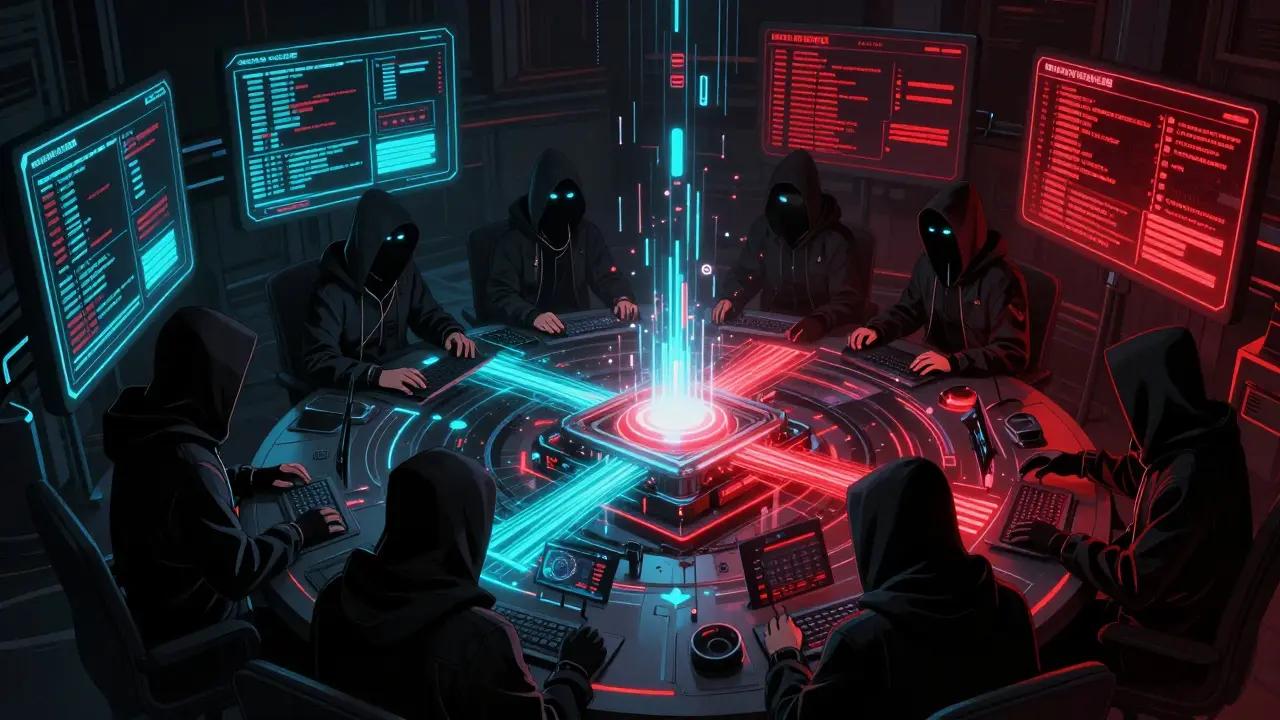
Imagine waking up to find $1.5 billion gone from a single exchange. That isn't a movie plot; it happened to Bybit on February 21, 2025. This wasn't a random glitch or a lone hacker in a basement. It was the work of the Lazarus Group is a sophisticated state-sponsored cybercriminal organization operating under North Korea's Reconnaissance General Bureau (RGB). While most hackers want a quick payday, this group is funding a nuclear weapons program, making them one of the most dangerous entities in the digital asset space.
The Anatomy of a Billion-Dollar Heist
The Bybit attack showed us that even the "gold standard" of security can be cracked. The group didn't just guess a password; they played a long game. It started with spear phishing, where they tricked key employees into giving up access to the exchange's user interface and cold wallet signers. Once they were inside, they didn't just drain everything instantly-that would trigger every alarm in the building.
Instead, they manipulated the Safe Wallet frontend. When the CEO attempted to authorize a routine transaction, the hackers had already embedded malicious code into the software. To the CEO, the screen showed a legitimate transfer. In reality, the code was rewritten in the background to redirect 401,000 Ethereum coins-worth about $1.46 billion-straight into the group's own wallets. It was a masterclass in frontend manipulation, proving that the human-machine interface is often the weakest link in a security chain.
Beyond the Big Hits: A Campaign of Chaos
If you think the Bybit hit was an isolated event, look at the summer of 2025. Between June and September, the group went on a rampage, hitting five major targets in just 104 days. They walked away with $100 million from Atomic Wallet, $60 million from Alphapo, and $41 million from Stake.com. They didn't stop there, allegedly netting another $54 million from CoinEx in September.
What makes this truly terrifying is how they hide the money. They use a technique called fund mixing. By overlapping stolen assets from different hacks-like mixing Stake.com funds with Atomic Wallet coins-they create a digital smoke screen. Elliptic, a blockchain analysis firm, found that the group consolidates these thefts across different blockchains to make it nearly impossible for law enforcement to follow the breadcrumbs.
| Target Entity | Estimated Loss | Primary Tactic | Year |
|---|---|---|---|
| Bybit | $1.5 Billion | Frontend Manipulation / Multi-sig Bypass | 2025 |
| Ronin Network | $620 Million | Social Engineering / Fake Job Offer | 2022 |
| Atomic Wallet | $100 Million | Wallet Vulnerability Exploitation | 2025 |
| CoinEx | $54 Million | Cross-chain Fund Mixing | 2025 |

The Hacker's Toolkit: Trojan Horses and Fake Jobs
Lazarus doesn't just rely on one trick. They've branched out into specialized subgroups. One of the most dangerous is TraderTraitor. Instead of sending a sketchy email, this group creates fake cryptocurrency trading apps. These apps look and feel legitimate at first, but they contain a hidden "update" mechanism. Once you install the update, it drops a payload called MANUSCRYPT-a remote access trojan that harvests your private keys and gives the hackers total control over your system.
They've also evolved their social engineering. Long gone are the days of generic spam. Now, they haunt LinkedIn, posing as high-end recruiters. They spend weeks building rapport with security researchers, making them feel special and valued. Once the trust is established, they send a "job description" or a "technical test" via a PDF. One click, and the target's computer is compromised. It's a psychological game that leverages professional ambition against the victim.

The Vulnerability of the "Cold Wallet"
For years, the industry told us that Cold Storage (offline wallets) was the ultimate safety net. The logic was simple: if the private key isn't on the internet, it can't be stolen. But Lazarus found the gap. They don't attack the cold storage while it's offline; they attack the transition.
When an exchange moves funds from a cold wallet to a hot wallet for user withdrawals, there is a moment of interaction. This is where they strike. By compromising the multi-signature process-where multiple people must sign off on a transaction-they ensure the "approvers" are seeing one thing on their screen while the blockchain is processing another. This effectively kills the concept of a "single point of failure," because the hackers have compromised the very process of authorization.
How to Protect Your Assets from State-Level Threats
If a billionaire-backed state agency is after the money, can a regular person even stay safe? While you aren't the primary target, the tools they use often leak into the wild and affect everyone. To stay secure, you need to move beyond basic passwords.
- Hardware MFA: Stop using SMS-based two-factor authentication. Use physical keys like YubiKeys that require a physical touch to authorize a login.
- Verify the UI: If you are managing large sums, use multiple devices to verify the destination address of a transaction. Never trust a single screen.
- Professional Skepticism: Be wary of "too good to be true" job offers on LinkedIn, especially those requiring you to download software or open files to "complete a task."
- Diversified Storage: Don't keep all your assets on a single exchange, regardless of how many "security certifications" they claim to have.
Why does North Korea target cryptocurrency specifically?
Cryptocurrency provides a low-barrier, high-profit way to generate revenue that bypasses traditional international banking sanctions. Because transactions are pseudonymous and can be mixed across different blockchains, it is significantly harder for global authorities to freeze these assets compared to traditional wire transfers.
Can stolen Bitcoin actually be recovered?
It is very difficult, but not impossible. In the Bybit case, over $40 million was recovered through intense collaboration between the exchange and blockchain forensic analysts who tracked the movement of funds before they were fully mixed or converted to cash.
What is a "Multi-Signature" wallet and why did it fail?
A multi-signature (multi-sig) wallet requires more than one private key to authorize a transaction. It is designed so that if one person's key is stolen, the funds are still safe. It failed in the Bybit heist because the hackers didn't steal the keys-they manipulated the software the signers were using, making the signers believe they were approving a safe transaction when they were actually approving a theft.
Is my money safe on a centralized exchange?
No system is 100% secure, especially against state-sponsored actors. While exchanges implement better security, the most secure way to hold assets is through a non-custodial hardware wallet where you have total control over the private keys, though this puts the burden of security entirely on you.
What is the MANUSCRYPT trojan?
MANUSCRYPT is a remote access trojan (RAT) used by the Lazarus Group. It is typically delivered via a fake software update in a trading app. Once active, it can steal credentials, harvest system data, and allow hackers to execute commands on your computer remotely to hunt for wallet keys.





Comments
Shantal Sanjur
April 18, 2026 AT 01:58 AMOh sure, because the government just "discovered" these hackers out of the goodness of their hearts. Please.
It's so obvious they're just using North Korea as a convenient boogeyman to justify more surveillance on our own wallets. I mean, you actually believe a few LinkedIn messages can crash a billion-dollar exchange? Absolute joke.
Shannon Kelly Smith
April 19, 2026 AT 03:51 AMIt's a great reminder for everyone to double-check their security settings! 🛡️ Let's all help each other stay safe in this wild west of crypto 🚀✨
Joshua Salwen
April 20, 2026 AT 22:39 PMOH MY GOD!! Like, imagine being the CEO and just clicking a button thinking your money is safe while it's literally flying away to Pyongyang!! I can't even imagine the sheer PANIC in that room!! Totaly unbelievable!! 😱
Saurav Bhattarai
April 21, 2026 AT 20:32 PMTypical Western shock. You act like this is some divine magic, but it's just basic social engineering. While you all panic, the real elites have already moved their assets into safer havens. Your "gold standard" security is basically a screen door in a hurricane. Pathetic.
John and Lauren Busch
April 22, 2026 AT 16:31 PMClassic crypto. Just another day in paradise.
Michelle Stanish
April 23, 2026 AT 13:29 PMHardware wallets aren't that safe anyway.
Jeff Barlett
April 24, 2026 AT 08:35 AMWait, so we're just supposed to trust YubiKeys now? Who's to say those aren't compromised by the same people? The irony of suggesting a physical device to stop a digital ghost is just too much for me to handle.
Adedamola Oyebo
April 24, 2026 AT 10:17 AMFrontend manipulation is extremely dangerous!! Use a separate device for verification!! Always!!
Kaitlyn Wu
April 25, 2026 AT 16:30 PMWe need to establish clearer boundaries regarding employee access to cold wallets. It's not just about the tech; it's about the organizational policy that allows a single point of human failure to jeopardize billions.
nikki krinkin
April 26, 2026 AT 14:17 PMIt's really sad to think about how many people lost their life savings in these attacks. I hope they find a way to get it back.
Kim Smith
April 28, 2026 AT 08:33 AMIt's kinda wild when u think about the flow of money in the modern age, like how a digital string of numbers can fund an entire nations nuclear program while we just sit here scrolling on our phones... it makes u wonder if the concept of value even exists anymore or if we're just playing a giant game of pretend with the ghosts of old bankng systems that dont even worke right anymoore
Mark Pfeifer
April 29, 2026 AT 10:00 AMI wonder if there's any coordinated effort between international agencies to actually dismantle the RGB's cyber infrastructure rather than just tracking the coins after the theft has already happened.
Keri Pommerenk
April 30, 2026 AT 01:58 AMjust keep your keys offline and stay safe everyone
Gillian Kent
April 30, 2026 AT 20:29 PMI think we should try to understnd the geopolitcs here instead of just blaming a few hackers. Its a complex situation and we need more peacefull solutions than just sanctions that dont work anywayy