
Imagine locking up your digital assets not just to secure a network, but to actually vote on how a protocol is run-and getting paid for it. That is the core promise of Governance Token Staking, which allows cryptocurrency holders to lock tokens in smart contracts to participate in decentralized decision-making while earning financial incentives. In 2026, this mechanism has moved from a niche experiment to a central pillar of the $114.3 billion decentralized finance (DeFi) ecosystem. But before you commit your capital, you need to understand that this isn't just about passive income. It’s about power, risk, and the evolving landscape of decentralized autonomous organizations (DAOs).
The concept didn't appear overnight. It evolved from early experiments like MakerDAO's MKR token in 2017, which gave holders voting rights on stability fees and collateral types. The real explosion happened in June 2020 when Compound introduced its COMP token distribution model. This move pioneered 'yield farming,' where users earned governance tokens simply by using the protocol. Today, according to Bitbond's 2023 analysis, roughly 78% of the top 50 DeFi protocols use some form of governance token staking. It’s no longer optional; it’s fundamental to how these digital economies function.
How Governance Token Staking Actually Works
At its simplest, governance token staking involves depositing your tokens into a smart contract. Unlike traditional Proof-of-Stake (PoS) staking, which primarily secures the underlying blockchain layer (like Ethereum or Solana), governance staking focuses on the application layer-the specific protocol you are interacting with. You are essentially putting your money where your mouth is. By locking up tokens, you signal commitment to the project’s success, which grants you voting power on proposals ranging from interest rate adjustments to treasury allocations.
The technical implementation varies wildly between platforms. Smart contracts define the rules: minimum staking amounts, lock-up periods, and reward calculations. For example, Aave uses a linear reward curve, meaning if you double your staked tokens, you generally double your rewards. Other platforms use time-weighted multipliers, rewarding those who stay locked up longer. Algorand’s 2024 update illustrates a significant shift in this space. They eliminated the previous three-month governance commitment period, replacing it with a flexible model that has no lock-up periods for basic participation, though node operators still face a 30,000 ALGO minimum requirement. This flexibility aims to lower the barrier to entry while maintaining security.
Reward sources are another critical detail. Where does the money come from? In sustainable models, rewards are funded by transaction fees generated by the protocol. However, many projects still rely on token emissions-printing new tokens to pay stakers. According to TokenInsight, 32% of governance token staking rewards in 2023 were funded by unsustainable inflation rather than actual revenue. This distinction is vital for long-term investors. If the rewards aren't backed by real usage, the value of those rewards may dilute over time.
Comparing Major Staking Models
Not all governance staking looks the same. The trade-offs between liquidity, yield, and influence vary significantly across ecosystems. Understanding these differences helps you choose a model that fits your risk tolerance and technical comfort level.
| Protocol/Ecosystem | Lock-up Period | Estimated APY (2024-2026) | Slashing Risk | Key Feature |
|---|---|---|---|---|
| Aave | Minimum 10 days | ~5% | Low | Voting power proportional to square root of stake |
| Curve Finance | Up to 4 years (veCRV) | Up to 12.7% | None | Boosted emissions for long-term lockers |
| Uniswap | Variable | ~3.2% | Low | Focus on protocol fee sharing debates |
| Algorand | No lock-up (flexible) | Variable | None (temp pause only) | High accessibility, no slashing penalties |
| Cosmos-based Networks | Unbonding period (~21 days) | Varies widely | High (up to 5%) | Double-signing penalties for validator misbehavior |
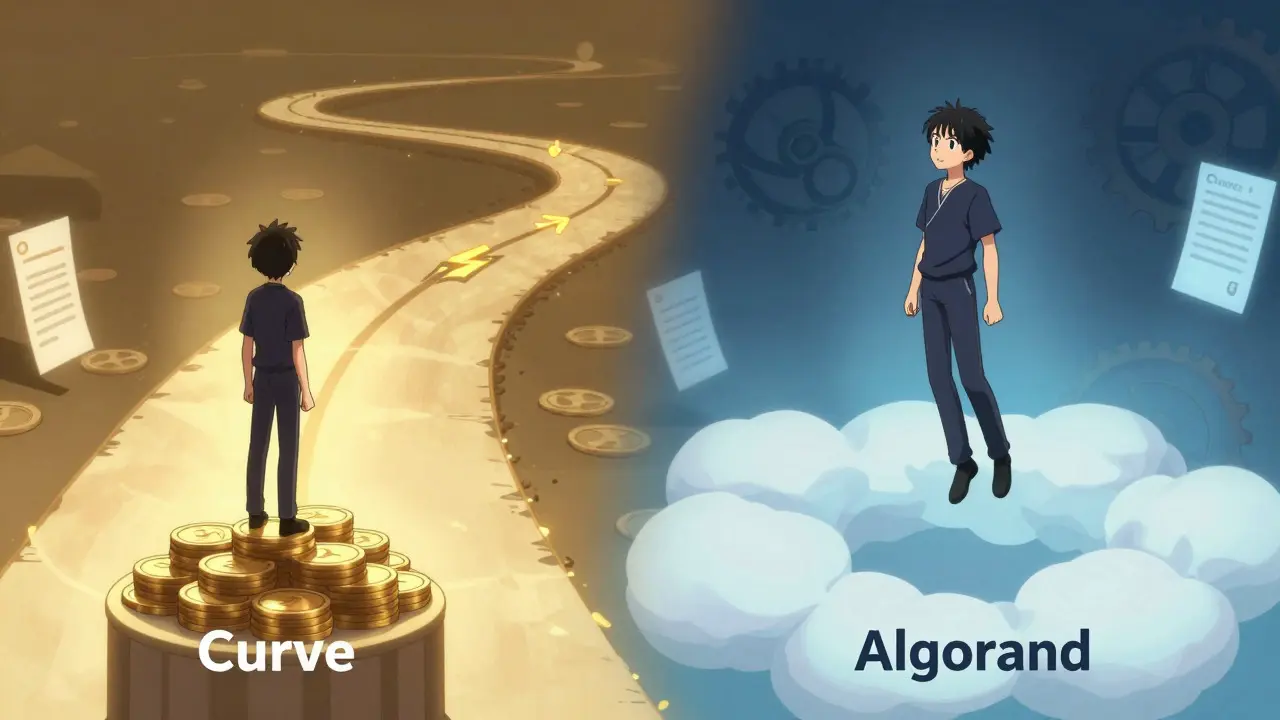
Notice the difference between Curve’s veCRV model and Algorand’s approach. Curve demands a long-term commitment-locking tokens for up to four years-to get the highest yields. This creates sticky capital but reduces liquidity. Algorand, conversely, removed slashing penalties entirely. Instead of losing tokens for poor performance, nodes temporarily cease participation. This user-friendly approach contrasts sharply with Ethereum’s average 5.33% slashing rate for validator misbehavior documented in the 2023 validator report. Your choice depends on whether you prioritize maximum yield (Curve) or flexibility and safety (Algorand).
The Hidden Risks: Plutocracy and Sustainability
It’s easy to focus on the APY, but the structural risks of governance staking are substantial. One major concern is plutocracy-the rule by the wealthy. When voting power is tied directly to token holdings, large entities can dominate decisions. The 2023 MakerDAO incident highlighted this flaw, where a single entity controlled 28% of the voting power, effectively dictating protocol changes despite opposition from smaller holders. This concentration of power undermines the 'decentralized' ideal.
Sustainability is the other elephant in the room. Dr. Garrick Hileman, Principal Economist at Blockchain.com, noted in a 2023 CoinDesk article that governance token staking creates a self-reinforcing ecosystem, but it requires careful design to prevent centralization. If a protocol cannot generate enough fee revenue to cover staking rewards, it must inflate its token supply. Nic Carter of Castle Island Ventures warned in Harvard Business Review that many governance tokens are 'effectively unbacked securities that provide illusory governance rights.' If the token price drops because of inflation, your high APY might be offset by capital depreciation.
User feedback reflects this tension. On Reddit’s r/ethfinance, a July 2024 thread titled 'Governance token staking: worth it or just inflation?' gathered over 1,200 comments. Users reported returns between 2.1% and 8.7%, but many expressed frustration with impermanent loss in liquidity-staking hybrids. Aave community member 'DeFi_Dave' summed it up: 'Staking my AAVE for governance gives me voting power but the 5% APY isn't worth the lockup period when I can get 7% on liquid staking elsewhere.' This highlights a key trade-off: governance staking often offers lower yields than pure yield farming, but it comes with the added benefit of protocol influence.

Getting Started: Practical Steps for Beginners
If you’re ready to dive in, the path forward depends on your technical skill level. For non-technical users, centralized exchanges and wallets have made staking incredibly accessible. Platforms like Coinbase Wallet and Trust Wallet now offer one-click staking interfaces. A 2024 Consensys usability study found that average setup times for these interfaces are just 7-12 minutes. You connect your wallet, select the protocol, and confirm the transaction. No command lines required.
However, if you want deeper involvement, such as running a node, the learning curve steepens. Running an Algorand node, for instance, requires understanding command-line interfaces and maintaining uptime. The Algorand Foundation reports that 68% of new node operators need 10-15 hours of learning time before successful operation. Documentation quality matters here too. Ethereum-based protocols scored 4.2/5 on clarity in a 2024 GitBook analysis, while newer layer-1 blockchains lagged at 3.1/5. Always check the documentation before committing funds.
Here is a quick checklist for beginners:
- Start Small: Begin with liquid staking solutions like Lido or Rocket Pool to understand mechanics without long lock-ups.
- Check Reward Sources: Look for protocols that fund rewards from transaction fees, not just token emissions.
- Understand Lock-ups: Know exactly how long your tokens will be illiquid. Can you afford to lose access for 10 days? Four years?
- Verify Slashing Conditions: Read the smart contract terms. What happens if the validator goes offline?
- Consider Tax Implications: In many jurisdictions, staking rewards are taxable events upon receipt. CoinTracker data shows 73% of US-based users cite tax management as a major concern.
Future Trends: What’s Next for Governance Staking?
The landscape is shifting rapidly. We are moving toward 'liquid governance' solutions. Lido recently introduced governance-pegged derivatives, allowing users to maintain voting power while retaining token liquidity. This solves the illiquidity problem that plagues traditional staking. Additionally, Aave’s 2024 Governance v3 implementation introduced time-weighted voting power decay. This encourages active participation rather than passive accumulation, addressing the plutocracy concern by rewarding engaged voters over dormant whales.
Regulatory clarity remains a wildcard. The SEC’s 2023 enforcement action against Uniswap Labs signaled that some governance tokens might be classified as securities under the Howey Test. This could impact institutional adoption. Currently, retail users dominate short-term staking (87% of commitments under 30 days per Nansen data), while institutions prefer longer lockups. As regulations evolve, we may see more sophisticated models incorporating reputation systems to mitigate centralization, as piloted by projects like 1Hive.
Delphi Digital predicts the market for staked governance tokens will expand to $210 billion by 2026. However, Gartner’s 2024 blockchain hype cycle places governance staking at the 'peak of inflated expectations.' This suggests a period of consolidation ahead. Protocols with unsustainable reward models will likely fail, leaving only those with genuine utility and revenue streams. For participants, this means doing your homework is more important than ever.
What is the main difference between governance token staking and regular PoS staking?
Regular Proof-of-Stake (PoS) staking secures the underlying blockchain network (like Ethereum or Solana) by validating transactions. Governance token staking, on the other hand, focuses on the application layer. You stake tokens to gain voting rights on protocol-specific decisions, such as interest rates or treasury spending, within a DeFi platform like Aave or Compound.
Are governance token staking rewards taxable?
In most jurisdictions, including the US and New Zealand, staking rewards are considered taxable income at the fair market value when they are received. This applies even if you haven't sold the tokens yet. Keep detailed records of your reward dates and values for accurate reporting.
Can I lose my tokens through governance token staking?
Yes, through a process called 'slashing.' If you operate a validator node and behave maliciously or go offline, the protocol may penalize you by burning a portion of your staked tokens. However, some platforms like Algorand have eliminated slashing, opting instead for temporary suspension of participation. Always check the specific protocol's penalty structure before staking.
Which governance token staking models are best for beginners?
Beginners should look for platforms with no lock-up periods or short unbonding times, such as Algorand or liquid staking derivatives. Avoid complex models like Curve’s veCRV unless you are comfortable locking assets for years. Start with small amounts to understand the interface and reward mechanics before committing significant capital.
How do I know if a governance token's rewards are sustainable?
Look for transparency in the protocol's revenue model. Sustainable rewards are funded by transaction fees generated by real usage. Unsustainable models rely heavily on token emissions (printing new tokens). Check resources like Token Terminal or Messari to see if the protocol’s fee revenue covers its staking payouts. If rewards are mostly inflationary, the token price may dilute over time.