
Imagine running a massive global computer network that never sleeps, processes billions of dollars in value daily, and requires zero central authority to keep it honest. Who pays the bills? In traditional tech, a company like Google or Amazon covers server costs from advertising or subscription revenue. In the world of Blockchain, specifically decentralized networks like Bitcoin and Ethereum, the answer is far more clever-and controversial. It’s called the block reward.
The block reward is the heartbeat of cryptocurrency economics. It is the sum of newly minted coins and transaction fees given to miners or validators who successfully add a new block of transactions to the ledger. Without this financial incentive, no one would spend electricity on hardware or lock up capital to secure the network. The system relies on a simple truth: people protect what they stand to lose or gain. But as these networks mature, the way they pay for security is changing dramatically, creating both opportunities and existential risks.
The Anatomy of a Block Reward
To understand where the money comes from, we have to split the block reward into two distinct parts. Think of it like a salary plus tips.
- The Block Subsidy (The Salary): This is brand-new cryptocurrency created out of thin air by the protocol code. When a miner solves a puzzle or a validator is chosen to propose a block, the network grants them a specific amount of new coins. This is how money enters circulation in a decentralized way, without a central bank printing presses.
- Transaction Fees (The Tips): Users sending money attach small fees to their transactions to prioritize them. These fees are collected by the person who packages those transactions into a block.
In the early days of Bitcoin, the first cryptocurrency launched in 2009, the subsidy was huge-50 BTC per block-and fees were negligible. Today, the dynamic has shifted. For Bitcoin, the subsidy still makes up about 98.5% of miner revenue, but that number is dropping fast. As the subsidy shrinks through periodic "halvings," the relative importance of transaction fees skyrockets. If fees don't rise enough to replace the lost subsidy, the economic model breaks.
Bitcoin’s Scarcity Engine: The Halving Cycle
Bitcoin operates on a rigid monetary policy defined by its creator, Satoshi Nakamoto. The core mechanism here is the halving. Every 210,000 blocks (roughly every four years), the block subsidy is cut in half. This isn't a suggestion; it's hard-coded math.
- 2009: Reward started at 50 BTC.
- 2012: Dropped to 25 BTC.
- 2016: Dropped to 12.5 BTC.
- 2020: Dropped to 6.25 BTC.
- 2024: Dropped to 3.125 BTC.
This predictable disinflation creates artificial scarcity. There will only ever be 21 million Bitcoins. By 2140, the last satoshi will be mined, and the block subsidy will hit zero. At that point, Bitcoin miners will rely 100% on transaction fees for income. This design mimics the extraction of physical commodities like gold. As easier-to-mine veins run dry, it takes more effort (and cost) to find the remaining supply.
However, this model carries a heavy burden. Miners currently spend roughly $35 billion annually on electricity and hardware to secure the network. If the price of Bitcoin doesn't rise alongside the shrinking reward, miners go bankrupt. We saw this stress during the 2020 halving, where only miners with access to ultra-cheap electricity (under 4 cents per kWh) could stay profitable using standard ASIC machines. This pressure drives centralization, as smaller players are squeezed out by industrial-scale operations.
Ethereum’s Pivot: From Mining to Staking
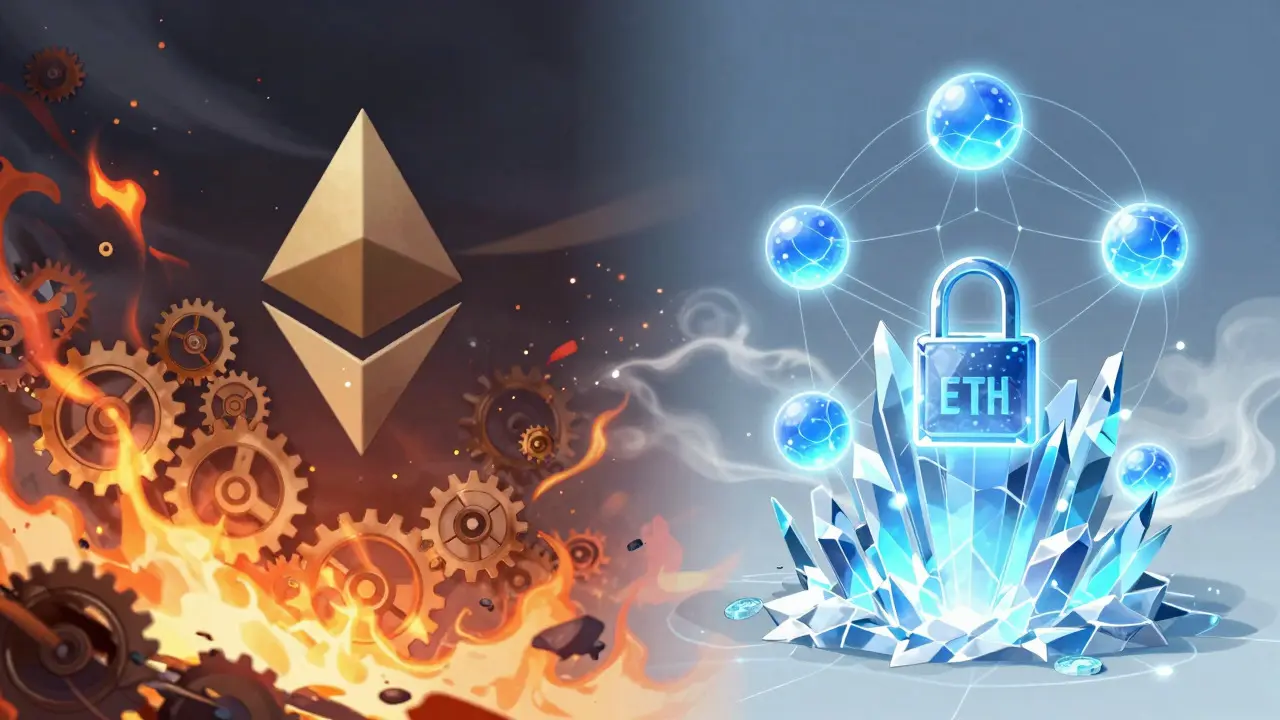
While Bitcoin doubled down on proof-of-work, Ethereum, the leading smart contract platform took a radically different path. On September 15, 2022, Ethereum completed "The Merge," transitioning from energy-intensive mining to proof-of-stake (PoS).
In PoS, there are no miners burning electricity. Instead, validators lock up (stake) 32 ETH each to participate in securing the network. Their rewards come from two sources:
- New Issuance: Similar to Bitcoin’s subsidy, new ETH is created to pay validators. However, this rate is variable and much lower than Bitcoin’s historical rates, typically between 0.2% and 0.5% annually.
- Burnt Fees: Thanks to EIP-1559, a portion of every transaction fee is permanently destroyed (burned). When network activity is high, more ETH is burned than is issued. This can make Ethereum deflationary, reducing the total supply over time.
This shift fundamentally changed the economics. Instead of buying expensive hardware, you need capital. The annual yield for stakers has dropped from over 10% at launch to around 3.8% as millions of ETH have been locked up. This model prioritizes sustainability and flexibility over fixed scarcity. Ethereum has no hard cap on supply, allowing it to adjust issuance based on security needs.
| Feature | Bitcoin (PoW) | Ethereum (PoS) |
|---|---|---|
| Consensus Mechanism | Proof-of-Work | Proof-of-Stake |
| Supply Cap | Fixed (21 Million) | Dynamic (No Hard Cap) |
| Reward Source | New Coins + Fees | New Coins + Fees (Partial Burn) |
| Annual Issuance Rate | ~1.72% (Decreasing) | 0.2% - 0.5% |
| Primary Cost Barrier | Hardware & Electricity | Capital (ETH Stake) |
| Long-Term Goal | Fee-only security by 2140 | Sustainable staking yields |
The Great Transition: Can Fees Save Bitcoin?
The biggest question haunting blockchain economists is simple: What happens when the free money stops?
For Bitcoin, the transition to a fee-only economy is inevitable. Critics, including researchers from Goldman Sachs, warn of a "tragedy of the commons." As individual block rewards shrink, miners might become less motivated to reject invalid blocks because the risk outweighs the diminishing reward. If security drops, confidence drops, and the network fails.
Proponents argue that demand will save the day. They point to Layer-2 solutions like the Lightning Network, which handle small payments off-chain but settle on the main Bitcoin blockchain. If billions of micro-transactions occur, the aggregate fees could theoretically exceed the current subsidy. MIT Digital Currency Initiative estimates that average transaction fees would need to reach $50 to maintain current security levels once subsidies vanish. That sounds steep today, but if Bitcoin becomes the primary reserve asset for global trade, high-value settlements could easily justify such fees.
Meanwhile, Ethereum faces a different challenge: keeping staking attractive. If yields drop too low compared to traditional bonds or savings accounts, validators might withdraw their ETH, weakening the network’s decentralization. The upcoming Dencun upgrade aims to reduce fees for Layer-2 solutions, which indirectly affects validator income by changing how fees are distributed across the ecosystem.
Real-World Impact on Users and Investors
You don’t need to be a miner or validator to feel the effects of block reward economics. Here is how it hits your wallet:
- Transaction Costs: During periods of low subsidy (like post-halving), miners may ignore low-fee transactions entirely. We saw this in late 2021 when Bitcoin fees spiked to over $55 per transaction during the NFT boom. Users were forced to wait weeks or pay exorbitant prices to move funds.
- Price Volatility: Halvings often precede bull markets. Why? Supply shock. If demand stays constant but new supply cuts in half, basic economics suggests price should rise. However, this isn't guaranteed. If the broader market crashes, a halving won't save the price.
- Centralization Risks: As rewards shrink, only the most efficient players survive. For Bitcoin, this means massive mining farms in places with cheap hydroelectric power. For Ethereum, it means large pools controlling significant portions of the staked ETH. Less decentralization means the network is more vulnerable to collusion or regulation.
A survey by CoinTracker found that nearly 70% of users consider transaction fees the most important factor when choosing a blockchain. High fees drive users to alternative chains with different reward structures, fragmenting liquidity and attention.
Looking Ahead: The Future of Blockchain Money
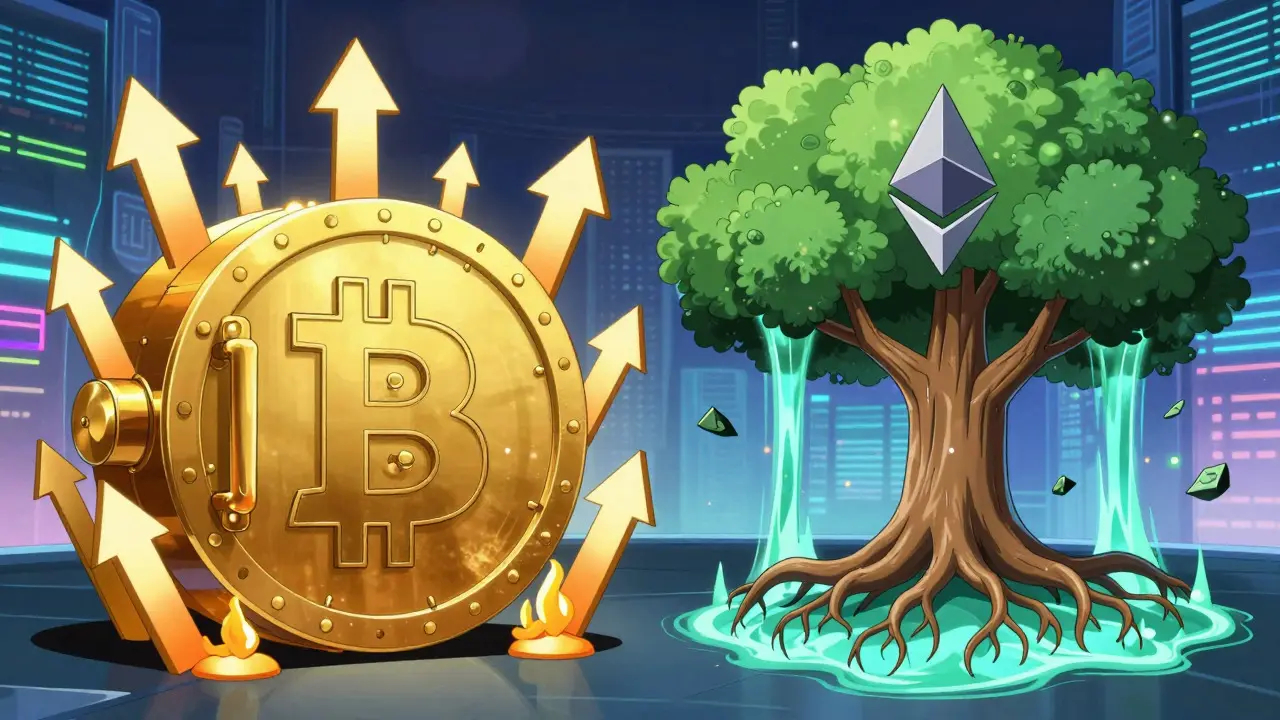
We are living through a critical experiment in digital economics. Bitcoin is testing whether a fixed-supply commodity model can sustain a global payment layer. Ethereum is testing whether a flexible, service-oriented model can scale without inflation spiraling out of control.
Other chains offer middle grounds. Monero, for example, uses a "tail emission" model, where after the main mining phase ends, a tiny, constant reward continues forever to ensure miners always have an incentive. Litecoin follows Bitcoin’s halving schedule but with faster blocks and a higher supply cap.
As we move further into 2026, the divergence between these models will sharpen. Institutional investors increasingly favor Bitcoin’s predictability, citing its verifiable scarcity as a hedge against fiat debasement. Developers flock to Ethereum for its programmability and evolving fee dynamics. Understanding block reward economics isn't just for nerds; it’s essential for anyone holding crypto. You aren't just buying a token; you're betting on an economic theory. Make sure you know which theory you're backing.
What happens to Bitcoin miners after the block reward reaches zero?
After the estimated year 2140, when the last Bitcoin is mined, miners will rely exclusively on transaction fees for revenue. The viability of the network will depend on whether user demand generates enough fees to cover the cost of securing the blockchain. If fees are insufficient, miners may leave, potentially reducing network security unless other incentives emerge.
Why does Ethereum burn transaction fees?
Ethereum burns a portion of transaction fees via EIP-1559 to create deflationary pressure. When network activity is high, more ETH is burned than is issued as rewards to validators. This reduces the total supply of ETH over time, potentially increasing its value and aligning the interests of users (who want efficiency) with holders (who want appreciation).
How does the Bitcoin halving affect the price?
Historically, halvings have preceded significant price increases due to reduced supply issuance meeting steady or growing demand. However, past performance is not a guarantee of future results. Market sentiment, macroeconomic conditions, and regulatory news also play major roles in price action surrounding halving events.
Is Proof-of-Stake better than Proof-of-Work for security?
It depends on the definition of security. Proof-of-Work secures the chain with physical energy expenditure, making attacks physically costly. Proof-of-Stake secures the chain with financial collateral, making attacks economically self-defeating. PoS is vastly more energy-efficient, but some argue it introduces different centralization risks related to wealth concentration rather than hardware access.
Can transaction fees replace block subsidies in all blockchains?
Not necessarily. Blockchains with low transaction volume or those designed for high-speed, low-cost micro-transactions may struggle to generate enough fees to incentivize validators. Some networks use hybrid models, tail emissions, or external funding mechanisms to bridge the gap until organic fee revenue becomes sufficient.