

Running a decentralized organization used to mean wrestling with complex code just to pass a simple proposal. In 2026, that friction has largely disappeared, but the choice of platform still defines how your community operates. You aren't just picking software; you are choosing the constitution for your digital entity. The wrong tool can lock you into rigid voting structures or make treasury management a nightmare. The right one scales with you, from a small group of founders to a global protocol.
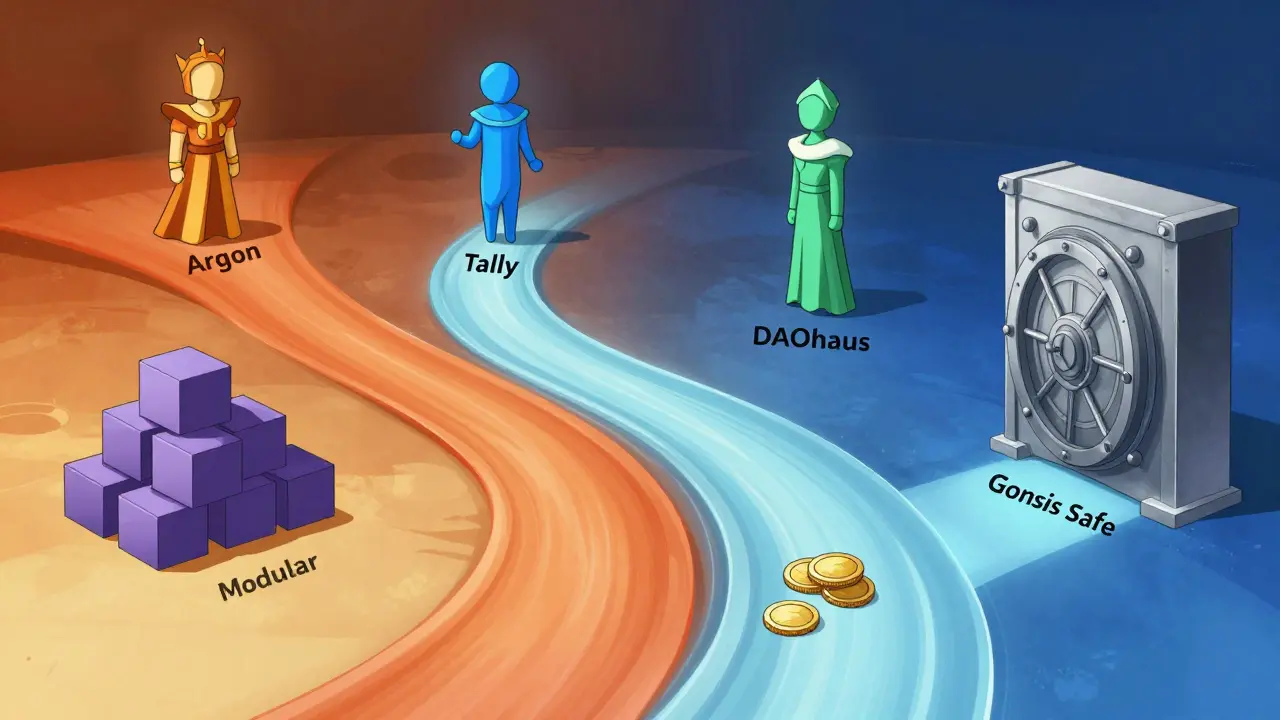
The landscape has matured significantly. We have moved past the experimental phase where every DAO built its own custom contracts. Today, dominant platforms offer specialized architectures designed for specific needs. Whether you need granular permission controls, seamless cross-chain voting, or a simple membership model, there is a proven infrastructure layer ready to deploy. Let’s look at the four primary paths available today and how to choose the one that fits your structure.
Key Takeaways
- Aragon OSx is best for protocol DAOs needing modular, programmable governance with granular permissions and multichain support via plugins.
- Tally offers the superior user experience for token-voting DAOs on Ethereum and EVM Layer 2s, focusing on delegation and analytics.
- DAOhaus (Moloch v3) suits early-stage communities prioritizing simplicity, membership tokens, and easy exit mechanisms like ragequitting.
- Gnosis Safe + Zodiac provides a secure, treasury-first path for teams starting with multisig wallets and wanting to gradually decentralize.
- Selection depends on three factors: your current maturity stage, your need for cross-chain coordination, and your technical capacity for integration.
Understanding the Four Architectural Paths
When evaluating DAO governance tools is software infrastructure that enables decentralized communities to manage treasuries, execute proposals, and coordinate decision-making through blockchain mechanisms, you will find they generally fall into four distinct categories. These aren't just different interfaces for the same backend; they represent fundamentally different philosophies on how power and execution should flow within an organization.
The first category is the modular framework. Here, the core system is lightweight, and functionality is added via plugins. This allows you to swap out voting mechanisms or permission systems without redeploying your entire organization. The second is the governance interface, which sits on top of existing smart contract standards (like OpenZeppelin Governor) to provide a polished user experience for voters and delegates. The third is the membership-centric model, which focuses on shares, loot, and the ability for members to leave cleanly. Finally, there is the treasury-first approach, which starts with a secure multi-signature wallet and adds governance layers progressively.
Choosing between these isn't about which is "better" in a vacuum. It is about alignment. A product team building a new DeFi protocol has different needs than a grant-giving foundation or a social club. Misalignment leads to governance attacks, stalled proposals, or abandoned projects. Let’s break down the leading platforms in each category.
Aragon OSx: The Modular Powerhouse
If your DAO is a protocol or a product team that requires deep customization, Aragon OSx is a comprehensive on-chain governance system featuring a plugin architecture that separates core permissions from governance functions stands out as the most robust option. Unlike monolithic systems, Aragon OSx treats governance as a set of composable parts. You install plugins for token voting, dual governance, or optimistic governance as needed.
The standout feature here is the fine-grained permission system. You can define exactly who can do what, using allowlists, role scoping, and time delays. This level of control is critical for high-value protocols where a single erroneous transaction could be catastrophic. For example, you might restrict treasury withdrawals to a specific council while allowing all token holders to vote on parameter changes.
Aragon OSx also handles multichain vote aggregation natively through its plugin system. As more DAOs operate across Ethereum, Polygon, Arbitrum, and other chains, this capability becomes essential. You don’t have to build bridges or write custom scripts to aggregate votes; the platform does it for you. However, this flexibility comes with moderate integration complexity. While no-code options exist, getting the most out of Aragon often requires developer involvement to configure custom plugins.
Tally: The User Experience Leader
For DAOs that already use standard smart contracts, particularly those based on the OpenZeppelin Governor is a widely adopted smart contract standard for implementing token-based voting and proposal execution in Ethereum-compatible networks, Tally is an on-chain governance interface providing production-grade UX for proposal creation, delegation, voting, and analytics is arguably the best choice. Tally doesn’t replace your contracts; it enhances them with a sophisticated frontend.
The primary value proposition of Tally is reducing friction. Governance participation drops when the process is confusing. Tally consolidates delegation management, voter history, and treasury visibility into one clean dashboard. If you run a delegate-driven DAO, this is crucial. Delegates need to see their constituents’ preferences, track their voting record, and manage delegations easily. Tally provides the analytics and workflow tools to make delegation effective rather than burdensome.
Tally also excels at cross-chain governance orchestration. It coordinates proposals spanning multiple blockchain networks, ensuring that vote failures due to logistical issues-like missing gas on a secondary chain-are minimized. This makes it ideal for large-scale token voting DAOs operating on Ethereum and EVM Layer 2 solutions. The trade-off is that Tally relies on the underlying contract capabilities for permissions. It doesn’t offer the deep, granular permission editing that Aragon does, so if your security model requires highly customized role structures, Tally alone may not suffice.

DAOhaus: Simplicity for Early Communities
Not every DAO needs enterprise-grade complexity. For early-stage communities, cooperatives, or social groups, DAOhaus is a governance platform based on the Moloch v3 framework emphasizing simplicity, membership tokens, and community exit patterns offers a streamlined alternative. Built on the Moloch v3 framework, DAOhaus uses ERC20-based shares and loot tokens to manage membership. Shares give you voting power; loot represents your claim on the treasury.
The key innovation here is the focus on exit patterns. In traditional organizations, leaving is messy. In DAOhaus, you can "ragequit," burning your shares and taking your proportional share of the treasury instantly. This de-risks early coordination because members know they aren’t trapped. It encourages active participation and reduces the fear of joining a potentially failing venture.
DAOhaus integrates seamlessly with Gnosis Safe is a widely adopted multi-signature smart account used for securing DAO treasuries and managing funds through collective approval via the Zodiac pattern. This means you get the security of a multisig wallet with the governance layer of DAOhaus. It supports arbitrary execution in proposals, including multisend batching, which allows you to execute multiple transactions in one go. This is perfect for operational workflows like paying invoices, hiring freelancers, or updating metadata. The platform is hosted, meaning low setup friction, but it lacks the advanced multichain coordination and granular permission systems of Aragon or Tally.
Gnosis Safe + Zodiac: The Treasury-First Path
Many organizations start by securing their funds before worrying about governance. If you are already using a Multisig Wallet is a digital wallet requiring multiple private keys to authorize a transaction, enhancing security for shared funds, specifically Gnosis Safe, the natural evolution is to add governance modules via Zodiac is a modular ecosystem of smart contract modules that extend Gnosis Safe with governance, roles, and bridge functionalities. This combination represents the treasury-first governance pathway.
Zodiac provides a suite of modules that sit on top of your Safe. The Roles module lets you assign specific permissions to addresses or other contracts. The Bridge module enables cross-chain communication. The Governor module allows you to implement token-based voting that executes directly through your Safe. This architecture is ideal for teams that want progressive decentralization. You start with a tight-knit group controlling the Safe, then gradually introduce voting and roles as the community grows.
This approach is highly secure because Safe is the industry standard for treasury management. It is also flexible. You can mix and match modules based on your needs. However, integration complexity can range from moderate to advanced, depending on which modules you select and how you configure them. It requires a good understanding of Safe’s architecture and Zodiac’s module interactions. For DAOs standardizing on Safe as their account layer, this is the most logical and secure path forward.
Comparison Table: Choosing Your Platform
| Feature | Aragon OSx | Tally | DAOhaus | Safe + Zodiac |
|---|---|---|---|---|
| Voting Mechanism | Plugin-based (Token, Dual, Optimistic) | Governor-compatible (Token Voting) | Membership Tokens (Shares/Loot) | Governor Module (Token Voting) |
| Multichain Support | Native via Plugins | Coordination Interface | Via Safe Modules | Via Bridge Module |
| Permission System | Granular Core Permissions | Limited to Contract Capabilities | Shamans & Safe Modules | Roles Modifier |
| Best For | Protocol DAOs, Product Teams | Delegate-driven Token DAOs | Early-stage Communities, Co-ops | Treasury-first Teams, Progressive Decentralization |
| Integration Complexity | Moderate (Custom Plugins) | Low to Moderate | Moderate | Moderate to Advanced |
| Cost Structure | Open Source + Gas/Audits | Platform Fees + Gas | No SaaS Fee + Gas | Open Source + Gas |
Implementation Strategy and Costs
Deploying a governance platform involves more than just clicking "install." You must consider the ongoing costs and technical resources required. Small community DAOs often start with DAOhaus and a Safe treasury. There are no published SaaS fees for DAOhaus, so your primary costs are on-chain gas fees for proposals and membership updates. This keeps overhead low while you test your community dynamics.
Mid-size protocols frequently move to Aragon OSx or Safe plus Zodiac. Both operate primarily on open-source models. Your costs shift to service engagements for development, audits for custom plugins, and on-chain expenses for governance execution. If you choose Tally, you may encounter platform fees for premium features, along with gas costs for execution. Exact pricing metrics vary, so it is wise to budget for variable service costs.
When planning your implementation, ask yourself: Do we need token voting? Do we need multichain coordination? What is our technical capacity? If you lack in-house developers, a hosted solution like Tally or DAOhaus reduces initial friction. If you have engineering resources, Aragon OSx or Safe plus Zodiac offers greater long-term flexibility and control.
Future Trends in DAO Governance
The trajectory for 2026 and beyond points toward increasing sophistication in multichain execution and permission systems. We are seeing a convergence toward modular architecture patterns across all major platforms. Monolithic governance systems are disappearing, replaced by composable components that can be mixed and matched.
Integration with security infrastructure and delegation tools is strengthening. Platforms are bundling governance execution with related services like treasury management and analytics. The distinction between treasury-first approaches (Safe plus Zodiac) and governance-first approaches (Aragon, Tally, DAOhaus) is blurring as organizational maturity stages evolve. Eventually, we expect these platforms to offer similar core capabilities, differentiated mainly by user experience and niche features.
Frequently Asked Questions
What is the best DAO governance tool for beginners?
For beginners, DAOhaus is often the best starting point. It offers a simplified governance layer, easy-to-understand membership tokens (shares and loot), and integrated treasury management via Gnosis Safe. The "ragequit" feature allows members to exit cleanly, reducing risk for early adopters. It requires minimal technical setup compared to modular frameworks like Aragon OSx.
Can I use Tally with my existing smart contracts?
Yes, Tally is designed as an interface for existing smart contracts, particularly those built on the OpenZeppelin Governor standard. It does not replace your contracts but provides a user-friendly dashboard for proposal creation, voting, and analytics. If your DAO uses a compatible governor contract, Tally can integrate seamlessly to enhance the user experience for voters and delegates.
How do I handle multichain governance?
Multichain governance requires platforms that can aggregate votes across different blockchains. Aragon OSx offers native multichain support through its plugin system, allowing you to aggregate votes from various chains into a single execution. Tally provides multichain coordination interfaces for Governor-style DAOs. If you use Gnosis Safe + Zodiac, you can utilize the Bridge module to enable cross-chain communication and execution.
What is the difference between Aragon OSx and DAOstack?
While both are established names in DAO governance, Aragon OSx is a modern, modular framework focused on granular permissions and plugin-based extensibility. It is highly customizable for protocol-level governance. DAOstack is an older platform with a different architectural philosophy, often criticized for higher gas costs and less flexible permission systems in recent years. Most new projects in 2026 prefer Aragon OSx for its efficiency and modularity.
Are DAO governance platforms free to use?
Most core DAO governance platforms like Aragon OSx, DAOhaus, and Zodiac are open-source and do not charge direct software fees. However, you will always incur on-chain gas fees for deploying contracts, creating proposals, and executing transactions. Some hosted interfaces like Tally may offer premium features with associated platform fees. Additionally, costs for auditing custom plugins or engaging developers for integration should be budgeted separately.
What is "Ragequitting" in DAOhaus?
Ragequitting is a unique feature in DAOhaus (based on Moloch v3) that allows members to burn their voting shares and immediately withdraw their proportional share of the treasury's assets. This mechanism ensures that members are not locked into a failing organization and can exit cleanly without needing approval from others. It promotes accountability and reduces the risk for new members joining early-stage communities.
How does Gnosis Safe integrate with governance?
Gnosis Safe serves as a secure multi-signature wallet for treasuries. To add governance, you can integrate Zodiac modules. The Governor module allows token holders to vote on proposals, which, if passed, automatically execute transactions through the Safe. This creates a secure path from centralized multisig control to decentralized voting, ensuring that funds remain protected even as governance becomes more distributed.





Comments
pankaj chawla
June 19, 2026 AT 18:00 PMGreat breakdown of the current landscape. I've been using Aragon OSx for a protocol DAO and the modular approach is genuinely a lifesaver when you need to tweak permissions without redeploying everything. The granular control over who can execute what is non-negotiable for us given the treasury size. It's not the easiest setup, but once it's running, it scales incredibly well. We integrated it with a custom plugin for optimistic governance and it reduced our proposal lag time significantly.
Charles Pawlikowski
June 20, 2026 AT 05:15 AMthis whole dao thing is just another way for tech bros to avoid real accountability lol. nice guide though i guess if you wanna play in the sandbox
Andrea Burd
June 20, 2026 AT 21:05 PMI mean, its fine but honestly most of these tools are just bloated interfaces for smart contracts that nobody actually reads. Tally looks pretty tho so whatever.
Akeem Whittaker
June 21, 2026 AT 15:39 PMIf you're just starting out, don't overcomplicate it. DAOhaus is perfect for getting your first ten members aligned. The ragequit feature sounds crazy at first, but it actually builds trust because everyone knows they aren't trapped. Once you have a stable core group, then you can think about migrating to something like Aragon or Safe+Zodiac. Start simple, iterate fast.
Manish Prajapat
June 23, 2026 AT 00:47 AMThe philosophical shift from monolithic to modular governance mirrors the broader trend in software architecture towards microservices. It allows for greater resilience and adaptability. However, one must consider the cognitive load on participants. If the governance mechanism is too complex, participation drops regardless of the technical elegance. Simplicity in UX, as seen in Tally, often wins over theoretical perfection.
Annemarie Fitzgerald
June 23, 2026 AT 03:02 AMOh wow, another article pretending daos are the future of democracy. Please. Its all just code written by guys in basements. And dont get me started on gas fees. So expensive. Anyway, safe+zodiac seems boring but probably works i guess??
Mark Brunschwiler
June 24, 2026 AT 05:32 AMi feel like people forget that behind every cool dashboard is just a bunch of math. does any of this actually help regular people or is it just for crypto natives? feels like we are building castles in the air while the ground shakes under us
Terry Hyland
June 25, 2026 AT 21:50 PMthese platforms are all controlled by the same elite groups. dont trust them. they want to track your votes and sell your data. stick to cash and gold. digital currency is a trap set by globalists to destroy privacy.
Tim Lefebvre
June 26, 2026 AT 20:50 PMhey folks, just wanted to add that if you use gnosis safe make sure you update to the latest version before adding zodiac modules. there was a small bug in the bridge module last month that caused some txs to fail silently. also check your signers carefully. easy to miss a typo in an address. hope that helps!
Monica Pathammavong
June 28, 2026 AT 17:13 PMActually, the author missed a crucial point about cross-chain liquidity fragmentation. Just because you can vote across chains doesn't mean your treasury assets are liquid everywhere. You need to consider the slippage costs of moving funds between L2s during execution. Also, DAOhaus isn't really for 'early stage' anymore, its legacy. Use Subquery for indexing instead of relying on their hosted graphs. Wake up.
JEVON HALL
June 29, 2026 AT 05:22 AMTally is super user friendly 👍 I love how it handles delegation. Makes it easy for whales to see who they are supporting. Gas fees are still annoying though 😩 but layer 2s are helping. Good summary overall! 🔥
Dr Lynea LaVoy
June 29, 2026 AT 10:09 AMThis is a really helpful overview for those of us trying to navigate the decision process. One thing I'd emphasize is the importance of community education regardless of the tool chosen. Even the best UI won't save you if your members don't understand the implications of their votes. Take time to explain the mechanics. Transparency builds trust more than any platform feature ever will.
Matthew Malone
June 30, 2026 AT 15:47 PMFascinating read. Truly remarkable how Americans continue to lead the world in decentralized innovation despite the constant naysayers. While other nations struggle with bureaucratic red tape, we build the future of governance right here. Though I suppose the EU with their MiCA regulations might have a different perspective on 'freedom' in this context. Still, US dominance in crypto infrastructure is undeniable.