

Imagine trying to run a global logistics company where every employee is also responsible for driving trucks, managing inventory, handling customer service, and auditing finances. That’s essentially how traditional blockchains work. They try to do everything at once. This "monolithic" approach is starting to crack under pressure as more people join the network.
Enter Modular blockchains, which are an architectural shift that splits blockchain functions into specialized layers. Instead of one chain doing it all, modular systems break the job down. One team handles the data storage, another manages the consensus, and a third processes the transactions. It’s like moving from a general store to a specialized supply chain. This isn’t just theory; projects like Celestia and various Layer 2 solutions are already building this future.
The Problem with Doing It All
To understand why we need modularity, you first have to see what’s wrong with the old way. Legacy blockchains like Bitcoin and early Ethereum are called Monolithic blockchains. These are networks that handle execution, settlement, data availability, and consensus within a single layer.
In a monolithic system, every node (computer) on the network must process every transaction, verify every block, and store every piece of historical data. As the network grows, this creates a bottleneck. If you want faster transactions, you often have to sacrifice security or decentralization. This is known as the blockchain trilemma. You can pick two, but rarely all three.
Think about your smartphone. In the early days, phones were just for calling. Then came the "feature phone" era where manufacturers tried to cram cameras, music players, and internet browsers into one device. It got messy. The solution wasn't a bigger phone; it was specialization. Modern smartphones rely on cloud servers for heavy lifting, app stores for software, and separate hardware manufacturers for components. Modular blockchains apply this same logic to crypto infrastructure.
Breaking Down the Four Core Functions
A blockchain isn't just one thing. It’s actually four distinct jobs bundled together. To build a modular system, you have to unbundle them. Here is what each part does:
- Execution: This is where the action happens. When you swap tokens on Uniswap or mint an NFT, the smart contract code runs here. It processes the logic of the transaction.
- Settlement: This is the final word. Once a transaction is settled, it’s immutable. It cannot be reversed. Think of this as the supreme court of the blockchain. It resolves disputes and confirms the final state.
- Data Availability: This ensures that the data needed to validate a transaction is accessible to everyone. If the data disappears, validators can’t check if a transaction was valid. This layer stores the raw information.
- Consensus: This is how the network agrees on the order of transactions. It prevents double-spending and ensures everyone sees the same version of the truth.
In a monolithic chain, one layer does all four. In a modular chain, these tasks are distributed. For example, an execution layer might process transactions quickly, but it sends the proof of those transactions to a separate settlement layer for finality. Meanwhile, the raw data might be stored on a dedicated data availability layer.
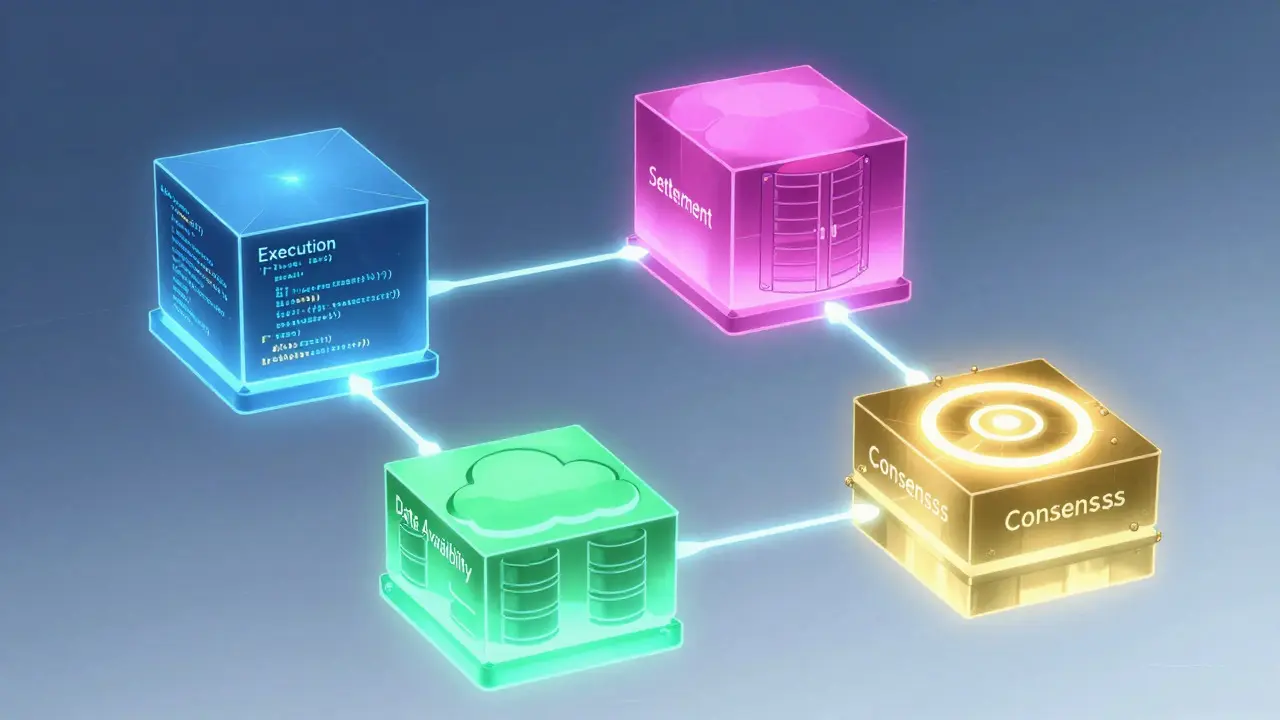
Levels of Modularity: From Monolith to Fully Modular
Not all chains are created equal when it comes to modularity. Industry analysts, including those at Visa, categorize architectures into four levels based on how much they specialize.
| Architecture Type | Description | Examples |
|---|---|---|
| Monolithic | Handles all four functions (execution, settlement, data, consensus) in one layer. | Bitcoin, Solana, Tron |
| Polylithic | Base layer supports multiple independent blockchains, splitting the network into subnets. | Cosmos, Avalanche, Polkadot |
| Semi-Modular | Blends internal operations with external systems for specific tasks while keeping core processing independent. | Ethereum (post-sharding), Near, Mina |
| Fully Modular | Specialized chains focus on one function and rely on other chains for the rest. | Celestia (Data), Arbitrum (Execution) |
Fully modular blockchains represent the extreme end of this spectrum. They don’t try to be everything. They aim to be the best at one thing. This allows for massive improvements in performance because each layer can be optimized specifically for its task without compromising the others.
Celestia: The Pioneer of Data Availability
If you’re looking for the face of the modular movement, it’s Celestia. It is a modular blockchain focused specifically on providing data availability services.
Celestia doesn’t execute smart contracts. It doesn’t settle disputes. Its only job is to make sure data is available. Why is this important? Because storing data is expensive and slow. By offloading data storage to a specialized layer like Celestia, execution chains (like Layer 2s) can run much faster and cheaper. They don’t need to bloat their own networks with historical data.
This model has sparked a whole new category of projects. Other data availability layers are emerging, and execution-focused chains are springing up to plug into them. It’s becoming a plugin ecosystem. Developers can choose the best execution environment and the best data provider, mixing and matching to build the most efficient application possible.

Real-World Examples: How It Works Today
You might be using modular blockchains right now without realizing it. Most Layer 2 solutions on Ethereum are semi-modular or fully modular in practice.
Take Arbitrum or Optimism. These are execution layers that process transactions off the main Ethereum chain. They handle the computation (execution) locally. However, they rely on Ethereum for settlement and security. They post data to Ethereum (or increasingly, to specialized data layers) so that anyone can verify their state. This separation allows them to process thousands of transactions per second while still inheriting Ethereum’s security.
Similarly, ZkSync and Polygon Hermez use zero-knowledge proofs to compress transaction data. They execute transactions efficiently and then send a cryptographic proof to the settlement layer. This is a perfect example of modularity: execution is separated from verification and storage.
Why This Matters for You
So, why should you care about modular vs. monolithic? It comes down to cost, speed, and experience.
Monolithic chains struggle to scale. As more users join, gas fees spike, and transactions slow down. Modular architectures solve this by allowing different layers to scale independently. The execution layer can get faster without making the settlement layer slower. The data layer can become cheaper without compromising the consensus mechanism.
For developers, this means more flexibility. You aren’t locked into one rigid ecosystem. You can build an application that uses the fastest execution engine available and connects to the most secure settlement layer. For users, it means lower fees and faster confirmations. Imagine sending money across borders with the security of Bitcoin but the speed and cost of a credit card transaction. That’s the promise of modularity.
However, there are trade-offs. Complexity increases. Coordinating between multiple chains requires robust interoperability protocols. Security risks can spread if one layer fails. But as standards improve and tools mature, these challenges are being addressed. The industry is moving toward a future where modularity is the default, not the exception.
Is Ethereum a modular blockchain?
Ethereum is transitioning toward a semi-modular architecture. After its upgrade to Proof-of-Stake and the introduction of sharding concepts, it separates execution from consensus. However, it still handles data availability and settlement largely within its own ecosystem, though it increasingly relies on Layer 2s for execution scaling.
What is the difference between Layer 1 and Layer 2 in modular blockchains?
In modular terms, Layer 1 often serves as the settlement and security layer (like Ethereum). Layer 2s act as execution layers that process transactions and then submit proofs to the Layer 1. This separation allows Layer 2s to be faster and cheaper while relying on the Layer 1 for finality.
Why is data availability important?
Data availability ensures that the information required to validate a blockchain’s state is accessible to all participants. If data is missing, validators cannot check for fraud, leading to potential security failures. Specialized data availability layers like Celestia optimize this process, reducing costs for execution chains.
Are modular blockchains more secure than monolithic ones?
Security depends on implementation. Modular blockchains can inherit security from robust settlement layers (like Ethereum). However, they introduce complexity and potential attack surfaces at the interfaces between layers. Proper design and rigorous testing are crucial to maintaining high security standards.
What is the future of modular blockchains?
The future points toward greater interoperability and standardization. We expect to see more specialized chains for specific functions, seamless communication between layers, and improved user experiences that hide the underlying complexity. Modularity is likely to become the dominant architecture for scalable decentralized systems.