

Most people think Web3 is just about buying NFTs or trading crypto coins. But that’s like thinking the internet is just about email. Web3 is a whole new way the web works-where you own your data, your assets, and your digital identity. No middlemen. No corporate gatekeepers. Just code and consensus.
By 2025, Web3 applications aren’t experimental side projects anymore. They’re running real services people use every day. From lending money without a bank to earning cash just by browsing the web, these apps are changing how we interact online. And it’s not just crypto fans using them-people in Vietnam, Nigeria, and the Philippines are relying on Web3 for basic financial access.
What Exactly Is a Web3 Application?
A Web3 app isn’t a website you log into with a password. It’s a program that runs on a blockchain, not a company’s server. Instead of Facebook controlling your posts or Spotify owning your listening history, you hold the keys. Your data lives on decentralized storage like IPFS. Your actions are recorded on a public ledger. And you interact through a wallet-not an email.
Three things make Web3 apps different:
- Smart contracts: Self-executing code that runs automatically when conditions are met. No human approval needed.
- Token-based ownership: You earn tokens for using the app-whether you create content, lend crypto, or even just browse.
- Decentralized governance: Users vote on changes through DAOs. No CEO decides your fate.
Most Web3 apps run on Ethereum, which hosts over 64% of them. But Solana, Polygon, and BNB Chain are catching up fast. You’ll need a wallet like MetaMask or Phantom to use them. And yes, there are gas fees-but Layer 2 networks like Arbitrum have cut those costs to pennies per transaction.
Decentralized Finance (DeFi): Banking Without Banks
DeFi is the biggest chunk of Web3, with $58.3 billion locked in protocols as of early 2025. It’s not about gambling on coin prices. It’s about lending, borrowing, and earning interest-without a bank.
Take Aave. You deposit ETH and earn interest every 15 seconds. The rate changes based on how much everyone else is borrowing or lending. No monthly statements. No credit checks. Just code.
Compound works the same way. If you have $1,000 in USDC, you can lend it out and earn 4.2% APY-better than most savings accounts. And if you need cash fast, you can borrow against your crypto as collateral. No loan officer. No paperwork.
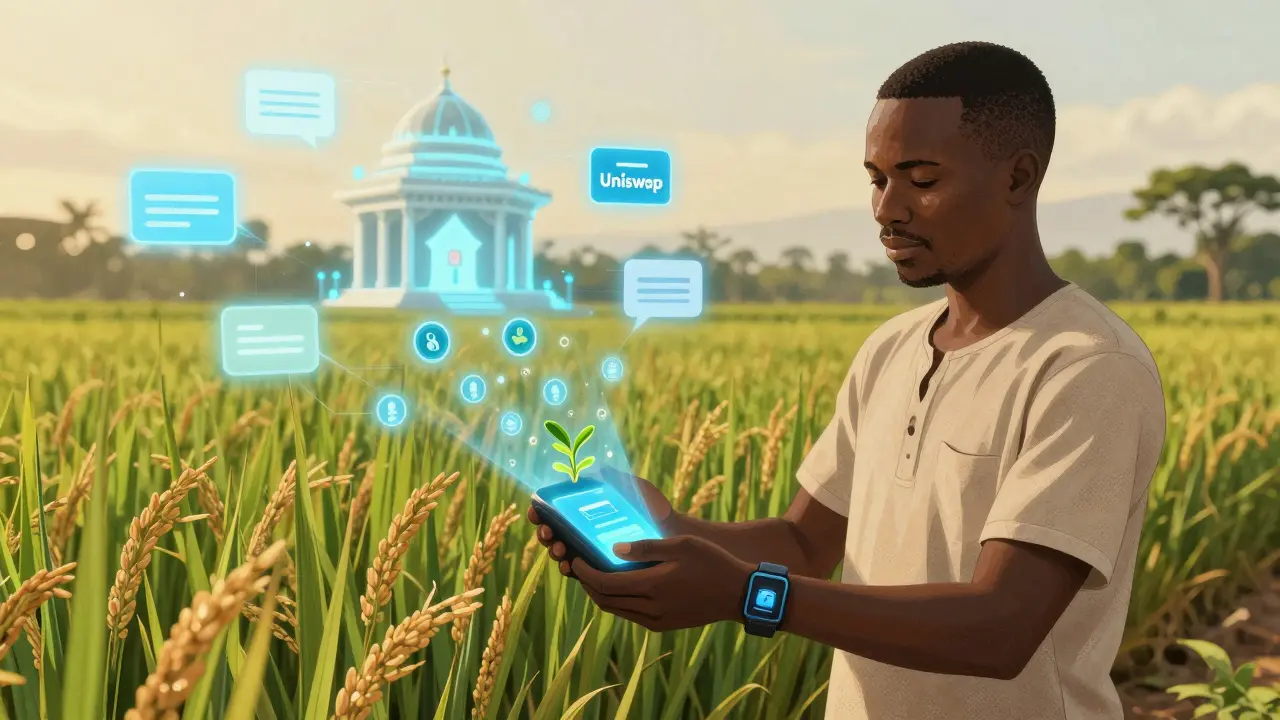
Uniswap lets you swap tokens directly from your wallet. No exchange. No KYC. Just a liquidity pool where users like you provide the money, and you earn a cut of every trade. But watch out: during big price swings, slippage can hit 2.3%. You need to set your limits.
DeFi works best for people who can’t access traditional banking. In Nigeria, where banks freeze accounts without warning, DeFi is a lifeline. In the Philippines, farmers use it to get microloans without collateral.
NFT Marketplaces: Owning Digital Stuff for Real
NFTs got a bad rap because of flashy monkey pictures and $2 million JPEGs. But NFTs are just digital receipts-proof you own something unique. And they’re powering real economies.
OpenSea still leads the market with 43.8% of sales. But Blur and Magic Eden are eating into its share by offering better tools for traders. In 2024, these platforms processed $12.7 billion in volume.
It’s not just art. Think:
- Music rights: Artists sell NFTs that give fans a share of streaming royalties.
- Real estate: Virtual land in Decentraland and The Sandbox is bought, rented, and built on.
- Event tickets: Concerts and conferences issue NFT tickets that can be resold without scalpers.
Shopify now lets online stores accept NFT payments. A New Zealand craft seller added NFT access passes to her handmade jewelry store. Buyers got exclusive content and early releases. Sales jumped 37% in three months.
Gaming: Play to Earn, But Don’t Get Burned
Axie Infinity was the poster child for ‘play-to-earn.’ In 2022, thousands of Filipinos earned more from playing than from their day jobs. But by Q1 2025, monthly users dropped from 2.8 million to 2.1 million.
Why? The game’s economy collapsed. The token value fell 97% in eight months. Players weren’t earning enough to cover the $47.50 entry cost for a starter Axie. It wasn’t gaming-it was a pyramid scheme dressed up as a game.
STEPN, another ‘move-to-earn’ app, had the same fate. Users walked to earn tokens. When the token price crashed from $4.20 to $0.13, 67% of users left. The lesson? If the only incentive is money, people leave when the money dries up.
But not all Web3 games fail. Axie’s developers are rebuilding with better tokenomics. New games like Illuvium and Star Atlas are focusing on real gameplay first-tokens second. They’re building worlds people want to live in, not just cash in on.
Web3 Browsers and Content: Get Paid to Browse
Brave Browser is the quiet success story of Web3. It blocks ads and trackers by default. In return, you earn Basic Attention Tokens (BAT) for viewing privacy-respecting ads.
Users earn between $0.08 and $0.13 per session. That’s not life-changing-but $3.20 a month adds up. Over a year, that’s $38.40. And you’re not selling your data to Google.
Brave has 57 million monthly users. That’s more than some crypto exchanges. And it’s growing because it doesn’t feel like crypto. It feels like a better way to browse.
Reddit’s Community Points are another example. Users earn tokens for posting and commenting. These tokens unlock special badges and perks. Over 42 million users participate. No one’s trading them for profit-they’re using them for status and access.
Storage and Infrastructure: The Hidden Backbone
Behind every Web3 app is a decentralized storage system. IPFS, Filecoin, and Storj store the files, images, and videos that would normally sit on Amazon’s servers.
They handle 18.7 exabytes of data across 38,000 nodes worldwide. That’s more than Netflix’s entire library. And it costs 70% less than AWS.
But there’s a catch: retrieval is slower. Loading an image from IPFS takes 3.2 seconds. On AWS, it’s 0.8 seconds. For most apps, that’s fine. For video streaming? Not yet.
Still, it’s a win for censorship resistance. A journalist in Iran can publish a report on IPFS. The government can’t take it down because there’s no central server to shut down.
Who’s Using Web3-and Why?
The U.S. leads in Web3 users at 28.3%. But the real growth is in emerging markets:
- Vietnam: 14.7% of users
- Philippines: 12.9%
- Nigeria: 9.8%
- Turkey: 7.3%
Why? Because traditional systems are broken. Banks freeze accounts. Inflation eats savings. Remittance fees are 10%. Web3 apps offer alternatives.
In Nigeria, people use DeFi to send money to family abroad for 1% fees instead of 10%. In the Philippines, students earn crypto by doing microtasks on decentralized platforms. In Turkey, people use stablecoins to protect savings from currency collapse.
It’s not speculation. It’s survival.

The Hard Truth: Why Most Web3 Projects Fail
Here’s the uncomfortable part: 78% of Web3 projects die within 18 months, according to Gartner. Why?
- Tokenomics that don’t make sense
- Over-reliance on speculation
- Bad user experience
- No real utility
StepN’s collapse proved that if you build a product around token rewards, you’re building a house on sand. When the rewards drop, so does the user base.
Successful Web3 apps have one thing in common: they solve a real problem. Brave solves ad tracking. Uniswap solves exchange control. Shopify’s NFT checkout solves digital ownership for small businesses.
Enterprise adoption is slow. Only 12% of Fortune 500 companies have moved beyond pilots. But those that have-like JPMorgan’s Onyx for trade finance and BlackRock’s BUIDL for asset tokenization-are seeing real efficiency gains.
What’s Next? Web2.5 and the Future
The future isn’t ‘Web3 or bust.’ It’s Web2.5-apps that look and feel like regular websites but run on decentralized tech in the background.
Reddit’s Community Points? Web2.5. Shopify’s NFT checkout? Web2.5. Google Cloud’s new Web3 Application Studio? That’s Web2.5.
Ethereum’s Prague upgrade in March 2025 cut transaction finality from 12 minutes to 3.2 seconds. Gas fees became way more predictable. That’s huge. Apple now allows Web3 apps on the App Store-if they have ‘clear non-speculative utility.’ That’s a game-changer.
AI is starting to merge with Web3. Projects like Metaversal use AI to curate NFT galleries based on your taste. You own the art. The AI helps you find it. That’s the future: ownership + personalization.
How to Get Started (Without Getting Scammed)
You don’t need to be a coder to use Web3 apps. But you do need to be careful.
Here’s how to start safely:
- Get a wallet: MetaMask (Ethereum) or Phantom (Solana).
- Only use trusted sites. Check URLs. Bookmark them.
- Never share your seed phrase. Ever.
- Start small. Try Brave Browser. Earn BAT. See how it feels.
- Use Layer 2 networks. Arbitrum and Optimism are cheaper and faster.
- Don’t invest more than you can lose.
The learning curve is 8-12 weeks. You’ll mess up. You might lose a few dollars. But that’s how you learn. Most people who quit Web3 do so because they didn’t understand private keys or gas fees-not because the tech failed.
Web3 isn’t magic. It’s code. And code can be understood. You just have to start.
Are Web3 apps safe to use?
Web3 apps are secure by design-your funds are protected by cryptography, not corporate policies. But the biggest risk is you. If you lose your wallet password or share your seed phrase, you lose everything. Scammers create fake websites that look real. Always double-check URLs. Use trusted wallets. Never click random links. Safety comes from awareness, not technology.
Do I need to buy crypto to use Web3 apps?
Not always. You can start with Brave Browser and earn BAT just by browsing. Reddit’s Community Points don’t require crypto. But if you want to use DeFi, NFTs, or gaming apps, you’ll need to buy some ETH, SOL, or USDC. You can do that through Coinbase, Kraken, or even Apple Pay on MetaMask. Start with $10. Learn how it works before putting in more.
What’s the difference between Web2 and Web3?
Web2 is the internet you know: Facebook, Google, Amazon. You use their services, but they own your data and can delete your account anytime. Web3 is yours. You own your identity, your assets, and your data. No company can shut you down. You interact through a wallet, not a password. The backend runs on code, not servers controlled by one company.
Can I make money with Web3 apps?
Yes-but not like a get-rich-quick scheme. Brave users earn $3-$5 a month just by browsing. NFT creators earn royalties every time their art is resold. DeFi lenders earn steady interest. But if a project promises 100% returns, it’s a scam. Real money comes from utility, not speculation. Focus on apps that give you value beyond tokens-like better privacy, lower fees, or ownership.
Why do gas fees exist?
Gas fees pay the network to process your transaction. On Ethereum, it used to cost $10-$50. Now, on Layer 2 networks like Arbitrum or Optimism, it’s under $0.10. The fee isn’t a tax-it’s a small payment to validators who keep the network running. Think of it like a toll on a highway. You pay a little to move fast. If you’re just testing, use a testnet. No fees there.
Is Web3 bad for the environment?
Ethereum switched to proof-of-stake in 2022 and cut its energy use by 99.95%. Today, the entire Ethereum network uses less electricity than a small town. Other chains like Solana and Polygon are even more efficient. Compared to global banking or gold mining, Web3’s footprint is tiny. The real environmental cost is in Bitcoin mining-not Ethereum-based Web3 apps.




Comments
Janet Combs
December 19, 2025 AT 11:22 AMbrave browser is kinda wild tbh. i just leave it open while i do other stuff and somehow i’m making like $4 a month just for not being spied on? no ads, no tracking, and i get paid? it’s the only crypto thing that doesn’t feel like a scam. also, my cat likes the logo. she stares at it. weird, but nice.
Ellen Sales
December 19, 2025 AT 23:04 PMsooo… you’re telling me i can earn money by not clicking on ads? and the government can’t delete my stuff if i post something spicy? lol. this is the first time i’ve ever felt like the internet might be on my side. also, i’m 72 and i just set up metamask. my grandkid helped. he said i’m ‘a crypto grandma now.’ i told him i’m a crypto grandma who’s gonna buy a yacht with bat tokens. 🚤
Sheila Ayu
December 20, 2025 AT 23:10 PMWait-so you’re saying… people in Nigeria are using this… because their banks freeze accounts? And you’re comparing it to… the internet? But the internet is just email? That’s… not even a metaphor. That’s a broken analogy. Also, why are we pretending that ‘you own your data’ when 90% of users can’t even find their private keys? And why is everyone ignoring that 78% of projects die? This isn’t innovation-it’s capitalism with a blockchain tattoo.
Dan Dellechiaie
December 21, 2025 AT 18:58 PMAs a Nigerian who’s seen 3 banks freeze my account for ‘suspicious activity’ while I was sending money to my sister’s hospital bill-this isn’t ‘cool tech,’ it’s survival. DeFi isn’t speculative-it’s the only thing keeping my family fed. And yes, gas fees? They’re cheaper than Western Union’s 10% cut. If you’re not seeing this, you’re not looking at the real world. Stop talking about NFT monkeys and start talking about real people using this to eat.
vaibhav pushilkar
December 21, 2025 AT 19:27 PMStart with Brave. Earn BAT. Try Uniswap with $5. Use Arbitrum. No drama. No hype. Just learn. You don’t need to be a coder. Just curious.
Lloyd Yang
December 23, 2025 AT 03:55 AMLet me tell you something-Web3 isn’t about the tech, it’s about the *feeling*. It’s the quiet thrill of knowing your digital life isn’t owned by some CEO in Silicon Valley who thinks you’re just a data point with a credit score. It’s the first time I’ve ever felt like my online presence had dignity. I used to feel like a tenant in my own life. Now? I’m the landlord. And yeah, I lost $12 on a bad swap last month. But I learned more in that hour than I did in a decade of using Facebook. This isn’t a revolution-it’s a reclamation. And it’s messy. And it’s beautiful.
Luke Steven
December 24, 2025 AT 09:17 AMwe’re building a new internet… but we’re still using the same human brains that built the old one. we think decentralization = freedom. but what if it just means more responsibility? no one’s holding your hand anymore. no customer service. no reset button. you lose your key? goodbye, everything. maybe the real question isn’t ‘can we build it?’ but ‘are we ready to live in it?’ 🤔
Radha Reddy
December 25, 2025 AT 12:02 PMWhile I appreciate the optimism surrounding Web3, I must emphasize the importance of regulatory clarity and user education. Many emerging-market users are entering this space without understanding the risks of private key management. A structured onboarding framework, possibly in collaboration with local NGOs, would significantly reduce exploitation. The potential is immense, but safety must precede scale.
Craig Fraser
December 25, 2025 AT 13:54 PMI’ve read this whole thing. And I’m still not convinced. It’s just crypto with a new coat of paint. And now we’re supposed to believe that ‘ownership’ means you can lose everything because you misspelled your password? I’d rather trust a bank that’s corrupt than a system that’s just… broken by design. Also, why is everyone ignoring the fact that IPFS takes 3 seconds to load a picture? That’s not progress. That’s a bug.
Jacob Lawrenson
December 26, 2025 AT 16:47 PMYESSSSSS!!! 🚀 This is the future and I’m here for it! Brave = free money, DeFi = freedom, NFTs = real art ownership! Stop hatin’ and start earning! I just bought my first piece of virtual land and I’m already planning my digital mansion! Who’s with me?! 💪🌐💎 #Web3IsHere