
Nonce Overflow: What It Is and Why It Matters in Crypto and Blockchain
When you send a crypto transaction, your wallet uses a number called a nonce, a sequential number assigned to each transaction from a wallet to ensure order and prevent replay attacks. Also known as transaction nonce, it starts at 0 and increases by 1 with every new transaction you make. If this number gets too high or gets out of sync, you hit something called nonce overflow, which can freeze your funds or cause transactions to fail permanently.
Nonce overflow isn’t common, but when it happens, it’s serious. It mostly affects wallets that send hundreds or thousands of transactions — like automated trading bots, DeFi protocols, or high-frequency staking systems. Imagine your wallet’s nonce counter hits the maximum value allowed by the blockchain (usually 2^64 - 1). Once it overflows, the system resets it to zero or rolls over unpredictably. Now your next transaction might be treated as a duplicate, rejected, or even sent to the wrong address. Ethereum and other EVM chains are especially sensitive to this because they rely on strict nonce ordering. If you’re running a bot that sends 500 transactions an hour, you’re one glitch away from a nonce disaster.
It’s not just about technical limits. Nonce overflow exposes deeper risks in how crypto systems handle state. Wallets like MetaMask or hardware devices don’t always track nonce values perfectly across restarts or network changes. If your device loses connection during a batch of transactions, the nonce might get stuck. Later, when you reconnect, your wallet might send a transaction with an old nonce, causing conflicts. This is why serious DeFi users and institutional traders use nonce management tools or custom smart contracts to monitor and control sequence numbers. Even small mistakes here can cost thousands.
What you’ll find in the posts below isn’t just theory — it’s real cases. You’ll see how Iranian traders bypass restrictions using tools that ignore nonce rules, how Russian exchanges got shut down because of flawed transaction handling, and why a $10 million airdrop failed because of nonce conflicts in the smart contract. You’ll also learn how exchanges like Nomiswap and ZYX Swap handle transaction queues, and why some platforms ban certain wallets entirely to avoid nonce chaos. These aren’t edge cases. They’re warning signs.
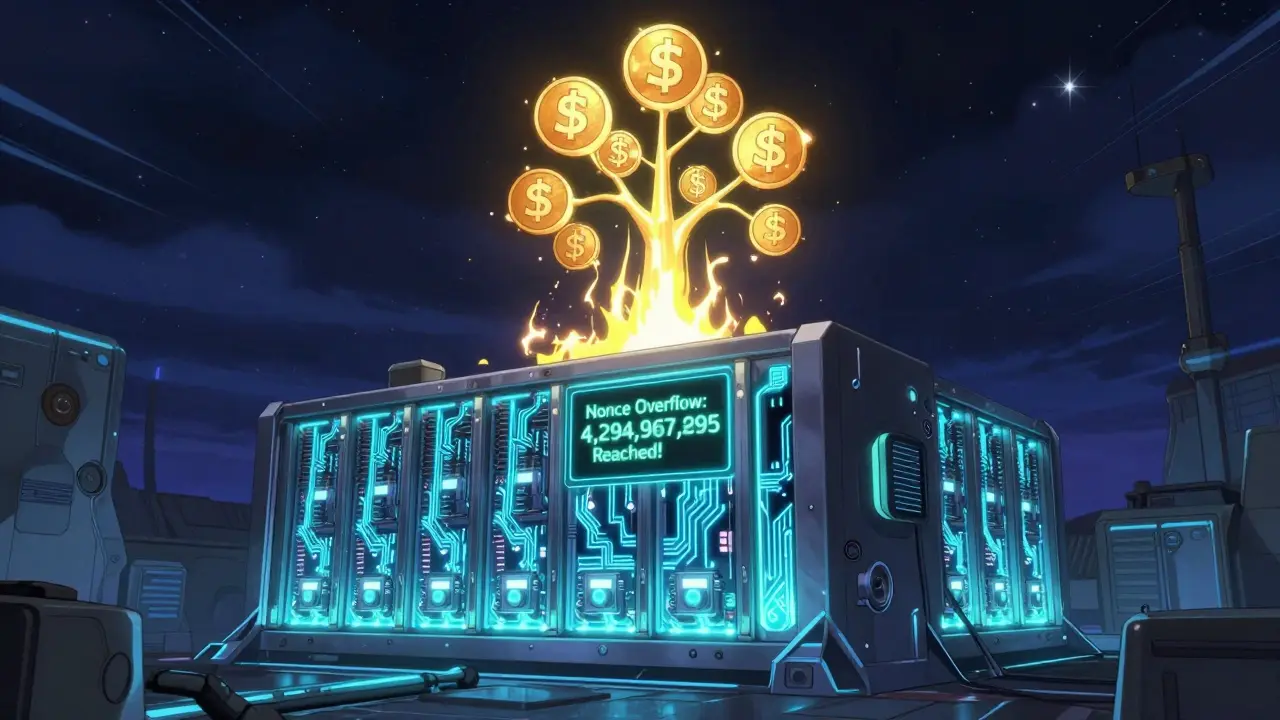
Nonce Overflow in Bitcoin Mining: How Miners Keep Going When the Numbers Run Out
Nonce overflow in Bitcoin mining is a routine event where miners exhaust all 4.2 billion possible nonce values. The system handles it automatically using the extraNonce, ensuring continuous mining without disruptions.