
extraNonce: What It Is and Why It Matters in Bitcoin Mining
When you mine Bitcoin, you’re not just guessing numbers—you’re solving a puzzle that requires extraNonce, a variable field added to the block header to help miners test billions of combinations without changing the core transaction data. It’s a tweakable part of the mining process that lets miners change the input without rebuilding the entire block from scratch. Without extraNonce, miners would hit a wall after trying all possible values in the regular nonce, a 4-byte field in the block header that can only hold about 4 billion unique values. Once that limit is reached, the miner needs a way to keep going—and that’s where extraNonce steps in.
Think of the nonce like a single dial with 4 billion positions. Once you turn it all the way, you’re stuck. extraNonce is like adding a second dial, then a third, letting you jump to entirely new ranges of combinations. It’s not part of the original Bitcoin protocol design, but it became essential as mining hardware got faster. Modern ASIC miners churn through trillions of hashes per second. If they only had the regular nonce, they’d run out of options in milliseconds. extraNonce gives them room to breathe. It’s also tied to the block header, the data structure that includes the previous block’s hash, timestamp, Merkle root, and mining targets. When extraNonce changes, it alters the Merkle root, which changes the block’s hash—making every new attempt unique.
This isn’t just theory. In real mining pools, extraNonce is managed by the pool server and assigned to each miner’s work package. It’s how your home rig can be part of a global effort without stepping on others’ toes. If two miners got the same work, they’d waste power. extraNonce ensures every miner gets unique data to work on. You’ll see this in action in posts about mining hardware, pool protocols, and blockchain efficiency. You’ll also find cases where flawed extraNonce implementation led to rejected blocks or lost rewards. And while most people think mining is about electricity and hash power, the real magic is in these tiny, clever tweaks—like extraNonce—that keep the whole system running smoothly. Below, you’ll find real-world examples of how extraNonce interacts with mining software, pool setups, and even blockchain forks. Some posts dig into how it’s used in altcoins too. Others show how mistakes with extraNonce caused real financial losses. This isn’t just a technical detail—it’s one of the quiet engines behind Bitcoin’s security.
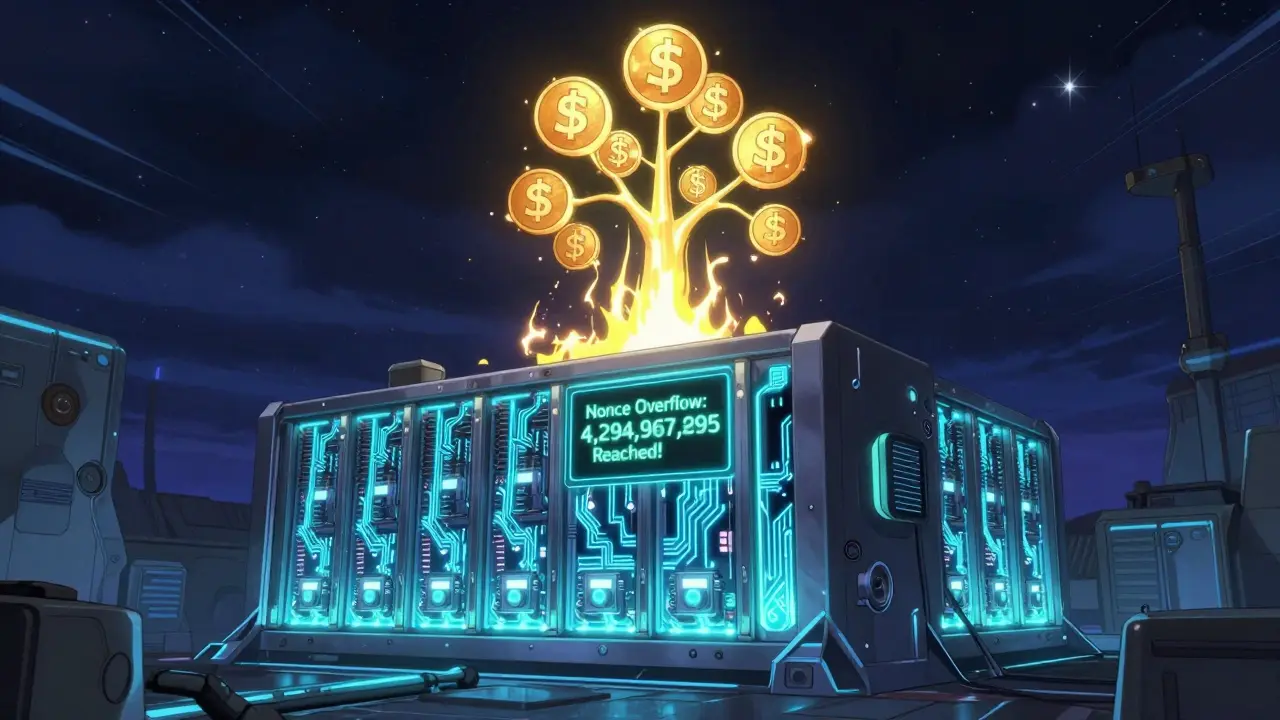
Nonce Overflow in Bitcoin Mining: How Miners Keep Going When the Numbers Run Out
Nonce overflow in Bitcoin mining is a routine event where miners exhaust all 4.2 billion possible nonce values. The system handles it automatically using the extraNonce, ensuring continuous mining without disruptions.