
Block Header: What It Is and Why It Matters in Blockchain
When you hear block header, the compact digital fingerprint at the top of every blockchain block that contains essential metadata like timestamp, previous hash, and nonce. It's not just a technical detail—it's the part that makes the whole chain trustworthy. Without it, blocks couldn't link together, miners couldn't prove work, and no one could verify transactions without trusting a middleman. Think of it like the serial number and barcode on a product package: you don't open the box to know it's real—you just check the header.
The blockchain, a distributed, immutable ledger made of chained blocks, each secured by cryptographic hashes relies entirely on the block header to maintain order. Every new block includes the hash of the previous block’s header, creating a chain of trust that’s nearly impossible to break. If someone tries to change a transaction in an old block, the hash changes, which breaks the link to the next block—and everyone else on the network instantly knows something’s wrong. This is why block headers are the reason Bitcoin has run for over 15 years without a single successful tampering attempt.
Behind every block header is a consensus mechanism, the rule set that determines how nodes agree on which block comes next, usually through proof-of-work or proof-of-stake. In Bitcoin’s case, miners compete to solve a cryptographic puzzle using the block header’s data. The nonce, a random number they tweak, is the key variable. When they find the right one, the header’s hash meets the network’s difficulty target—and that’s how a new block gets added. Other chains like Ethereum 2.0 use different rules, but they all still need a block header to record what happened and who validated it.
On-chain data like transaction counts, timestamps, and miner IDs all live inside the block header. That’s why analysts track it to spot mining centralization, predict network congestion, or even detect suspicious activity. When Germany shut down Russian exchanges in Operation Final Exchange, they didn’t just seize servers—they traced blockchain headers to map out hidden transaction flows. Same with India’s 1% TDS on crypto trades: tax authorities use block headers to track wallet activity across chains. Even fan tokens like YMS or meme coins like BRIAN still rely on block headers to record their transfers—no matter how pointless the token itself may be.
Block headers aren’t flashy. They don’t have whitepapers or Twitter hype. But every time you send crypto, stake a coin, or trade on a DEX like AnimeSwap or Nomiswap, you’re depending on a block header to make sure your transaction is recorded, verified, and permanent. The real power of crypto isn’t in the price charts or airdrops—it’s in this quiet, unchanging layer beneath it all.
Below, you’ll find real-world breakdowns of how block headers enable everything from Bitcoin’s security to DeFi’s trustless systems—and how scams, regulations, and global crackdowns all hinge on what’s hidden in plain sight inside these tiny data structures.
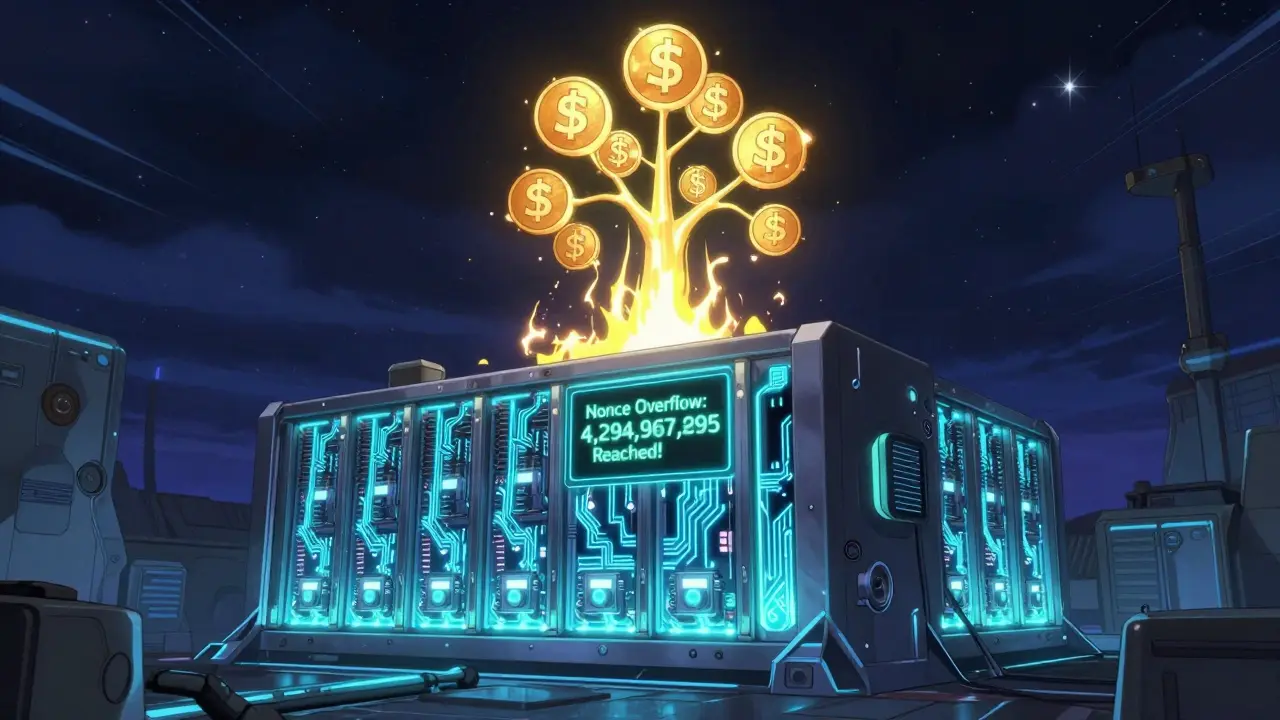
Nonce Overflow in Bitcoin Mining: How Miners Keep Going When the Numbers Run Out
Nonce overflow in Bitcoin mining is a routine event where miners exhaust all 4.2 billion possible nonce values. The system handles it automatically using the extraNonce, ensuring continuous mining without disruptions.