
ASIC Miners: What They Are, How They Work, and Why They Dominate Crypto Mining
When you hear about Bitcoin mining, you’re really hearing about ASIC miners, specialized hardware built to solve cryptographic puzzles faster and more efficiently than any general-purpose computer. Also known as application-specific integrated circuit miners, these machines are the backbone of proof-of-work blockchains like Bitcoin and Litecoin. Unlike your laptop or gaming rig, ASIC miners don’t do anything else—they exist for one reason: to mine crypto at maximum speed and minimum power use.
Why does this matter? Because mining isn’t just about earning coins—it’s about securing the network. Every new Bitcoin block requires thousands of trillions of guesses per second, and only ASIC miners can keep up. Back in 2010, you could mine Bitcoin with a CPU. By 2013, GPUs took over. Today, if you’re not using an ASIC, you’re not competing—you’re just wasting electricity. The machines used by large mining farms like those in Texas or Kazakhstan cost thousands of dollars, pull 3,000+ watts, and run nonstop. But even small-scale miners use compact ASICs like the Bitmain Antminer S19 or MicroBT WhatsMiner M30S to stay relevant.
It’s not just about the hardware. Crypto mining, the process of validating transactions and adding them to the blockchain depends entirely on the hash rate these devices deliver. A single ASIC can outperform hundreds of GPUs combined. That’s why home mining with graphics cards is nearly dead. And it’s why countries like Iraq and Turkey have banned mining altogether—they can’t handle the power drain. Even then, underground mining persists because the rewards still outweigh the risks for those with cheap electricity.
Bitcoin mining, the most common use case for ASICs isn’t the only game in town. ASICs are also built for Litecoin (Scrypt), Dogecoin, and other SHA-256 or Scrypt-based coins. But Bitcoin still eats up 90% of the market. That’s because its network difficulty adjusts every two weeks, pushing out weaker miners. If your ASIC isn’t efficient enough, you’ll lose money on electricity before you earn a single coin. That’s why the best miners track power costs, coin prices, and difficulty trends like traders track stock charts.
And then there’s the flip side: what happens when the price drops? In 2022 and 2025, we saw entire mining operations shut down overnight because their ASICs couldn’t cover their power bills. Some miners sold their gear for scrap. Others moved to places like Iran or Kazakhstan where electricity is dirt cheap—and unregulated. The truth is, ASIC mining isn’t a hobby anymore. It’s a business. And like any business, it demands real numbers, real risks, and real planning.
You won’t find many posts here about mining with your laptop. That’s because the data shows the reality: if you’re not using an ASIC, you’re not mining profitably. The articles below cover everything from how to choose your first ASIC miner, to the latest crackdowns on mining in Brazil and Germany, to why some exchanges now block users who run mining software. You’ll also see how regulatory moves—like India’s 1% TDS or South Korea’s 49.5% tax—impact miners’ bottom lines. And yes, there are stories about failed mining ventures, scam hardware, and the hidden costs of running a rig in your garage.
Whether you’re curious about the tech, thinking about starting out, or just trying to understand why your neighbor’s basement is always hot—this collection cuts through the noise. No fluff. Just what you need to know about ASIC miners in 2025 and beyond.
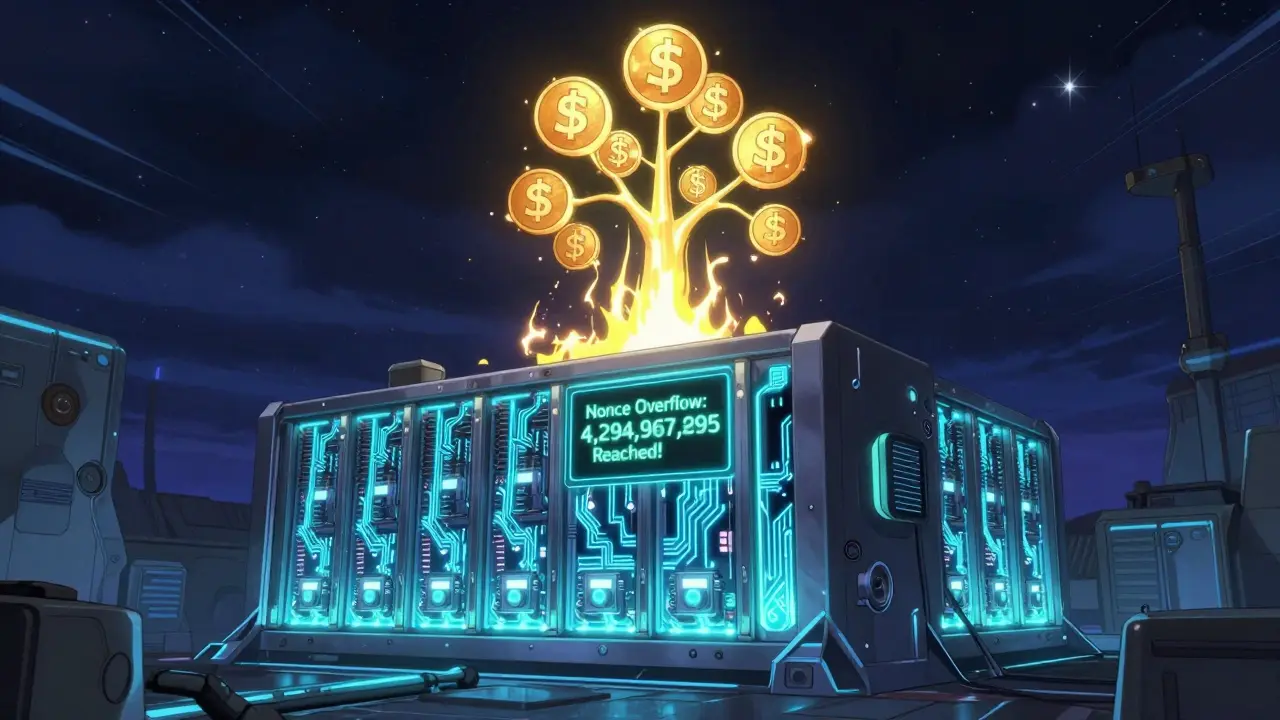
Nonce Overflow in Bitcoin Mining: How Miners Keep Going When the Numbers Run Out
Nonce overflow in Bitcoin mining is a routine event where miners exhaust all 4.2 billion possible nonce values. The system handles it automatically using the extraNonce, ensuring continuous mining without disruptions.