

Crypto Exchange Risk Assessment Tool
This tool estimates the risk level of using a cryptocurrency exchange based on factors highlighted in Germany's Operation Final Exchange. The higher the risk score, the more likely the exchange is to be targeted by law enforcement.
Risk Assessment Results
On September 19, 2024, German police didn’t just shut down a few shady crypto websites. They wiped out 47 of them-simultaneously. No warning. No gradual takedown. Just a clean, surgical strike that left thousands of users staring at blank screens and wondering if their data was already in the hands of law enforcement. This was Operation Final Exchange, and it changed how governments fight crypto crime.
What Exactly Was Operation Final Exchange?
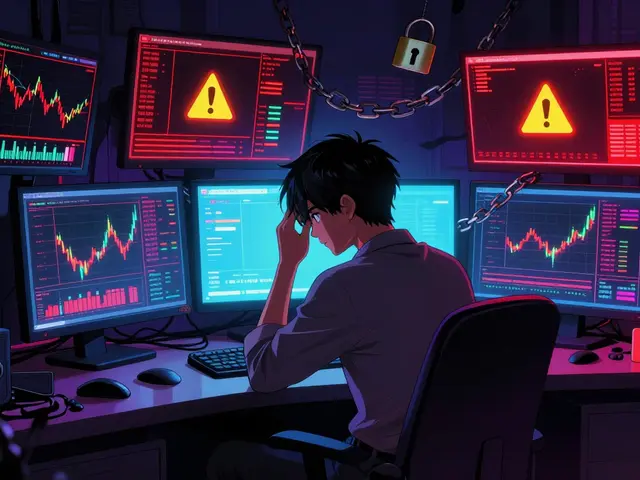
Operation Final Exchange was a coordinated action by Germany’s Federal Criminal Police (BKA), targeting Russian-language cryptocurrency exchanges that didn’t ask users for any identification. No name. No email. No phone number. Just deposit crypto, get cash out-no questions asked. These were no-KYC exchanges, and they weren’t just convenient for privacy seekers. They were the backbone of Russian sanctions evasion, ransomware payments, and darknet drug markets. The BKA didn’t just freeze accounts or block domains. They seized every server they could find: production servers, development servers, backup servers, even the ones hidden in cloud storage. Over 8 terabytes of data were pulled-transaction logs, IP addresses, registration details, everything. And then they sent a message directly to users: “We have found their servers and seized them… We have your data. See you soon.” That message wasn’t just a threat. It was a psychological weapon. For the first time, law enforcement didn’t just take down a service-they made every user feel exposed.Why Did This Work When Other Crackdowns Failed?
Before Operation Final Exchange, crypto enforcement was like playing whack-a-mole. Take down one mixer like ChipMixer? The operators just spun up a new one under a different name. Move the servers to another country? No problem. Delete the database? Easy with backups. This time, Germany hit every layer at once. They didn’t just target the main website. They found the backup servers in Latvia, the development servers in the Netherlands, and the hidden mirrors in Romania-all in one operation. No time to react. No chance to escape. And they didn’t go after all exchanges. They went after the ones that attracted criminals. No-KYC services are the perfect tool for money launderers. Legit users can use exchanges like Coinbase or Kraken. But if you’re laundering ransomware cash or paying for illegal drugs on the dark web, you need anonymity. That’s where these 47 Russian-language platforms came in. They were built for criminals, by criminals. Chainalysis called it “the most effective disruption of crypto-based financial crime infrastructure in Europe.” And they weren’t exaggerating.Who Got Hit-and Why Russian Exchanges?
The 47 exchanges weren’t random. They all shared three things:- They operated primarily in Russian
- They allowed direct fiat on-ramps to sanctioned Russian banks
- They had zero identity checks

What Happened After the Takedown?
Within hours, darknet markets reported a spike in failed payments. Vendors who relied on these exchanges to cash out their Bitcoin earnings suddenly couldn’t get paid. Some switched to peer-to-peer trades. Others tried newer, less-known no-KYC services. But the ones that survived? They got smarter. More encrypted. More decentralized. On Reddit’s r/cryptocurrency, users posted screenshots of error messages from once-popular exchanges. One user wrote: “I used this for years. Now I have no idea if the cops have my IP. I’m not touching crypto until this blows over.” Telegram groups that once buzzed with tips on how to swap crypto anonymously went quiet. Activity dropped by 60% in the first two weeks. Meanwhile, compliance-focused forums like BitcoinTalk saw a surge in posts praising the operation. “Finally,” one user wrote, “someone’s cleaning up the trash so real users can use crypto without being tainted.” CoinGecko’s trust scores for no-KYC exchanges plummeted. Some platforms lost over 40% of their user ratings in a week. Trust, in crypto, is fragile. And this operation shattered it for the worst offenders.What Does This Mean for the Rest of the World?
Germany didn’t act alone. They worked with prosecutors in Frankfurt, intelligence agencies in the EU, and blockchain analytics firms like Chainalysis. The operation took months to plan. They infiltrated forums, traced transaction flows, mapped server networks-all before pulling the trigger. Now, other countries are watching. The FBI and FinCEN in the U.S. have publicly referenced the operation as a model. The EU is pushing for similar coordinated actions across member states. The global crypto compliance market hit $1.2 billion in 2024-up 300% since 2022-largely because governments are now investing in the tools to do this kind of work. But here’s the catch: this isn’t a global solution. It’s a targeted one. The 47 exchanges were Russian-speaking. They weren’t serving American users or Chinese traders. So while it crippled a major part of the criminal crypto pipeline, it didn’t end it. New no-KYC services are already emerging-this time using decentralized protocols, peer-to-peer networks, and non-custodial wallets. Criminals are adapting. And they’re learning from this mistake: don’t centralize your infrastructure. Don’t keep logs. Don’t make it easy to seize.
Is This a Win for Privacy or a Threat to It?
Privacy advocates aren’t celebrating. They argue that Operation Final Exchange blurred the line between targeting criminals and surveilling ordinary users. If your IP address and transaction history are now in a government database, what’s stopping them from using it later for other purposes? Some users who never broke any laws still used these exchanges because they didn’t trust banks. Maybe they lived in a country with capital controls. Maybe they were freelancers avoiding high fees. Now, they’re caught in the same net as ransomware gangs. There’s no easy answer. On one hand, these exchanges enabled billion-dollar crimes. On the other, they gave people a way to move money without permission. The operation didn’t just shut down servers-it changed the entire landscape of digital finance.What Comes Next?
As of October 2024, German authorities haven’t announced any arrests. But they’ve confirmed the seized data is being used to build cases. That 8 terabytes? It’s a goldmine. Every transaction, every IP, every wallet address-now linked to real identities. Prosecutors are tracing money flows from ransomware attacks to darknet vendors to bank accounts. Expect more operations like this. Not just in Germany, but across Europe and North America. The playbook is proven: target the infrastructure, seize everything, scare the users, and follow the data. The crypto world will keep evolving. But one thing is clear: anonymity isn’t dead. But if you’re using a service that doesn’t ask for your name, and you’re doing anything even remotely shady-you’re not invisible anymore. You’re just waiting for your name to show up in a German courtroom.What is Operation Final Exchange?
Operation Final Exchange was a coordinated law enforcement operation by Germany’s Federal Criminal Police (BKA) on September 19, 2024, targeting 47 Russian-language cryptocurrency exchanges that operated without Know Your Customer (KYC) checks. Authorities seized all server infrastructure-including backups-and collected over 8 terabytes of user data, including transaction records and IP addresses. The goal was to disrupt sanctions evasion, ransomware laundering, and darknet market operations tied to Russian financial networks.
Why were Russian exchanges targeted specifically?
These exchanges were chosen because they were the primary tools used to bypass Western sanctions on Russia. They allowed users to convert cryptocurrency directly into Russian rubles via sanctioned banks, with no identity verification. This made them ideal for laundering money from cybercrime, including ransomware attacks and darknet sales. By targeting them, Germany struck at a key financial pipeline supporting Russia’s evasion of international economic penalties.
How did German authorities manage to shut down so many exchanges at once?
German police spent months mapping the infrastructure of these exchanges, identifying not just live servers but also development and backup systems across multiple countries. They coordinated with international partners and blockchain analytics firms like Chainalysis to trace transaction flows and locate hidden servers. On the day of the operation, they executed simultaneous seizures, preventing operators from migrating data or restoring services. This multi-layered approach made it impossible to recover quickly.
Did Operation Final Exchange lead to any arrests?
As of October 2024, no official arrests have been announced. However, German authorities confirmed that investigations are actively underway using the 8+ terabytes of seized data. This includes tracing transactions back to real-world identities, linking users to criminal activities like ransomware payments and darknet market sales. Arrests are expected in the coming months as cases are built.
Is this operation a threat to legitimate crypto users?
Yes, in some cases. While the operation targeted criminal infrastructure, many legitimate users-such as those in countries with capital controls or freelancers avoiding bank fees-also used these no-KYC exchanges. Their data was seized alongside criminals’, raising concerns about mass surveillance. Privacy advocates warn this sets a precedent where anonymity tools are treated as inherently suspicious, even when used for legal purposes.
Will other countries copy this operation?
Absolutely. The U.S. FBI and FinCEN have already cited Operation Final Exchange as a model. The EU is pushing for similar coordinated actions across member states. The success of this operation has led to increased funding for blockchain analytics and cross-border law enforcement collaboration. Expect more large-scale, multi-jurisdictional takedowns targeting no-KYC services, especially those linked to sanctioned regions.
What impact did this have on the crypto industry?
The operation caused a major shift in trust. CoinGecko ratings for no-KYC exchanges dropped sharply, and user activity on privacy-focused forums declined. At the same time, compliance-focused platforms gained credibility. The global crypto compliance market grew to $1.2 billion in 2024, driven by increased demand for tools that help exchanges meet regulatory standards. Criminals are adapting, but the message is clear: no-KYC doesn’t mean no-trace.




Comments
priyanka subbaraj
November 28, 2025 AT 19:42 PMThis is the most beautiful thing I’ve seen all year. Finally, someone had the guts to cut the Gordian knot.
fanny adam
November 29, 2025 AT 18:44 PMLet’s be honest-this wasn’t about crime. It was about control. They seized data, not just servers. What’s next? Mandatory blockchain surveillance for every wallet? Don’t pretend this was clean.
Wilma Inmenzo
December 1, 2025 AT 01:36 AMOh wow, the government just did what they’ve been threatening to do since 2017… and you’re all cheering? 🤡 Next they’ll ‘seize’ your phone because you bought Dogecoin. They’re not cleaning up the trash-they’re building a dossier on YOU. Wake up, sheeple.
Tony spart
December 2, 2025 AT 03:57 AMGermany did what the US should’ve done years ago. These no-KYC trash were literally bankrolling Putin’s war machine. If you used them, you’re either a criminal or an idiot. Either way, you got what you deserved. #Justice
Eddy Lust
December 2, 2025 AT 06:02 AMI get why people used these exchanges. Not everyone trusts banks. Some of us live in places where your money gets frozen for saying the wrong thing. This feels like punishing the scared instead of the scammers. The data they took? It’s a time bomb. What happens when it leaks-or gets repurposed?
Janice Jose
December 3, 2025 AT 10:36 AMThere’s a real human cost here. I know people who used these platforms just to get paid for freelance work. No bank would touch them. Now they’re scared to even open a wallet. This wasn’t just a takedown-it was a cultural reset. And I’m not sure we’re ready for what comes next.
Susan Dugan
December 4, 2025 AT 02:03 AMLet’s not forget the tech behind this. Months of mapping, cross-border coordination, blockchain tracing-it’s a masterpiece of modern law enforcement. This isn’t just about crime. It’s proof that decentralized doesn’t mean untraceable. The future is hybrid: privacy + accountability.
Tom MacDermott
December 4, 2025 AT 09:39 AMOh please. You think this was about justice? Germany’s using this as a Trojan horse to push EU-wide crypto surveillance. They didn’t shut down exchanges-they built a surveillance empire. And you’re all clapping like it’s a TED Talk. Pathetic.
Grace Zelda
December 4, 2025 AT 18:22 PMSo what’s the alternative? Let criminals run wild? Or force everyone into KYC hell? The truth is, we’re stuck between two terrible options. Maybe the real question isn’t ‘who got caught’-but ‘why did we build systems this fragile in the first place?’
Casey Meehan
December 6, 2025 AT 12:15 PMY’all are overreacting 🤦♂️ This is like complaining because the cops took down a meth lab. Yeah, some legit users got caught in the crossfire-but the *main* targets were the ones laundering ransomware cash. Let’s not cry over spilled crypto. 💪
Ben Costlee
December 7, 2025 AT 16:37 PMI’ve seen the fear in people’s eyes since this happened. Not just criminals-regular folks who just wanted to move money without bureaucracy. We’re not just losing anonymity. We’re losing trust in the entire system. And once that’s gone, it’s harder to rebuild than any server.
SARE Homes
December 9, 2025 AT 03:06 AMWow. Just… wow. You people are naive. This wasn’t a law enforcement operation-it was a geopolitical assassination of financial sovereignty. Russia didn’t lose 47 exchanges. They lost their entire underground banking system. And now? The West owns the ledger. You think this ends here? It’s only the beginning.
Martin Doyle
December 9, 2025 AT 04:42 AMEnough with the ‘privacy’ nonsense. These platforms existed to launder money from kids’ ransomware. If you used them, you were part of the problem. Germany did the right thing. Stop crying about your ‘freedom’ when you’re funding war crimes.
stephen bullard
December 9, 2025 AT 13:05 PMIt’s not black and white. Some people used these for survival. Others used them for sin. But the data seized? It’s not just evidence-it’s a map of human behavior under pressure. We should be asking: How do we build systems that protect both the innocent and the law? Not just punish everyone who slipped through the cracks.
Angel RYAN
December 9, 2025 AT 18:09 PMGermany didn’t just take down servers-they changed the game. The real win? Making criminals think twice before centralizing again. Now the next wave will be fully decentralized, peer-to-peer, zero-log. And that’s going to be way harder to stop. This was a tactical victory, not a strategic one.
Ian Esche
December 10, 2025 AT 18:15 PMLet’s not forget who funded this. Chainalysis. The same company that sells surveillance tools to governments. This wasn’t justice. It was a corporate-government partnership with a PR team. And we’re supposed to be grateful?