
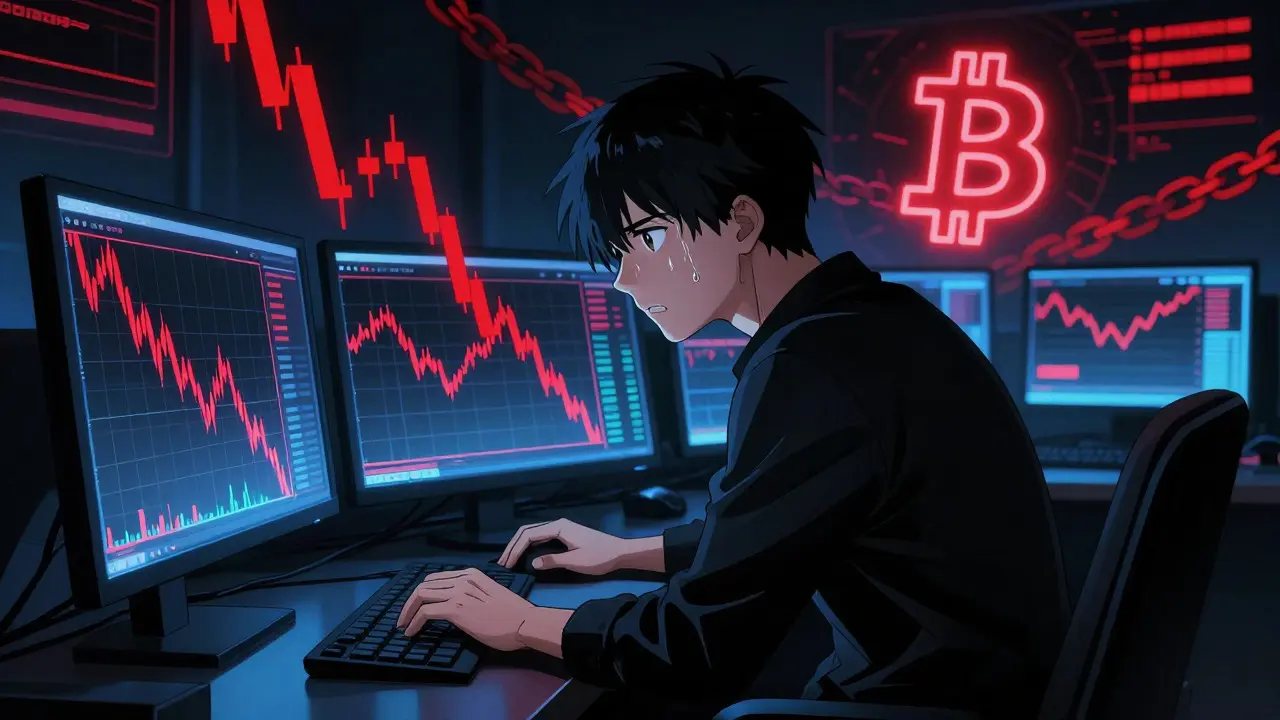
Imagine you have $1,000. You want to buy Bitcoin, but you think the price is going up fast. So, you borrow $9,000 from an exchange to control a $10,000 position. This is leverage. It sounds like a shortcut to wealth. In reality, it is often a shortcut to losing everything.
In 2026, cryptocurrency markets are more mature than ever, but they remain wildly volatile. Daily swings of 5% or even 15% are not anomalies; they are routine. When you add borrowed money into that mix, small moves become catastrophic. A 2% drop against you with 10x leverage wipes out your entire initial investment. That is the core danger of leverage trading: it amplifies gains, yes, but it amplifies losses just as fast.
The Mechanics of Margin and Leverage
To understand the risk, you need to understand how the trade works. When you open a leveraged position, you put down some of your own money, called margin. The exchange lends you the rest. The ratio between your money and the total position size is your leverage ratio.
If you use 10x leverage, your buying power increases tenfold. But your exposure to risk also increases tenfold. Here is why this matters in crypto specifically:
- Traditional Markets: Stocks rarely move more than 2-3% in a day unless there is major news. A 10x leveraged stock trader can sleep at night.
- Crypto Markets: Bitcoin and altcoins can swing 10-20% in hours due to regulatory news, whale movements, or exchange outages. That same 10x leveraged crypto trader is one bad hour away from ruin.
The exchange does not care if you lose. They only care that their loan is repaid. If your position value drops too low, they step in. This brings us to the most feared term in trading: liquidation.
Liquidation Risk: The Silent Account Killer
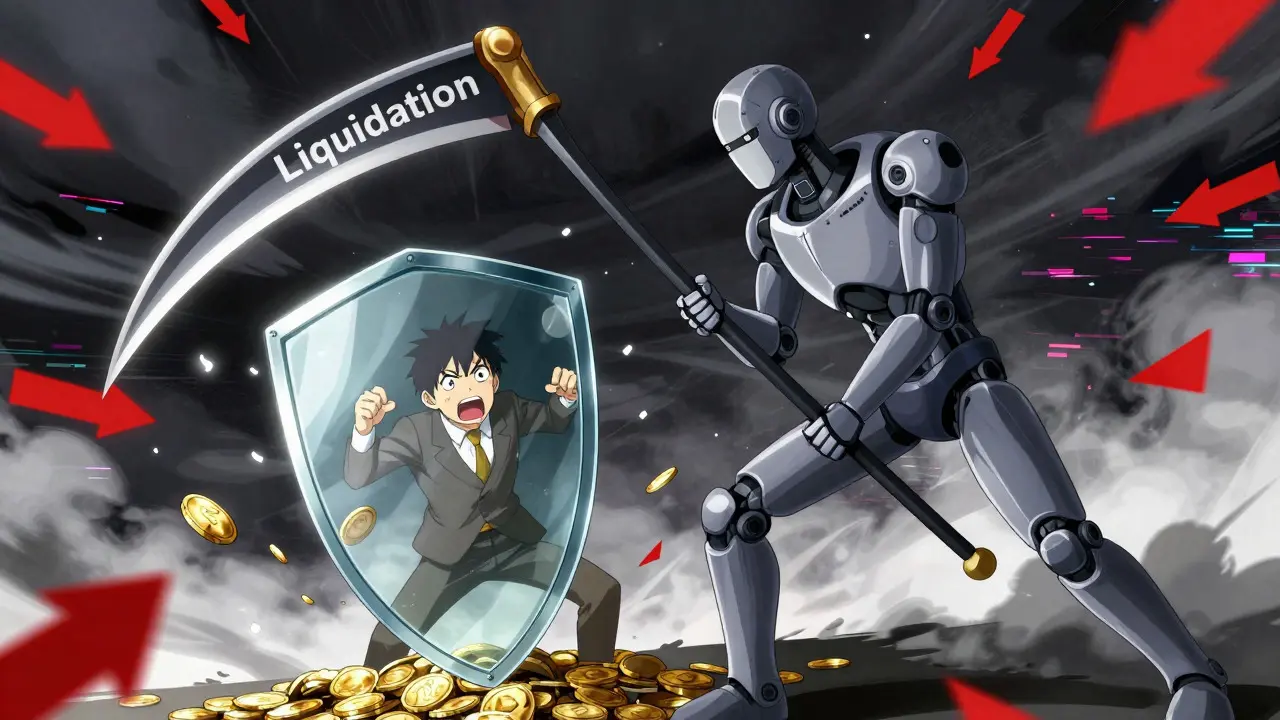
Liquidation is when the exchange automatically closes your position because your remaining equity falls below the minimum required to keep the trade open. You don’t get a warning call. An algorithm executes the sale instantly.
Why is this so dangerous? Because it happens during volatility. Let’s look at real-world data. In May 2024, a trader known as "qwatio" was liquidated eight times in a single week, losing $12.5 million. Why? Overexposure. He kept adding to losing positions instead of cutting his losses. The market moved slightly against him, and the math caught up.
Consider the March 2020 crash. In a matter of days, over $1 billion in leveraged positions were wiped out across multiple exchanges. Then, in May 2021, Bitcoin dropped over 30% in a single day, triggering over $8 billion in liquidations. These weren't outliers. They were features of the system.
When you are leveraged, you are fighting against two things: the market direction and time. Every minute the market stays flat or moves against you, funding fees (interest on the borrowed money) eat into your margin. Eventually, if the price dips just enough, you are gone.
| Leverage Ratio | Initial Capital | Total Position Size | Price Drop to Wipe Out Capital (Approx.) |
|---|---|---|---|
| 1x (Spot) | $1,000 | $1,000 | 100% (Bitcoin goes to zero) |
| 5x | $1,000 | $5,000 | ~20% |
| 10x | $1,000 | $10,000 | ~10% |
| 20x | $1,000 | $20,000 | ~5% |
| 50x | $1,000 | $50,000 | ~2% |
Look at that last row. With 50x leverage, a mere 2% dip kills your account. In crypto, a 2% dip can happen while you are brushing your teeth. Is that risk worth the potential reward?
The Five Critical Risk Vectors
Beyond simple liquidation, leverage introduces complex layers of risk that many beginners ignore until it is too late.
- Market Volatility: Crypto prices are driven by sentiment, news, and large holder actions (whales). A tweet from a high-profile figure or a regulatory announcement in the EU or US can cause instant spikes. Leverage magnifies these spikes.
- Slippage: You might set a stop-loss order at a specific price. But in a fast-moving market, the next available buyer might be at a much worse price. Your stop-loss triggers, but you exit at a loss larger than expected. This is common during flash crashes.
- Margin Calls: Some exchanges require you to deposit more funds quickly to save your position. If you don’t have extra cash ready immediately, the position is closed. This adds psychological pressure.
- Emotional Impact: Leverage triggers primal fear and greed. Watching a position swing wildly makes it hard to stick to a plan. Traders often panic-sell at the bottom or FOMO-buy at the top.
- Counterparty Risk: You are borrowing from an exchange. If that exchange has technical issues, low liquidity, or collapses (as seen with FTX and others), your funds may be stuck or lost entirely, regardless of your trade performance.
Common Mistakes That Destroy Accounts
I have analyzed countless trading forums and post-mortems from failed traders. The patterns are always the same. Here is what you must avoid.
Mistake 1: Overleveraging Early On Beginners often start with 20x or 50x leverage because they see it offered. Professional traders rarely go above 5x, and many stay at 2x or 3x. High leverage leaves no room for error. If you are new, treat anything above 5x as gambling, not trading.
Mistake 2: Averaging Down Without a Plan Your trade goes against you. Instead of taking the small loss, you buy more to lower your average entry price. This works in stable markets. In volatile crypto markets, it compounds your risk. If the trend continues downward, you now have twice the exposure to the same losing direction. This is how accounts go from 50% down to 100% gone.
Mistake 3: Ignoring Funding Rates In perpetual futures contracts, you pay or receive funding fees every 8 hours based on whether the market is bullish or bearish. If you hold a long position in a strongly bullish market, you might pay significant fees daily. Over weeks, these fees can eat all your profits, even if the price doesn’t move much.
Mistake 4: Trading Without Stop-Losses Entering a leveraged trade without a pre-set stop-loss is suicide. You hope the market will turn. The market does not care about your hopes. Set your exit point before you enter.
Risk Management Strategies That Work
You don’t have to quit leverage trading to survive it. You just have to respect the math. Here is how professional traders protect themselves in 2026.
Use Isolated Margin
This is non-negotiable. There are two types of margin modes: Cross and Isolated.
- Cross Margin: Uses your entire account balance as collateral. If one trade goes wrong, it can drain your whole account.
- Isolated Margin: Allocates a specific amount of funds to a single trade. If that trade gets liquidated, you only lose the allocated amount. Your rest of your portfolio is safe.
Always use isolated margin unless you have a very specific hedging strategy. It limits your maximum loss per trade.
The 1-2% Rule
Never risk more than 1-2% of your total account value on a single trade. If you have a $10,000 account, your maximum acceptable loss on one trade should be $100-$200. Calculate your position size and stop-loss distance to ensure this holds true. This allows you to survive a string of bad trades without blowing up your account.
Diversify Positions
Don’t put all your leverage into one coin. Bitcoin, Ethereum, and Solana move differently. Spreading risk across uncorrelated assets can smooth out volatility. However, be careful: diversification reduces risk, but leverage increases it. Don’t let them cancel each other out mentally.
Take Profits Early
Greed is the enemy. If your trade moves in your favor, consider scaling out. Sell 50% of your position at your first target. Move your stop-loss to breakeven. Now, the house pays for the rest of the ride. You have locked in profit and eliminated downside risk.
The Psychological Trap
Leverage trading is addictive. The dopamine hit from a quick win is powerful. But the pain of a loss is deeper. Many traders report entering a cycle of "revenge trading" after a loss. They try to win back the money quickly, using higher leverage and ignoring their rules. This leads to bigger losses.
Recognize the signs. Are you checking your phone every five minutes? Are you feeling anxious when the market opens? Are you increasing position sizes after a loss? If yes, step away. The market will still be there tomorrow. Your capital might not be if you keep pushing.
In 2026, decentralized finance (DeFi) protocols also offer leveraged trading via smart contracts. While this removes counterparty risk with centralized exchanges, it introduces smart contract risk. Bugs in code can lead to drained liquidity pools. Stick to reputable platforms and understand the underlying mechanism.
Conclusion: Respect the Market
Leverage is a tool, not a strategy. Used correctly, it can enhance returns. Used incorrectly, it guarantees failure. The crypto market is unforgiving. It rewards patience and punishes arrogance.
Start small. Use low leverage. Protect your capital. Remember that the goal of trading is not to make money in one trade, but to stay in the game long enough to compound gains over time. If you cannot afford to lose the money you are leveraging, do not trade it.
What is the safest leverage ratio for beginners?
For beginners, a leverage ratio of 2x to 5x is considered safest. This provides some amplified exposure without requiring extreme precision in entry and exit points. Anything above 10x significantly increases the risk of liquidation due to normal market volatility.
Can I lose more money than I deposited with leverage?
In most modern centralized exchanges, no. They use auto-deleveraging or isolated margin to ensure you only lose your collateral. However, in cross-margin mode or certain DeFi protocols, if the market gaps down faster than the liquidation engine can react, you could theoretically owe more than your initial deposit, though this is rare on major platforms.
What is the difference between cross margin and isolated margin?
Cross margin uses your entire account balance as collateral for a trade, meaning a bad trade can wipe out your whole account. Isolated margin allocates a specific amount of funds to a single trade, limiting your loss to just that allocated amount. Beginners should always use isolated margin.
How does slippage affect leveraged trades?
Slippage occurs when your order is executed at a different price than expected, usually during high volatility. For leveraged traders, slippage can mean your stop-loss triggers at a much worse price, leading to larger-than-expected losses or immediate liquidation.
Is leverage trading suitable for long-term investing?
Generally, no. Leverage involves funding fees and liquidation risks that make holding positions for months or years expensive and dangerous. Long-term investors are better served by spot buying (holding the actual asset) without debt.





Comments
Heather Austin
July 19, 2026 AT 15:19 PMhey guys just a quick tip from someone who has been trading since the early days of btc. isolated margin is literally the only way to go unless you want to wake up one morning and see your entire life savings gone because one altcoin decided to dump 30% overnight. cross margin feels safe until it isnt and then its game over for sure. also dont forget about funding rates they eat into your profits slowly but surely if you hold positions too long without checking them.
Lisa Chong
July 19, 2026 AT 22:44 PMThe exchanges are rigged against us from the start, think about it. They lend you money at interest rates that seem reasonable but are actually designed to bleed you dry while they front-run your orders using their own proprietary algorithms. It is not just bad luck or volatility, it is a systematic extraction of wealth from the little guy by the elite financial oligarchs who control these platforms. You are not trading the market, you are trading against the house which always wins in the end because they have inside information and superior technology. Wake up sheeple before they liquidate your soul along with your portfolio.
Ran Tao
July 21, 2026 AT 09:35 AMLol typical retail mindset 😂 you people treat leverage like its a casino slot machine when it’s clearly an instrument for sophisticated capital allocation. The problem isn’t the leverage, it’s your incompetence. If you can’t handle 50x, maybe you shouldn’t be in this space at all. True alpha hunters don’t whine about volatility, they exploit it. Most of you are just noise traders getting swept out by real liquidity providers. 📉💀
Andrew Schneider
July 22, 2026 AT 05:56 AMOh please, spare me the 'sophisticated' nonsense Ran. You’re probably down 90% on your last trade and hiding behind buzzwords. Leverage is basically financial heroin for idiots who think they’re smarter than the market. I’ve seen guys turn $10k into zero in seconds because they couldn’t resist the dopamine hit of a green candle. It’s not sophistication, it’s self-destruction wrapped in jargon. The market doesn’t care about your feelings or your 'alpha', it will chew you up and spit you out if you get cocky. 🤡🔥
Eric Braddock
July 22, 2026 AT 23:51 PMThe real issue here is the centralized nature of these exchanges. They are essentially unregulated banks holding your funds hostage. When you use leverage, you are trusting a third party with your collateral, and we all know how trustworthy those entities are given the recent collapses. The smart contracts in DeFi offer a semblance of transparency, but even there, oracle manipulation is rampant. Whales are feeding data to keep prices stable enough to liquidate latecomers. It’s a shadow banking system built on sand, and the tide is coming in. You need to understand the underlying protocol risks, not just the price action. The narrative is controlled by those who benefit from your ignorance.
Anuj Kashyap
July 23, 2026 AT 17:25 PMInteresting perspective Eric, though I’d argue the psychological aspect is more immediate than the systemic one. We are wired to fear loss twice as much as we desire gain, which makes leverage a nightmare for our primitive brains. Every red candle triggers a fight-or-flight response that overrides logic. I’ve found that stepping away from the screen is the best risk management tool available. The market will still be there tomorrow, but your sanity might not be if you stare at the charts all day. 🧘♂️✨
Nick G
July 25, 2026 AT 16:38 PMI think it is important to recognize that different cultures approach risk differently, and perhaps our Western obsession with rapid accumulation contributes to this reckless behavior. In many traditional societies, patience is valued over speed, and this principle applies beautifully to investing. When we rush to multiply our capital, we often forget the value of preservation. By adopting a more holistic view of our financial health, considering not just the monetary aspect but also the emotional toll, we can find a better balance. It is not just about the numbers; it is about maintaining harmony between our goals and our peace of mind. Let us learn from each other’s experiences and create a more supportive community for traders worldwide.
Nick Wengel
July 26, 2026 AT 07:03 AMsimple advice: buy spot and hold. stop trying to get rich quick.
Alicia Hull
July 27, 2026 AT 02:40 AMThis article misses the point entirely! Why are we even discussing risk management when the entire premise of crypto is speculative gambling? You cannot manage risk in a market that has no intrinsic value. It is all based on hype and FOMO. Stop pretending there is a 'safe' way to gamble. Just admit it for what it is. The sooner we accept that, the sooner we can move on to more productive discussions about actual assets.
Johan Otto
July 27, 2026 AT 10:22 AMBoring read tbh. Everyone knows leverage kills you. But hey, let me tell you about my latest disaster. Lost my shirt on ETH yesterday because I thought the dip was the bottom. Classic mistake right? Now I’m staring at a blank account wondering why I bother. At least I got a good story out of it. Who else is feeling the pain today? 😭💸
Tracy Marshall
July 27, 2026 AT 15:44 PMIt is truly shameful how many people fall for this greed trap. The moral decay of society is evident in these forums where everyone wants something for nothing. Hard work and saving are virtues that have been discarded for instant gratification. Use emoticons to hide your shame but deep down you know you failed. The system rewards the lazy and punishes the diligent. It is a tragedy really. :-(
Guy Davis
July 27, 2026 AT 19:13 PMstop losing money u morons. use stop losses.
KEITH WONG
July 29, 2026 AT 00:25 AMLook at these noobs crying about liquidation. Real pros know that risk is just a word for opportunity. I made 500% last week on a shitcoin using 100x leverage. You guys are just jealous because you lack the vision. Keep reading these basic guides while I count my profits. 🚀🌕 The difference between us is simple: guts. You have none.