

Governance Token Distribution Calculator
Distribution Calculator
Input your token distribution percentages to see if you meet Web3 best practices for fair governance.
Distribution Analysis
Key Recommendations
Why Governance Token Distribution Matters More Than You Think
Most people think governance tokens are just another way to make money. But if you look closer, they’re the actual voting ballots of a decentralized organization. Every UNI, MKR, or COMP token you hold gives you a say in how a protocol evolves - whether it’s changing fees, adding new assets, or even shutting down a risky feature. The problem? If those tokens end up in the hands of a few big players, the whole system becomes just another centralized company with a blockchain logo.
That’s why how tokens are distributed isn’t just a technical detail - it’s the difference between a community-run system and a corporate shell. Projects that get this right, like Uniswap and MakerDAO, have seen years of steady growth. Those that don’t, like Steemit or early EOS, collapsed under the weight of concentrated power. The goal isn’t to give tokens to everyone. It’s to give them to the people who actually use the protocol.
How Governance Tokens Actually Work
Governance tokens aren’t like regular crypto. You can’t spend them at Starbucks. You can’t trade them for quick profits (though people try). Their only real use is voting. When a proposal comes up - say, increasing the interest rate on loans in a lending protocol - token holders vote yes or no. The more tokens you hold, the more weight your vote carries.
But here’s the catch: voting only works if people show up. And if 80% of the tokens are held by three wallets, then the other 99% of users might as well not exist. That’s why smart projects design their token distribution to prevent this. They don’t just hand out tokens. They reward real behavior - swapping on the platform, providing liquidity, or even just holding for months.
Uniswap’s 2020 airdrop is the textbook example. They gave 400 UNI to anyone who had used the platform before September 2020. That meant real users got rewarded, not bots or speculators. Over 250,000 addresses received tokens, and 92% of them held less than 1% of the total supply. That’s what fair looks like.
The Five Common Distribution Models (And Which Ones Work)
There are five main ways projects distribute governance tokens. Each has pros, cons, and real-world examples.
- Public Token Sales: You pay for tokens during a launch event. Common on platforms like CoinList. Pros: raises capital fast. Cons: attracts speculators, risks regulatory trouble. The SEC fined CoinList in 2024 for selling unregistered securities. Many projects now limit these to accredited investors only.
- Private Sales: Tokens sold to venture firms or wealthy individuals before the public launch. Often used to fund development. But if too many tokens go here - like EOS in 2018 - whales control the vote. Nansen data showed 40% of EOS tokens ended up in exchange wallets within months.
- Airdrops: Free tokens given to users who did something valuable. Uniswap’s airdrop is the gold standard. But many airdrops fail because of farming bots. Balancer’s 2020 airdrop had 37% claimed by bots, not real users. To fix this, some now use proof-of-use: you had to interact with the protocol for a minimum time.
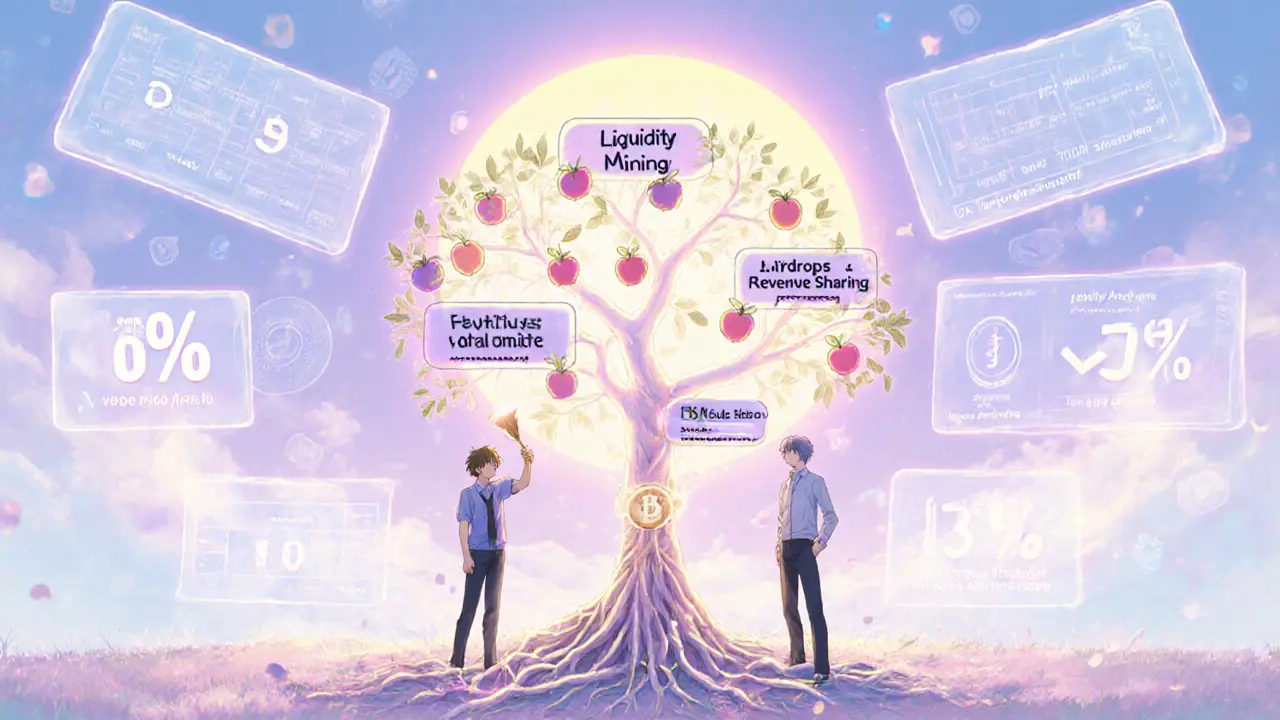
- Liquidity Mining: Reward users for locking up assets in a pool. Compound did this in 2020, handing out 2,880 COMP daily to liquidity providers. It worked - but also led to short-term speculation. People rushed in, earned tokens, then pulled out. The protocol lost real users.
- Protocol Revenue Sharing: A small portion of fees goes to token holders. MakerDAO does this: 10% of protocol revenue buys back MKR and burns it, reducing supply. This keeps long-term holders aligned with the protocol’s success.
The most successful models combine two or more. MakerDAO started with private sales, then added community rewards, and now uses revenue sharing. That’s why it’s still around after eight years.

What a Good Distribution Looks Like (The Numbers)
There’s no perfect formula, but top projects follow clear patterns.
| Category | Typical % Range | Vesting Schedule |
|---|---|---|
| Community & Users | 30%-50% | Immediate or 6-12 month cliff |
| Team & Founders | 10%-15% | 4-year vesting, 12-month cliff |
| Investors | 15%-20% | 2-4 year vesting, tiered unlocks |
| Ecosystem Reserves | 20%-25% | Released over 3-5 years |
| Advisors | 2%-5% | 2-year vesting, 6-month cliff |
Notice anything? The biggest slice goes to the community. That’s intentional. Projects that give less than 30% to users rarely build lasting engagement. Also, vesting is non-negotiable. If the team gets 15% and can sell it all day one, they’ll leave the moment the price drops. Vesting locks them in.
How to Stop Whales From Controlling the Vote
Even with fair distribution, whales show up. They buy tokens on the open market, accumulate voting power, and push proposals that benefit them - like lowering fees for big traders while ignoring small users.
Two tools fix this: delegation and quadratic voting.
Uniswap lets token holders delegate their vote to someone else - like a trusted expert or a DAO delegate. In 2025, 78% of UNI voting power was delegated. That means the 22% who actively vote are the ones who actually understand the proposals. The rest just trust someone else to do it right.
Aave is testing quadratic voting. Instead of one token = one vote, it’s one token = one vote, but the cost of additional votes goes up exponentially. So if you hold 100 tokens, you can’t just use them all for one vote. You’d have to pay a higher cost for each additional vote. This stops whales from dominating single votes.
MakerDAO’s problem? Their proposal threshold is 10,000 MKR. That’s over $20 million worth. Only 8% of MKR holders can even submit a proposal. That’s not governance - it’s an elite club.
Legal Risks No One Talks About
The SEC doesn’t care if your token is called "governance". They care if it looks like an investment contract. The Howey Test still applies. If people buy your token expecting profits from others’ efforts, it’s a security - even if it gives voting rights.
That’s why the 2023 SEC v. Ripple Labs ruling changed everything. The court said tokens sold to the public without clear utility could be securities. So now, projects do two things: they limit sales to accredited investors (who can handle the risk), and they design tokenomics so the token’s value comes from usage, not speculation.
The EU’s MiCA rules (effective Jan 2025) go even further. They require governance tokens to prove "substantial utility" - meaning you can’t just vote. You need to use the protocol. That’s why Curve Finance’s veCRV model works: you lock your CRV for up to four years, get boosted voting power, and earn fees. That’s utility.
Bottom line: if you’re distributing tokens to the public, assume the SEC is watching. Build for compliance from day one.
What Happens When Distribution Goes Wrong
Bad distribution isn’t just a mistake - it’s a death sentence.
Steemit, a blockchain-based social media platform, gave out governance tokens to early users. But within two years, the top 20 accounts controlled 51% of voting power. The community lost trust. Developers left. The platform died.
Terraform Labs’ UST collapse in 2022 was partly due to governance failure. Most governance tokens were held by insiders. When the algorithm broke, no one could vote fast enough to fix it. The system froze.
Even Uniswap had problems. After the airdrop, 12% of UNI holders sold within 48 hours. But because the rest were real users, the protocol survived. The difference? Intent. Uniswap targeted users. Others targeted wallets.
How to Build a Sustainable Distribution Strategy
If you’re launching a DAO or DeFi protocol, here’s your checklist:
- Define your goal: Are you trying to get 10,000 users? Raise $15M? Build long-term adoption? Your goal shapes your distribution.
- Give at least 35% to users: No exceptions. If you give less, you’re building a company, not a community.
- Vest everything: Team, investors, advisors - all need 12-month cliffs and 3-4 year unlocks.
- Use proof-of-use for airdrops: Require interaction with the protocol over time. No more bot farms.
- Enable delegation: Let small holders pass their vote to trusted participants.
- Start with compliance: Talk to a lawyer before you launch. Use SAFT agreements if selling to investors.
- Document everything: MakerDAO’s governance docs score 92/100. Most new projects score below 70. Clarity builds trust.
And remember: governance isn’t a one-time event. It’s a living system. The best projects don’t just distribute tokens - they keep rewarding participation. That’s how you build something that lasts.
What’s Next for Governance Tokens
The next wave of innovation is already here.
Projects are testing decentralized identity to stop sybil attacks - one person, one vote, no fake accounts. MakerDAO’s 2026 "Endgame" upgrade will use this.
Quadratic voting is being tested by Aave and others to reduce whale dominance. If it works, it could change how every DAO votes.
And cross-chain governance is coming. The "DeFi Alliance Governance Layer" (launching Q1 2026) will let you vote on multiple protocols with one token. Imagine holding one token that gives you say in Uniswap, Aave, and Curve.
The trend is clear: from centralization to progressive decentralization. The best projects don’t start fully decentralized. They start with structure, then open up over time.
Are governance tokens the same as utility tokens?
No. Utility tokens give you access to a service - like paying for storage on Filecoin. Governance tokens give you voting rights in a DAO. You can hold both, but their purpose is different. A token can be both, but if it’s mainly for voting, it’s a governance token.
Can I make money from governance tokens?
You can, but it’s risky. Some governance tokens appreciate in value, but their main purpose isn’t speculation. If you buy them just to flip, you’re likely to lose money. The real value comes from participating - voting on proposals, earning fees, or helping shape the protocol. Long-term holders who engage often see better returns than traders.
Why do some DAOs have such low voting turnout?
Because voting is hard. Most people don’t understand the proposals, or they’re too busy. Some proposals are written in jargon. Others require gas fees to vote. That’s why delegation and Snapshot (a gasless voting tool) are so important. Projects with good education and simple interfaces get 20-30% participation. Others stay below 5%.
Do I need to hold tokens to participate in a DAO?
No, not always. You can join discussions, suggest ideas, or help with development without holding tokens. But if you want to vote on official proposals, you need governance tokens. Some DAOs let non-token holders submit proposals, but only token holders can vote on them.
What’s the biggest mistake new DAOs make with token distribution?
Giving too many tokens to investors and the team. If more than 40% of voting power is held by insiders, the community loses control. The project becomes a venture-backed startup with a blockchain name. The most successful DAOs give the majority of tokens to users - the people who actually use the product.


Comments
Kirsten McCallum
October 29, 2025 AT 09:00 AMReal governance isn't about tokens. It's about who shows up. And most people? They don't. They just HODL and wait for free money.
Lawrence rajini
October 29, 2025 AT 10:14 AMThis is actually one of the clearest breakdowns I've seen 🙌 Love how you called out delegation + quadratic voting. So many projects skip this and wonder why their DAO is dead.
Will Barnwell
October 30, 2025 AT 20:40 PMProof-of-use? LOL. You think bots can't be programmed to simulate 'real usage'? I've seen wallets swap 0.0001 ETH across 12 protocols just to qualify for an airdrop. This whole 'fair distribution' thing is a fantasy. The whales always win.
Matt Zara
October 31, 2025 AT 12:06 PMI’ve seen DAOs fail because they treated governance like a marketing campaign. You don’t get engagement by handing out tokens-you get it by listening. Make the proposals readable. Reward participation, not just ownership. Simple.
Henry Gómez Lascarro
November 1, 2025 AT 00:42 AMYou say Uniswap got it right? Please. 250k addresses? Most of them were sybils. And 92% held less than 1%? So what? That means the top 8% controlled 92% of the voting power. That’s not fair-it’s a pyramid scheme with a UI. And now they’re all just selling to ETFs anyway. The whole thing is a farce. Real decentralization means no one has more than 0.5%. Anything else is corporate theater.
Jean Manel
November 2, 2025 AT 02:27 AMThe SEC doesn't care if you call it 'governance'. They care if it looks like a security. And guess what? Every single one of these tokens is a security. The fact that people still pretend otherwise is why we're heading for a regulatory bloodbath. You think MakerDAO is safe? They're next. Just wait.
William P. Barrett
November 2, 2025 AT 05:13 AMGovernance tokens are a mirror. They don't create democracy-they reveal the existing power structures. If your community is already fragmented, unequal, or disengaged, handing out tokens won't fix it. It'll just make the inequality look official. The real work isn't in the smart contract. It's in the conversations you have before you ever deploy it.
Cory Munoz
November 3, 2025 AT 11:30 AMI appreciate this breakdown. Really. But I wonder-how many of these projects actually test their governance models with real users before launch? Or do they just copy-paste Uniswap’s model and hope it works? I’ve seen DAOs with perfect tokenomics but zero onboarding. People don’t know how to vote. They don’t know where to find proposals. The tech is there. The humanity isn’t.
Clarice Coelho Marlière Arruda
November 4, 2025 AT 15:32 PMi think the biggest issue is that no one reads the proposals. i mean, i got uniswap tokens and i still have no idea what the last vote was about. like, is it about fees? or new chains? or something with airdrops? idk. i just clicked 'yes' because someone on twitter said to lol
Ron Murphy
November 5, 2025 AT 19:47 PMMiCA’s 'substantial utility' requirement is the most interesting development here. It forces projects to build actual use cases-not just voting. Curve’s veCRV model is the blueprint: lock tokens, earn rewards, get voting power. That’s utility. Not just a ballot. This is the future.
jummy santh
November 5, 2025 AT 23:24 PMIn Nigeria, we’ve seen how power concentrates when access is uneven. This isn’t just a crypto problem-it’s a human one. If your governance model doesn’t account for digital inequality, language barriers, or data costs, you’re not building for the world. You’re building for Silicon Valley. The real test is: can a farmer in Kano vote meaningfully? If not, your token is just a flag.
Jasmine Neo
November 6, 2025 AT 23:47 PM35% to users? That's laughable. The top 10 wallets in most DAOs hold over 60% even after airdrops. And you think vesting fixes it? Please. They just time their unlocks with bull markets. The entire model is designed to extract value from the crowd while pretending it’s decentralized. This isn’t innovation-it’s rebranded venture capital.
Prateek Kumar Mondal
November 7, 2025 AT 00:37 AMI have been in crypto since 2017 and I have never seen a DAO that lasted more than 3 years without real engagement. Tokens are not the solution. People are. Reward contribution not ownership. That is the only way
Nick Cooney
November 7, 2025 AT 08:34 AMYou say 'vesting is non-negotiable'... yet every single team I've seen with a 4-year vesting schedule sold their tokens at 3 years and 11 months. And then they launched a new token. It's a cycle. The real problem isn't distribution-it's accountability. No one gets punished for betraying the community.
Brian Collett
November 7, 2025 AT 18:03 PMWhat about non-token holders? I contribute to docs, translate proposals, moderate forums-but I don’t hold tokens. Am I just a ghost in the machine? Shouldn’t contribution be weighted too? Or is this all just about who owns the most ether?
Allison Andrews
November 9, 2025 AT 12:21 PMI think the real innovation isn't in token distribution-it's in voting tools. Snapshot, Coordinape, Galxe-they’re making participation frictionless. If you’re still using on-chain voting for everything, you’re not building for humans. You’re building for nodes.