
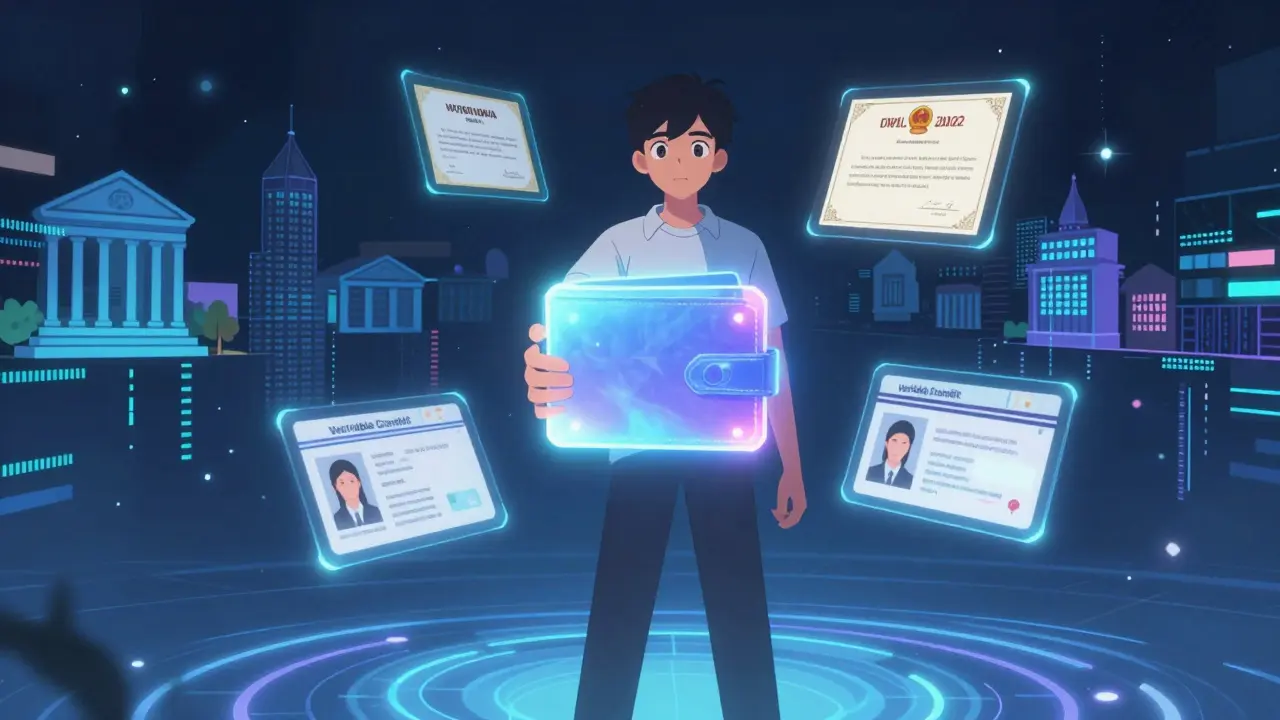
Imagine logging into a bank, a university, or even a government service without handing over your passport, driver’s license, or social security number. No forms. No passwords. No third party storing your personal data. Just a quick, private, and secure confirmation that you are who you say you are. That’s not science fiction-it’s decentralized identity management, and it’s already being built.
What Exactly Is Decentralized Identity?
Decentralized identity (also called DID or DCI) flips the script on how we prove who we are online. Right now, when you sign up for a website, app, or service, you give them your email, phone number, maybe even a government ID. They store it. They control it. And if they get hacked? Your data is gone. Decentralized identity changes that. Instead of handing your identity to companies, you keep it in your own digital wallet. You decide who sees what, and when.This isn’t about replacing passwords. It’s about replacing the whole system behind them. The core idea? You own your identity. No middleman. No central database. Just you, your data, and cryptographically secure proofs.
How It Works: DIDs, VCs, and Digital Wallets
At the heart of decentralized identity are three key pieces: Decentralized Identifiers (DIDs), Verifiable Credentials (VCs), and your digital wallet.A DID is a unique string of letters and numbers-like a username, but it’s not tied to your name or email. It’s a cryptographic address that points to a public key. Think of it like a digital fingerprint that only you can prove you own. DIDs follow a global standard set by the W3C is a global consortium that develops open standards for the web, including the DID specification. This means any system built to understand DIDs can verify your identity, no matter where it’s built.
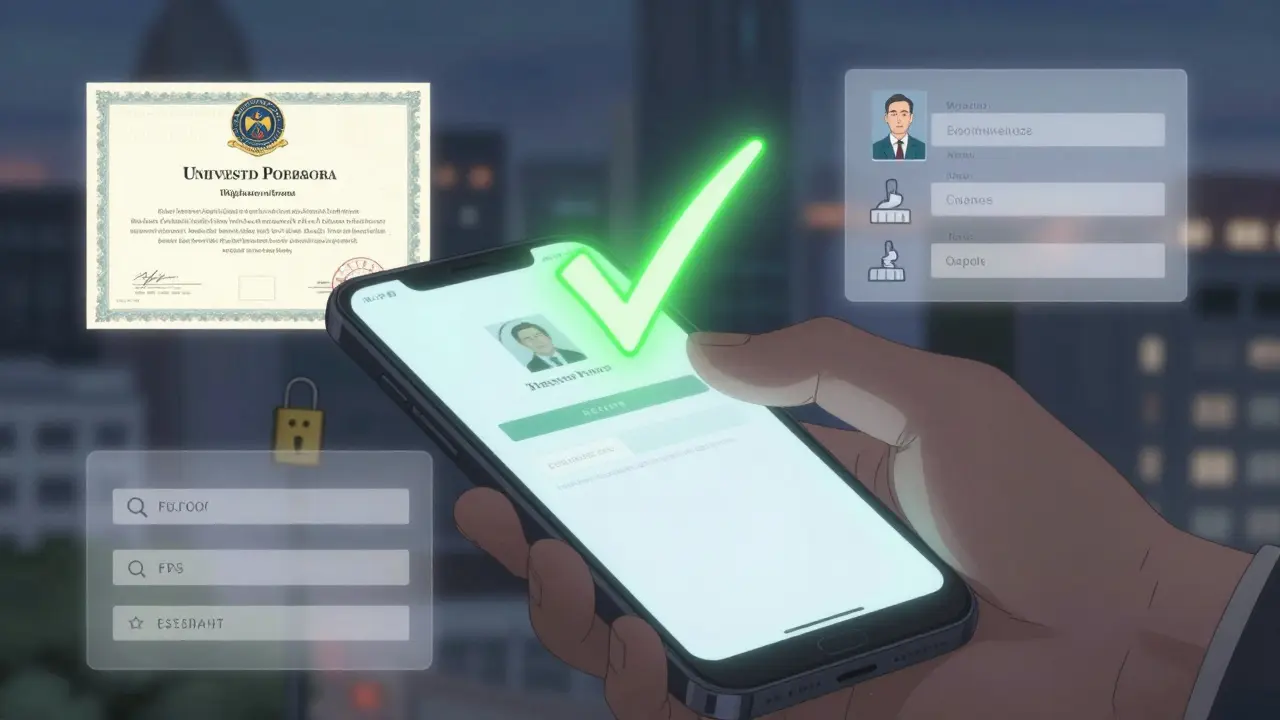
Verifiable Credentials are the actual proof you’re carrying. These are digital versions of your diploma, driver’s license, or employee badge. But instead of being stored on a server, they’re signed by the issuer (like a university or government) and stored in your wallet. The issuer doesn’t keep a copy. You do. And here’s the magic: you can prove you graduated from Harvard without showing your entire transcript. You just show the credential and a cryptographic signature that proves it’s real.
Your digital wallet is your identity hub. It holds your DIDs and your VCs. It generates private keys (which only you control) and public keys (which you share). When a verifier asks for proof, your wallet creates a zero-knowledge proof-a mathematical way to say “yes, I meet this requirement” without revealing any extra data. For example, you can prove you’re over 21 without saying your birthdate or address.
Self-Sovereign Identity: The Ultimate Goal
Decentralized identity is the umbrella. Self-Sovereign Identity (SSI) is the ideal version under it. SSI means you have full control. No one can freeze your account. No company can sell your data. No government can demand access without your permission. You’re not just a user-you’re the owner.SSI removes the power imbalance that exists today. Right now, if Facebook or Google shuts down your account, you lose access to everything connected to it. With SSI, your identity lives in your wallet. Even if every service you use disappears, your identity stays intact. You can take it with you.
Why This Matters: The Problems With Centralized Identity
Think about how many accounts you have. Email, banking, social media, work portal, health records, tax filing, shopping sites. Each one asks for the same things: name, email, phone, maybe a photo ID. Every time, you give it away. And every time, that data gets stored somewhere.That’s a disaster waiting to happen. In 2023, over 4,500 data breaches were reported globally. Each one exposed millions of records. Companies don’t even know how much data they’re holding. And when they get hacked? You’re the one who suffers-resetting passwords, dealing with fraud, losing trust.
Decentralized identity fixes this by design. No central database means no single target for hackers. Credentials are stored in your wallet. Only the public DID is on the blockchain-just enough to verify, not enough to exploit.
Real-World Use Cases Already Happening
This isn’t just theory. Real organizations are using it now.- Universities in Canada and the EU are issuing digital diplomas as VCs. Graduates share them instantly with employers-no more waiting for transcripts.
- Hospital systems in New Zealand and Australia are testing SSI for patient records. Patients control who sees their medical history. Doctors get verified access without storing sensitive data.
- Government services in Estonia and Singapore let citizens use DIDs to sign legal documents, file taxes, or access healthcare. No physical cards needed.
- Banking apps in the U.S. and Europe now let users verify identity with a DID instead of uploading a passport photo.
These aren’t pilot programs. They’re live, functional, and growing. The tech works. The standards are set. The only thing missing is widespread adoption.
The Big Hurdles: Why It’s Not Everywhere Yet
If this is so great, why aren’t we all using it?First, it’s still new. Most people don’t know what a DID is. You can’t just click “login with blockchain.” You need a wallet. You need to back it up. You need to understand private keys. That’s a steep learning curve.
Second, not every service supports it. If you have a DID, but the website you’re trying to log into only accepts Google or Facebook, you’re stuck. For decentralized identity to work, verifiers-banks, employers, government portals-must adopt it too.
Third, recovery is hard. If you lose your phone, forget your password, or delete your wallet? There’s no “forgot password” button. No customer service rep can reset it. You’re locked out. That’s why backup systems (like encrypted recovery phrases) are critical. But most users don’t use them properly.
Finally, there’s confusion. Many projects claim to be decentralized, but they’re just using blockchain to store usernames. That’s not real DID. True decentralized identity means full user control, no central authority, and verifiable cryptographic proofs. Not all “blockchain identity” projects meet that bar.

Who’s Leading the Way?
Major players aren’t waiting. Okta is a leading identity and access management company that calls decentralized identity "the future of digital identity management". Ping Identity says it reduces data exposure while improving security. Even CrowdStrike highlights it as a fix for the broken security model of centralized systems.Standards bodies like the Trust Over IP Foundation is a consortium that catalogs and promotes interoperable DID methods across blockchain platforms are making sure different systems can talk to each other. Without standards, we’d have 50 different versions of DID-none of which work together. That’s why W3C’s role is so important.
What You Can Do Today
You don’t need to be a developer to start exploring decentralized identity.- Download a DID wallet. Try Microsoft ION, uPort, or Spruce. They’re free and open-source.
- Learn how to back up your recovery phrase. Write it down. Store it somewhere safe. Treat it like a bank account password.
- Look for services that offer “login with DID” or “verify with blockchain.” Some crypto exchanges and privacy-focused platforms already do.
- Ask your employer, university, or local government if they’re planning to adopt digital credentials. Pressure drives change.
The shift won’t happen overnight. But the direction is clear. The old system is broken. The new one is here. And it’s built for you-not for corporations, not for governments, but for the person holding the wallet.
Is decentralized identity the same as blockchain?
No. Blockchain is just one tool used to store public DIDs. Decentralized identity is the whole system-DIDs, verifiable credentials, wallets, and zero-knowledge proofs. You can build DID systems without blockchain (using other distributed ledgers), but blockchain is the most common because it’s tamper-proof and public.
Can I lose my decentralized identity?
Yes-if you lose access to your wallet and don’t have a backup. Unlike traditional systems, there’s no “forgot password” option. Your private key is your identity. If you lose it, you lose access. That’s why backup phrases and secure storage are non-negotiable. Treat your recovery phrase like a house key.
Are verifiable credentials secure?
Yes, if issued by trusted entities. VCs are digitally signed using public-key cryptography. Anyone can verify the signature without seeing the original credential. That means you can prove you’re a licensed doctor without showing your license number or address. The signature proves authenticity. The data stays private.
Do I need cryptocurrency to use decentralized identity?
No. While some DID systems run on blockchains like Ethereum or Polygon, you don’t need to own or trade crypto. The wallet you use might be free, and transactions (if any) are often paid by the issuer, not the user. You’re not buying anything-you’re just managing your identity.
Will governments adopt decentralized identity?
Yes-some already have. Estonia, Singapore, and parts of Canada and the EU are issuing digital IDs using DID. Governments like it because it reduces fraud, cuts paperwork, and gives citizens more control. The real question isn’t if they’ll adopt it-it’s how fast.
What’s Next?
In the next five years, decentralized identity will move from niche tech to everyday tool. Schools will issue digital transcripts. Hospitals will let patients control access to records. Employers will verify qualifications without asking for resumes. The internet won’t ask you who you are-it’ll just know, because you chose to share it.The future of identity isn’t more passwords. It’s less data. More control. And a system that works for you-not the other way around.




Comments
Vishakha Singh
February 20, 2026 AT 18:13 PMDecentralized identity is one of those rare technologies that actually aligns with human dignity. For too long, we’ve treated personal data like a commodity to be sold, traded, and exploited. But what if your identity belonged to you? Not your employer. Not your bank. Not Facebook. You.
This isn’t just about security-it’s about autonomy. Imagine being able to move between services without re-verifying your identity every time. No more 12-step verification processes. No more ‘upload a selfie with your ID.’ Just a simple, private, cryptographic handshake.
And the best part? It’s already working. Universities in Canada are issuing digital diplomas that employers can verify instantly. No more waiting weeks for transcripts. No more forged certificates. The system is here. We just need to adopt it.
I’ve started using uPort for my professional credentials. It’s not perfect yet, but the potential is undeniable. We’re not waiting for the future-we’re building it.
To everyone still skeptical: try a wallet. Back up your recovery phrase. Test it with one service. You’ll see how different this feels. It’s not magic. It’s math. And math doesn’t lie.
Cameron Pearce Macfarlane
February 22, 2026 AT 08:29 AMThis is just blockchain marketing bullshit wrapped in fancy jargon.
Nicki Casey
February 23, 2026 AT 20:32 PMLet’s be perfectly clear: this entire decentralized identity movement is a Trojan horse for globalist technocrats who want to dismantle national sovereignty under the guise of ‘user empowerment.’ The W3C? A UN-aligned body. The Trust Over IP Foundation? Funded by entities with known ties to the World Economic Forum. And now we’re supposed to believe this is about ‘privacy’?
When you remove government-issued identity and replace it with algorithmic digital IDs, you’re not gaining freedom-you’re surrendering to opaque systems controlled by unaccountable corporations and technocrats who operate beyond democratic oversight. Estonia? Singapore? These are surveillance states masquerading as digital utopias.
The real threat isn’t centralized databases-it’s centralized control disguised as decentralization. Your ‘wallet’ is a digital leash. Your ‘credentials’ are tokens of compliance. And your ‘self-sovereignty’? A marketing slogan designed to pacify the masses while they quietly hand over their legal identity to a blockchain-based meritocracy that answers to no one.
Paul Reinhart
February 25, 2026 AT 16:29 PMI understand the appeal of decentralized identity, and I think the vision is noble-but let’s not pretend this is easy or universally accessible. The average person doesn’t care about cryptographic signatures or zero-knowledge proofs. They care about not getting hacked. They care about not losing access to their bank account.
Right now, if I forget my password, I hit ‘forgot password.’ If I lose my phone, I call customer service. With DIDs, if I lose my recovery phrase? Game over. No second chances. No human help. That’s not empowerment-it’s exclusionary by design.
And while we celebrate universities issuing digital diplomas, what about the 70-year-old retiree who still uses a flip phone? What about the refugee without a smartphone? What about the rural community without reliable internet?
Decentralized identity sounds beautiful on paper. But unless we build bridges for the people who aren’t tech-savvy, we’re not solving a problem-we’re creating a new class of digital disenfranchisement. The technology is brilliant. The rollout? A disaster waiting to happen.
Amita Pandey
February 27, 2026 AT 00:35 AMOne must question the moral architecture underlying this so-called ‘self-sovereign identity.’ If identity is truly yours, then why are we being urged to adopt proprietary digital wallets-many of which are developed by venture-backed startups with opaque governance models?
True sovereignty does not mean trading corporate surveillance for blockchain surveillance. It means reclaiming the legal, social, and philosophical foundations of identity as a human right-not as a digital asset to be managed via an app.
Furthermore, the romanticization of ‘no middlemen’ ignores the fact that institutions-banks, governments, universities-exist not merely as data repositories, but as guarantors of social trust. Removing them without replacing their epistemic authority with something equally robust is not liberation. It is anarchy dressed in cryptographic robes.
Let us not confuse decentralization with disintegration.
Jan Czuchaj
February 27, 2026 AT 15:11 PMThe real revolution here isn’t the technology-it’s the shift in mindset. For centuries, identity has been granted by institutions. You are who the state says you are. You are who the bank verifies you are. You are who the social platform allows you to be.
Decentralized identity flips that. It says: you are who you prove yourself to be. Not through documents, but through cryptographic assertions. This is philosophical as much as it is technical.
It’s the difference between being a subject and being a citizen of your own digital life. And that’s profound.
Yes, there are hurdles. Recovery is hard. Adoption is slow. But this isn’t about convenience. It’s about dignity. And dignity doesn’t come from a password reset link. It comes from control. From ownership. From the quiet power of knowing no one else holds the keys to who you are.
KingDesigners &Co
February 27, 2026 AT 23:25 PMLol. You're telling me I should trust a wallet app more than my bank? 😂
My bank has 24/7 support. Your wallet? If you lose your phrase, you're SOL. No refunds. No help. Just a blockchain and a prayer.
Also, why do I need another app? I already have 17. 🙄
Trenton White
February 28, 2026 AT 01:13 AMAs someone who’s worked across five continents, I’ve seen how identity systems vary wildly. In rural India, a government-issued Aadhaar card is the only thing that unlocks healthcare. In rural Maine, a driver’s license is everything.
Decentralized identity assumes universal access to smartphones, internet, and literacy. But in too many places, those don’t exist.
This isn’t a global solution-it’s a privileged one. We need to ask: who benefits? Who gets left behind?
True innovation doesn’t just solve problems for the connected. It lifts up the disconnected. Until then, this feels less like progress and more like digital colonialism.
Michelle Mitchell
March 1, 2026 AT 00:52 AMi dont get it why cant we just use google login like normal people
Mary Scott
March 2, 2026 AT 00:27 AMThis is all just a cover for the government to track us better. They’ll make you prove you’re ‘compliant’ with their rules before they issue a credential. Next thing you know, you can’t buy groceries if you don’t have the ‘healthy lifestyle’ badge. 🤔
Shannon Holliday
March 3, 2026 AT 17:56 PMI love this!! 🌍✨ Imagine not having to upload your passport again. Just tap and go. This is the future!! 💫
maya keta
March 5, 2026 AT 03:27 AMLet’s be honest-this isn’t about privacy. It’s about control. The same people pushing ‘self-sovereign identity’ are the ones who want to eliminate cash, ban crypto, and mandate digital IDs. They call it empowerment, but it’s just a new form of compliance engineering.
And don’t get me started on ‘verifiable credentials.’ Who issues them? Governments? Corporations? The same entities that already track your spending, your location, your politics?
It’s not decentralized. It’s rebranded. And if you’re buying into this as ‘freedom,’ you’re not enlightened-you’re being manipulated.